

You’re 52, staring at your screen after yet another flare-up knocked you out of work for a week. HR has quietly hinted about “attendance concerns.” Your body is telling you that working to 67 is fantasy, but your bank account sure was planning on it.
If that’s you—or close to it—this is where fantasy ends and strategy begins. You do not have the luxury of vague goals and feel-good advice. You need a plan that assumes your work horizon is shorter than average, your medical costs are higher than average, and your energy is limited.
Here is how to handle it, step by step.
1. First, Reset Your Mindset: You’re on a Different Track Now
You are not planning “normal” retirement. You’re planning:
- Earlier retirement or semi-retirement
- Higher health expenses
- Less earning runway
That means you cannot copy what your healthy coworkers are doing. If you try, you’ll lose.
You have three core realities to accept quickly:
Your future work capacity is a risk factor, not a constant.
Stop projecting income to 65 or 67 like nothing will change. Build your plan assuming:- You might need to stop 5–10 years earlier than planned.
- Or you may only manage part-time / flexible work.
Cash flow flexibility > fancy investments.
You need:- Buffers
- Options
- Access to money without blowing up your future
You’re not trying to “win retirement.” You’re trying to stay solvent and stable.
That might mean smaller lifestyle, more public benefits, less ego. That’s fine. Survival beats pride.
We’ll structure your planning around three timelines:
- Right now (0–12 months)
- Near horizon (1–5 years)
- Longer term (5+ years)
2. Lock Down Income Protection and Safety Nets (0–12 Months)
Before you obsess over Roth vs traditional, you need to protect the income you still have. Because when your body finally says “I’m done,” the paperwork you’ve already set up will matter more than your mutual fund choices.
A. Clarify Your Work Status and Options
Sit down (ideally in writing) and answer:
- Can I realistically do my current job full-time for the next 3 years? 5 years?
- If not, what’s more likely:
- Reduced hours?
- Switch to lower-stress role?
- Complete exit?
If you have a decent manager and HR, request a meeting and ask very specific questions:
- “Is my role compatible with a 0.8 FTE or 0.6 FTE schedule?”
- “What’s the policy on remote days for medical reasons?”
- “What documentation do you need from my doctor for accommodations?”
Document all this. Dates, who said what, what’s in writing vs verbal.
B. Disability Insurance: This Is Your Lifeline
If you’re still working, disability insurance can literally be the difference between “barely okay” and “total disaster.”
You need to check:
Short-term disability (STD)
- How many weeks?
- What % of income?
- Is there an elimination (waiting) period?
Long-term disability (LTD)
Ask HR the following:- Is LTD offered? Is it employer-paid or employee-paid?
- What’s the definition of disability? (“Own occupation” vs “any occupation”)
- What % of income is covered (often 40–60%) and what’s the cap?
- Does it coordinate/offset with Social Security Disability Insurance (SSDI)?
If you can still qualify medically for private individual disability coverage, you should at least explore it. If your condition is well-documented, approval may be tough, but sometimes you can get a policy with exclusions.
Key point: Disability benefits often require you to stop working before they pay.
Do not quit impulsively. Talk to:
- Your doctor (about documentation)
- HR/benefits
- A disability attorney (for SSDI strategy, usually free consultation)

| Step | Description |
|---|---|
| Step 1 | Still working with chronic illness |
| Step 2 | Keep working and review benefits |
| Step 3 | Consider reduced hours or new role |
| Step 4 | Request accommodations |
| Step 5 | Review disability coverage |
| Step 6 | Apply for STD/LTD if needed |
| Step 7 | Consider SSDI with attorney help |
| Step 8 | Can you work full-time? |
C. Emergency Fund, But Adapted To Your Reality
Classic advice says “3–6 months of expenses.” With chronic illness, that’s often not enough. Aim for 6–12 months if at all possible.
But if you’re behind, here’s the triage order:
- Stop high-interest debt bleed (credit cards >15% APR).
- Build at least 1–2 months’ bare-bones expenses in cash.
- Then balance debt payoff and cash building.
You want this money:
- Liquid (high-yield savings, not locked CDs)
- Separate from checking so you don’t accidentally spend it
3. Rebuild Your Retirement Plan Around a Shorter Work Horizon
Now we assume you may realistically work until, say, 60 instead of 67. Or 55 instead of 65. You need to see the numbers.
A. Get a Brutally Honest Snapshot
No hand-waving. Lay it all out:
- Current retirement accounts:
- 401(k), 403(b), 457
- IRAs (traditional, Roth)
- Pensions (if any)
- Other savings/investments:
- Taxable brokerage
- Savings/CDs
- Debts with interest rates
- Monthly actual spending (track 2–3 months)
You can use a simple spreadsheet or a free planner. Fancy tools are optional. Accuracy is not.
Then add two uncomfortable estimates:
- Reasonable retirement age if disease progresses: e.g., 58
- Reasonable part-time years: e.g., 55–58 half-time work
B. Compare “Typical” vs “Reduced” Work Scenarios
Rough but useful: run two scenarios.
Example:
- Scenario A: Work full-time to 67
- Scenario B: Full-time to 58, part-time 2 years, then stop
(See also: Planning Retirement After Switching From W-2 to 1099 Locums Work for details.)
Focus on:
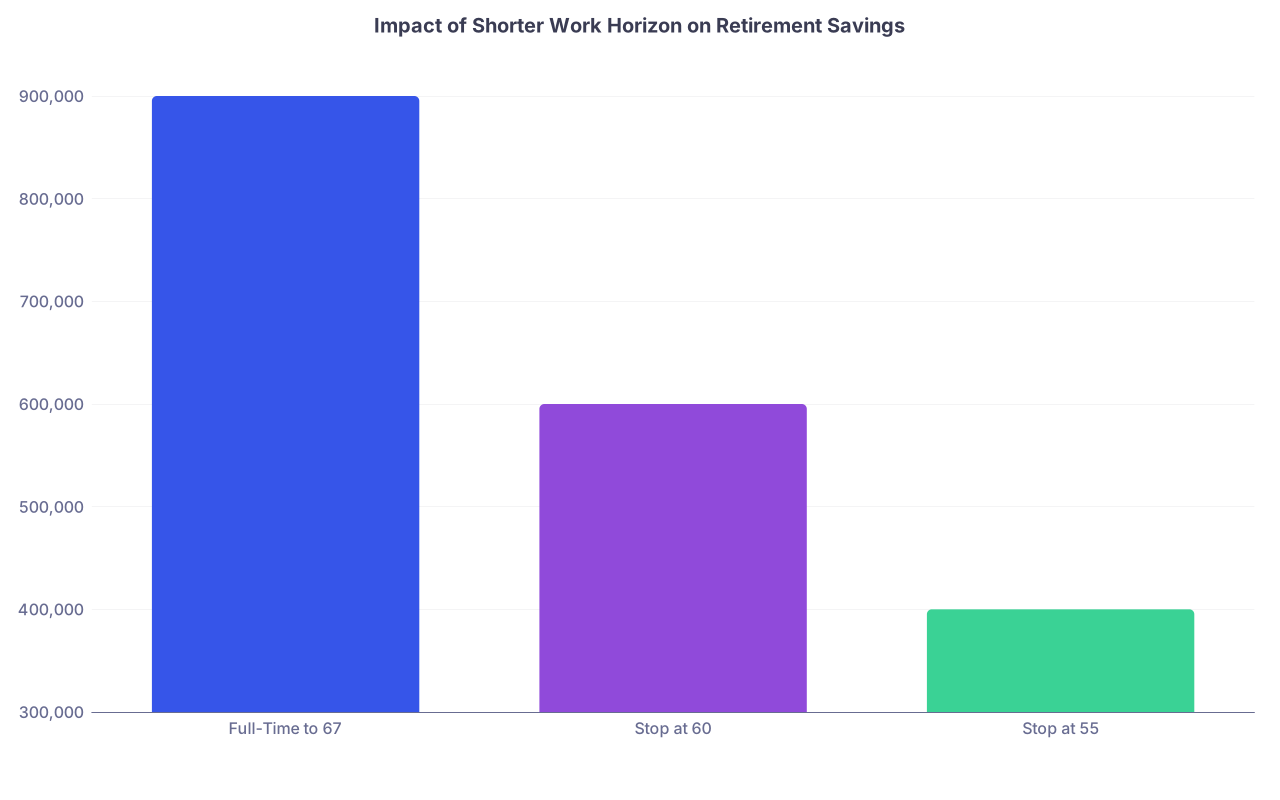
- Projected retirement savings at retirement date
- Monthly income in retirement from:
- Social Security
- Pensions
- Withdrawals from savings
If you don’t want to build your own model, a fee-only financial planner (ideally with experience in disability/medical complexity) is worth paying for a one-time plan.
| Category | Value |
|---|---|
| Full-Time to 67 | 900000 |
| Stop at 60 | 600000 |
| Stop at 55 | 400000 |
This is illustrative, but you get the idea: fewer years working = fewer contributions + fewer compounding years.
C. Prioritize Where New Dollars Go
General priority for someone with chronic illness and limited horizon:
- Emergency fund to minimum stability level
- Capture any employer retirement match (free money)
- Pay down high-interest debt
- Add to tax-advantaged retirement accounts (401(k)/IRA)
- Start or fund a taxable brokerage for more flexible access
If you expect to need money before 59½, do not shove every spare dollar into accounts with penalties. You’ll want a mix:
- Tax-advantaged for later
- Taxable for bridge years if you need to stop early
4. Plan Around Health Care and Social Security, Not After
Chronic illness + retirement = health care is your biggest risk variable. Ignore this and your numbers will be fantasy.
A. Health Insurance Pre-Medicare
There are three common phases:
While still employed:
- Maximize use of your current plan.
- Know your out-of-pocket max and plan cash for it yearly.
- Use FSA/HSA if offered and if you can afford the withholding.
If you stop work before 65:
- COBRA (usually 18 months, sometimes longer) – expensive but predictable.
- ACA marketplace plan – often with subsidies if income drops.
- Spouse’s plan – if they’re working and have coverage.
Do not guess. Go on your state’s ACA marketplace site and look at:
- Premiums
- Deductibles
- Networks that actually include your specialists
Build those numbers into your retirement budget assumptions.
B. Social Security: Timing Is Strategic, Not Emotional
You can claim:
- As early as 62 (reduced benefits)
- At full retirement age (66–67 depending on birth year)
- Up to 70 (increased benefits)
With chronic illness, the answer to “Should I claim early?” is not automatic.
Consider:
- If you can’t work and aren’t yet 62, SSDI may be on the table.
- If your illness significantly reduces life expectancy, claiming earlier can make sense.
- If longevity is still reasonable but work capacity is weak, sometimes you:
- Bridge a few years using savings
- Delay Social Security for higher lifetime benefits
That decision is math + health reality. Not vibes. Get a Social Security benefit estimate directly from SSA.gov and model a few options.
| Claim Age | Approx. Monthly Benefit (vs FRA) | Pros | Cons |
|---|---|---|---|
| 62 | ~70–75% of FRA benefit | Cash sooner | Lower lifetime benefit if you live long |
| FRA | 100% | Balanced | Delayed income |
| 70 | ~124–132% of FRA benefit | Highest monthly | Need other income until then |
5. Legal Structures: Protect Yourself While You Still Can
Here’s the part people avoid until it’s too late. With chronic illness, you really do not have that luxury.
A. Core Documents You Need
Minimum set:
- Will
- Durable financial power of attorney
- Medical power of attorney / health care proxy
- Advance directives / living will
- HIPAA releases (so your people can talk to your doctors)
These are not just “end of life” documents. They’re “What happens if I’m in the hospital for three weeks and someone needs to deal with my bills, disability paperwork, and doctors?”
If your finances are complex (business ownership, multiple properties, children from previous relationships), talk to an estate planning attorney about a revocable living trust.
B. Review Beneficiaries and Titling
You’re likely juggling:
- 401(k)
- IRA(s)
- Life insurance (through work or private)
- Bank accounts
Check beneficiary designations now:
- Are they updated?
- Do they match your intentions?
- Do you have contingent beneficiaries?
These override your will. I’ve seen adult children completely cut out because a parent never changed an ex-spouse beneficiary on an old 401(k).
6. Adjust Lifestyle Intentionally, Not in Panic Mode
Here’s the harsh reality: if your earning years are getting cut, something has to give. Either:
- You downshift lifestyle now while you still have income, or
- Life will downshift it for you later when you have less control.
I’d rather you pick the terms.
A. Identify the “Non-Negotiables”
With chronic illness, some expenses are non-optional:
- Medications
- Specialist visits
- Adaptive devices
- Possibly cleaner / help with household tasks
You cut around those, not through them.
B. Big Levers That Actually Move the Needle
Tiny cuts don’t save a broken retirement plan. Big structural changes do.
Consider:
- Housing: downsizing, moving to cheaper area, renting out a room
- Cars: going from two to one, or selling an underused expensive vehicle
- Lifestyle: fewer big vacations, more local/low-cost rest
Build a written “If I must reduce expenses by 20%, here’s the order I’d cut” list now, while you’re calm. When a flare hits and you’re making decisions in survival mode, that list will save you from chaos.

7. Coordinate With Professionals Who Actually Get Chronic Illness
(Related: Handling Retirement Planning When Your Partner Is Also a Physician)
Not all advisors are equal. Some give textbook advice that completely ignores your medical reality. You want people who understand:
- SSDI and private disability interaction
- How chronic illness affects insurability
- The cost profile of long-term medical care
People to Consider:
Fee-only financial planner (ideally a CFP) for:
- Scenario planning with reduced work
- Optimal account use and withdrawal strategy
- Social Security timing
Disability attorney for:
- SSDI application or appeal
- Understanding how work attempts affect your case
Estate planning attorney for:
- Wills, POAs, health directives
- Planning for dependents
Benefits counselor (through your employer or local non-profits) for:
- Navigating employer plans
- Understanding public benefit eligibility
The test question for any advisor:
“Have you worked with clients who had to stop working early due to chronic illness? What did you change about their plan?”
If they fumble that, keep looking.
8. If You’re Already Out of Work or Close to It
Some of you are past the “prep” stage. You’re already on reduced hours or out of work. Different playbook, same seriousness.
A. Stabilize Cash Flow First
- List current income sources: unemployment, spouse income, SSDI, LTD, savings.
- Cut expenses hard but smart—protect health-related spending.
- Pause retirement contributions if you must to avoid debt spiral. You can restart when stable.
B. Explore Every Possible Benefit
This is where pride kills people financially. Drop it.
Look into:
- SSDI (if you have enough work credits)
- SSI (if assets and income are low)
- Medicaid (especially if SSDI is not yet approved)
- SNAP, energy assistance, local charity medical funds
- Hospital financial assistance programs for big bills
None of this makes you a failure. It makes you alive.
C. Create a “Minimum Viable Retirement Plan”
Maybe you won’t build a big nest egg anymore. Fine. But you can still:
- Safeguard what you already have
- Avoid catastrophic decisions (early 401(k) cashouts if possible)
- Plan a realistic, lower-cost lifestyle
This may mean planning to:
- Rent long-term instead of own
- Share housing with family or roommates
- Rely more on public programs
It’s not glamorous. It is survivable.

9. Keep a Simple Yearly Checklist
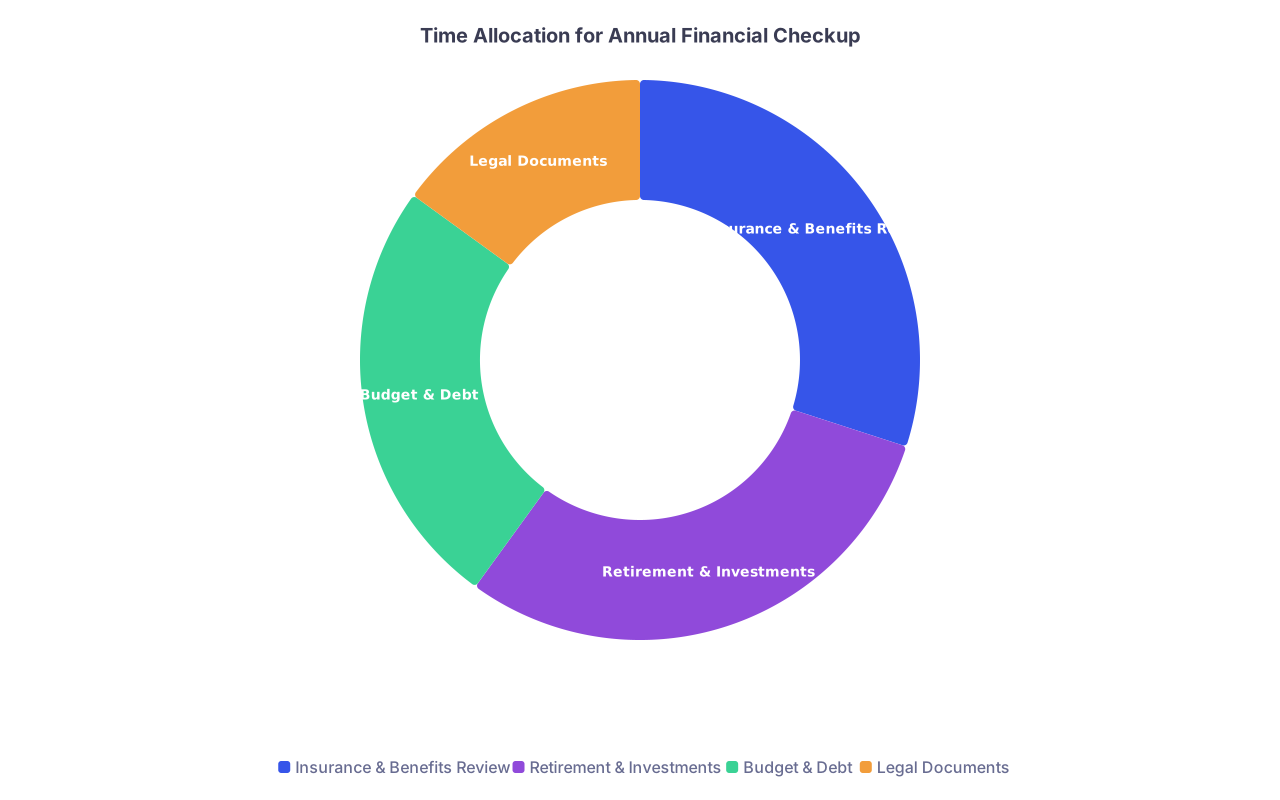
You have limited energy. You do not need a 40-page financial plan you’ll never look at again. You need a short checklist you hit every year.
Something like:
- Review disability, life, and health insurance
- Update beneficiaries
- Check retirement contributions (even small ones)
- Re-run retirement scenarios if health/work status changed
- Review budget and make one meaningful cost change
- Verify estate documents still match reality
This doesn’t have to take more than a couple of hours once a year. But it keeps you from drifting into disaster.
| Category | Value |
|---|---|
| Insurance & Benefits Review | 30 |
| Retirement & Investments | 30 |
| Budget & Debt | 25 |
| Legal Documents | 15 |
FAQ (Exactly 5 Questions)
1. Should I stop contributing to retirement accounts to pay for current medical bills?
If medical bills are forcing you into high-interest debt (credit cards, personal loans), then yes, pausing or reducing retirement contributions can make sense temporarily. Priority order: keep essential meds and care, avoid 20%+ debt spirals, then restart retirement savings as soon as things stabilize—even if it’s just a small monthly amount. Do not raid retirement accounts with penalties unless you’ve exhausted better options (payment plans, financial assistance, lower-interest loans).
2. Is it worth applying for SSDI if I might still be able to work part-time?
Possibly. SSDI rules are strict, but many people with chronic illness qualify and can later explore “trial work periods” and limited earnings without instantly losing benefits. The key is medical documentation and clarity that you cannot perform substantial gainful activity in a consistent, full-time way. A disability attorney can usually tell you in one consult whether you have a realistic case.
3. Should I claim Social Security early because of my illness?
Not automatically. If your illness significantly shortens life expectancy, early claiming can be rational. But if your disease is serious yet compatible with living into your 70s or 80s, claiming early may severely cut lifetime benefits. Run the numbers: different claiming ages, your current savings, and realistic work potential. A planner who understands chronic illness can help you choose based on both math and medical reality.
4. Is a Roth IRA still a good idea if my income is dropping?
Often yes, especially if:
- You’re in a relatively low tax bracket now and expect similar or higher later
- You want flexibility—Roth contributions (not earnings) can be withdrawn tax- and penalty-free
But if cash is tight and you need every dollar liquid, priority might be building taxable savings and emergency funds first, then Roth. It’s a good tool, not a religion.
5. What if I feel completely behind and it seems “too late” to plan?
Then your goal shifts from “classic comfortable retirement” to “maximum stability and damage control.” That still matters. You can:
- Stop the worst leaks (high-interest debt, unnecessary expenses)
- Protect what’s left via legal documents and insurance
- Optimize public benefits and claim timing
- Design a lower-cost but realistic living plan
You’re not trying to impress anyone. You’re trying to stay housed, treated, and as independent as your situation allows. That’s still absolutely worth planning for.
Key takeaways:
- Assume a shorter work horizon and build your plan around reality, not hope.
- Protect income (disability, benefits), plan for health costs, and use legal documents to guard your future self.
- Shrink lifestyle strategically now so you’re not forced into chaos later when your illness makes the decisions for you.


