

The worst retirement mistake physician couples make is assuming “two good incomes” automatically equals “we’re fine.” It does not.
If you and your partner are both physicians, your retirement planning is more complex, not less. Two incomes, two benefit structures, two call schedules, two sets of student loans, and usually…zero time. That combination creates blind spots that wreck otherwise solid financial lives.
Let’s fix that.
Below is exactly how to handle retirement planning when both of you are physicians. Not theory. Actual steps, decisions, and scripts you can use.
Step 1: Get Out of the “I’ll Deal With It Later” Trap
Physician couples are world-class procrastinators with finances. I’ve seen all the versions:
- “We’ll plan after we both make partner.”
- “Let’s wait until the kids are older.”
- “We’ll talk to a planner once my loans are paid.”
You already know this pattern from training: if something is “nobody’s job,” it doesn’t happen.
So first move: you assign roles.
One of you becomes the Financial Point Person. Not the dictator. The coordinator.
Their job is:
- To schedule 2–4 “money meetings” a year
- To gather logins and statements
- To keep a one-page summary of accounts and goals
If you both hate this stuff, fine. Outsource to a fee-only fiduciary planner. But even then, one of you still has to be the person who responds to emails, sends the docs, and keeps things moving.
You are two physicians. Your time is limited and expensive. Disorganization is a real cost here.
Step 2: Map Your Two Benefit Systems on One Page
Most physician couples have no idea what the other’s benefits actually are. You might vaguely know: “They have a 403(b) and some match.” That’s not enough.
You need a simple, shared map.
Create a one-page snapshot that lists:
- Employer names (e.g., “Mass General – Hospitalist,” “Private Ortho Group”)
- Retirement accounts offered: 401(k), 403(b), 457(b), pension, cash balance plan
- Employer match or contributions
- Vesting schedules
- Current balance and contribution level
- Loan programs (public service, forgiveness eligibility)
It might look something like this:
| Account Type | Partner | Employer Match | Current Contribution | Current Balance |
|---|---|---|---|---|
| 403(b) | A | 4% | 10% of salary | $220,000 |
| 457(b) | A | None | $1,000/month | $80,000 |
| 401(k) | B | 3% | $22,000/year | $150,000 |
| Cash Balance | B | Employer only | N/A | $90,000 |
| Roth IRA | A & B | N/A | $7,000 each/year | $60,000 total |
Once this is on one page, patterns appear:
- Who has the better match?
- Who has access to the better investment options?
- Are you both accidentally in super high-fee funds?
- Is someone not contributing enough to get the full match? (That’s leaving free money on the table.)
This snapshot also becomes essential if something happens to one of you. Surviving spouses get stuck digging through portals and HR emails. You don’t want that.
Step 3: Decide Your “We Number,” Not Just “My Number”
Here is where being two physicians is a blessing and a trap.
Trap first: you each think in terms of “my retirement.” You mentally separate “my 403(b)” and “their 401(k).” Then you both over-save or under-save because you’re planning in silos.
You need a household retirement target.
Example:
Let’s say your joint goal is to spend $220,000/year in retirement (today’s dollars), mortgage paid off, kids launched. Using a simple 4% rule as a rough guide, that means:
- $220,000 ÷ 0.04 ≈ $5.5 million needed in investment assets (not counting home equity)
Now you work backwards:
- How much do you already have?
- How many years until you roughly want to retire (or at least scale back)?
- Given two high incomes, what combined savings rate hits that number?
For most physician couples in their 30s–40s, a combined savings rate of 20–30% of gross income toward retirement and investments usually puts you in strong shape. If you started late or have big lifestyle burn, you may need more.
Here’s the move that couples skip: actually splitting that savings goal between you in a way that makes sense.
For example:
- Total household income: $700,000
- Goal: Save 25% to retirement/investments → $175,000/year
- Reality:
- Partner A (academic): $260k salary, great 403(b) and 457(b)
- Partner B (private practice): $440k, 401(k) and cash balance plan
You might decide:
- Max both 403(b)/401(k): ~$23k each → ~$46k
- Max 457(b) for A: ~$23k
- Cash balance for B: employer puts in, say, $40k
- Backdoor Roth IRAs: $7k x 2 = $14k
- Taxable brokerage: whatever’s needed to get to ~$175k total
This is how physician couples retire early without “feeling” like they’re doing something radical. It’s just math and default settings.
Step 4: Coordinate Your Tax Strategy Like Adults
Two high incomes usually means you’re living in the top tax brackets. You can either complain about it or use it.
Here’s the basic reality for dual-physician households:
- You’re almost certainly in a high marginal bracket (federal + state)
- Tax savings from pre-tax retirement contributions are massive
- Roth vs pre-tax is a more nuanced decision for you than for most people
You should at least consider:
- Maximizing all available pre-tax accounts (403(b)/401(k)/457(b)) during peak earning years
- Using backdoor Roth IRAs annually if eligible
- Deferring income into a non-governmental 457(b) – but only after evaluating the risk (these are technically employer assets)
- Planning for Roth conversions in early retirement years or lower-income years if one of you cuts back
Here’s what a typical tax-efficiency stack might look like for a physician couple:

| Category | Value |
|---|---|
| Pre-tax retirement | 55 |
| Roth accounts | 15 |
| Taxable brokerage | 25 |
| Cash reserves | 5 |
You’ll notice something: your retirement plan isn’t “max the 403(b) and hope.” It’s deliberate layering.
One more thing no one tells you: if both of you are working, you may not want all your eggs in the pre-tax basket. That can create a huge required minimum distribution problem at 73+. So some balance—pre-tax, Roth, and taxable—is ideal.
This is where a good CPA plus a planner can earn their fee quickly. But only if you show them the whole picture, not just “my accounts.”
Step 5: Handle the “What If One of Us Wants Out Early?” Problem
This is the scenario I see all the time:
- One partner is burned out and wants to go part-time at 50.
- The other is fine working full-time to 65.
- They’ve never talked about what that does to money, lifestyle, or resentment.
You can’t treat both careers as identical if they aren’t.
You need to answer some questions explicitly:
- Is it okay if one of you cuts back earlier, even if that means saving less?
- Are you pooling everything fully, or does each person feel like they need to “earn” their share of retirement?
- If one of you takes a lower-paying academic job for sanity, does the other consciously agree to carry more of the financial load?
Stop pretending your marriage is a roommate arrangement. Legally and financially, it isn’t.
Here’s a simple framework that actually works:
- Treat retirement savings as household goals, not individual quotas
- Acknowledge that in different seasons, one of you may contribute more financially, the other more with time, childcare, or flexibility
- When one person wants to cut back, you run the numbers together:
- Updated retirement date
- New savings rate
- Lifestyle tradeoffs (vacations, private school vs public, etc.)
It’s much easier to work through this when you’re 40 than when you’re 58 and furious.
Step 6: Decide on Asset Ownership and Legal Structure Intentionally
Dual physicians often default to: “Everything is joint.” Sometimes that’s right. Sometimes it’s dumb.
You have three overlapping realities:
- Marriage and property laws in your state (community property vs separate property)
- Two high-liability professions
- Two people who both might out-earn and out-live the other
You need a basic legal structure:
Titling of accounts and property
- Retirement accounts (401(k)/403(b)) will always be individually owned, but beneficiaries matter
- Taxable accounts can be joint or separate
- Home can be joint tenancy, tenancy by the entirety (in some states), or something else
Liability protection
- Strong malpractice coverage for both of you
- Consider umbrella insurance
- In some high-risk specialties, keeping some assets in the lower-risk partner’s name may make sense (within legal and ethical boundaries; don’t play games here)
Estate planning basics
- Wills
- Healthcare proxies and powers of attorney
- Guardianship choice if you have kids
- Clear primary and contingent beneficiaries on every retirement account and life insurance policy
I’ve watched physician couples with no will assume, “If something happens, everything just goes to my spouse.” Sometimes that’s true. Sometimes state law, ex-spouses, or outdated beneficiary forms create a mess.
It’s stunning how many physicians have ex-partners still listed as beneficiaries on old retirement accounts. Do not be that cautionary story.
Step 7: Align Retirement Timing and Lifestyle – Not Just the Math
The math is the easy part. The hard part is this:
- One of you wants to work until 70 because you love it
- The other wants out by 55 and dreams of travel, grandkids, or a non-clinical pivot
You don’t have to retire on the same day. You do need a plan that isn’t a surprise.
Have these conversations in specific terms, not vague “someday.”
Try this:
Each of you separately writes down:
- Ideal retirement age
- Minimum acceptable retirement age
- What a “typical week” looks like in retirement
- Where you’re living
- How much you think you’d spend, roughly
Compare answers. Expect differences. Then ask:
- Which parts are non-negotiable?
- Where can we compromise?
- Do we want a phased approach – e.g., one goes part-time at 55, both fully retired by 62?
A lot of physician couples end up with this pattern:
- Early 50s: First reduction (drop nights, cut to 0.6–0.8 FTE)
- Late 50s/early 60s: Both mostly out of high-intensity clinical work
- 60s+: Some consulting, teaching, or low-volume practice if they enjoy it
Use those phases in your planning. That means:
- You might only need to fully fund “high-expense” retirement until early 70s instead of forever
- Health insurance planning (pre-Medicare) gets crucial if one of you leaves an employed role
Step 8: Coordinate Across Multiple Employers and Career Moves
Physician couples move. A lot. New jobs, new states, new systems.
Every time one of you changes jobs, you create planning questions:
- What happens to the old 403(b) or 401(k)?
- Is there a frozen pension or cash balance plan?
- Are you leaving unvested employer contributions behind?
- Is the new job better or worse in terms of retirement benefits?
You want a repeatable workflow for each career change:

| Step | Description |
|---|---|
| Step 1 | New Job Offer |
| Step 2 | Get Benefits Summary |
| Step 3 | Compare Retirement Plans |
| Step 4 | Increase Savings if Possible |
| Step 5 | Adjust Other Accounts |
| Step 6 | Review Health and Disability |
| Step 7 | Plan Old Account Rollovers |
| Step 8 | Consolidate or Leave In Place |
| Step 9 | Update Household Snapshot |
| Step 10 | Better or Worse? |
Do not just roll everything into whatever 401(k) the new employer offers without checking fees and fund options. Sometimes the right move is:
- Roll old 403(b)/401(k) into an IRA
- Or leave it where it is if the plan is excellent and low-cost
- Or consolidate into the spouse’s better employer plan if the rules allow (some don’t)
Your goal is fewer, larger, better accounts. Not 12 tiny orphaned accounts scattered across three decades and five states.
Step 9: Handle Student Loans and Retirement Together, Not Competing
This one’s specific to younger physician couples (30s–40s). The tension is always:
“Do we prioritize loan payoff or retirement?”
Wrong frame. For most dual-physician households, it’s not either/or. It’s both/and. The question is how much to each.
Two common setups:
You’re both pursuing PSLF or other forgiveness:
- Aggressively fund retirement accounts (lowers AGI, can reduce payments in some plans)
- Stay in qualifying employment long enough
- Treat loan balances as a scheduled expense, not an emergency to kill ASAP
You’re not using forgiveness, or one of you isn’t:
- Set a clear payoff window (e.g., 5–7 years)
- During that window, still at least capture all employer retirement matches
- Once loans are gone, immediately redirect those payments to extra retirement savings and investments
The key move for couples: don’t treat your loans as “my debt vs your debt” if your whole financial life is otherwise joint. That just breeds resentment. You’re a team. Tackle them like one.
Step 10: Build a Simple Monitoring System So You Don’t Lose the Thread
Retirement planning for physician couples fails in the follow-through. People do a big planning meeting once, then five years vanish in a blur of call, kids, and EMR upgrades.
You need something lightweight and repeatable.
Here’s a simple system that works:
Quarterly 30-minute check-in
- Net worth update (ballpark is fine)
- Check if contributions went through as expected
- Any big upcoming expenses or changes?
Annual 60–90 minute meeting
- Review investment allocation once
- Confirm you’re still on track for your “we number” and retirement timing
- Talk about any burnout/red flags that might change career paths
- Consider tax planning and charitable giving for the year
Every job change or major life event
- Run a mini-plan: How does this affect savings, timing, and goals?
You can track this in a boring shared spreadsheet, a financial app, or with a planner. The structure matters more than the tool.
Common Landmines for Physician Couples (And How to Step Around Them)
Let me call out a few patterns I’ve seen blow up otherwise solid plans:
Lifestyle inflation times two
Early attending years, you both upgrade everything at once: house, cars, schools, travel. Retirement contributions stay at “whatever HR auto-enrolled.”
Fix: Set retirement savings first, then inflate lifestyle with the leftovers.Mismatched money anxiety
One partner checks Mint every day. The other never logs into a single portal.
Fix: Agree on a basic structure where the anxious one gets transparency, the avoidant one gets simplicity. That’s your snapshot plus scheduled check-ins.Overconfidence because “we’re both physicians”
That line ends a lot of conversations: “We’ll be fine, we’re both doctors.” I’ve seen 65-year-old dual-surgeon couples with millions tied up in their practice, no real plan, and no idea how to turn net worth into income.
Fix: Respect your expertise boundaries. You’re great at medicine. Money is a different specialty.Ignoring survivorship scenarios
Hard truth: it’s common that one spouse outlives the other by a decade or more. And sometimes that’s the spouse who was less involved in the finances.
Fix: Both of you should know the basics: what you have, where it is, who to call if something happens.
A Quick Reality Check: Are You On Track?
If you want a rough gut-check without building a full financial model, you can use very crude benchmarks.
Assume:
- You started seriously saving in your mid-30s
- You want some version of financial independence by mid-60s
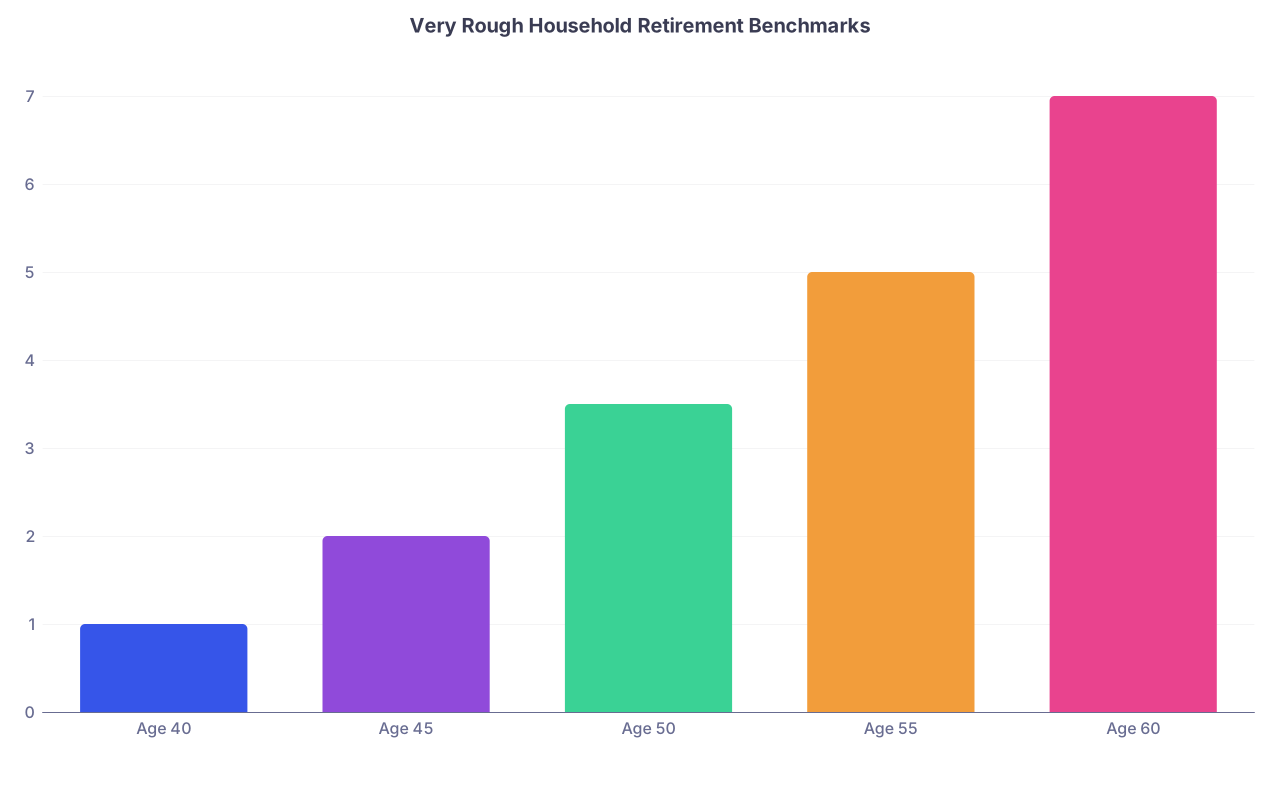
Then something like this is a decent sanity gauge for a high-earning couple:
| Category | Value |
|---|---|
| Age 40 | 1 |
| Age 45 | 2 |
| Age 50 | 3.5 |
| Age 55 | 5 |
| Age 60 | 7 |
Interpretation:
Those numbers are multiples of your current annual spending, not income. So if your household spends $200k/year now:
- At 50, having around 3.5x spending (~$700k) in retirement assets is solid progress
- At 60, 7x (~$1.4M) starts to look pretty decent, especially if you plan to work part-time or have pensions
These are very rough. But they at least tell you if you’re grossly off base.
If that chart makes your stomach drop, don’t spiral. You’re two physicians. You have more income power than 99% of the population. But you have to treat it like a tool, not like an endless stream.
With this kind of structure—shared snapshot, joint target, coordinated tax and legal planning—you stop winging it and start acting like what you are: a two-physician household with serious firepower.
You’ll still adjust. Jobs will change. Burnout will flare. Kids will surprise you. But you’ll be adjusting from a plan, not making it up fresh every time the hospital merges or the group dissolves.
Handle these financial and legal pieces now, and you free up future you to decide how you want to practice—or whether you want to practice at all. And when you’re ready to think about the softer side of retirement as physicians—identity, purpose, what your days actually look like—that’s the next chapter worth writing.


