

It’s 10:45 p.m. You just got home from a brutal call. The kids are finally asleep. Your partner is half-passed-out on the couch. You open your banking app and see…$712 in checking, $0 in savings, and $230k in student loans. Somewhere in the fog, you remember you’re “supposed” to be saving for retirement.
You’re a resident. You have kids. You’re living on one income. Every Instagram finance guru telling you to “max your Roth IRA” feels like they live on another planet.
Here’s the reality: you can do smart retirement planning in this situation. But it will not look like the standard advice. And that’s fine.
Let’s walk through what to do, in order, if you’re exactly here.
Step 1: Accept That Your Retirement Plan Has Two Phases
Before you start feeling behind, you need the right mental model.
Your retirement plan is not one smooth 40-year glide. It’s two completely different phases:
Training Phase (now)
- Low (or barely livable) income
- Kids’ expenses already hitting
- One partner not working or earning much
- High debt, low or negative net worth
- Almost zero flexibility in schedule
Attending Phase (later)
- Massive income jump (often 2–5x)
- More control over schedule, overtime, moonlighting
- Potential for aggressive saving and investing
- Opportunity to “catch up” if you structure it right
Your goal during training is not to fully fund retirement. Your goals are:
- Survive without going deeper into bad debt
- Avoid making big, permanent financial mistakes
- Do a few small, high-leverage moves that make future you’s life dramatically easier
If you’re thinking, “I cannot possibly save for retirement right now,” you might be partly right. But there are still strategic decisions that count as “retirement planning” even if you’re only putting in $0–$200/month.
Step 2: Get Brutally Clear on the Money Situation
You cannot plan retirement in a vacuum. You have kids. Real-world cash flow matters more than abstract compounding charts.
You need one thing: a clear monthly picture. Not a beautiful spreadsheet. Just honesty.
Do this on a single sheet (paper or Notes app):
- Write your take-home pay per month (after taxes, benefits, etc.).
- List the non-negotiables:
- Rent/mortgage
- Utilities
- Groceries
- Transportation (gas, insurance, car payment)
- Childcare
- Minimum required debt payments
- List everything else:
- Subscriptions
- Eating out / DoorDash when you’re post-call and dead
- Amazon “kid stuff”
- Clothing, phone, internet, etc.
Now you answer three questions:
- After non-negotiables, what’s left?
- Of what’s left, how much is realistic to redirect to any financial goal (retirement, emergency fund, debt)?
- Are you actually running negative each month?
If you’re negative, retirement savings is not step one. You’re in “stop the bleeding” mode first: cut, renegotiate, or get more income (moonlighting if allowed, small side shifts, spouse picking up part-time, etc.).
If you’re positive, even by $50–$100, we can work with that.
Step 3: Decide Your Priority Order: Survival, Cushion, or Retirement
For residents with kids on one income, the usual “save for retirement first” doesn’t always apply. You decide your priority order based on reality, not dogma.
Here’s a reasonable framework:
| Financial Priority | When It Comes First | Typical Target |
|---|---|---|
| Survival (cash flow) | Running negative or barely breaking even | Get to $200–$500/mo positive |
| Emergency cushion | Any small shock would go on credit card | $1,000–$3,000 during residency |
| Retirement savings | Stable cash flow and minimal high-interest debt | Even $50–$200/mo helps |
| Aggressive debt payoff | High-rate private loans, credit cards | Mostly an attending-phase strategy |
If you’re using credit cards regularly for basics, your “retirement planning” is:
- Get to break-even
- Build a tiny buffer so emergencies don’t become 22% APR debt
- Avoid terrible student loan choices
Calling it what it is: your first retirement move is not going broke in training.
Step 4: Don’t Screw Up Your Student Loans (This Affects Retirement)
For a resident with one income, student loans are not just about “getting rid of debt.” They’re about how much future retirement saving capacity you’ll have.
You need to make a call in two areas: repayment plan and forgiveness strategy.
1. Income-Driven Repayment (IDR) vs. Standard
Most of you should not be on standard 10-year during residency. It crushes your cash flow.
You’re typically choosing between IDR plans like:
- PAYE
- SAVE (the replacement for REPAYE)
- IBR (usually worse than the others, especially for newer borrowers)
The key features you care about:
- Lower payments now → more cash for survival and tiny savings
- Interest subsidies (especially under SAVE, where unpaid interest doesn’t balloon your balance)
- Whether you’re aiming for Public Service Loan Forgiveness (PSLF) or just minimizing damage during training
If you’re at a non-profit hospital and plan to work academic or non-profit long term, PSLF is on the table. That changes everything. Every qualifying payment you make during residency is a step toward having your loans wiped tax-free later. That’s huge for retirement.
If you’re at a for-profit hospital or community site and expect to work private practice, PSLF might be off the table, and your approach is more “keep payments manageable, then crush the loans as an attending.”
2. Why This Matters for Retirement
Lower payments now + PSLF later = extra thousands per month in your 30s/40s available for retirement accounts instead of debt. That’s not small.
So even if you’re not saving much in residency, choosing the right loan path is retirement planning. You’re deciding if future you has $3,000/month to invest or to flush into old debt.
Step 5: If You Can Save Anything, Where Should It Go?
Say you’ve clawed out $50–$300/month of discretionary cash. You have kids. One income. You feel like that amount is pointless.
It isn’t. But you have to prioritize.
Here’s the rough order I’d use for most resident families:
- Mini Emergency Fund – $1,000–$3,000 in a high-yield savings account
- Employer Match (if you have one) – free money, do not leave it on the table
- Roth IRA (often preferable in residency)
- 403(b)/401(k) beyond match (if you’re still comfortable)
- 529s for kids (only after your own retirement is in motion)
Let me unpack that.
Mini Emergency Fund
You have kids. Which means unexpected costs. Fevers, car seats, broken glasses, ER copays.
No emergency fund → every small hit lands on a credit card → high interest that murders your future retirement options.
You don’t need 6 months in cash as a resident. You probably can’t. But $1,000–$3,000 in cash is realistic and makes a huge difference.
Employer Match: Don’t Turn Down Free Money
If your residency gives a match (a lot don’t, but some academic hospitals do something like “50% on the first 4% you contribute”) and you can afford it, you grab the match, even if you’re still building that mini-emergency fund.
Because that’s a 50% or 100% instant return.
If contributing 4% of your $60k salary is too much ($200/month pretax feels like a lot), you still try to at least hit the match. If there is no match, we move on.
Roth IRA: Why It’s Usually Best in Training
During residency, your income is relatively low for a physician. That means:
- Your tax rate now is likely much lower than it will be as an attending
- Every dollar you put into a Roth IRA grows tax-free forever
- You can withdraw contributions (not earnings) later without penalty if you really get stuck
So even small amounts into a Roth are powerful.
A lot of resident families end up doing something like:
- $50–$100/month auto-transferred into a Roth IRA
- Invested in a single broad market index fund (e.g., total US stock market)
No fancy stock picking. No seven-fund portfolio. You’re busy and exhausted. Simple wins.
Roth vs. Pre-Tax 403(b)/401(k) in Residency
In residency, Roth usually wins because:
- You’re in a lower tax bracket now
- Pre-tax savings isn’t saving you that much federal tax
- You’d rather pay lower taxes now than higher taxes later as an attending
If your program only offers a traditional (pre-tax) option and no match, and your budget is razor-thin, I’d often prioritize Roth IRA instead of the 403(b), because of flexibility and tax-free growth.
Here’s the trade-off at a glance:
| Feature | Roth IRA | 403(b)/401(k) |
|---|---|---|
| Tax benefit timing | Pay tax now, tax-free later | Tax break now, taxed later |
| Investment options | Usually broader, more control | Limited to plan lineup |
| Access to contributions | Can withdraw contributions anytime | Harder to access before 59.5 |
| Employer match | None | Possible (if offered) |
If there’s a match in the 403(b) → take it first. Then Roth IRA.
Step 6: Automate Something Tiny and Forget About It
You’re working long hours. You’re exhausted. You are not going to “manually transfer” money into investments each month. Be honest with yourself.
Once you’ve decided:
- How much you can send ($50, $100, $200/month)
- Where it’s going (Roth IRA vs 403(b))
- What fund you’re using (broad index fund)
You set up automatic contributions and you do not mess with it.
Your job is not to optimize every detail right now. Your job is to:
- Get something going
- Make it automatic
- Let compounding work even at a small scale
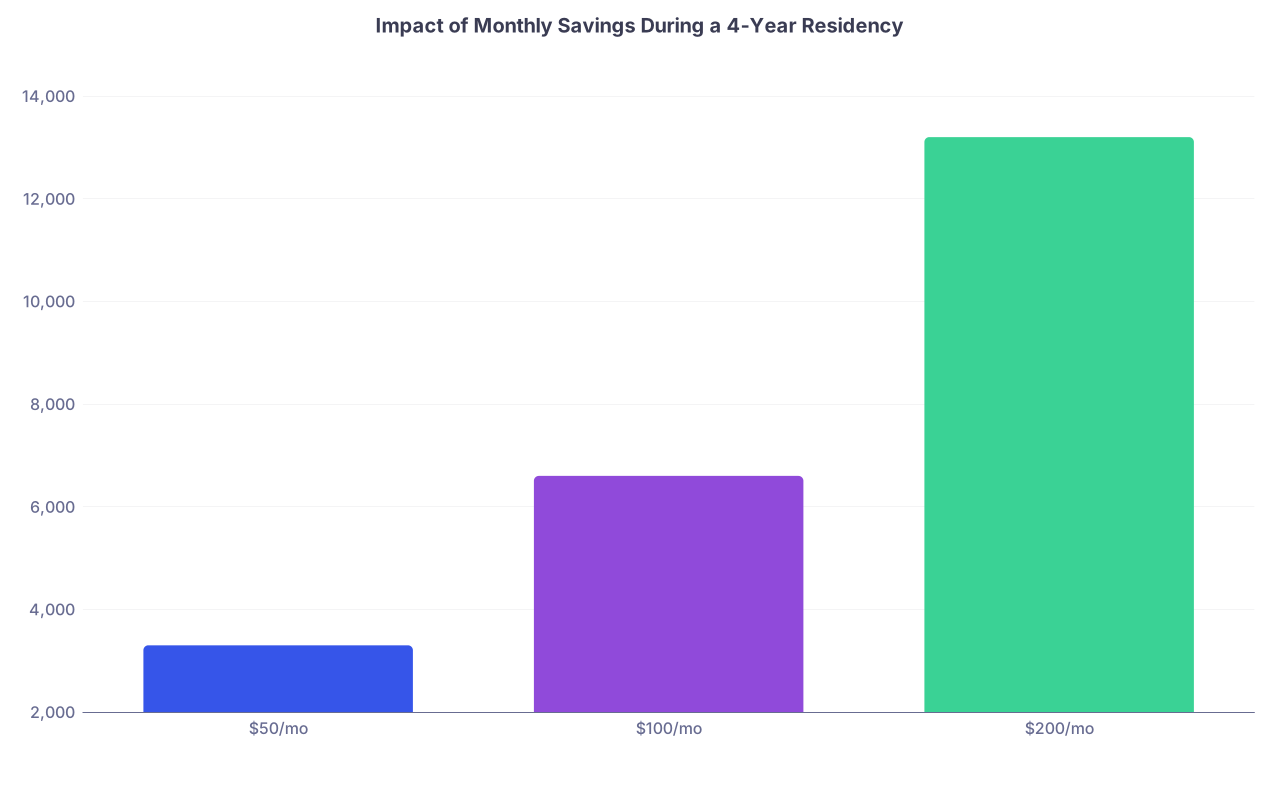
To show you why even small amounts matter:
| Category | Value |
|---|---|
| $50/mo | 3300 |
| $100/mo | 6600 |
| $200/mo | 13200 |
Assuming 7% annual return over 4 years of residency, you’re roughly in that range. Not life-changing… yet. But if you never withdraw it, let it sit for 30 years, those same contributions could grow to:
- ~$12k from $50/month contributions
- ~$24k from $100/month
- ~$48k from $200/month
For four years of small sacrifice. While you were broke. That’s why we still bother.
Step 7: Decide What You’re Not Doing Right Now (On Purpose)
You will drive yourself insane if you try to:
- Max out 401(k)
- Max out two Roth IRAs
- Open 529s
- Rapidly pay off six figures of loans
- Build a big emergency fund
- Live a normal life with kids
on a resident salary.
So you make intentional trade-offs.
For many one-income resident families, that looks something like this:
- We are not prioritizing kids’ college (529s) during residency. Our retirement comes first so we don’t become a financial burden to them later.
- We are not attacking student loans aggressively yet. We’re using IDR, maybe PSLF, and will kill the remaining balance as attendings.
- We are not obsessing over investment details. One or two broad funds is enough.
- We are not chasing an arbitrary retirement number now. We’re just laying basic groundwork.
That’s not failure. That’s a plan.
Step 8: Build a Simple “Attending Switch” Plan Now
The smartest residents with kids don’t only think about today. They write a one-page rough plan for their first 3 attending years.
Not perfect numbers. Just intentional percentages. For example:
- Year 1 attending:
- 20% of gross income to retirement
- 10–20% to student loan payoff (if not PSLF)
- Small 529 start for each kid (e.g., $50–$100/month)
- Year 2–3:
- 25–30% of gross to retirement
- Accelerated loan payoff or invest more if PSLF wipes them
That way, when your paycheck triples, lifestyle creep doesn’t swallow all of it. You already know: “First attending contract, I’m putting at least 20% into retirement off the top.”
Here’s a simple mental target:
If you consistently save and invest 20–25% of your gross income as an attending, starting by your early 30s, you can absolutely retire comfortably. Even if residency savings were small.
Your residency retirement planning is really about positioning yourself to hit that 20–25% later without being chained by dumb debt decisions now.
Step 9: Protect the Downside: Insurance and Legal Basics
You have kids. One income. If something happens to you, retirement accounts won’t matter. So part of “retirement planning” here is not letting your family get wiped out.
Term Life Insurance
If anyone depends on your income, you need term life insurance. Full stop.
Basic rule of thumb:
- Coverage = 7–10x your annual attending income target, not your resident salary.
- Buy level term that covers you at least until kids are out of the house and mortgage is manageable (20–30 years).
Get it while you’re young and (hopefully) healthy. Don’t buy anything labeled “whole life,” “universal life,” or “cash value” from the nice guy who gave a free lunch talk at noon conference. That stuff is usually trash for residents.
Disability Insurance
Your future income is your biggest retirement asset. If you get disabled and cannot practice, your entire retirement plan is shot.
You want:
- An individual own-occupation disability policy (ideally specialty-specific)
- Enough coverage that, combined with any group policy, keeps your family afloat
Residents often get these through specialty-focused brokers. Yes, the premiums sting on a resident income, but losing your entire future attending income stings more.
Basic Legal Stuff
Especially with kids, you should have:
- A simple will naming a guardian for your children
- Beneficiaries set correctly on any retirement accounts and life insurance
- At least a basic power of attorney/healthcare proxy (depending on your state)
This is all part of “retirement planning” in the real world. You’re not just planning to live to 65. You’re protecting your family if you don’t.
Step 10: Communicate With Your Partner Like You’re on the Same Team (Because You Are)
Money stress breaks people. Residency breaks people. Combine them, add kids, and you have a high-risk environment for resentment.
Do this:
- Once a month, short “money check-in” with your partner. 20–30 minutes.
- Same agenda every time:
- What came in
- What went out
- Any unexpected expenses
- What we’re putting (even if small) toward savings/retirement
And you say out loud:
“We are not trying to be perfect during residency. We are just trying to not dig a deeper hole and to set up a few things for future us.”
The emotional part matters. Because if your partner thinks you’re funneling money into some future fantasy while they’re drowning now, it’ll blow up.
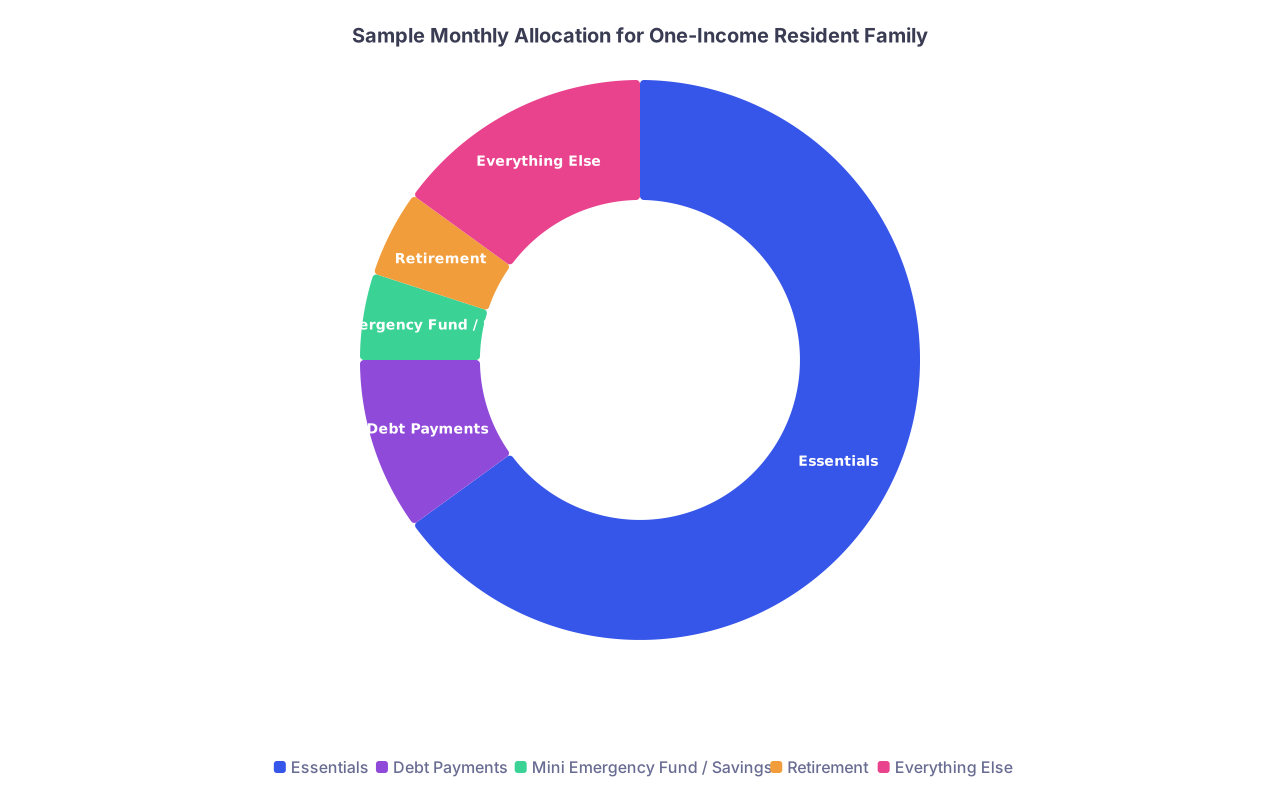
Quick Visual: Where Your Limited Dollars Might Go
Here’s a rough idea of allocation for a one-income resident family that’s just barely positive each month:
| Category | Value |
|---|---|
| Essentials | 65 |
| Debt Payments | 10 |
| Mini Emergency Fund / Savings | 5 |
| Retirement | 5 |
| Everything Else | 15 |
This is not a prescription. It’s just to show: even 5% to retirement is something. You’re playing the long game.
FAQ (Exactly 5 Questions)
1. I literally have $0 left at the end of the month. Should I still try to save for retirement?
If you’re truly at $0 or negative, your first move is to fix cash flow, not force retirement savings. That might mean:
- Moving to cheaper housing or getting a roommate
- Adjusting childcare arrangements if possible
- Your partner picking up part-time or flexible work
- Moonlighting if your program allows and you can do it safely
Once you have even $25–$50/month consistently free, you can start a tiny automatic Roth IRA contribution. But do not feel guilty if right now every dollar is going to basics and minimum payments. Stabilizing your household is step one.
2. Should I pause retirement savings to pay off credit cards or personal loans?
If your credit card interest is double digits (e.g., 18–25%), yes, that usually comes before investing. You might still grab an employer match if you have one because that’s free money, but after that, aggressively paying down high-interest consumer debt is effectively a guaranteed “return.”
Once those are gone, you can shift that payment amount toward retirement savings or a small emergency fund.
3. Is it a mistake to ignore 529 college savings for my kids during residency?
No. For most one-income resident families, skipping 529 contributions in training is completely reasonable. Your kids can get:
- Scholarships
- Loans
- Work-study
They cannot get loans for your retirement. If you end up broke at 70, they’re the safety net. So the priority order stands: your retirement > their college. You can absolutely start 529s as an attending once you’re putting a solid percentage into retirement accounts.
4. I’m doing PSLF. Should I still care about retirement during residency?
Yes, but the emphasis shifts. If you’re on track for PSLF:
- Your priority during residency is keeping IDR payments low and qualifying
- But even then, small Roth IRA contributions are huge because you’re in a relatively low tax bracket
As an attending in non-profit work, with PSLF wiping your loans, your retirement saving capacity will be excellent. Tiny amounts during residency + big amounts later is a perfectly valid plan.
5. How do I choose what to invest in? I have no time to learn this.
Keep it brutally simple. In your Roth IRA or 403(b):
- Pick one broad total US stock market index fund or
- A target date retirement fund close to your expected retirement year
That’s it. No individual stocks. No trying to time the market on rounds. As long as your fees are low (expense ratio ideally under 0.20%), you’re 90% of the way there. You can always refine and get fancy as an attending if you really want to. You probably won’t need to.
Key points to walk away with:
- Your job in residency with kids and one income is not to fully fund retirement; it’s to avoid big mistakes, automate a few small smart moves, and protect your future capacity to save.
- A tiny, consistent Roth or matched contribution now plus a disciplined 20–25% savings rate as an attending can absolutely get you to a solid retirement, even if you feel behind today.
- Survival, cash flow stability, and good student loan and insurance decisions are retirement planning in this phase of your life.


