

You’ve just matched. Congratulations.
Now you’re looking at rent prices in San Francisco, New York, Boston, Seattle, LA, DC—pick your poison—and your stomach drops.
Your PGY-1 salary: ~$65–75k.
Studio apartment near the hospital: $2,200–3,000/month (for something that still has questionable plumbing).
You’re staring at your loan balance, your new contract, and that old “max out your Roth IRA no matter what” advice and thinking:
“Is any of that realistic for me now?”
This is where you are:
Recently matched in a high-cost-of-living (HCOL) city, not attending money yet, but people keep telling you, “You have to start retirement early or you’ll regret it.” You’re trying to figure out what’s actually smart versus what’s Instagram-finance fantasy.
Here’s how to think about retirement planning in this exact situation—and what to actually do in the next 12–24 months.
Step 1: Get Your Financial Reality on Paper (Not in Your Head)
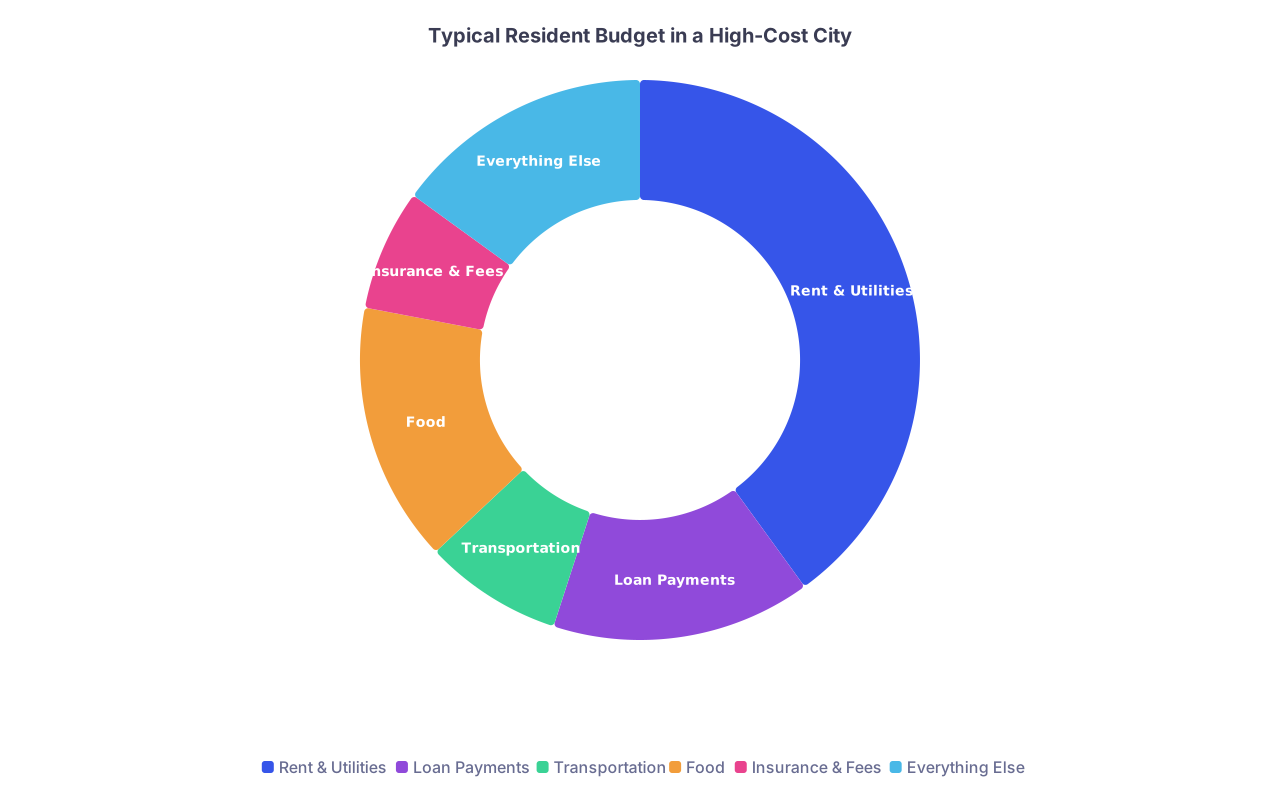
| Category | Value |
|---|---|
| Rent & Utilities | 40 |
| Loan Payments | 15 |
| Transportation | 8 |
| Food | 15 |
| Insurance & Fees | 7 |
| Everything Else | 15 |
Before talking about Roth IRAs, 403(b)s, or “FIRE,” you need one thing: a clear view of what’s left over each month after surviving your city.
Sit down one evening, no distractions, with:
- Your contract (PGY-1 salary and any differentials)
- A realistic rent estimate from listings near your hospital
- Your student loan data (from studentaid.gov or your servicers)
- Your car situation (payment? insurance? parking?)
Write down:
Take-home pay
Use a paycheck calculator with:- Salary: your PGY amount
- State + city tax (NYC, SF, etc. will hurt)
- Pre-tax items if your hospital forces any (union dues, disability, etc.)
Non-negotiable monthly costs
- Rent + utilities (don’t kid yourself with unrealistically low numbers)
- Insurance (health out-of-pocket estimates, auto, renter’s if you’re smart)
- Minimum loan payments (even if on IDR, estimate it)
- Transit/parking (subway pass, gas, parking garage, Uber if you’ll actually use it)
- Phone + internet
- Groceries (not the “rice and beans” fantasy; the actual you on 80-hour weeks)
What’s left
This leftover—maybe $300, maybe $1,000, maybe negative—is the real variable.
That number decides what kind of retirement planning you can do now, not what some attending on Twitter thinks you “should” be doing.
If your leftover number is:
- Negative: You’re not in retirement-planning mode yet. You’re in survival and damage-control mode.
- $0–$300: You’re in “minimal but meaningful” retirement mode.
- $300–$800: You can do real, structured retirement contributions.
- $800+ (rare in true HCOL without roommates): You have options; the question becomes priorities, not feasibility.
We’ll walk through what to do in each scenario.
Step 2: Decide Your Priority Order in a High-Cost City
You can’t fund everything at once on a resident salary in an expensive city. So you need a clear priority stack.
Here’s the order I’d recommend for most residents in a high-cost city:
- Do not drown: Basic cash buffer
- Insurance that protects your future earning power
- Loan plan that doesn’t sabotage your future
- Retirement accounts (yes, but in a realistic dose)
1. Build (or keep) a Small, Realistic Emergency Buffer
Forget the “6 months of expenses” fantasy during PGY-1 in Manhattan. That’s not happening.
Target something like:
- $1,000–$2,000 as absolute minimum “oh crap” money
- Eventually ~1 month of expenses if you can get there
This sits in:
- A high-yield savings account
- Not in your checking where it silently evaporates
If your leftover money is tiny, your first “retirement” move is actually building this buffer. Why? Because if one flat tire or sudden move wipes you out and goes on a credit card at 25% interest, your future Roth IRA contributions won’t save you.
2. Protect Your Biggest Asset: Future Attending Income
I’ve seen too many residents ignore this until something bad happens on a ski trip or a random car accident.
At minimum:
-
- If your employer offers group long-term disability, read the details. It’s often not enough, but it’s something.
- Strongly consider an individual own-occupation policy (especially if you’re going into a procedural field). It’s not cheap, but losing your future $300–500k/year earnings is more expensive.
-
- If no one financially depends on you, skip for now.
- If you have a partner or kids relying on your income, a simple 20–30-year term policy is non-negotiable.
This is part of “retirement planning” whether you like it or not. Retirement assumes you make it through your working years able to earn money. These policies help guarantee that.
Step 3: Understand Your Retirement Options as a Resident
Now we can talk about accounts.
Typical options you might have in residency:
| Account Type | Tax Treatment | Good Use Case |
|---|---|---|
| Roth IRA | After-tax in, tax-free out | Residents in low tax bracket |
| Traditional IRA | Pre-tax in, tax-deferred | Rarely optimal for residents |
| 401(k)/403(b) Roth | After-tax in, tax-free out | Programs offering Roth option |
| 401(k)/403(b) Pre-tax | Lowers taxable income now | If you’re PSLF-focused or higher taxed |
| 457(b) | Tax-deferred | Some large hospital systems |
Roth IRA: Usually the MVP for Residents
You’re probably in one of the lowest tax brackets you’ll ever see again. That makes Roth contributions very attractive.
- 2024 limit: $7,000 (you will not hit this without serious sacrifice in a HCOL city)
- You can contribute any time from Jan 1 of the year to Tax Day of the next year
What makes Roth especially nice for residents:
- Contributions (not earnings) can be withdrawn tax- and penalty-free later
- So in a pinch, it doubles as a pseudo-backup emergency fund
If you can only do $100/month? Fine. Do $100/month. This is not a perfection contest.
Employer Plan: 403(b) / 401(k)
Check if your program offers:
- Match: rare in residency, but if they match 3–5%, that free money jumps to the top of the priority list.
- Roth option vs pre-tax only
Basic rules:
- If there’s a match: Contribute at least enough to get the full match, even in a high-cost city, unless you literally cannot pay rent.
- No match, Roth option available: If you’re already doing some Roth IRA and have extra, consider using this too.
- No Roth option, pre-tax only:
- If you’re pursuing PSLF and want to keep your AGI lower to lower IDR payments, pre-tax 403(b) can be strategic.
- If not PSLF-bound, pre-tax contributions during residency are less compelling because your tax rate is low now and higher later.
Step 4: Choose a Strategy Based on How Squeezed You Are
Let’s get concrete. Here are three realistic profiles.
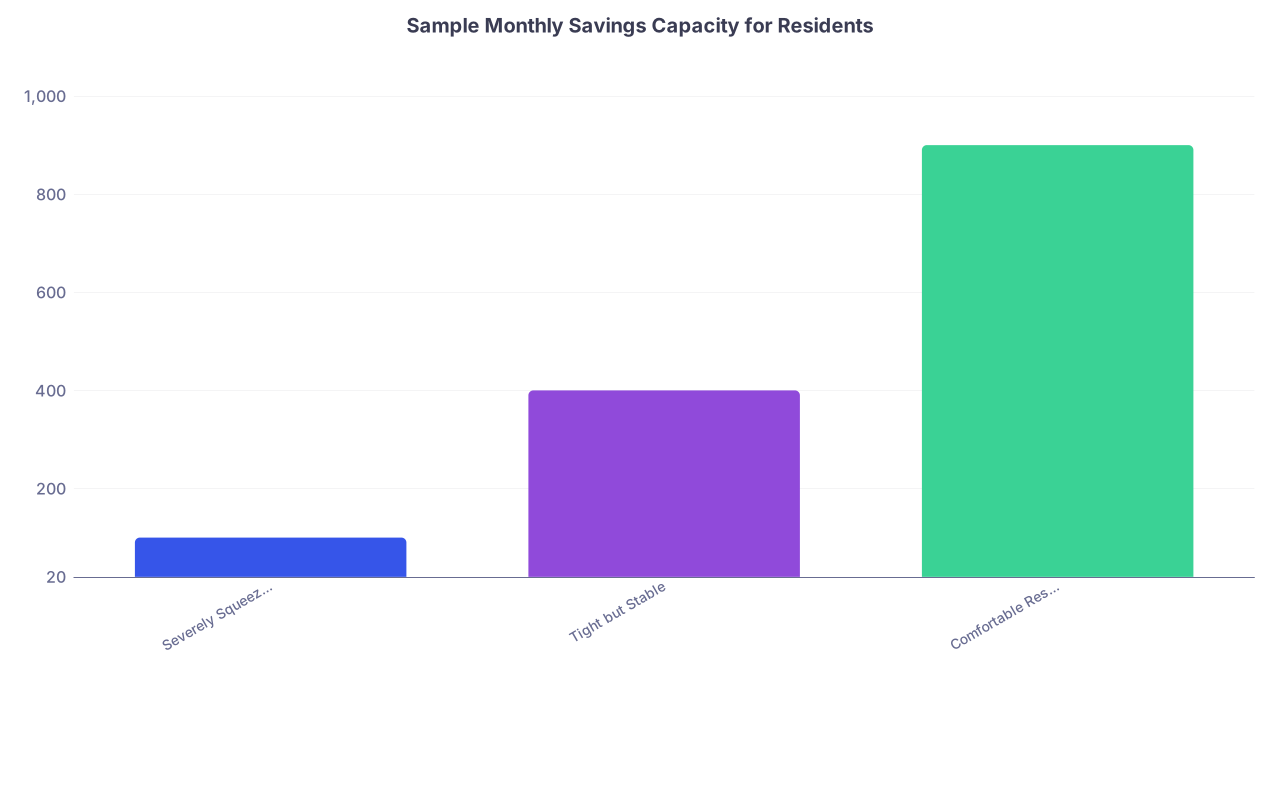
| Category | Value |
|---|---|
| Severely Squeezed | 100 |
| Tight but Stable | 400 |
| Comfortable Resident | 900 |
Scenario A: You’re Severely Squeezed (Leftover ≤ $200/month)
Example:
PGY-1 in SF, $2,400 rent (with roommate), loans on IDR, no car but high city costs.
Your move:
- Stop apologizing for not maxing retirement right now. Survival first.
- Put $50–$100/month into:
- Either a Roth IRA or
- Straight into a small emergency fund if you have literally nothing saved
- If your employer has a match you can’t fully reach, try to hit it slowly over time, but don’t blow your rent money on it.
Your retirement “plan” here is simply:
- Don’t go deeper into debt for daily life.
- Avoid catastrophic mistakes (no crazy car leases, no 20% APR credit cards).
- Get through residency without wrecking your future self.
That is still retirement planning. Just not the Instagram version.
Scenario B: Tight but Stable ($200–$600/month Available)
Example:
Resident in Boston, 2 roommates, modest IDR payments, uses public transit.
Your move:
- Build/maintain a small buffer: Aim for $1,500–$3,000 in savings.
- Start a Roth IRA:
- Even $200–$300/month is huge over time
- Invest it in a broad low-cost index fund (e.g., total US market or target date)
- If your program offers a match:
- Divert enough monthly to get the full match, even if that means a slightly smaller Roth IRA contribution.
A sample monthly breakdown:
- $150 to emergency savings (until you hit goal)
- $250 to Roth IRA
- $100 to 403(b) to get a small match (if available)
This is realistic. You’re not maxing anything, but you’re building a habit and getting the tax advantage.
Scenario C: Relatively Comfortable ($600+ Available)
Example:
Resident in DC with spouse working, shared expenses, or unusually low rent.
Your move:
- Build a 1–2 month buffer fairly quickly.
- Fully fund Roth IRA if you can: up to $7,000/year.
- Then:
- Get your employer match in 403(b) or 401(k)
- Decide if additional contributions should be Roth or pre-tax (PSLF, tax situation, etc.)
In this scenario, you actually can play at an attending-like structure:
- 15–20% of gross income going to retirement accounts
- Some extra toward loans if not planning PSLF
Step 5: Understand the PSLF vs. Aggressive Loan Payoff Trade
This is where retirement and loan strategy collide.
If you’re working at a non-profit hospital and may do 10 years in qualifying employment (residency + attending), PSLF is on the table.
In that case:
- Lower AGI = lower IDR payments = more forgiven at the end
- Pre-tax 403(b) contributions reduce AGI
- So contributing to pre-tax retirement might indirectly increase the total forgiven balance
If you’re clearly not doing PSLF (planning private practice, locums, etc.):
- There’s an argument for:
- Roth IRA first (low tax rate now)
- Then some extra directed at high-interest loans
- But I’ll be blunt: during residency in a high-cost city, you’re not “crushing loans.” You’re mostly stabilizing them.
The wrong move in a high-cost city:
Starving yourself to make huge extra loan payments while contributing nothing to retirement and having no safety net. That usually backfires.
Step 6: Picking Actual Investments (Not Just Accounts)
Don’t overcomplicate this. You’re on nights and 28-hour calls; you don’t have time to become a portfolio manager.
Inside your Roth IRA or 403(b), default to something like:
- A target-date retirement fund roughly matching the year you’ll be around 65. Example: retiring around 2060 → “Target Retirement 2060” fund.
- Automatically diversifies across stocks/bonds
- Adjusts over time
- Slightly higher fees than pure index funds, but the simplicity is worth it for residents
Or, if you want to be more hands-on but still simple:
- 1 broad US stock index fund (e.g., total US market)
- 1 international stock index fund
- 1 bond index fund (for a small portion, or even none if you’re young and can tolerate volatility)
Do not day-trade. Do not buy individual pharma stocks “because you’re in medicine.” This is retirement money, not a hobby account.
Step 7: Lifestyle Guardrails in a High-Cost City
This is where most residents sabotage their financial future, not in the investment choices.
A few non-negotiables if you care about retirement at all:
- Housing:
- If you can tolerate it, have a roommate. Solo living in a true HCOL city is often a $800–$1,000/month lifestyle tax.
- Car:
- If you don’t absolutely need one, don’t get one.
- If you must, no luxury leases, no $800/month payments. A reliable used car beats a shiny new one every time during residency.
- “I deserve it” spending:
- The sentiment is true. The math still doesn’t care.
- Build a small “fun money” allowance into your budget (seriously, you’re human), but don’t let lifestyle creep eat the entire gap you could send to Roth or savings.
I’ve seen residents who made $65k in NYC finish with $0 in retirement and $5k in credit card debt. And I’ve seen others in the same city put away $3–5k/year in Roth and walk out of residency with a decent foundation. The difference was never their gross salary. It was rent choices, car choices, and eating out frequency.
Step 8: Timeline: What to Do Your First 2 Years
Here’s a simple sequence for your first half of residency.

| Step | Description |
|---|---|
| Step 1 | Match in HCOL City |
| Step 2 | Estimate take home pay |
| Step 3 | Build 1k to 2k buffer |
| Step 4 | Review disability and insurance |
| Step 5 | Contribute to get full match |
| Step 6 | Open Roth IRA |
| Step 7 | Add Roth IRA contributions |
| Step 8 | Refine loan and PSLF plan |
| Step 9 | Employer match available |
PGY-1 (Months 1–6):
- Understand your actual paycheck and rent.
- Build your first $1–2k in savings.
- Figure out:
- Employer retirement plan?
- Match?
- Insurance offerings?
- If you can, start small Roth IRA contributions: even $50–$100/month.
PGY-1 (Months 7–12):
- Adjust as you see your pattern of expenses.
- Increase Roth IRA or 403(b) contributions if possible.
- Decide: are you aiming for PSLF or not?
This will guide pre-tax vs Roth in employer plan.
PGY-2 and beyond:
- Ideally, get to:
- Some automatic monthly amount going into Roth IRA.
- Some employer plan contributions (especially if match).
- Each year with a salary bump, increase contributions by a small percentage before you inflate your lifestyle.
Step 9: When to Stop Feeling Guilty
Let me be blunt: A lot of attending-level advice about “always max your Roth IRA during residency” is disconnected from reality in cities where parking is $300/month and rent eats half your paycheck.
If you:
- Avoid high-interest consumer debt,
- Have a small buffer,
- Get basic insurance in place,
- And contribute something to retirement most years of residency,
You’re already way ahead of many colleagues.
You can ramp things up dramatically 2–3 years into attending life. A physician who starts “late” at 32 but puts away 20–25% of income consistently can easily catch up to, or surpass, a resident who scraped together tiny amounts while stressed and miserable.
The point of starting now is not perfection. It’s:
- Building the habit.
- Taking advantage of your low tax bracket with Roth.
- Preventing “I’ll start later” from becoming “I never started.”
Key Takeaways
- In a high-cost city as a new resident, survival and basic protections (buffer, disability insurance) come before aggressive retirement savings. That’s not laziness; it’s math.
- For most residents, some Roth contributions—Roth IRA first, then Roth or pre-tax 403(b) with a match—are the best realistic retirement move, even if the amounts are small.
- The big wins are structural: your housing, car, and lifestyle choices. Get those under control, automate modest retirement contributions, and stop beating yourself up for not maxing everything on a resident paycheck in an expensive city.


