
You are in your office between cases. Your CPA just told you: “Given your income, a cash balance pension plan could let you put away another $150k–$300k a year pre-tax.” You nodded like you understood, then immediately thought, What actually is this thing, and what’s the catch?
Let me break this down specifically for you as a high-earning physician. Not generic “business owner” fluff. The version that matters if you are a partner in a group, run your own practice, or are negotiating with a hospital system.
1. What a Cash Balance Plan Actually Is (In Physician Terms)
Start here: a cash balance plan is a type of defined benefit pension that has been redesigned to feel like a defined contribution plan.
Translation for you:
- It is legally a pension (like the old-school ones).
- But your “benefit” is expressed as a hypothetical account balance that grows with:
- Annual pay credits (employer contributions)
- Guaranteed interest credits (a formula, not market returns)
From your perspective as an owner/partner, it behaves like a mega-401(k) bolted on top of your existing 401(k)/profit-sharing plan. Except with more rules and more liability.
Core features in plain language
Employer-funded only
You do not make “employee” deferrals into a cash balance plan. The practice (or entity) contributes on your behalf. Those contributions are tax-deductible to the practice and not taxable to you until distributed.Much higher contribution limits than a 401(k)
In your 40s–60s, the combined employer contributions can be well into the six figures per physician per year, especially when stacked on top of a 401(k)/profit sharing plan.Guaranteed interest credit
The plan promises a set interest credit each year, usually something like a fixed 4–5% or “bond-like” variable rate (e.g., tied to the 30-year Treasury yield). This is not what the investments actually earn; it is just the notional credit on your “bookkeeping” account.Back-end: looks like a big IRA
When you leave or the plan terminates, your “account balance” is usually available as:- A rollover to an IRA (what most physicians do)
- A lump sum taxable distribution
- Or an annuity (almost nobody in your demographic chooses this)
So why does the IRS let you put so much in? Because, under pension rules, the “benefit” they’re limiting is not the annual contribution but the projected retirement benefit at a given retirement age. For a high earner, that translates into very large annual contributions.
2. How the Numbers Work: Contributions, Limits, and Ages
This is where most physicians get lost, because CPAs and actuaries start throwing actuarial jargon at you. Let’s strip that out.
The IRS sets a maximum annual retirement benefit for defined benefit plans. For 2024, it is up to $275,000 per year at age 62–65 (adjusted annually). The actuary then works backward:
- Target retirement age (say 62)
- Your current age (say 50)
- Assumed interest rate and mortality
- That desired future pension
From that, they calculate how much your practice can contribute each year to fund that promised future benefit.
Older physicians = fewer years to fund it = higher permissible annual contributions.
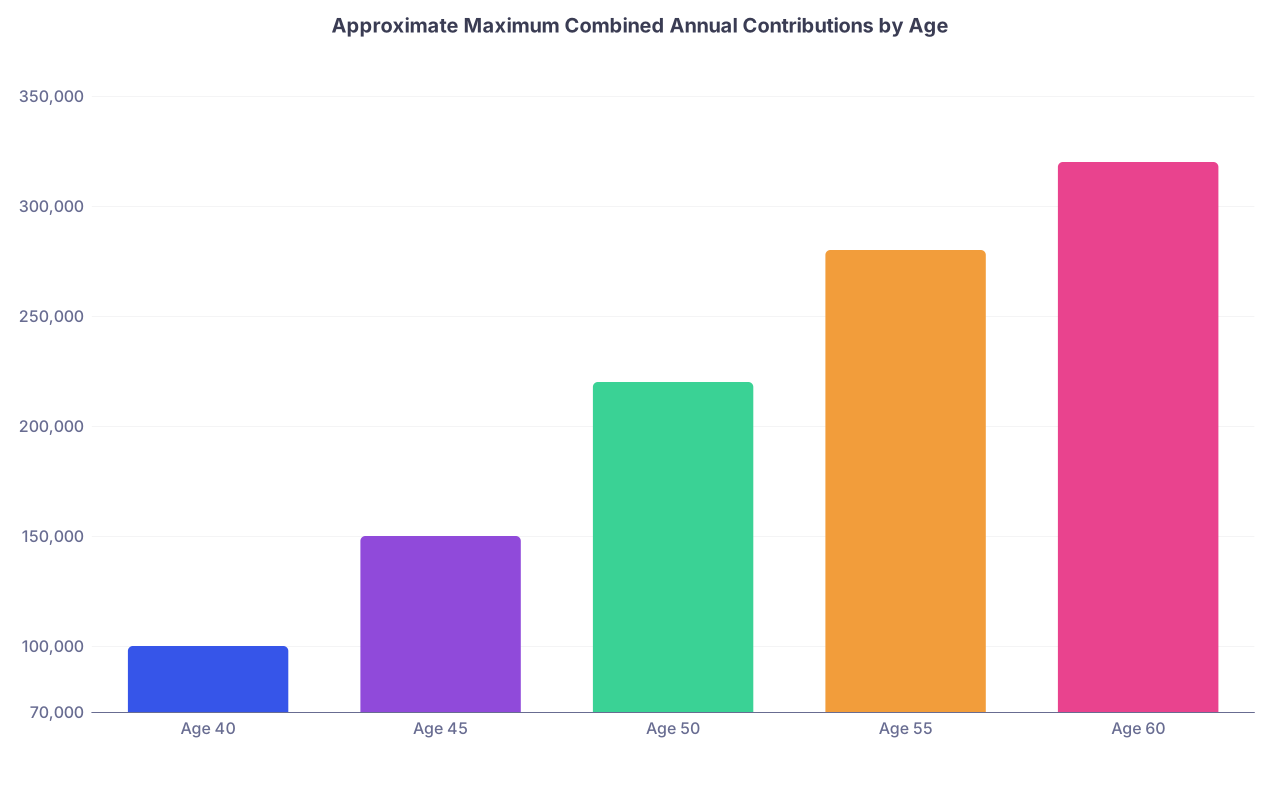
Age vs possible contribution
Actual numbers depend on plan design, compensation, and other variables, but this is the rough shape for a high-earning partner with compensation in the $400k–$800k range, with a combined 401(k)/profit-sharing already maxed:
| Category | Value |
|---|---|
| Age 40 | 100000 |
| Age 45 | 150000 |
| Age 50 | 220000 |
| Age 55 | 280000 |
| Age 60 | 320000 |
These figures are ballpark totals (401(k)/profit-sharing + cash balance). The actual cash balance portion might be, for example, $80k–$250k+ depending on the design.
The stacking effect with a 401(k)
You do not choose between a 401(k) and a cash balance plan. In a well-designed physician setup, you use both:
- 401(k) salary deferral: up to $23,000 employee (2024) + catch-up if over 50
- Employer profit-sharing: up to the overall DC plan limit (e.g., $69,000 / $76,500 with catch-up in 2024)
- Plus cash balance employer contribution on top
That is how you get to $150k–$300k+ per partner in total tax-deferred savings.
3. What Makes This Work (or Fail) in a Physician Group
Cash balance plans are fantastic when designed correctly and a slow-motion train wreck when done lazily. I have seen both.
The key drivers for physicians
You are an ideal candidate if:
- You are a high earner (usually $350k+; for groups, often $400k+ physician comp).
- You can commit to ongoing contributions for 5+ years.
- You are comfortable with pre-tax vs after-tax trade-offs; you are not trying to stuff everything into a taxable brokerage just to have “flexibility.”
But that is not enough. The group structure and staff profile matter a lot.
The staff cost problem
Every qualified retirement plan must be nondiscriminatory. That means if partners get a big benefit, staff must get some benefit. The art is in minimizing staff costs while keeping the plan compliant.
Typical move: pair a new comparability profit-sharing 401(k) design with a cash balance plan. This lets you give:
- Higher contribution percentages to physicians
- Lower (but still permissible) percentages to staff
Here is how the tradeoff can look in a simplified small group example (numbers illustrative, not universal):
| Category | Physicians (3) | Staff (7) |
|---|---|---|
| Average salary | $500,000 | $55,000 |
| 401(k)/PS % pay | 20% | 5% |
| Cash balance % | 40% | 2% |
| Approx $ contrib | $900,000 | $77,000 |
So in this scenario, physicians get about $900k total in contributions, staff about $77k. That is a staff cost of ~8–9 cents per physician contribution dollar. For most high-earner groups, that ratio is acceptable.
If your staff payroll is huge relative to partner comp, the math gets ugly quickly. I have seen hospital-employed groups where an attempt at a cash balance overlay died fast once the HR department realized the required staff costs.
4. How the Plan Actually Runs Year-to-Year
Let me demystify the mechanics, because this is where actuaries like to hide behind thick reports.
Each year, roughly this happens:
The actuary calculates the minimum required and maximum allowable contributions for the plan based on:
- Plan formula (e.g., pay credit 5–10% of pay for staff, 40–60% of pay for partners)
- Interest crediting rate
- Current asset level and investment performance
- Participant ages and compensation
The partners decide how much to contribute within that range. Most physician groups aim near the maximum allowable to capture the tax benefit.
Contributions are allocated to each participant’s hypothetical account (per the formula).
The plan credits interest to those hypothetical accounts — again, using the plan formula, not actual investment returns.
On the back end:
- The plan’s investments (real money) produce actual returns.
- If investments outperform the assumed interest credit, future required contributions can be lower.
- If investments underperform, future required contributions may need to be higher.
So the group is still taking investment risk at the plan level.
Visual overview: from decision to benefit

| Step | Description |
|---|---|
| Step 1 | Start Plan Year |
| Step 2 | Actuary sets min and max contributions |
| Step 3 | Partners choose contribution level |
| Step 4 | Practice funds plan by contribution deadline |
| Step 5 | Allocate pay and interest credits to accounts |
| Step 6 | Plan assets invested per IPS |
| Step 7 | Actuary evaluates funding status next year |
Notice who is not making any decisions here: your employees. This is all employer-driven.
5. Tax Impact for High-Earning Physicians
This is the part your CPA tried to tell you in two sentences on a Zoom call.
Immediate benefit: big tax deferral
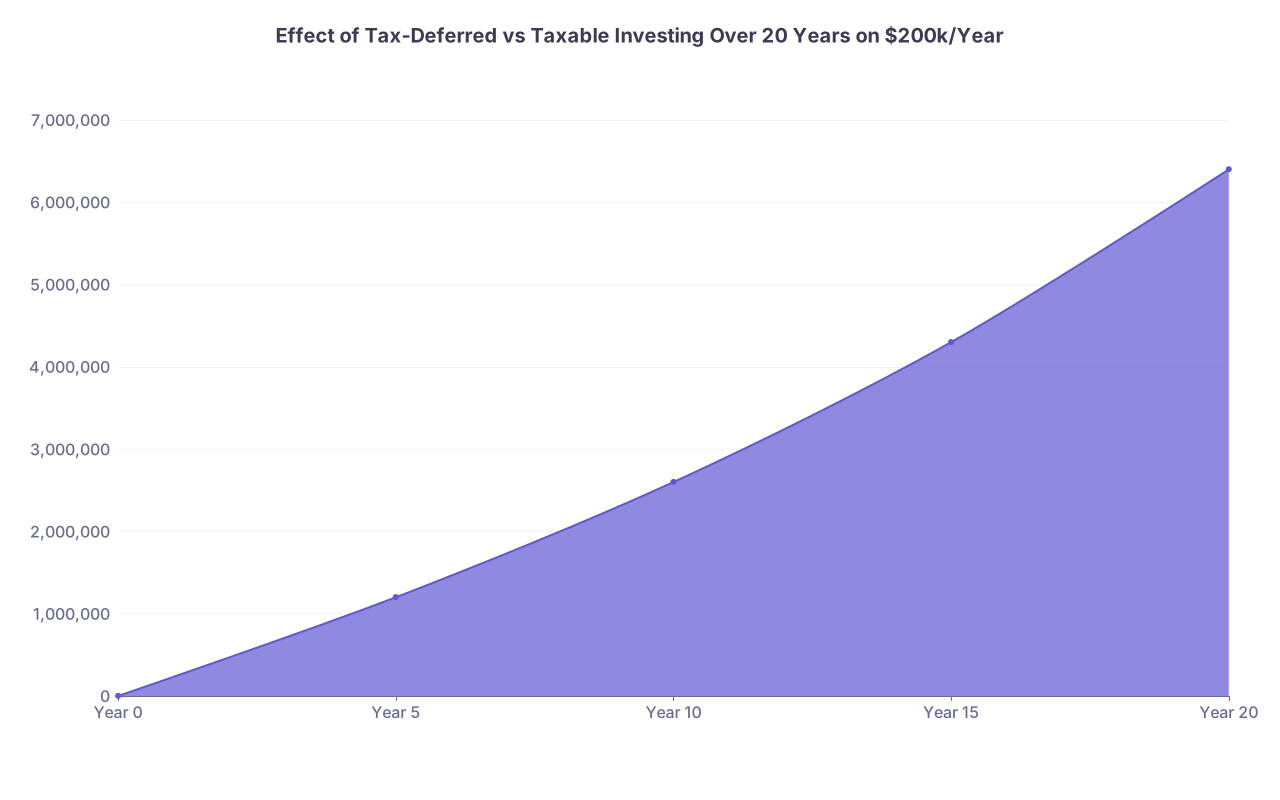
Say you are in California, partnership income $700k, combined federal + state marginal rate 45–50%. If the group designs a plan allowing you an additional $200k in cash balance contributions:
- That $200k is not taxed this year.
- If you would otherwise invest that in a taxable brokerage account, after tax maybe $110k–$120k goes in.
- Instead, $200k goes into the plan, grows tax-deferred, and is taxed later in retirement.
| Category | Value |
|---|---|
| Year 0 | 0 |
| Year 5 | 1200000 |
| Year 10 | 2600000 |
| Year 15 | 4300000 |
| Year 20 | 6400000 |
Think of that chart as rough scale only: the relative benefit of compounding pre-tax dollars vs after-tax over time is what matters.
The strategy works best if:
- You expect to be in a lower bracket in retirement than now.
- Or at least not in a much higher bracket than your current marginal rate.
Most high-earning physicians: top marginal bracket now, somewhat lower blended effective rate later. That is the arbitrage.
Long-term: RMDs, rollovers, and exit options
At retirement or exit:
- Most physicians roll over their cash balance benefit to an IRA.
- It merges into your other qualified assets.
- Then you face required minimum distributions (RMDs) at the statutory age (73+ depending on year of birth).
If you are worried about future RMD size, you can layer in:
- Partial Roth conversions in lower-income years.
- Charitable planning (QCDs from IRAs, donor-advised funds, etc.).
- Coordinating retirement ages between spouses.
Bottom line: the tax geometry overwhelmingly favors using these plans during peak-earning years, then managing distributions strategically.
6. Investment Strategy Inside a Cash Balance Plan
Here is where many physician groups get it wrong: they invest the cash balance plan like a 30-year-old’s Roth IRA. Too aggressive, then complain when the required contributions spike after a bad market year.
Remember: the plan promises a fixed or formula-based interest credit, often around 4–5%.
The plan’s actual investments should be designed to roughly match that liability, not chase double-digit equity returns.
Typical target:
- Lower volatility, bond-heavy allocation.
- Maybe a 30–50% equity / 50–70% fixed income mix, depending on funding status, group risk tolerance, and interest credit formula.

If your investments earn 3–6% per year, and you promise 4–5% credit, you are in the sweet spot.
You are not trying to “beat the market” inside a cash balance plan. You are trying to:
- Keep the funding status stable.
- Avoid big negative years that suddenly force much higher required contributions.
If your group wants aggressive equity exposure, do that in your 401(k) or taxable accounts, not the cash balance plan.
7. Big Risks and Common Mistakes for Physicians
Let us talk about the ways this blows up. Because I have seen more than one group end up angry and confused.
1. Overcommitting without partner consensus
A cash balance plan is a multi-year commitment. Not technically permanent, but the IRS does not like plans that appear “abusive” or too short-lived.
Red flags:
- Partners in their early 40s sign on, then half the group wants out 2–3 years later.
- New partners join who do not want the same level of contribution.
- Retiring partners want to maximize just before exit, without thinking about the impact on remaining partners.
You need:
- Clear partnership agreement language about funding responsibility.
- A long-term mindset: 5–10+ year horizon.
2. Ignoring future staff demographics
If you design the plan when you have mostly young staff, then over 10 years your staff ages and tenure increases, required contributions to staff grow faster than you expected.
This is manageable if the plan is reviewed and tweaked every few years. It is a problem when the group “sets and forgets” the design for a decade.
3. Investment misalignment
Two extremes:
- Hyper-aggressive: 80–100% equity, massive volatility. In a bad year, future required contributions spike.
- Overly conservative: 100% cash-like, barely earning anything. Contribution requirements can also increase because the assets are not keeping up with the assumed interest credit.
You want an actuary + investment advisor who understand pension liability matching. Not just “my buddy who does my brokerage account.”
4. Doing this with the wrong entity or employment structure
Hospital-employed physicians almost never get to drive this themselves. The hospital might have a defined benefit plan, but that is not a partner-level, contribution-maximizing cash balance targeted to you.
Cash balance plans tend to work best when:
- You have a professional corporation (PC), S-corp, or partnership structure.
- You have control (or strong influence) over compensation and benefits design.
If you are purely W-2 without any ownership or independent entity, you are usually out of luck for this specific strategy.
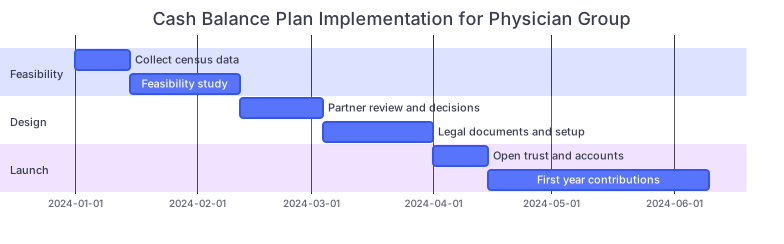
8. Step-by-Step: How a High-Earning Physician Group Implements One
If you are in a position to influence your group, here is the actual sequence you follow. Not the theory—the steps.
| Task | Details |
|---|---|
| Feasibility: Collect census data | a1, 2024-01, 2w |
| Feasibility: Feasibility study | a2, after a1, 4w |
| Design: Partner review and decisions | a3, after a2, 3w |
| Design: Legal documents and setup | a4, after a3, 4w |
| Launch: Open trust and accounts | a5, after a4, 2w |
| Launch: First year contributions | a6, after a5, 8w |
Here is what is happening in those phases.
Phase 1: Feasibility
You gather:
- Dates of birth
- Hire dates
- Compensation
- Ownership status
- Current 401(k) / profit sharing design
The actuary runs what-if scenarios:
- Different physician vs staff ratios
- Various physician contribution targets
- Impact on required staff contributions
You get a clear output: “If you want $200k per physician, here is the staff cost and total plan cost.”
Phase 2: Design
The group makes decisions on:
- Pay credit formula for partners vs staff.
- Interest crediting rate (fixed 4–5% or variable).
- Target retirement age (62 vs 65 vs 60—this matters).
- How to coordinate with the 401(k) / profit-sharing plan design.
This is when you also clean up governance:
- Who decides annual contribution levels within IRS min/max?
- How do you onboard new partners?
- What happens for partners who are near retirement?
Phase 3: Setup and funding
- Plan document drafted and adopted.
- Plan trust and investment account opened.
- Investment policy statement drafted.
- Contributions funded by the deadline (often employer tax filing deadline with extensions).

And then, going forward, you get an annual actuarial valuation and make yearly contribution decisions.
9. Solo and Micro-Practice Physicians: Is It Still Worth It?
If you are a solo practitioner or a two-physician practice with a few staff, the dynamic is slightly different, but these plans can be incredibly powerful.
Solo or one-owner scenario
If you:
- Have little or no staff, or
- Are comfortable with modest staff contributions,
You can often design a cash balance plan where 90–95% of contributions go to you.
These are the setups where you see $250k–$350k+ per year going into combined 401(k) + cash balance for a single physician in their 50s or 60s. Very effective for late-career catch-up or aggressive tax management.
But you must be realistic about:
- Your practice cash flow: Can you reliably fund $150k–$300k per year for 5–10 years?
- Your timeline to exit: Setting this up two years before you sell the practice is asking for IRS questions.
10. Comparing Cash Balance Plans to Other Physician Retirement Options
Instead of treating this like some exotic product, put it in context with the usual suspects.
| Feature | 401(k)/Profit Sharing | Cash Balance Plan | Backdoor Roth IRA |
|---|---|---|---|
| Contribution potential | High (up to ~70k/yr) | Very high (100k–300k+/yr) | Low (6.5k–7.5k/yr) |
| Tax treatment | Pre-tax or Roth | Pre-tax only | After-tax, tax-free grow |
| Investment risk borne by | Participant | Employer/group | Participant |
| Complexity | Moderate | High | Low |
| Ideal for | All physicians | High earners/owners | Everyone with income |
Notice the pattern. Cash balance plans are not your first step. You:
- Max your 401(k) (and profit sharing if you are an owner).
- Do backdoor Roths if feasible.
- Use HSAs (if you have them).
- Then, if you still have high tax bills and strong free cash flow, you look at cash balance.
FAQ (Exactly 4 Questions)
1. I am a W-2 hospital-employed physician making $700k. Can I set up a cash balance plan on the side?
Usually no, unless you have separate self-employment income (e.g., moonlighting as 1099, independent consulting, expert witness work) with its own legitimate business entity and earnings that justify the plan. Most purely W-2 physicians without side 1099 income cannot just tack on a personal cash balance plan.
2. What happens if my group wants to stop the cash balance plan in a few years?
The plan can be frozen (no new benefit accruals) or terminated. On termination, assets are used to pay out participants’ vested benefits—often as rollovers to IRAs. The IRS expects these plans to be “permanent” in spirit, so starting one and terminating after 2–3 years purely to juice deductions is a bad look. But ending a plan after a genuine multi-year run for business reasons is common and acceptable.
3. How does a cash balance plan affect my student loan repayment or PSLF strategy?
If you are truly in the running for PSLF or using income-driven repayment, shifting a big chunk of cash into pre-tax plans like 401(k) and cash balance can lower your AGI, which may reduce income-driven payment amounts. That said, most physicians considering $150k–$300k/year cash balance contributions are beyond the PSLF timeframe or already refinanced. The two strategies rarely overlap materially, but if they do, the AGI reduction is a bonus.
4. What professional team do I actually need to set this up correctly?
Minimum viable team:
- A pension actuary/TPA that specifically does cash balance plans for professional groups.
- A CPA who understands partner comp, entity taxation, and high-income planning.
- A fiduciary investment advisor comfortable designing low-volatility portfolios that align with actuarial assumptions.
If any of those three are weak, you end up with either a noncompliant plan, a tax mess, or a funding roller coaster.
Key points to walk away with:
- Cash balance plans let high-earning physicians move six figures per year from taxable income into tax-deferred retirement, on top of a 401(k).
- They only work well when designed and managed carefully—balancing partner goals, staff costs, investment strategy, and long-term commitment.
- For the right physician group or solo owner, they are one of the most powerful, underused retirement and tax tools available.