
You are three years from pulling the plug on full‑time practice. Call is wearing thin. Your investment accounts look respectable. And yet your inbox is a rotating wall of guilt: hospital foundation, alma mater, local synagogue, a food bank your partner cares about, a GoFundMe for a former nurse.
You want to give. You also do not want to light money on fire with sloppy tax planning.
This is where advanced charitable tactics actually matter. At $400K–$800K income with a seven‑figure portfolio, the difference between “I just write checks” and “I structure this intelligently” is not hundreds of dollars. It is five‑ and sometimes six‑figure lifetime tax savings, plus a lot more control over when and how you give.
Let me break this down specifically.
1. Get Your Baseline: What “Smart Enough” Looks Like
Before we go fancy, you need a baseline charitable strategy that is not amateur hour.
At a minimum, a physician near retirement should be:
- Maxing pre‑tax space that genuinely reduces their current marginal rate (401(k), 403(b), 457(b), cash balance/defined benefit where appropriate).
- Using appreciated taxable investments rather than cash for larger donations.
- Understanding their true marginal bracket once you factor in state tax, NIIT (3.8% net investment income tax), and phaseouts.
You do not plan charitable giving in a vacuum. It sits on top of:
- Your projected retirement spending.
- Required minimum distributions (RMDs).
- Social Security start date.
- Any practice sale or buyout payments.
- Real estate or private practice equity liquidity events.
Most physicians I see miss this: they donate reactively out of cash flow while in peak earning years, then later stare at massive pre‑tax IRA or 401(k) balances generating forced taxable income in their 70s. A coordinated plan often flips some of that: be a bit more ruthless about deductions now, and weaponize your big pre‑tax balances for charity once RMDs hit.
2. Advanced Bunching with Donor‑Advised Funds (DAFs)
You have probably heard of donor‑advised funds. Many people use them like a glorified checkbook. That is fine, but it is leaving strategy on the table.
The core move for a high‑income physician: bunch charitable deductions and pre‑fund future giving through a DAF using appreciated assets.
How it works in practice:
- Instead of giving $25K per year for 8 years, you donate $200K of appreciated stock or mutual funds to a DAF in a single year.
- You get a $200K itemized deduction now (subject to AGI limits).
- The DAF invests that money; you “grant” it out to charities over time (even decades).
This interacts directly with the standard deduction. Many physicians are in the zone where their itemized deductions (state tax capped, mortgage perhaps paid off, modest charitable giving) barely exceed the standard deduction. Result: the tax benefit of donating is watered down.
So you bunch.
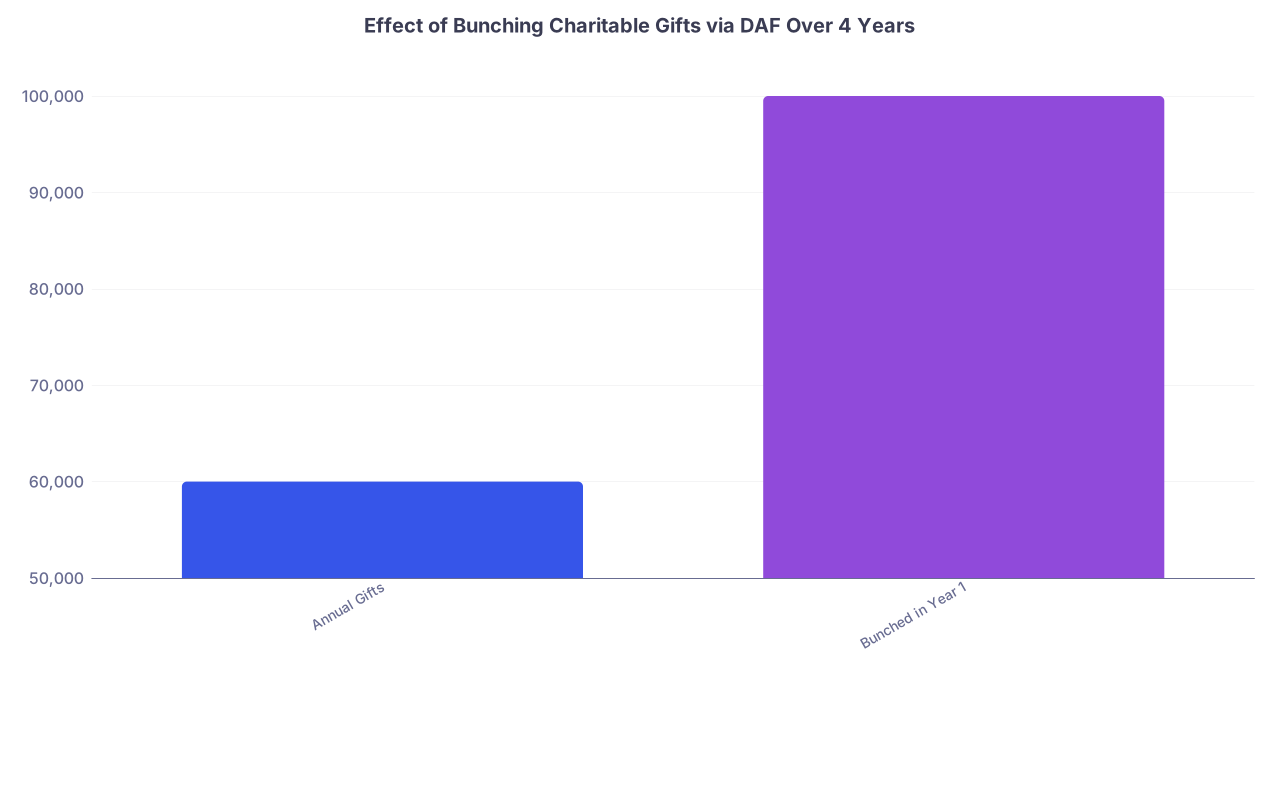
| Category | Value |
|---|---|
| Annual Gifts | 60000 |
| Bunched in Year 1 | 100000 |
Example:
- Married filing jointly.
- Normal pattern: $15K property + state tax (capped at $10K), $25K gifts each year.
- Over 4 years without bunching:
- Charitable = $25K × 4 = $100K
- SALT = $10K × 4 = $40K
- Total potential itemized = $140K
- But standard deduction is ~ $29K (varies by year; assume around that).
- Many years you are only slightly above standard; effective incremental benefit of giving is diluted.
Now suppose in Year 1 (your last big W‑2 year at $600K income), you front‑load:
- Contribute $100K of appreciated funds to a DAF.
- Year 1 itemized = $10K SALT + $100K gifts = $110K. You clearly itemize.
- Years 2–4, you take the standard deduction and give out of the DAF.
You have:
- Locked in a large deduction in your highest-income year.
- Eliminated capital gains on the donated appreciated assets.
- Preserved the ability to give slowly and thoughtfully over the next decade.
Key rule details:
- Deduction limits (current law):
- Appreciated securities to public charities/DAF: up to 30% of adjusted gross income (AGI).
- Cash to public charities: up to 60% of AGI.
Excess can be carried forward up to 5 years.
Practical refinements for physicians:
Use the DAF in your last 3–5 working years
That is when your marginal rate is highest, and your charitable capacity is biggest.Offload concentrated positions
If you have a single stock (ex: old employer stock, inherited shares) that ballooned in value, the DAF is where you send that. You erase the embedded gain and still get full FMV deduction (subject to limits).Align with a practice sale or one‑time income spike
Big buyout year? Lump a major DAF contribution then. I have seen attendings contribute $500K+ in the year of selling a stake in a surgery center. That can blunt the tax hit on the sale.
3. Charitable Giving Inside Your Retirement Accounts: QCDs and RMD Strategy
The IRS gives you one elegant charitable lever once you turn 70½: qualified charitable distributions (QCDs). Most physicians never exploit it fully.
Qualified Charitable Distributions (QCDs)
Mechanics:
- Age requirement: You must be at least 70½ at the time of distribution.
- Source: Traditional IRA (not 401(k); you can roll 401(k) assets to IRA first).
- Limit: Up to $100K per year per individual (indexed under recent law; check the current figure).
- Payment: Must go directly from IRA custodian to a qualifying 501(c)(3) charity.
Not to a DAF, not to a private foundation, not to you then the charity.
Why QCDs are powerful:
- QCDs count toward your required minimum distribution but are excluded from your taxable income.
- That is different from making a normal charitable gift and then taking an itemized deduction. QCDs never enter AGI at all.
For a retired physician, AGI is the landmine. It drives:
- IRMAA surcharges on Medicare Part B and D.
- Taxability of Social Security benefits.
- NIIT exposure on investment income.
- Phaseouts or limitations on other items.
Example:
- You are 73, married filing jointly.
- IRA RMD for the year: $120K.
- You want to donate $20K to your church and a clinic.
Scenario A – no QCD:
- IRA RMD of $120K hits your income.
- You then write $20K in checks, maybe itemize.
- AGI is higher, possibly pushing you into higher IRMAA brackets.
Scenario B – QCD:
- You direct $20K of your RMD as QCDs directly to charities.
- Only $100K of the RMD is taxable.
- AGI is lower by $20K.
- That drop alone can save thousands in Medicare surcharges and downstream taxes, well beyond the simple deduction math.
One trap: your tax software and even some CPAs will report your full 1099‑R and then “note” the QCD. You must ensure it is properly excluded from AGI, not just “deducted.” Those are not the same outcome.
Integrating QCDs with Your Overall Plan
What this looks like for a charitably inclined physician:
- Age 60–70: use DAFs and appreciated assets to ramp gifts while income is high.
- Age 70½+: shift annual giving from cash/checks to QCDs from IRAs.
If you have a very large IRA relative to your goals, you can do both:
- Roth conversions in early retirement years (lower‑income window).
- QCDs starting at 70½ to control RMD‑driven income.
| Strategy | Ideal Age Range | Funding Source | Main Tax Benefit |
|---|---|---|---|
| DAF (with appreciated assets) | 50–70 | Taxable brokerage | Big deduction in high-income years + avoid capital gains |
| Cash gifts (bunched) | Any, usually 50–65 | Cash / salary | Simpler, still bunch to exceed standard deduction |
| QCDs | 70½+ | Traditional IRA | Lowers AGI and satisfies RMD tax-efficiently |
Notice what is not on that table: charitable giving from Roth accounts. Do not do that. Roth dollars are your most valuable, flexible, tax‑free lifetime fuel. Use pre‑tax or taxable dollars for charity whenever possible.
4. Using Charitable Trusts in a Physician Retirement Plan
Now we step into the deeper end. For some physicians — especially those with large taxable portfolios, low basis real estate, or a practice sale — charitable trusts are the next layer.
These are tools, not trophies. You use them when the math and your actual charitable intent both justify the complexity.
Charitable Remainder Trusts (CRTs)
A charitable remainder trust is essentially:
- You put appreciated assets into the CRT.
- The CRT can sell those assets without immediate capital gains tax.
- You (and/or spouse) get an income stream from the trust for life or a fixed term.
- At the end, whatever is left goes to charity.
This can be ideal for a physician who is:
- Within 5–10 years of retirement.
- Holding a big low‑basis asset (e.g., $2M brokerage with $500K basis, or surgery center equity, or highly appreciated stock).
- Wanting income for life plus a charitable legacy.
Example structure:
- You donate $1M of low‑basis stock to a CRT.
- You retain a 5% payout for joint lives (you and spouse).
- You receive an immediate partial charitable deduction (based on actuarial tables and assumed rates).
- The CRT sells the stock, pays no immediate capital gain tax.
- Each year you get 5% of the trust value, taxed depending on the CRT’s income composition.
This is not a step for someone who wants all their capital back eventually. The charity is getting the remainder. That is the point.
When I like CRTs for physicians:
- High‑income now, expect to slow down soon.
- They want a smoother income stream and are comfortable baking in a significant charitable bequest.
- They have more concentrated asset risk than they should. The CRT is both a diversification tool and a charitable vehicle.
When I do not like them:
- The physician really just wants tax reduction and is ambivalent about actual charitable benefit.
- They still have significant unfunded retirement needs; they cannot afford to tie up capital.
- They hate complexity or will not maintain relationships with competent estate counsel and CPAs.
Charitable Lead Trusts (CLTs)
Flip side of CRTs.
- Charity gets income first for a defined term.
- At the end of the term, the remaining assets go back to your heirs or designated non‑charitable beneficiaries.
Why would a physician use this?
- They have “excess” capital for their own retirement.
- They care about supporting charities robustly during their lifetime.
- They are looking at estate tax issues (federal or state) and want to shift growth to children with a potential discount.
A CLT can be structured so that:
- You transfer assets to the CLT.
- The CLT pays, say, 5% annually to charity for 20 years.
- Whatever remains at the end passes to heirs. If the assets outperform the IRS assumed rate, that growth can escape some estate/gift taxation.
This is more of an ultra‑high‑net‑worth move. If your net worth is $4–8M and you will never approach estate tax thresholds (including state‑level), a CLT is usually overkill.
Physician reality: 90%+ of attendings never need a CLT. A small slice with $10M+ net worth, practice sale windfalls, or large real estate portfolios might.
5. Private Foundations vs DAFs for Physicians
A lot of doctors get seduced by the idea of “starting a family foundation.” It sounds impressive. It is also frequently a distraction.
Comparison at a glance:
| Feature | Private Foundation | Donor-Advised Fund |
|---|---|---|
| Setup cost | High (legal, filings) | Minimal |
| Ongoing admin | Significant (990‑PF, governance) | Very low |
| Minimum payout rules | Yes (5% assets per year) | No (practical norms vary) |
| Deduction limits | Lower (e.g., 20%/30% AGI) | Higher (30%/60% AGI) |
| Control & family involvement | Maximum | High but less formal |
| Suitable starting size | Usually $5M+ | Any size, very flexible |
For 99% of physicians, a DAF is strictly better:
- Cheaper and quicker to establish.
- Higher deduction limits.
- No need to file foundation tax returns or manage board meetings.
- Still allows family involvement: you can name children as successor advisors, hold annual “grantmaking meetings,” etc.
When a private foundation might make sense:
- You have $10M+ you honestly want to deploy charitably over time.
- You want to hire staff, run your own programs, or do direct overseas work.
- You care about making below‑market‑rate program‑related investments that a DAF might not support.
But as a retirement planning tool for most physicians? Overrated. If you like the idea of legacy and family engagement, start with a DAF and treat it like a mini‑foundation without the legal headache.
6. Charitable Giving Around Practice Sales, Buyouts, and Deferred Comp
A lot of missed opportunity happens in the year of a liquidity event:
- Group practice buy‑in/buyout.
- Sale of a surgery center stake.
- Deferred comp payouts.
- Real estate sale tied to the practice building.
The IRS does not care that “this is a one‑time spike.” It taxes the spike at your top marginal rate.
You should be aligning your biggest charitable moves with those spikes.
Tactics that work:
Pre‑transaction DAF funding with appreciated securities
If you know you are selling a $3M stake with large gains, you often also have marketable securities with gains. Fund a big DAF that same year to offset part of the income. The exact sizing depends on your AGI and deduction limits.Charitable planning with the asset itself
In some cases (business interests, real estate), you can donate a partial interest to a DAF or charity before sale, then have that slice sell inside the tax‑advantaged entity. This is delicate — get an attorney and CPA who know charitable structuring. Do not show up to the buyer 48 hours before closing with this bright idea.Coordinate with retirement plan contributions
If the practice has a defined benefit/cash balance plan and profit sharing, you can sometimes layer a high employer plan contribution with a large charitable donation in the same year to aggressively compress taxable income. Again, the theme: big deductions in big‑income years.
7. Timing: Sequencing Charitable Tools Over a Physician’s Lifecycle
Here is how a coherent charitable plan might look across your career if you are reasonably high‑earning and charitably inclined.
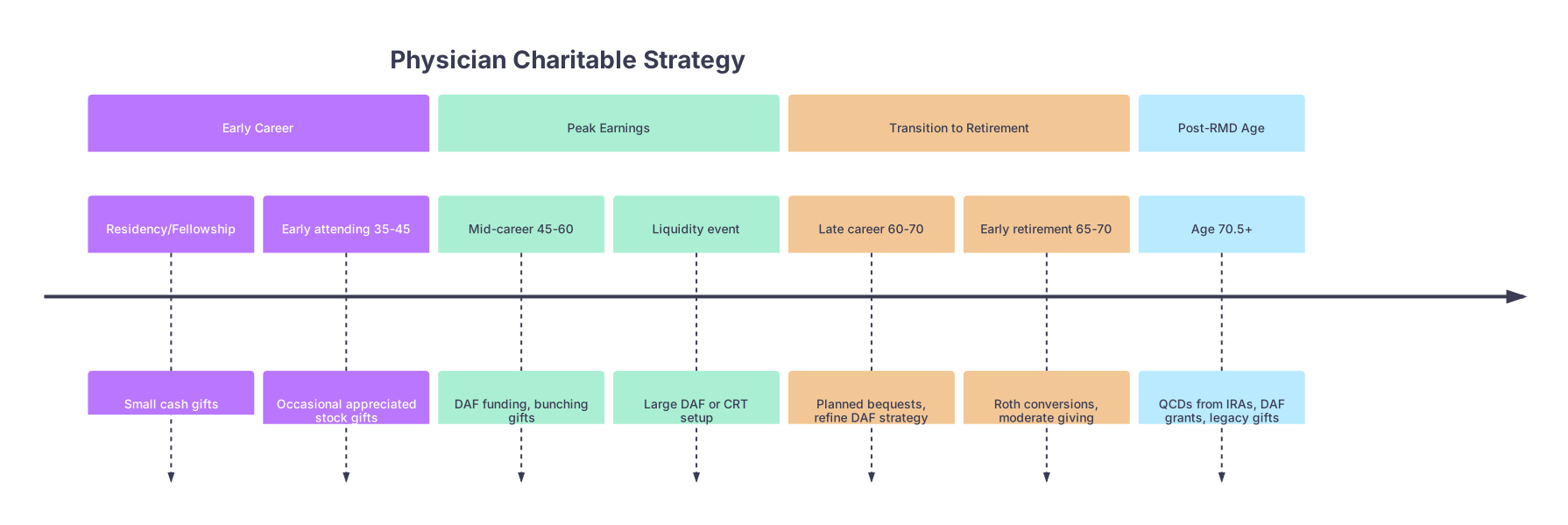
| Period | Event |
|---|---|
| Early Career - Residency/Fellowship | Small cash gifts |
| Early Career - Early attending 35-45 | Occasional appreciated stock gifts |
| Peak Earnings - Mid-career 45-60 | DAF funding, bunching gifts |
| Peak Earnings - Liquidity event | Large DAF or CRT setup |
| Transition to Retirement - Late career 60-70 | Planned bequests, refine DAF strategy |
| Transition to Retirement - Early retirement 65-70 | Roth conversions, moderate giving |
| Post-RMD Age - Age 70.5+ | QCDs from IRAs, DAF grants, legacy gifts |
Early attending (30s–40s):
- Cash flow is tight with loans, young family, maybe buy‑in obligations.
- Stick mostly to simple cash gifts and an occasional appreciated stock donation once your taxable account has real gains.
- Focus on building net worth and funding pre‑tax plans.
Peak earnings (mid‑40s to late‑50s/early‑60s):
- This is DAF and bunching territory.
- Fund DAFs with appreciated assets during your highest income years.
- If a practice sale is on the horizon, coordinate charitable moves around the transaction year.
Transition to retirement (60–70):
- Clarify actual retirement spending needs.
- Stop winging charitable amounts. Decide on a target annual giving range relative to your safe withdrawal plan.
- Use the final working years and early retirement period (before Social Security and RMDs kick in) to:
- Complete any large DAF contributions you want.
- Do Roth conversions in lower‑tax years — but weigh those against remaining charitable deduction carryforwards.
Post‑70½:
- Switch annual “routine” giving to QCDs from IRAs, at least up to the amount that fits your charitable budget.
- Use DAFs for episodic or large legacy‑style grants.
- Think through end‑of‑life bequests: direct IRA beneficiary designations to charities can be far more tax‑efficient than leaving Roth or brokerage assets.
8. Practical Implementation Details Physicians Constantly Trip Over
The conceptual stuff is not hard. The execution is where things go off the rails.
A few specific pitfalls I have seen repeatedly:
Writing checks instead of using appreciated securities or QCDs
If you are retired or close, you almost never should give large amounts from cash if you have appreciated taxable assets or large IRAs.Blowing deduction limits
High earners love to announce “We’ll just donate $400K this year” without running the AGI limit math. Then they are confused when half the deduction is trapped and may not be fully used within the 5‑year carryforward window.Setting up a DAF and then not using it
Yes, there is no legal requirement to distribute, but letting a DAF sit unused for a decade while you die with a large tax‑deferred retirement account is just bad planning.Mixing QCDs and itemized gifts sloppily
In older age, decide which part of your giving is going to be QCD‑based and which part (if any) will be through itemized deductions. Then track it. Do not guess at tax time.Over‑complicating for ego reasons
Starting a private foundation with $500K because “it sounds more serious” is mostly an ego play. The admin burn is not worth it. Same with CRTs for someone whose true charitable intent is marginal.Not aligning spouses
I have watched couples where one partner is charitably intense, the other is anxious about outliving assets. You need a shared, numbers‑based plan: “We will commit to X% of our annual retirement budget for giving, plus Y for legacy in the estate plan.”
9. Concrete Example: A Pre‑Retirement Physician Couple
Let me give you a composite case that reflects what this planning actually looks like.
- Two‑physician couple, mid‑50s.
- Combined W‑2 income: $800K.
- Net worth: $6M (2.5M tax‑deferred retirement, 1.5M Roth, 1.5M taxable, 0.5M home equity).
- Charitable inclination: currently donate about $20K/yr, would like to do more.
- Retirement target: age 60.
Plan:
Ages 55–60 (last working years):
- Increase annual giving goal to ~$40K/yr equivalent.
- In two of those years (say ages 57 and 59), they each donate $200K of appreciated mutual funds into a DAF ($400K each time, total $800K).
- They continue to grant out $40K–$60K per year from the DAF.
- Itemized deductions jump in those bunching years; they take the standard deduction in off years.
Age 60–70 (early retirement):
- No earned income; they fund spending from a mix of taxable and small Roth draws, keeping AGI in a moderate bracket.
- They continue to grant $40K–$60K per year from the DAF; no new big contributions.
- They do strategic Roth conversions annually up to the top of, say, the 22–24% bracket, eating into their pre‑tax balances before RMDs start.
- They hold a legacy intent: whatever is left in the DAF at second death will go to a curated list of charities.
Age 70½+:
- They start QCDs from their remaining IRAs, targeting at least the first $40K–$50K of annual charitable giving via QCDs.
- If their DAF still has a large balance, they use that for any larger, one‑off projects (naming gift to a residency program, endowed scholarship, etc.).
- They name several charities as contingent beneficiaries on part of their IRAs, so a slice goes to charity at death instead of kids.
This couple has:
- Reduced lifetime taxes significantly by timing big DAF contributions into peak-earnings years.
- Controlled RMDs by combining Roth conversions and QCDs.
- Preserved flexibility: if markets perform poorly, they can slow DAF grantmaking or reduce QCD amounts.
Notice what I did not include: private foundation, charitable trust. They do not need them. For $6–8M net worth with strong charitable intent, DAF + QCD + good sequencing is usually more than enough.
10. How to Actually Get Started Without Drowning in Complexity
If you are thinking, “Fine, but I have a clinic day tomorrow and no patience for 60‑page trust documents,” here is the minimal starting structure:
Decide on a realistic, numbers‑based charitable budget
For working years: some percentage of gross or net income.
For retirement: a percentage of your safe withdrawal target (for many, 5–10% of annual spending).Open a DAF at a competent sponsor
Fidelity Charitable, Schwab Charitable, Vanguard Charitable, or a reputable community foundation.
Start with a funded amount that meaningfully bunches a year or two of giving.Move appreciated assets first, cash last
Log in to your brokerage, identify your lowest‑basis positions, and use those to fund the DAF. Keep the higher‑basis or recently purchased assets.At age 70½, transition your mindset to “QCD first”
Sit down with your advisor or custodian and put QCD instructions on autopilot as much as possible for recurring donations.Only consider trusts or foundations if your net worth and true charitable intent justify it
Rough guide:- CRTs and CLTs start to make sense when you are at least high‑single‑digit millions and have specific appreciated assets causing capital gains headaches.
- Private foundations start to make sense when you are willing to seed them with several million dollars and treat them like an ongoing enterprise.
Key Takeaways
For most physicians, the core advanced charitable tools are simple: DAFs funded with appreciated assets during peak earning years, plus QCDs from IRAs after 70½. Used properly, those two can do 80–90% of the job.
Timing matters more than novelty. Align big gifts with big‑income years, and align RMD‑age giving with QCDs to control AGI, IRMAA, and overall retirement‑phase taxes.
Trusts and private foundations can be powerful, but they are niche tools. Use them when they solve a specific, clearly defined problem — not just because they sound sophisticated.