
27% of physician partners over age 60 have no formal, written buy-out formula in their practice documents. They are “planning” to retire. Eventually. Somehow.
Let me be blunt: that is malpractice on your own balance sheet.
If you own part of a medical practice—or you want to—your buy-in and buy-out structure will quietly determine hundreds of thousands (often millions) of dollars of lifetime wealth. And it is usually negotiated sloppily, based on vague “fairness” and whatever the senior partner before you did in 1998.
Let’s fix that.
1. The Core Problem: Practices Are Not Just “Worth What Someone Will Pay”
Most physicians talk about buy-in and buy-out like this:
“We’ll get a valuation and split it.”
Sounds reasonable. It is not enough.
There are at least four separate questions you must not muddle together:
- What exactly is being bought or sold?
- How is it valued?
- Over what time period and terms is it paid?
- Who bears which risks (collections risk, payer changes, partner leaving, early death, disability)?
Miss any of those, and you will have resentment, litigation, or both.
Start by dividing the practice into components. The economics are different for each.
| Component | Typical Treatment in Buy-In/Buy-Out |
|---|---|
| Tangible assets | Appraised or book value |
| Accounts receivable | Often excluded or separately valued |
| Real estate | Separate LLC, FMV rent/valuation |
| Goodwill | Usually the biggest point of conflict |
| Ancillary ventures | Separate agreements / equity |
I have seen practices where the only thing “sold” at buy-in was furniture and equipment at book value. No goodwill, no AR. I have also seen practices where goodwill alone was valued at 3x last year’s collections. One of those groups still exists. Not the second.
2. What Exactly Is the Physician Buying In To?
You cannot price what you have not defined.
Common ownership buckets
Most physician-owned groups end up with three layers, whether they call them that or not:
- Clinical practice entity (PC, PLLC, S-corp)
- Real estate entity (LLC that owns the building)
- Ancillary / side entities (ASC, imaging center, PT, lab, MSO)
Each of these should have its own buy-in and buy-out structure. If your documents lump everything into “partnership interest,” you are setting up fights.
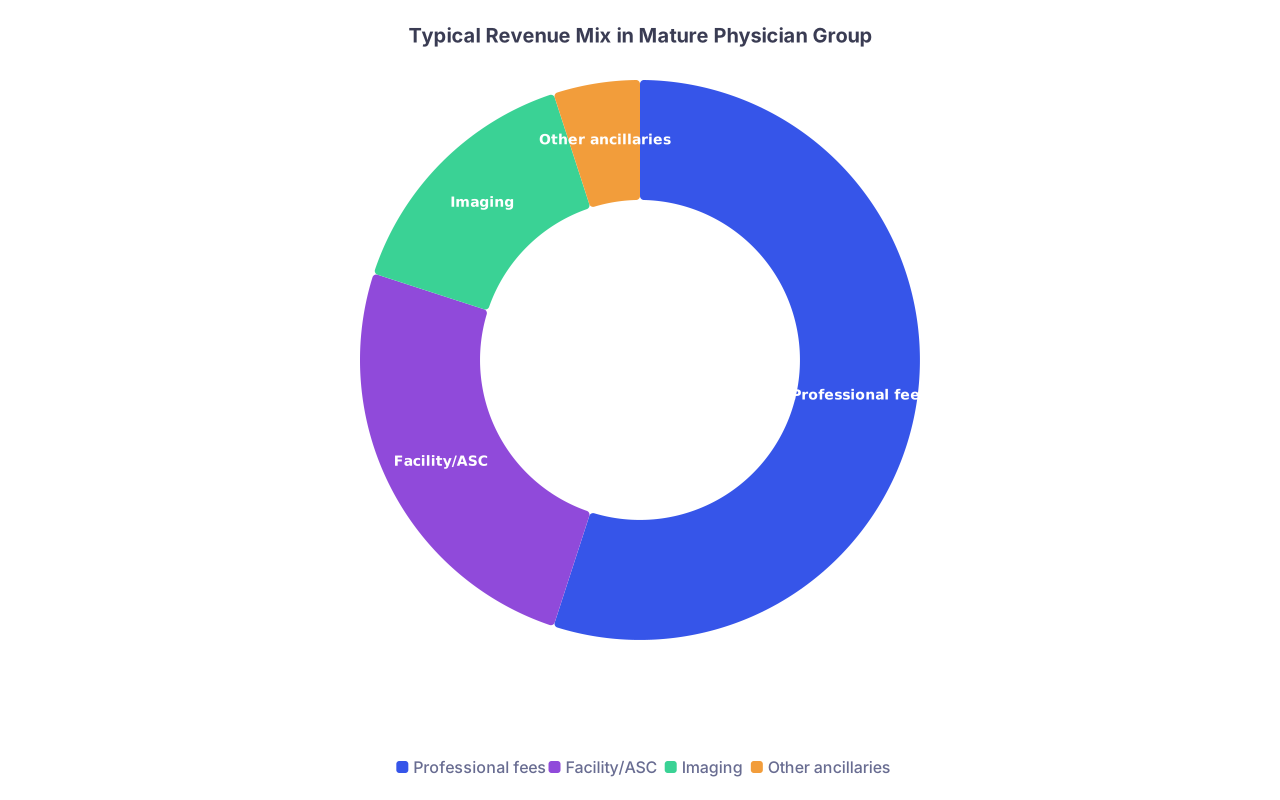
| Category | Value |
|---|---|
| Professional fees | 55 |
| Facility/ASC | 25 |
| Imaging | 15 |
| Other ancillaries | 5 |
That mix matters. A neurologist-heavy group with no ancillaries behaves very differently from a large orthopedics group with an ASC and imaging.
Assets vs. income streams
There are two different economic realities:
- Balance-sheet assets: equipment, AR, cash, deposits. You can appraise them.
- Future income streams: goodwill, referral base, brand, contracts, management infrastructure. You can only model them.
You generally want:
- Assets: clear, mechanical valuation rules, with limited room for argument.
- Income streams: conservative, formula-based proxies, not “investment banker fairy dust.”
A clean structure often looks like:
- Buy-in to tangible assets and working capital at or near book/appraised value.
- Buy-in to goodwill using a fixed formula (described later).
- Real estate: completely separate, treated like any commercial property with FMV price and FMV rent.
- Ancillaries: separate operating agreements, sometimes with different ownership percentages than the main practice.
3. Valuation Methods: Which One Actually Works for Physicians?
Three broad methods tend to appear in physician practice deals.
1. Book value / adjusted book value
You take assets minus liabilities from the balance sheet, maybe adjust equipment to fair market value (FMV), maybe discount old accounts receivable.
Upside:
Simple, objective, low legal risk.
Downside:
Captures almost none of the real economic value in a stable, high-margin group. Senior partners hate this as the sole method.
Works best as:
Baseline for tangible assets, not total practice value.
2. Earnings multiple / EBITDA multiple
You normalize earnings (partner compensation to market, adjust for non-recurring items), compute EBITDA, and apply a multiple—usually 3–7x depending on specialty, payer mix, region, and how hospital/PE-crazy your market is.
This is what private equity and hospitals use when they buy entire practices.
Upside:
Reflects going concern value. Matches external market offers.
Downside:
Too rich and too volatile for internal partner buy-in / buy-out unless you are trying to mimic a sale to a third party. Multiples spike and crash with PE cycles and consolidation waves.
If you peg internal buy-outs to “third-party value,” you may create a huge unfunded liability when the market is hot, or lock in absurdly low payouts if the multiple compresses.
I rarely recommend pure EBITDA multiple methods for internal partner transitions.
3. Revenue or compensation-based formula
This is where most sophisticated physician-owned practices end up:
- Goodwill value = X% of average collections or partner compensation over last Y years.
Why this works:
- Collections and comp already “bake in” margins, payer mix, and surgeon vs. cognitive dynamics.
- You smooth out good years and bad with multi-year averages.
- Easier for physicians to understand. “Two years of my average comp” sounds more intuitive than “5.5x normalized EBITDA after rent adjustments.”
Common ranges:
- Many multi-specialty and cognitive fields: 50–100% of one year’s collections as goodwill.
- Surgical subspecialties with strong ancillaries: 1.0–2.0x average partner compensation.
- Primary care groups with tight margins: sometimes zero goodwill, or 25–50% of one year’s comp.
Let me be crystal clear: you need numbers in your documents. Not “we will hire a valuator at the time.” That is how people end up paying $60,000 for a $300,000 interest because the appraiser assumed every physician would be replaced at $300k salary.
4. Structuring Buy-In: Mechanics That Do Not Blow Up the Group
New partners almost never write a seven-figure check. Nor should they. You have to design this so:
- The group remains solvent.
- Senior physicians are reasonably compensated for what they built.
- Younger physicians are not crushed by personal debt on top of student loans.
- Everyone understands the path from employee to full partner.
Typical stages: employee → shareholder → senior shareholder
Most groups now use a staged model:
- Employee associate (W-2 or K-1 service-only)
- Junior partner / shareholder (small equity, smaller buy-in)
- Full partner (full economics)
- Senior partner (modified compensation / call / buy-out phase)
The mistake is not defining the transitions in writing. I have sat in “informal” partnership meetings where a junior doc thought they were becoming a full partner; the seniors thought it was “another year or two, we will see.” That is how turnover happens.
Buy-in components
Let us break down a typical internal buy-in:
- Tangible assets and working capital
- Goodwill / intangible practice value
- Real estate entity (optional)
- Ancillary entities
Each can have separate pricing and payment terms.
Example structure
A mature cardiology group:
- 8 partners, 2 junior associates on track for partnership.
- Tangible assets + working capital allocated value per share: $150,000.
- Goodwill formula: 80% of one year of average partner comp, which is $700,000 → goodwill = $560,000 per full share.
- Total full buy-in per new partner = $710,000.
How they might structure payment:
- Down payment: $50,000 cash at admission.
- Remainder: $660,000 paid over 7 years via reductions in partner distributions.
- Imputed interest: 4–6%.
- Payments are fully funded from pre-tax earnings (critical tax nuance) because the income is allocated to the new partner who then uses distributions to service the obligation.
This keeps out-of-pocket cash low while still making it real money.
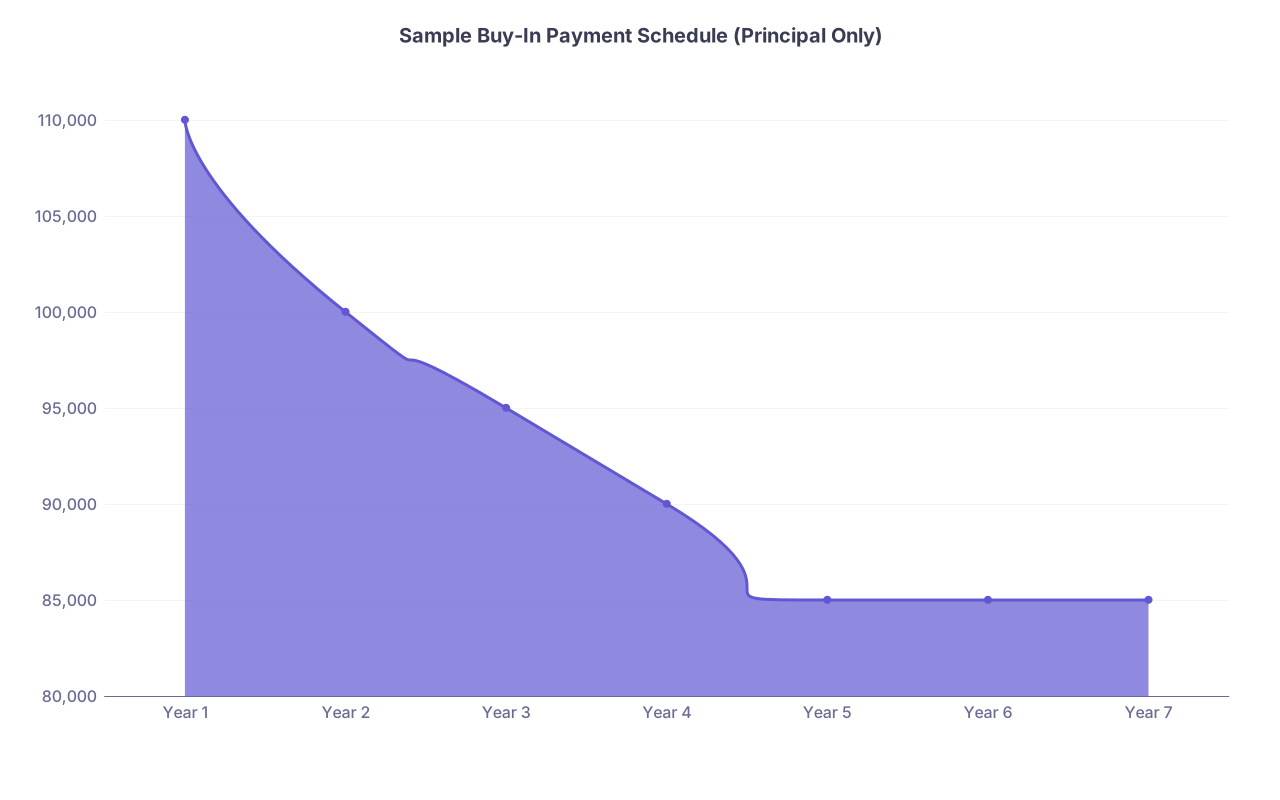
| Category | Value |
|---|---|
| Year 1 | 110000 |
| Year 2 | 100000 |
| Year 3 | 95000 |
| Year 4 | 90000 |
| Year 5 | 85000 |
| Year 6 | 85000 |
| Year 7 | 85000 |
The key: documents should specify not just “7-year promissory note” but:
- Whether payments adjust with changes in overall partner distributions.
- What happens if the new partner leaves early.
- Whether the note accelerates on termination, and if so, under what circumstances.
I strongly favor formulas where payments scale as a proportion of that partner’s income, not fixed dollar amounts. You align risk: if collections drop 30% across the group, the buy-in payments automatically ease.
5. Structuring Buy-Out: Retirement, Disability, and Death
Buy-out is more dangerous than buy-in. Because:
- It usually involves larger dollar amounts per person.
- It hits the group when a high producer leaves.
- Emotions are hotter. Retirement, illness, death—all high-stress events.
A buy-out formula that was “fine” when partners were in their 40s becomes unacceptable when three partners hit 65 within three years.
Basic building blocks of a buy-out
You are balancing two interests:
The retiring physician wants:
Liquidity, predictability, reward for building the practice, and some recognition of loyalty/tenure.The remaining physicians want:
Affordability, sustainability when multiple people exit, and no giant balloon obligations that strangle growth.
Common components:
- Return of capital (tangible assets / capital accounts)
- Goodwill or “retirement benefit”
- AR / WIP (if your group shares those)
- Tail insurance, restrictive covenants, transition assistance
Return of capital
This is the least controversial. If you put capital into the practice, you should get it back when you leave, subject to adjustments for losses.
Typically:
- Paid within 6–24 months of departure.
- 0–4% interest on unpaid balances.
- Structured regardless of age or reason for departure, unless fired for cause.
Goodwill / retirement benefit
Here is where groups either get it right or completely wrong.
Three main models:
No goodwill. Pure capital account return.
Cleaner, easier—but senior partners get no explicit retirement value. This often leads to unsanctioned “pre-retirement” behavior (hoarding RVUs, pushing for outsized comp in the last few years).Fixed goodwill formula.
For example: “Retiring partners receive 1.0x average partner compensation over the last 3 years, paid out over 5 years.”Tenure-weighted or age-adjusted goodwill.
For example:- 0–5 years as partner: no goodwill.
- 6–10 years: 0.5x average comp.
- 11–20 years: 1.0x average comp.
20 years: 1.5x average comp, capped at $X.
That last structure makes sense in most physician-owned groups. You reward those who built the practice, but you do not bankrupt the group when three founders retire.

Timing and caps: protecting the group from mass retirements
You better assume that:
- People cluster their retirements around similar ages.
- Payer changes and compensation risks do not politely wait until buy-outs are finished.
You need:
Annual cap on total buy-out payments as a percentage of group collections.
Example: “Total buy-out and retirement benefit payments in any year shall not exceed 7% of prior year net collections. If total obligations would exceed this, payments will be pro-rated and extended.”Clear definition of “retirement” vs. “resignation to work across the street.”
Common:- Retirement = age 60+ plus no clinical practice within X miles for Y years.
- Early departure / competition = capital account only, no goodwill.
Option to delay part of the buy-out if cash flow triggers are hit.
I have seen groups tie this to specific metrics: “If partner compensation per FTE falls below $400,000, the practice may extend goodwill payments by an additional 2 years.”
Disability and death scenarios
You will never have universal agreement here, so you aim for “acceptable to most.”
Typical middle-of-the-road structure:
Death:
- Immediate capital account payout (or over 1–2 years) to estate.
- Goodwill/retirement portion paid under same formula but possibly accelerated partially (for estate liquidity).
- Practice covers tail insurance or has insurance-funded mechanism.
Permanent disability:
- If at partner for >X years, treated like “early retirement” with partial goodwill.
- If new partner (<5 years), capital only.
- Optional disability buy-out insurance to fund part of this.
Where groups get burned:
- No buy-out written for disability, partner stops working, wants full retirement package at 48.
- Or worse, the practice terminates them “for cause” because of impairment, and the partner sues for full buy-out.
Spell out definitions of disability, who makes that determination (independent physician panel, insurance company ruling, etc.), and the associated economic consequences.
6. Aligning Buy-In and Buy-Out So The Math Actually Works
People often design buy-in and buy-out formulas in isolation. That is how you end up with a structure where:
- New partners pay in $300,000 over 7 years.
- Seniors receive $1.2 million at retirement.
- Math. Does. Not. Close.
Rule: your system must be cyclable and self-consistent over multiple generations of partners.
The internal “pension” vs. equity argument
A lot of physician groups, if you strip away the jargon, are running an internal pension:
- Younger doctors pay more (via lower income during buy-in years).
- Older doctors collect more (via buy-out/retirement benefits).
- The “pension fund” is the ongoing profitability of the practice.
That can be fine—if everyone understands it and the implied return is reasonable.
If, however, you are layering an implicit pension (overcompensated senior partners in their last years) on top of a rich goodwill buy-out, you are double-paying.
Cleanest alignment model:
- Compensation formula that accurately tracks current-year work RVUs, call, and nonclinical contributions.
- Separate, explicit retirement benefit defined in the docs, funded over time by a predictable skim from partner income (e.g., 3–5% of partner comp retained annually to build reserves).
- Buy-in that is meaningfully smaller than buy-out goodwill (because part of the buy-out is a “service/performance” reward, not pure equity return).

| Step | Description |
|---|---|
| Step 1 | New Partner Joins |
| Step 2 | Buys In Over 5-7 Years |
| Step 3 | Becomes Full Partner |
| Step 4 | Accrues Retirement Benefit |
| Step 5 | Retirement Trigger |
| Step 6 | Buy-Out Paid Over 5-10 Years |
| Step 7 | Next Generation Partners |
Stress test with scenarios
If you are serious about this, you run numbers on:
- One partner retiring every 2–3 years.
- Three partners retiring in the same 18-month window.
- A 20% drop in collections after a major payer cut.
- A failed recruitment year where you cannot replace a departing high producer.
You plug those into your model: collections, expenses, partner comp, buy-out obligations, bank covenants. Then you adjust:
- Lengthen payment periods from 5 to 8–10 years.
- Introduce caps and deferral triggers.
- Trim goodwill multiples.
If your attorney or consultant cannot show you this in a spreadsheet, you are paying the wrong people.
7. Real Estate and Ancillaries: Keep Them Out of the Main Fight
The building and the ASC often cause more tension than the practice itself.
Real estate
Golden rule: Real estate and practice ownership should be structurally separate.
Use a property LLC, with:
- FMV rent (documented every 3–5 years).
- Separate capital accounts.
- Clear buy-in and buy-out that mirror any other commercial property joint venture.
Common pitfalls:
- Older partners own 100% of the building, younger partners only own the practice. Over time this becomes economic slavery—seniors “retire” from practice but keep jacking up rent as their income stream.
- No buy-in path for younger physicians to become building owners, which undermines long-term retention.
Clean solution:
- Offer building equity on a separate track 3–5 years after practice partnership.
- Define pricing: usually appraised FMV, but consider internal discounts for younger partners in exchange for longer-term leases.
Ancillary ventures (ASC, imaging, PT)
These usually have different ownership percentages than the main practice for regulatory reasons and capital needs.
You need:
- Separate operating agreements.
- Stark/AKS-compliant ownership and distribution structures.
- Distinct buy-in and buy-out rules, often pegged more directly to EBITDA multiples or appraised FMV, because these behave more like standalone businesses.
Do not hide ASC value inside the main practice buy-out unless you want your documents to be a mess.
8. Governance, Documentation, and Avoiding Stupid Fights
All of this is worthless if it lives in a Word document everyone signed 12 years ago and nobody has read since.
You want three layers:
Organizational docs:
- Operating agreement, shareholder agreement, bylaws.
- These define ownership, admission and withdrawal of members, voting thresholds.
Compensation and distribution policy:
- How the money flows each year.
- Updated more often, but anchored to rules in the main agreements.
Transition policy / partnership track memo:
- A plain-English document new hires receive that explains:
- Timeline to partnership
- Expected buy-in range and payment structure
- Retirement / buy-out basics
- A plain-English document new hires receive that explains:
The most dangerous phrase I hear from senior partners: “We don’t put that in writing; it is understood.” Translation: it is not understood at all.

You revise buy-in/buy-out provisions periodically, but not casually. Reasonable cadence:
- Major structural review every 7–10 years or when the group grows by >50% or adds major ancillaries.
- Minor parameter adjustments (multiples, caps, payment periods) every 3–5 years based on updated financial modeling.
FAQ (Exactly 5 Questions)
1. How much should a new partner reasonably expect to pay to buy into a mature physician practice?
For most stable, well-run groups, total buy-in for the main practice (excluding real estate and big ancillaries) falls in the range of 0.5–1.5 times average partner compensation, paid over 5–10 years. If you are being asked for a buy-in equal to 3+ years of comp, especially as a lump sum, there had better be extraordinary ancillaries or a clear path to dramatically higher income. Otherwise, the risk-return trade-off is poor.
2. Should accounts receivable be part of buy-in and buy-out calculations?
AR is often more trouble than it is worth in partner transitions. Many practices simply pay out AR over 6–12 months after a partner leaves and require incoming partners to “earn into” AR through their own production, not to buy it. If you include AR in valuations, use conservative collection assumptions and clear cut-off dates to avoid arguments about old, uncollectible claims.
3. Is it fair for retiring partners to get more out than they put in as buy-in?
Yes, within reason. Internal buy-in/buy-out systems are not pure equity trades; they are partial compensation for building infrastructure, reputation, and referral patterns that new partners step into on day one. But when buy-out is several times larger than buy-in, and senior partners also pulled elevated compensation for years, you have shifted from “fair reward” to an unsustainable pension paid by the next generation.
4. How do hospital or private equity acquisition offers affect internal buy-out structures?
If your internal documents promise rich goodwill buy-outs but an external buyer values the practice at or near hard assets only, someone is going to be disappointed. Groups should explicitly state how a sale to a third party interacts with internal buy-out promises: whether internal goodwill obligations are waived, reduced, or funded from sale proceeds in a defined order. Leaving this vague is an invitation to litigation when a PE roll-up shows up with a term sheet.
5. Do we really need a healthcare-specific attorney to draft these agreements?
Yes. Generic corporate counsel regularly miss Stark/Anti-Kickback issues, compensation design pitfalls, and state-specific corporate practice of medicine rules. I have seen beautifully written partnership agreements that were completely unusable because they violated basic healthcare regulations or could not accommodate common physician comp models. You want someone who has actually structured multiple physician practice transitions in your state, not a general business lawyer learning on your file.
Key points, stripped down:
- Define exactly what is being bought and sold—assets, goodwill, real estate, ancillaries—and give each its own rules.
- Use clear, formula-based valuation and payment structures for buy-in and buy-out, then stress test them against real scenarios.
- Align incentives: reasonable buy-in, sustainable buy-out, explicit retirement benefits, all documented in language that future partners can actually understand.