
Most physicians are leaving free, tax-advantaged money on the table by treating HSAs like checking accounts instead of stealth IRAs.
Let me be blunt: if you are a physician and you are not aggressively integrating a Health Savings Account (HSA) into your long-term retirement strategy, you are playing the game on hard mode for no reason.
HSAs are not “just for deductibles.” Used properly, they are one of the most tax-efficient retirement tools you have—often better than your 401(k)/403(b) and Roth, especially given the way health care costs explode in your 60s–80s.
I will walk you through exactly how to integrate HSAs into a physician-specific retirement plan: attending-level income, irregular practice structures, high current tax brackets, and future medical costs. I am assuming you are reasonably financially literate and do not need definitions of “mutual fund” or “index fund.” We will focus on what actually moves the needle.
1. Why HSAs Are Especially Powerful For Physicians
If you remember nothing else, remember this: HSAs are triple tax-advantaged.
- Contributions are pre-tax (or tax-deductible).
- Growth is tax-free.
- Withdrawals are tax-free if used for qualified medical expenses.
That combination is rare. Most retirement accounts give you only two of the three.
Let me put them side by side.
| Account Type | Contribution | Growth | Withdrawal (Qualified Use) |
|---|---|---|---|
| Traditional 401(k)/403(b) | Pre-tax | Tax-deferred | Taxed as ordinary income |
| Roth IRA/401(k) | After-tax | Tax-free | Tax-free |
| Taxable Brokerage | After-tax | Taxed (dividends/cap gains) | Taxed (cap gains) |
| HSA | Pre-tax | Tax-free | Tax-free (for medical) |
For physicians, three features make HSAs particularly potent:
You are in a high marginal tax bracket.
Every pre-tax dollar saved at 35–37% federal plus state is much more valuable than the same maneuver for someone at 12–22%.Your future health expenses will be high.
You are likely to live a long time, use sophisticated care, and you know all the ways the system can bill you. Medicare premiums, Medigap, long-term care—this will add up to six figures easily.You can self-insure small expenses.
You do not need to touch HSA funds to pay a $400 urgent care bill. That is the key behavioral advantage physicians often fail to exploit.
Let me break that last one down, because it is where most people blow the opportunity.
2. The Core Strategy: Treat Your HSA As a “Stealth IRA”
The wrong way physicians use HSAs:
They contribute, let the money sit in cash, then use the HSA debit card to pay every copay and prescription as they go.
That’s not strategy. That’s just convenience.
The right way for long-term retirement planning:
- Enroll in a qualifying High Deductible Health Plan (HDHP).
- Max out HSA contributions every single year.
- Pay current health expenses out of pocket.
- Invest the HSA aggressively (like a long-term retirement account).
- Optional: Keep detailed receipts to reimburse yourself decades later.
- Use HSA tax-free in retirement for the avalanche of medical costs.
Let’s quantify this.
Annual contribution limits (2025 ballpark; check actual year numbers)
| Year | Individual HDHP | Family HDHP | Catch-up (age 55+) |
|---|---|---|---|
| 2023 | $3,850 | $7,750 | $1,000 |
| 2024 | $4,150 | $8,300 | $1,000 |
| 2025 (est. trend) | ~$4,300 | ~$8,600 | $1,000 |
If a dual-physician couple with a family HDHP maxes out the HSA for 25 years (say ages 35–60), contributes around $8–9k annually, and invests in a 80/20 stock-bond portfolio compounding at 6–7%, you are easily in the $500k+ range by the time Medicare shows up.
That $500k is:
- never taxed going in
- never taxed while growing
- never taxed coming out for medical
You will have no trouble finding qualified medical expenses in retirement to spend that on. Medicare Part B and D premiums, Medigap, dental, vision, hearing aids, copays, procedures, etc.
3. Step 1: Deciding If an HDHP + HSA Fits Your Clinical Reality
Not every physician should be on an HDHP. There are trade-offs.
The question is not “Is HSA good?”
The question is “Does an HDHP with an HSA make sense for my household’s utilization?”
Here is how I think about it clinically and financially.
Who usually should consider HDHP + HSA
- Attending-level income, comfortable cash flow.
- Healthy family (no chronic, expensive meds, no ongoing chemo or biologics).
- Sufficient emergency fund to float a full deductible and out-of-pocket max.
- Access to a good HSA custodian (or willing to transfer).
Who should be very cautious
- Families with a child with special needs, or chronic high-cost conditions.
- You or partner on expensive biologics, dialysis, or frequent hospitalizations.
- Residents or early attendings with thin cash cushions and unstable expenses.
- Pregnancies planned in the near-term where you know you will max out OOP costs.
But even with higher expected use, the math sometimes still favors HDHP + HSA when premiums for traditional PPOs or low-deductible plans are enormous. You have to actually calculate:
Premium savings + HSA tax benefit vs. extra out-of-pocket risk.
If your group offers, say:
- PPO: $800/month premiums, $1,000 deductible
- HDHP: $400/month premiums, $3,000 deductible, HSA-eligible
You save $4,800/year in premiums. You then shovel that, plus extra, into the HSA. For a high-earning physician who can self-insure most surprises, the HDHP often wins long-term.
4. Step 2: Max Out the HSA—Before Many Other Things
I am going to say something that makes some advisors squirm: for many physicians, the HSA contribution belongs right up there with your 401(k)/403(b) on the priority list. Sometimes above the Roth IRA.
My usual priority order for a typical attending (W-2 or 1099 with similar tools):
- 401(k)/403(b)/solo-k up to employer match (if any).
- HSA to the annual max.
- Backdoor Roth IRA (if allowed and clean).
- Fill remaining space in employer plans / defined benefit if applicable.
- Taxable brokerage, real estate, private investments, etc.
Why put the HSA this high?
Because no other account gives you the triple benefit plus the flexibility to use it pre-Medicare for current medical bills or retroactive reimbursements if you really need to.
5. Step 3: Investing the HSA Like a Long-Term Retirement Account
The HSA is not a glorified checking account. Or it should not be.
Most HSA custodians are terrible by default. They:
- keep your first $1,000–$2,000 in a zero-interest cash “core”
- offer a handful of high-fee, actively managed funds
- bury the index funds under layers of menus
You must treat choosing an HSA custodian like choosing a brokerage:
What you want:
- Low-cost, broad index funds (total US, total international, bond index).
- Ability to invest almost all of the balance (not forced into permanent cash).
- Reasonable or no account maintenance fees.
- Easy portability (so you can roll over if your employer plan is subpar).
Common approach I have seen physicians use:
- Keep 1 year’s worth of expected out-of-pocket medical expenses in cash (or none, if you are comfortable self-insuring completely).
- Invest the rest in a stock-heavy allocation, similar to or slightly more aggressive than your 401(k) for your “HSA assets” portion of your portfolio.
For a 40-year-old attending planning to use HSA funds primarily in their 60s-80s, an 80/20 or 70/30 stock-bond split in the HSA is entirely reasonable.
And please, stop letting $20,000+ sit in HSA cash at 0.1% interest while you complain about inflation.
6. Step 4: The “Save Receipts Now, Reimburse Decades Later” Move
Here is a subtle, but extremely powerful, tactic that almost no one outside of serious physician finance circles talks about properly.
IRS rules allow you to:
- Pay qualified medical expenses out of pocket now.
- Keep the receipts.
- Reimburse yourself from the HSA years or decades later, tax-free, as long as:
- The HSA was established before the expense.
- You keep documentation.
- You have not already reimbursed those expenses from the HSA or elsewhere.
That means your HSA can function like:
- A tax-free growth engine now, and
- A flexible “on-demand” tax-free withdrawal source later, even if you do not have new medical bills in that year.
Practical example:
You open an HSA at age 35.
Ages 35–50, you:
- Max out HSA annually.
- Invest the entire balance in a low-cost index fund mix.
- Pay, say, $3,000/year in routine family medical costs out of pocket.
- You keep a PDF folder of receipts, EOBs, and a simple spreadsheet of “HSA-eligible, not yet reimbursed” expenses.
At age 60, your HSA has grown to something like $350,000. Your log of unreimbursed medical expenses totals, say, $45,000 over 15 years.
You can now, at age 60, pull $45,000 tax-free from the HSA to spend on anything you want (down payment on a vacation home, bridge spending to delay Social Security, whatever), because technically you are just reimbursing yourself for past qualified expenses. The growth on those dollars for 10–20+ years was all tax-free.
This is not a loophole; it is exactly how the rules are written. The risk is operational: you must keep excellent records.
7. HSAs After Age 65: Beating IRAs At Their Own Game
The HSA gets a bit of a shape-shift at age 65.
Key changes:
- You can take HSA distributions for non-medical purposes without the 20% penalty.
- You will owe ordinary income tax on those non-medical withdrawals (just like a traditional IRA).
- For medical expenses, distributions remain tax-free as usual.
So, after 65 your HSA behaves like:
- A traditional IRA for non-medical use, and
- A super-Roth-like account for medical use.
Given that your medical expenses in retirement are very likely to be very high, the effective “medical-only Roth” portion is substantial.
Typical HSA use in retirement for physicians:
- Medicare Part B and Part D premiums.
- Medicare Advantage premiums (if you go that route).
- Medigap supplemental premiums.
- Long-term care insurance premiums (subject to age-based limits).
- Dental, vision, hearing aids, glasses.
- Copays, deductibles, and non-covered medically necessary services.
You can easily burn through six figures on just Medicare and Medigap premiums over 20–25 years.
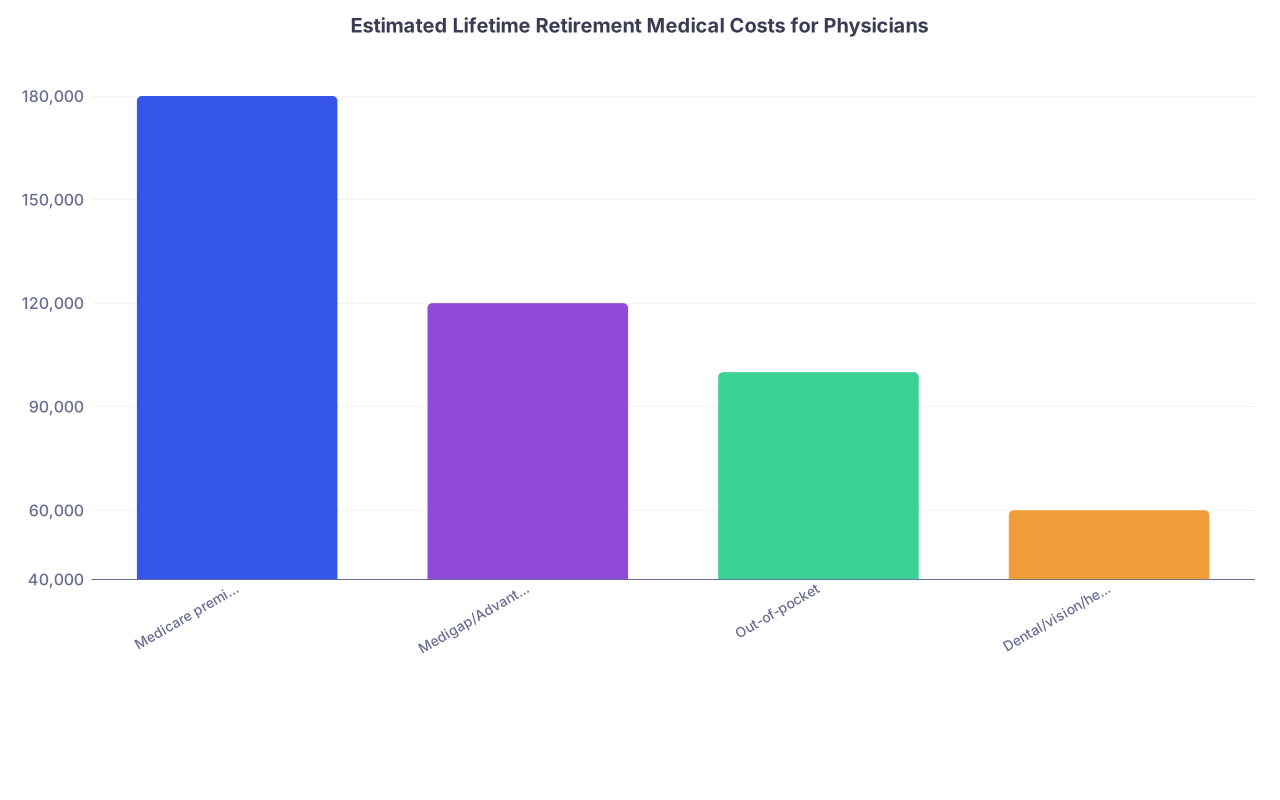
| Category | Value |
|---|---|
| Medicare premiums | 180000 |
| Medigap/Advantage | 120000 |
| Out-of-pocket | 100000 |
| Dental/vision/hearing | 60000 |
Numbers like those make a $300k–$600k HSA balance look very appropriate, not excessive.
8. Integrating HSAs With Other Physician Retirement Accounts
Your HSA is not an island. It has to mesh with:
- 401(k)/403(b)/solo-k
- Cash balance or defined benefit plans
- Backdoor Roth IRAs
- Taxable brokerage and practice ownership equity
- Real estate holdings
Let me give you a reasonable integrated framework for a mid-career physician couple.
Example: 45-year-old dual-physician couple, planning age 60–62 retirement
Profile:
- Both W-2 hospital employed, each with 403(b) and 457(b).
- Family HDHP with HSA.
- Running backdoor Roth IRAs.
- Some taxable index funds and one rental property.
How HSA fits:
- Primary role: Dedicated future medical fund + optional “receipt reimbursement” flexible pool.
- Asset allocation: Treat HSA as part of total portfolio but tilt slightly more aggressive, because its use will likely be later-life expenses.
- Distribution plan:
- Early retirement (60–65): If needed, start reimbursements from prior expenses to manage tax bracket and bridge to Medicare while Roths continue to grow.
- Medicare era (65+): Use HSA first to cover premiums and out-of-pocket costs, preserving Roth space for heirs or very-late-life needs.
The full ordering of withdrawals in retirement might look like:
- Taxable accounts (harvesting capital gains strategically).
- HSA for current medical + prior unreimbursed expenses.
- Traditional 401(k)/403(b)/457(b) to the extent required (RMDs).
- Roth IRA / Roth 403(b) last as the “heir and longevity” account.
You are essentially letting the HSA handle one big budget category (health care) in a highly tax-efficient silo.
9. W-2 vs 1099 Physicians: HSA Tactics Differ
The details shift depending on how you are paid.
W-2 employed physicians
- HDHP and HSA are usually chosen through employer benefits.
- Employer may contribute to your HSA (counted toward the annual limit).
- HSA contributions likely done by payroll deduction, reducing FICA as well (extra win).
In this case:
- Compare all available plan options every year; do not blindly default to PPO.
- If the employer covers a significant part of the HDHP premium and sweetens the pot with HSA contributions, the effective after-tax benefit is often huge.
1099 independent contractors / practice owners
- You choose your own HDHP on the individual or small-group market.
- HSAs are opened directly with chosen custodians.
- Contributions are pre-tax via above-the-line deduction, but you do not get the FICA savings on employer payroll contributions (since you are the employer and employee).
Your levers:
- Shop very carefully for HDHPs—network, out-of-network caps, family vs self-only coverage.
- Pair the HSA with your solo 401(k) and possibly a defined benefit (cash balance) plan. Your tax shelter stack becomes extremely powerful: pre-tax retirement (401k + CBP) + HSA + maybe backdoor Roth.
For high-earning 1099 physicians, I often see:
- $69,000+ into solo-k
- $20–100k into a cash balance plan
- ~$8k into family HSA
- $13k into two backdoor Roth IRAs
Now you are deferring and shielding a massive portion of your income from taxation and using HSA as the stealth, medical-focused retirement bucket.
10. Common Mistakes Physicians Make With HSAs
I have watched attendings with seven-figure incomes make all of these. Repeatedly.
Using the HSA debit card for everything
Lazy. Expensive. You trade a few seconds of convenience for decades of lost tax-free compounding.Letting HSA balances sit in cash for years
The HSA is not an emergency fund. Unless you are within a year of tapping it for a known large expense, invest.Not tracking receipts for unreimbursed expenses
Keeping a simple spreadsheet and PDF folder is not that hard. The payoff later is substantial.Choosing a non-investing HSA custodian and never moving
You can transfer your HSA to a better provider. Do not stay with a custodian that does not let you invest or charges predatory fees.Double-dipping with itemized deductions
If you pay medical expenses out of pocket and then later reimburse them from the HSA, you cannot also itemize those expenses for a medical deduction in the year paid. You have to pick one tax benefit per dollar.Ignoring the HSA in overall asset allocation
The HSA is part of your total portfolio. If you pile it 100% into equities but also run 100% equities in all other accounts, you may be more aggressive than you think.
11. Practical Implementation: What You Actually Do This Year
Let me simplify this into an actionable checklist you can execute over the next 12 months.
Evaluate your current health plan.
- Are you already on an HDHP? If not, when is open enrollment?
- Compare HDHP vs PPO total cost (premiums + expected out-of-pocket) and factor in HSA tax benefits.
If HDHP makes sense, commit to maxing the HSA.
- For a family plan: plan for ~$8–9k annual contribution.
- Set your payroll contributions or personal transfers accordingly.
Choose or improve your HSA custodian.
- If the employer-linked HSA is bad, consider periodic trustee-to-trustee transfers to a better one while still using the payroll link for FICA savings.
Set an investment policy for the HSA.
- Decide your cash buffer (0–12 months medical spend).
- Invest the rest in a low-cost, diversified portfolio.
Start (or refine) your receipt tracking system.
- Create a “HSA Receipts” folder (cloud-based).
- Keep a simple spreadsheet with date, provider, amount, description, and “reimbursed? Y/N”.
Coordinate with your broader retirement plan.
- Review your 401(k)/403(b)/457 allocations.
- Adjust other accounts if you decide to be aggressive in the HSA.
Decide your timing strategy.
- Are you planning to use HSA only in retirement (pure stealth IRA)?
- Or will you use it opportunistically earlier (e.g., to manage tax brackets in early retirement)?
You do not need a 40-page financial plan to do this. You need a few conscious choices and the discipline to keep your hands off the HSA for short-term spending.
12. Visualizing HSA Integration Over a Physician Career
Here is how HSA use typically evolves over a physician’s career if done intelligently:
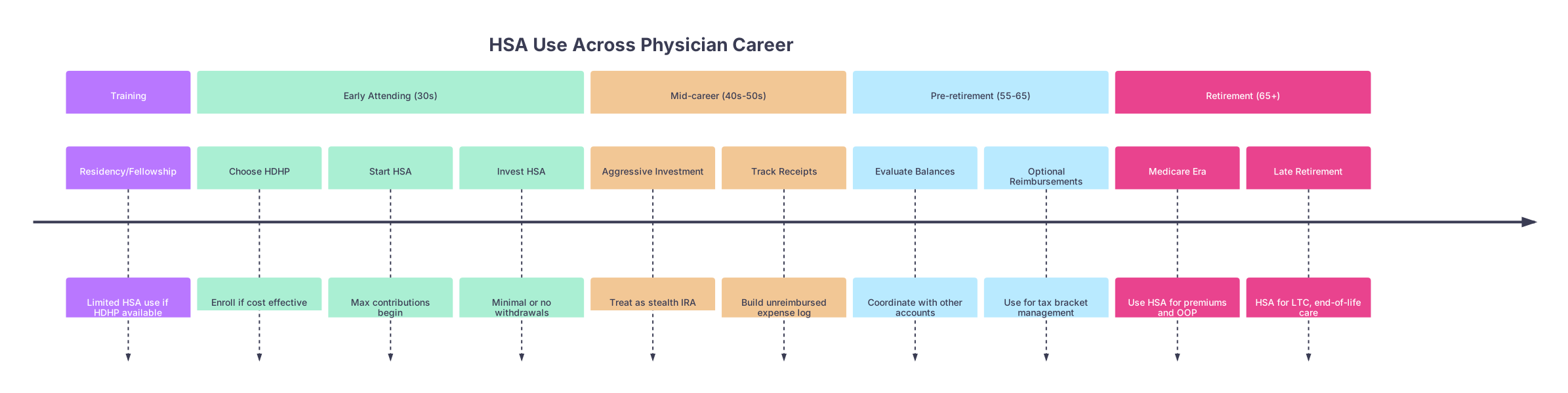
| Period | Event |
|---|---|
| Training - Residency/Fellowship | Limited HSA use if HDHP available |
| Early Attending (30s) - Choose HDHP | Enroll if cost effective |
| Early Attending (30s) - Start HSA | Max contributions begin |
| Early Attending (30s) - Invest HSA | Minimal or no withdrawals |
| Mid-career (40s-50s) - Aggressive Investment | Treat as stealth IRA |
| Mid-career (40s-50s) - Track Receipts | Build unreimbursed expense log |
| Pre-retirement (55-65) - Evaluate Balances | Coordinate with other accounts |
| Pre-retirement (55-65) - Optional Reimbursements | Use for tax bracket management |
| Retirement (65+) - Medicare Era | Use HSA for premiums and OOP |
| Retirement (65+) - Late Retirement | HSA for LTC, end-of-life care |
And here is a conceptual comparison of ending HSA balances with and without investing:
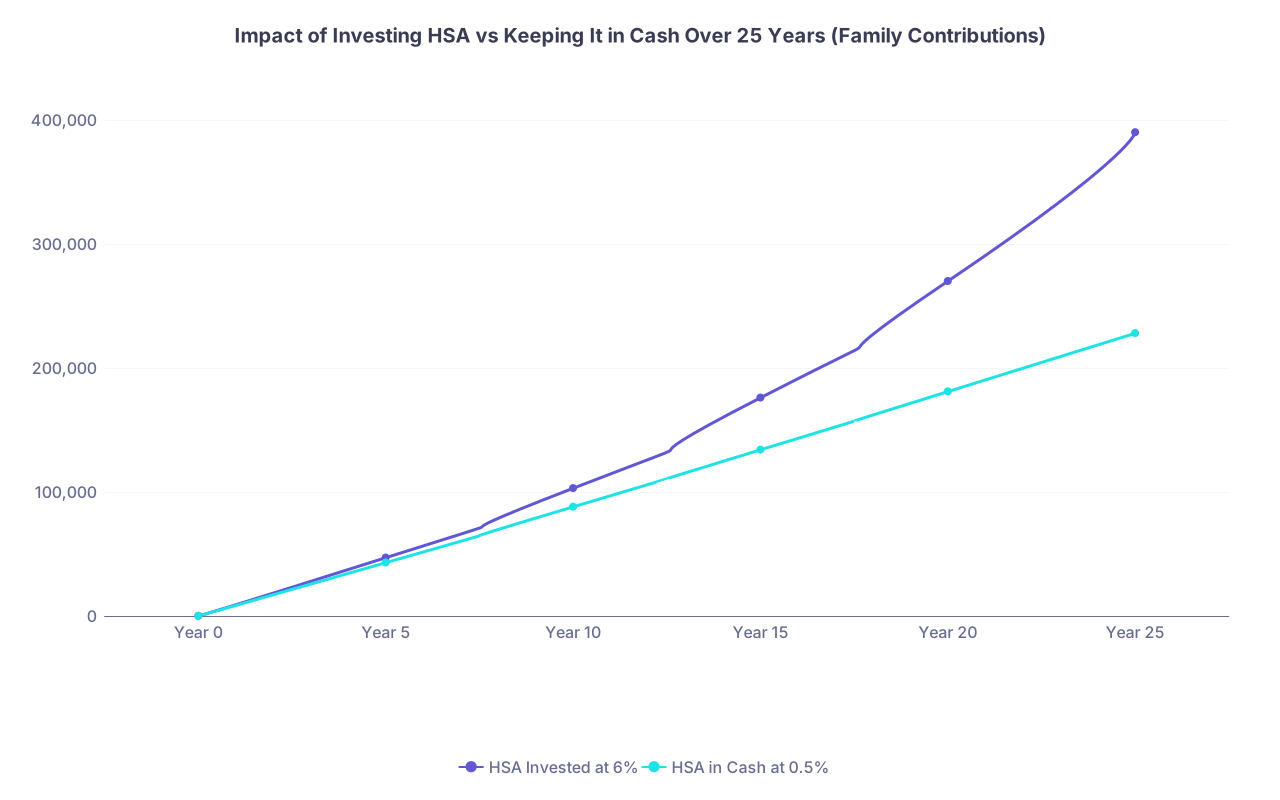
| Category | HSA Invested at 6% | HSA in Cash at 0.5% |
|---|---|---|
| Year 0 | 0 | 0 |
| Year 5 | 47000 | 43000 |
| Year 10 | 103000 | 88000 |
| Year 15 | 176000 | 134000 |
| Year 20 | 270000 | 181000 |
| Year 25 | 390000 | 228000 |
That gap—roughly $150k+—is the price of not investing. For a high-income physician, that is a completely avoidable own goal.
FAQ (Exactly 6 Questions)
1. If I can’t afford to max all accounts, should I prioritize the HSA or my 401(k)/403(b)?
If there is an employer match on the 401(k)/403(b), you take that first. Free money beats everything. After that, for a high-income physician, I usually place the HSA at least on par with additional pre-tax 401(k) contributions, and often slightly ahead of backdoor Roth contributions, because of the triple tax advantage and the inevitability of future medical expenses. The fine print is your expected health costs and time horizon, but if you can afford it, max both.
2. Can I use HSA money to pay for my child’s or spouse’s medical expenses?
Yes, as long as they are dependents or part of your tax household and the expenses are otherwise qualified, you can use your HSA to pay for their medical expenses tax-free, even if your spouse is not on your HDHP. The HSA is tied to the account owner, not just the person whose medical care is being funded. That means one spouse’s HSA can cover the whole family’s qualified expenses.
3. What happens to my HSA when I die?
If your spouse is the designated beneficiary, the HSA becomes their HSA and keeps all the tax advantages. If your beneficiary is anyone else (children, trust, etc.), the HSA essentially liquidates at your death and the full balance becomes taxable income to the beneficiary in that year. Because of this, HSAs are much better “spousal” inheritance tools than multigenerational wealth tools. Do not hoard HSA money forever if your spouse is likely to die before you or if you are single; use it strategically for your own medical and unreimbursed expenses.
4. Can I contribute to an HSA once I’m on Medicare?
No. Once you enroll in any part of Medicare (A, B, or D), you can no longer make new contributions to an HSA. You can, however, keep the HSA and continue to use it tax-free for qualified expenses, including your Medicare premiums (with some limits for Medigap). This is another reason it can be beneficial to front-load contributions during peak earning years before age 65.
5. Are there situations where an HSA is simply not worth it for a physician?
Yes. If the only way to get HSA eligibility is to accept a terrible HDHP with catastrophic out-of-network coverage, extremely high family out-of-pocket maximums, or a poor network for a high-need family, the medical risk can outweigh the tax benefit. Also, a very ill physician or family member with massive ongoing needs may be better off with a richer plan even if the HSA math looks tempting on paper. The health insurance decision comes first; the HSA strategy is layered on top of a sound coverage choice.
6. How often should I reimburse myself from my HSA versus letting receipts accumulate?
If your cash flow is strong, I typically prefer not reimbursing in real time. Let expenses accumulate on your spreadsheet, keep all documentation, and let the HSA compound untouched. Then, use retroactive reimbursements as a tactical tool: for example, in a low-income sabbatical year, early retirement years before RMDs, or to manage your tax bracket. If your cash flow is tight or you are just starting out, it is perfectly acceptable to reimburse in real time; you still get the tax benefit, you just give up some compounding. The mistake is not using the HSA at all, not the choice of reimbursement timing.
Key takeaways:
- HSAs, when paired with an HDHP that fits your situation, are one of the most powerful retirement tools available to physicians—often underused or misused.
- The optimal strategy is to max contributions, invest aggressively, avoid spending from the HSA in real time, and use it as a dedicated, tax-free medical (and optional reimbursement) bucket in retirement.
- Integrate the HSA deliberately with your 401(k)/403(b), Roth, and taxable accounts; do not let it drift as a random side account. Treat it like the stealth IRA it is, and your future self will thank you.