
You are standing in the physician lounge between cases, scrolling through your 401(k) balance on your phone. The number looks big. Seven figures, maybe close. You feel a small wave of relief. Then you flip to the “performance” tab and see something that does not quite make sense: the S&P did 9% annualized over the last decade. Your account? Closer to 6–7%.
You shrug. Markets. Volatility. You go back to your day.
That shrug is the mistake.
For many physicians, the biggest drag on retirement is not poor stock picking, a late start, or even lifestyle creep. It is quiet, automatic, and usually invisible unless you know where to look: fees. Layered, hidden, often justified with buzzwords—“professional management,” “access,” “active risk control.” Over a 20–30 year horizon, those fees can chop a third or more off your final portfolio. Sometimes half.
Let me walk you through where doctors get fleeced, how it actually shows up on your statements (or does not), and the specific traps you must avoid if you want your retirement portfolio working for you instead of for everyone else.
The Math Most Physicians Underestimate: Tiny Fees, Huge Damage
Start with the simple, brutal arithmetic. A lot of smart people ignore it because the numbers look “small.”
You see:
- Expense ratio: 0.90%
- Advisory fee: 1.00%
- Admin fee: 0.30%
You think: “Two-point-two percent, whatever. Markets return 8–10%. I’m fine.”
You are not fine.
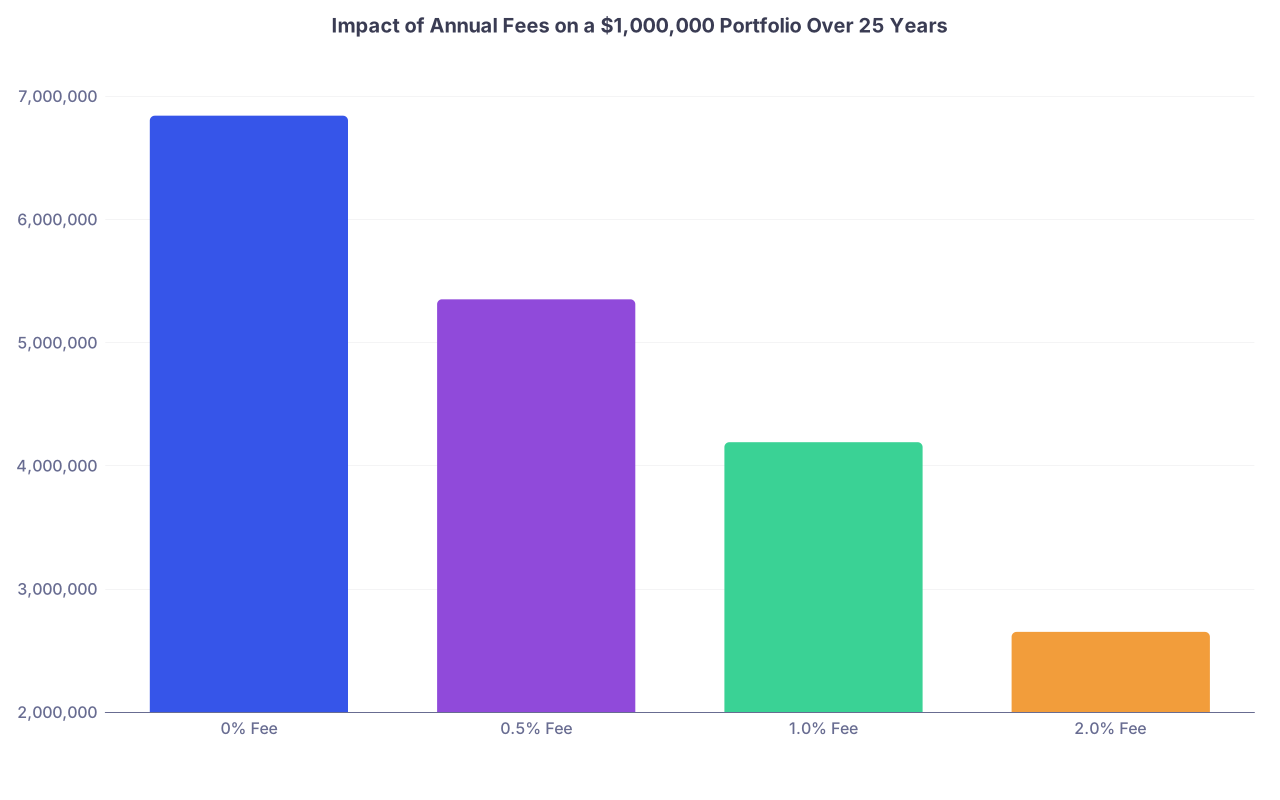
Here is what those “small” numbers do when they compound against you instead of for you.
| Category | Value |
|---|---|
| 0% Fee | 6840000 |
| 0.5% Fee | 5350000 |
| 1.0% Fee | 4190000 |
| 2.0% Fee | 2650000 |
Assuming 8% gross annual return over 25 years:
- At 0% fee: about $6.84 million
- At 0.5% fee: about $5.35 million
- At 1.0% fee: about $4.19 million
- At 2.0% fee: about $2.65 million
Lose 2% in total annual fees and you have given away more than half your ending portfolio compared with a low-cost option. That “2%” is not a rounding error. It is your second house, your travel budget, your ability to cut back to 0.5 FTE at 60 instead of 68.
The core mistake: physicians obsess over investment choices and almost ignore the fee drag. You are trained to think in terms of absolute outcomes (patient lives, diagnoses), but retirement investing is a relative game. A 7% net return in a world where you could easily have had 9% is a permanent loss, every single year.
The Five Major Fee Leaks in Physician Portfolios
You will not see a line on your statement labeled “We are quietly siphoning your future.” You will see euphemisms. Or nothing at all.
Here are the main fee categories that quietly erode physician wealth.
1. Mutual Fund and ETF Expense Ratios (The Obvious One People Still Ignore)
This is the visible fee, though even here many physicians barely glance at it.
Expense ratio = annual percentage the fund company takes out of your investment to run the fund.
Typical scenarios I see in physician portfolios:
- Actively managed mutual fund: 0.75–1.5%
- Sector or “smart beta” ETFs: 0.30–0.80%
- Simple index funds: 0.02–0.15%
You hold three “brand name” actively managed funds with 0.9%–1.2% expense ratios because some hospital-plan rep said, “These managers have historically outperformed.”
Reality: Most do not consistently beat their index after fees, and you pay for the privilege of that underperformance.
The mistake: thinking a 1% expense ratio is “normal” and ignoring that you can get broad market exposure for 0.03% at Vanguard, Fidelity, or Schwab. Over decades, that difference is lethal.
2. Advisory and Asset Management Fees (Often the Biggest Hole)
This is the classic “1% of assets under management” (AUM) fee.
A lot of physicians are paying:
- 0.8–1.5% annually to an advisor
- On top of 0.5–1.0% in underlying fund fees
- On top of 0.1–0.5% in plan/admin costs
Total: 2–3% per year.
What do you get for that?
Sometimes: real planning, tax strategy, disciplined rebalancing, behavioral coaching. Often: portfolio churn, shiny fund-of-the-month, and a leather binder full of pie charts that could have been automated for 0.05%.
The dangerous part is that the advisory fee looks small when the account is small. A $300,000 portfolio at 1% = $3,000/year. Annoying but tolerable. Then you quietly cross $2 million, still paying 1%. Now it is $20,000/year. For the same rebalanced 60/40 allocation you could run with three low-cost index funds and a spreadsheet.
The mistake: staying in an AUM relationship long after the value-add has been exhausted, and never asking: “If I was starting today, would I still pay this much for this service?”
3. 401(k), 403(b), and 457 Plan-Level and Recordkeeping Fees
Hospital and group plans love to hide behind language like “no out-of-pocket cost” or “employer provided platform.” That does not mean it is free. It means you are paying indirectly.
Typical embedded fees:
- Recordkeeping fee: 0.10–0.40% of assets
- “Wrap” or platform fee: 0.25–0.75%
- Per-participant admin fees, sometimes flat, sometimes asset-based
You might see a cryptic line like:
Asset-Based Fee: 0.35% annually
buried in a 30-page plan document no one reads.
Some plans sneak the fee into the fund lineup itself—“R” share classes of mutual funds with higher expense ratios, which kick revenue back to the recordkeeper. Physicians in these plans are often stuck with nothing under 0.5% expense ratio in their core funds.
The mistake: assuming an employer-sponsored plan is well-designed or low-cost by default. Many are not. Especially older hospital systems using legacy providers.
You cannot always avoid the plan. But you can:
- Choose the lowest-cost funds within it (often the index options)
- Avoid optional “managed account” services that tack on another 0.4–0.75%
- Maximize low-cost external accounts (IRAs, taxable brokerage) to offset the damage
4. Insurance-Wrapper Products Masquerading as Retirement Plans
This is where physicians really get ambushed: variable annuities, equity-indexed annuities, and cash-value life insurance sold as “tax-efficient retirement planning.”
You have probably heard some version of this pitch in a call room or conference room:
“As a high earner, you should be using this tax-deferred, asset-protected wrapper. It grows tax-deferred and you can take tax-free income later.”
Translation: expensive, opaque product with:
- Mortality and expense (M&E) charges: 1.0–1.5%
- Subaccount fees: 0.6–1.5%
- Riders: 0.5–1.0%
- Surrender charges that lock you in for 5–15 years
Total all-in cost: easily 2.5–4% per year.
In practice, that means if markets return 8%, you keep maybe 4–5% after all the internal garbage. Over 20–30 years, that is devastating relative to a simple low-cost portfolio in a 401(k)+IRA+taxable combo.
The mistake: confusing “tax deferral” with “good investment” and underestimating how brutal high internal fees are. I have seen physicians in their 50s discover that their policy’s internal return since inception is 2–3% annually while the S&P did >8%. That gap? All fees and insurance overhead.
If a product requires a 40-page glossy brochure and a multi-step flowchart to explain why you “win in the long run,” treat that as a red flag, not a feature.
5. Trading Costs and Tax Friction (The Hidden Turnover Tax)
Trading commissions are mostly gone. That is not where the leak is now. The real problem is portfolio turnover.
Every time your active mutual fund manager buys and sells, you incur:
- Bid–ask spreads (hidden trading cost)
- Potential short-term capital gains in taxable accounts
- Tax drag, especially damaging at physician marginal tax rates
A high-turnover fund might show a 1% expense ratio on paper but effectively cost you 1.5–2% when you include trading slippage and taxes. In your 401(k), you only feel the trading costs indirectly. In taxable accounts, you feel it as a nasty surprise at tax time.
The mistake: ignoring turnover, assuming “it’s inside the fund so it does not matter.” It matters. A lot.
Low-cost index funds have both low expense ratios and low turnover. That is why they win.
How Fees Creep into Each Account Type You Use
You probably do not have one neat portfolio. You have a mess of accounts pieced together over residency, jobs, and half-read articles.
Let us map where fees hide by account type.
| Account Type | Typical Hidden Fee Risks |
|---|---|
| 401(k)/403(b) | Plan admin fees, high-cost fund lineup, managed account add-ons |
| 457(b) | Insurance-wrapped products, annuity-style fees, limited options |
| IRA/Roth IRA | High-cost advisor portfolios, expensive active funds |
| Taxable | Advisory fees, high turnover, tax drag, unnecessary complexity |
| Cash-value life/annuities | Multi-layer internal fees, surrender charges, riders |
Employer 401(k), 403(b), 457(b)
Pitfalls:
- Default “target date” funds with 0.6–1.0% expense ratios when low-cost versions exist at 0.08–0.15%
- “Personalized management” or “professional allocation” check-boxes that quietly add 0.4–0.75%
- 457(b) plans that are actually variable annuities with embedded insurance costs and limited, expensive subaccounts
You do not control the plan design, but you control your elections. Choosing the wrong share class just because it is at the top of the list is an expensive bad habit.
IRAs and Rollovers
Common pattern: you leave a job, roll your 403(b) to an IRA “managed” by a brokerage advisor. You end up in:
- 1% AUM advisory fee
- 0.6–1.0% average fund expense ratio
Meanwhile, you could have rolled that same account to a low-cost custodian and used an index fund portfolio with total costs under 0.10%.
The mistake: rolling over into a high-cost provider out of convenience or loyalty, not cost analysis.
Taxable Brokerage Accounts
This is where poor design really hurts high-income physicians. High-fee actively managed funds and frequent trading cause:
- Higher annual taxes
- Short-term capital gains taxed at ordinary income rates
- Lower after-tax growth
You might not see a “fee” on your statement, but the IRS bill is the real cost. Especially if the advisor loves “tactical shifts” and “opportunistic trades.”
How to Actually See What You Are Paying (Because They Will Not Make It Easy)
Most physicians never do a full fee autopsy on their portfolio. They glance at one number, maybe an expense ratio, and move on. That is not enough.
Here is a basic process to avoid being the easy mark.

| Step | Description |
|---|---|
| Step 1 | Gather All Account Statements |
| Step 2 | List Every Fund and Product |
| Step 3 | Look Up Expense Ratios |
| Step 4 | Identify Advisory and Platform Fees |
| Step 5 | Calculate Total Annual Fee % |
| Step 6 | Compare to Low Cost Benchmarks |
| Step 7 | Decide What to Replace or Keep |
Step-by-step:
Gather statements for every account: 401(k), 403(b), 457(b), IRAs, Roth IRAs, taxable brokerage, annuities, permanent life policies. All of it.
For each holding:
- Look up the fund ticker on Morningstar or the provider site. Write down the expense ratio.
- If it is an annuity or insurance product, request the complete fee disclosure and prospectus. Yes, the entire ugly thing.
Identify advisor/platform fees:
- Look for “advisory fee,” “program fee,” “wrap fee,” or “wealth management fee.”
- Annualize it (if quarterly, multiply by four).
Identify plan-level or admin fees:
- In 401(k)/403(b) summaries: look for “asset-based fee,” “plan admin fee,” or “recordkeeping fee.”
Add it up for each account: Total annual fee percentage =
Expense ratio + advisory fee + platform/plan fee + known insurance/M&E charges.
Then compare that to a reasonable benchmark:
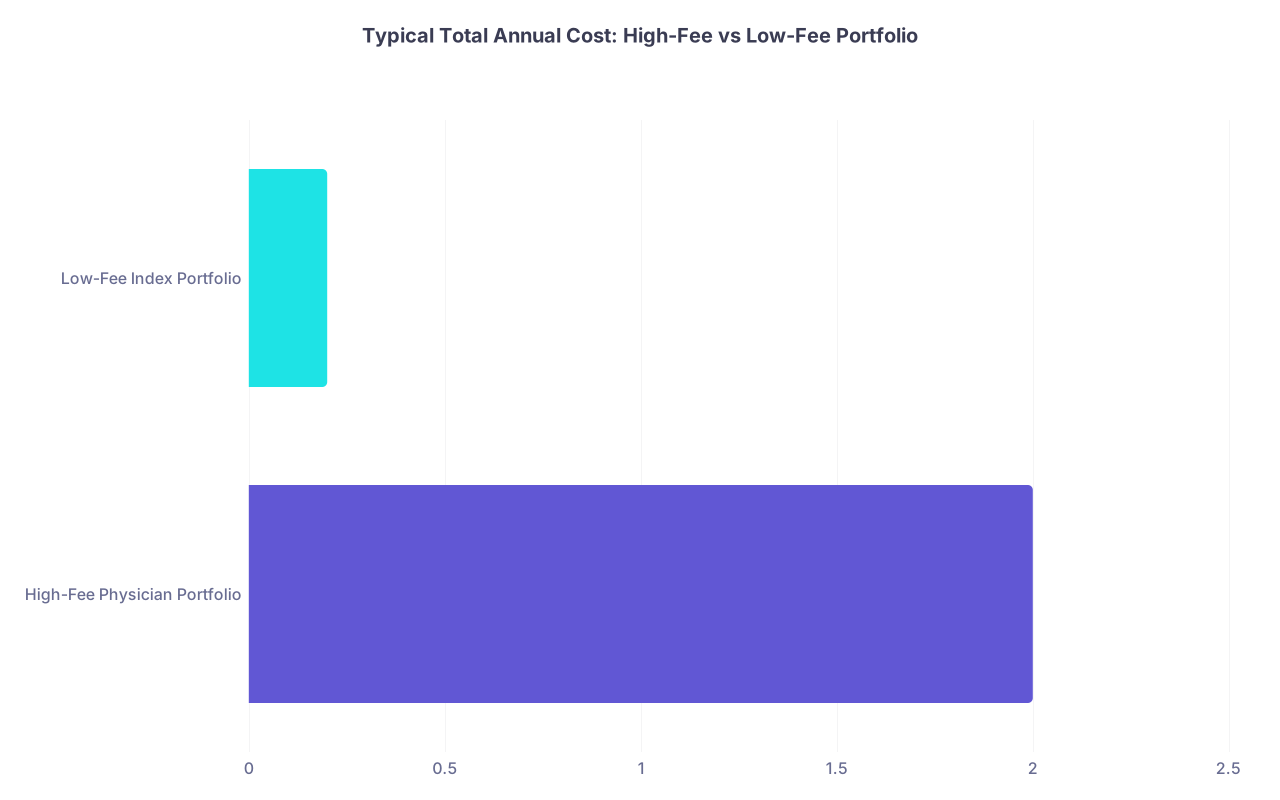
A well-structured, diversified, index-based physician portfolio can easily sit below 0.20–0.30% all-in. If you are over 1.0%, you are leaking badly. Over 1.5–2.0%? You are being harvested.
Classic Physician-Specific Fee Traps You Must Sidestep
Some mistakes are uniquely common among physicians because of your income profile and time constraints.
Trap 1: “Set It and Forget It” with the Wrong Default Choice
You sign up for a new hospital 403(b). HR shoves a link at you in orientation. You pick:
- The default target-date fund with a 0.80% expense ratio, or
- The “professionally managed” option with an extra 0.50% fee
You never revisit it. Twenty years pass.
You could have chosen the institutional index fund at 0.04%. You did not, because you treated the decision like a minor formality.
Fix: stop assuming the default is optimized. It is often chosen for administrative simplicity or revenue-sharing arrangements, not your benefit. Spend an afternoon once, save six figures+ over your career.
Trap 2: Physician-Only “Wealth Management” Groups
Many physician-specific wealth groups are excellent. Many are not. The bad ones:
- Charge 1–1.5% AUM
- Use proprietary or revenue-sharing funds
- Push insurance-heavy strategies
And they wrap it in language you respond to: asset protection, malpractice risk, “you do not have time to worry about this.”
If you are paying high AUM fees, you should be getting serious value: tax planning, entity structure help, retirement projections, student loan strategy, estate planning coordination. If all you are getting is a slightly-fancier asset allocation and an annual lunch, you are overpaying.
Trap 3: The “I Hate Taxes, So Anything Tax-Deferred Must Be Good” Reflex
Physicians rightly hate their tax bills. Salespeople weaponize that.
They pitch:
- Non-qualified deferred compensation inside insurance wrappers
- Indexed annuities: “uncapped upside with downside protection” (no, not really)
- Life insurance as “retirement income”
You end up saving 30–37% marginal tax today only to accept a 2–4% real return after monstrous internal costs, versus 6–8% in a normal portfolio. Over time, you lose more to bad returns than you ever saved in taxes.
If the sales pitch leads with “tax savings” and glosses over internal costs and realistic long-term returns, walk away.
What a Low-Fee, Physician-Friendly Setup Actually Looks Like
You do not need a perfect portfolio. You do need a cheap, simple, rational one.
The outline:
- Use the lowest-cost broad index funds available in each employer plan (often with “index” or “institutional” in the name, usually <0.10–0.15% expense ratio).
- Avoid optional “managed” or “advised” add-ons inside 401(k)/403(b) platforms unless they are free or obviously low cost.
- In IRAs and taxable accounts, prefer low-cost custodians (Vanguard, Fidelity, Schwab) and build with a small number of index ETFs or index mutual funds.
- If you want professional help, strongly consider flat-fee or hourly planners over percentage-of-assets advisors, especially once your portfolio exceeds $1–2 million.
| Category | Value |
|---|---|
| High-Fee Physician Portfolio | 2 |
| Low-Fee Index Portfolio | 0.2 |
Target total all-in fee: ideally under 0.30% per year. Under 0.20% is better. Over 1% means you have real work to do.
How to Unwind High-Fee Mistakes Without Making New Ones
You realize your fees are ugly. The temptation is to blow everything up. Be careful.
Taxable accounts
- Do not dump everything at once and trigger huge capital gains.
- Prioritize selling the worst offenders first (highest fees, worst performance, least embedded gains).
- Use new contributions to build the low-cost portfolio while you slowly phase out old holdings.
Retirement accounts (401(k), IRA, Roth)
- You can typically change funds without tax consequences. No reason to delay.
- In some bad employer plans, your only move may be to use the least-worst funds and redirect extra savings to external accounts you control.
Insurance products / annuities
- Before surrendering, get a realistic “internal rate of return since inception” and understand surrender charges.
- Sometimes the least-bad option is to stop contributing and let the policy ride until surrender charges drop. Sometimes a 1035 exchange into a lower-cost annuity is the step toward eventual exit. Get advice from someone who does not earn a commission on your decision.
Advisors
- If you are paying AUM and decide to leave, expect some emotional pressure. That is their income walking out.
- You do not owe loyalty to a fee structure that no longer makes sense. You owe loyalty to your future self.
Three Red-Flag Phrases That Usually Mean “High Fees Ahead”
To save you time, watch for these:
“This is a sophisticated strategy tailored for high-income professionals.”
Translation: expensive and unnecessarily complex, designed to impress and confuse.“There are no direct fees to you; the company pays us.”
Translation: you are paying indirectly through higher product fees and opaque revenue-sharing.“We use a carefully selected group of institutional-class managers who can outperform the market.”
Translation: high active-management costs layered on top of advisory fees. Odds of persistent net outperformance: low.
If you hear these, your guard should go up instantly.
The Bottom Line: Stop Letting Quiet Fees Steal Loud Goals
Your retirement success will not be determined by whether you picked the best small-cap fund in 2027. It will be determined by:
- Whether you allowed 1–3% in layered fees to compound against you for 20–30 years.
- Whether you confused “tax trick” with “good long-term investment.”
Reduce your total annual fee drag as low as reasonably possible, and you give yourself an enormous advantage.
If you remember nothing else:
- A “small” 1–2% annual fee difference is not small; it can cut your ending portfolio by a third to a half.
- Most of the worst offenders are wrapped in products pitched specifically to physicians: high-cost funds, AUM advisors, and insurance-based “retirement” schemes.
- Your strongest defense is brutal clarity: know your all-in fee percentage for each account, and refuse to accept anything much above 0.3% when low-cost alternatives exist.
Do not let hidden fees retire before you do.