
The standard “save 20% and you’ll be fine” advice is useless for physicians aiming for FIRE. The data shows you can either retire much earlier than you think—or work a decade longer than necessary—depending on how precisely you model your savings rate by age.
Below is a quantitative framework for modeling physician FIRE scenarios and deriving age-specific safe savings rates, not generic rules-of-thumb.
1. Core Modeling Assumptions (What We Are Actually Calculating)
Let me be transparent. Every FIRE model is just algebra wrapped in storytelling. Change the inputs, change the outcome. So we state the inputs clearly.
For a baseline “typical” attending scenario, I will assume:
- Start of attending life: age 32
- Target FIRE age: 50 (18-year horizon)
- Real (after-inflation) portfolio return: 4% per year
- Real income growth: 0.5–1.0% per year
- Real spending growth pre-FIRE: 0% (lifestyle stable in real terms)
- Safe withdrawal rate in early retirement: 3.5–4.0% (I will use 3.75% as a midpoint)
Income and lifestyle:
- Starting attending income: $350,000 (pre-tax) at age 32
- Target post-FIRE spending: $160,000 per year in today’s dollars (roughly 45–50% of gross, which is common for high earners hitting FI)
So target FI portfolio:
[ \text{FI Number} = \frac{\text{Annual Real Spending}}{\text{SWR}} = \frac{160{,}000}{0.0375} \approx 4.27\text{ million} ]
That $4.27M is in today’s dollars, so all modeling is in “real” terms. No inflation games.
Next: we use the standard future value of an annuity formula to solve for the required annual savings.
[ FV = P \times \frac{(1+r)^n - 1}{r} ]
Where:
- (FV) = 4.27M (FI number)
- (r) = 0.04 (real return)
- (n) = years of saving (varies by scenario)
- (P) = annual savings (what we solve for)
2. Safe Savings Rates by Starting Age: The Data
Now to the part most physicians actually care about: “If I start at age X, what percent of income must I save to hit FIRE by age 50?”
We will look at four start ages: 30, 35, 40, 45. Income assumed at start is $350k real and flat, to avoid overfitting. Returns 4% real.
Using the annuity formula:
- Factor (A = \frac{(1.04)^n - 1}{0.04})
Then
[ P = \frac{4{,}270{,}000}{A} ]
And the savings rate is:
[ \text{Savings Rate} = \frac{P}{350{,}000} ]
| Start Age | Years to 50 | Annuity Factor A | Annual Savings Needed | Savings Rate of $350k |
|---|---|---|---|---|
| 30 | 20 | 29.78 | $143,000 | 41% |
| 32 | 18 | 25.68 | $166,000 | 47% |
| 35 | 15 | 20.02 | $213,000 | 61% |
| 40 | 10 | 14.80 | $289,000 | 83% |
| 45 | 5 | 5.41 | $789,000 | 226% (impossible) |
Yes, those numbers are aggressive. That is the point. The math does not care about your feelings.
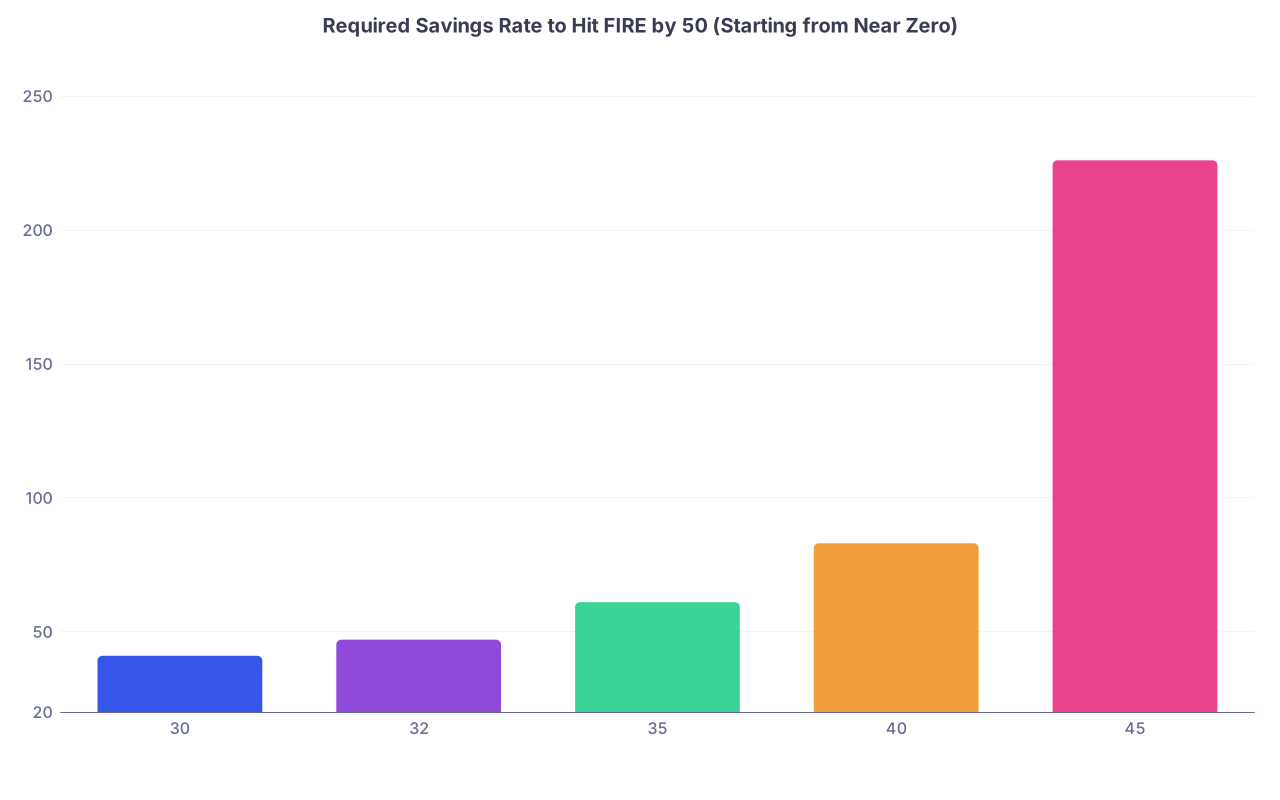
At a 4% real return, if you wake up at 45 and decide you want FIRE at 50 starting from near zero, the savings requirement is mathematically impossible. The data shows: time in the market dominates everything.
To visualize how sensitive the required savings rate is to starting age, we can chart it.
| Category | Value |
|---|---|
| 30 | 41 |
| 32 | 47 |
| 35 | 61 |
| 40 | 83 |
| 45 | 226 |
You can argue about whether 4% real returns or 3.75% withdrawal rates are “right,” but the shape of that bar chart will not change. Delaying serious saving from 32 to 40 more than doubles the required savings rate.
3. Incorporating Head Start: Resident Savings and Existing Nest Egg
Reality check: many physicians are not starting at zero at 32.
Some managed:
- $50–100k in Roth IRAs or 403(b) from residency
- A defined contribution from a spouse
- Occasionally, a prior career with savings
Let’s quantify how much this helps.
Say you start attending life at age 32 with a $150,000 existing portfolio, invested during residency and fellowship. At 4% real, by 50 this grows to:
[ FV = 150{,}000 \times (1.04)^{18} \approx 150{,}000 \times 2.025 \approx 304{,}000 ]
So you only need to accumulate:
[ 4.27M - 0.304M \approx 3.97M ]
New required annual savings:
[ P = \frac{3.97M}{25.68} \approx 154{,}600 \approx 44% \text{ of $350k} ]
So a $150k head start reduces the required savings rate from 47% to about 44%. Helpful, but not transformative, because:
- The contributions during attending years dominate the mass of the portfolio.
- The power of compounding over 18 years is real, but you are compressing into less than two decades, not 40+ years like a traditional retiree.
If you manage a $300k head start at 32 (unusual but not impossible with a high-saving spouse and dual income), the future value at 50 would be about $608k. That cuts the needed savings to about:
[ (4.27M - 0.608M) / 25.68 \approx 142{,}400 \approx 41% ]
Now you are back in the ~40% range. That is finally starting to look like a “reasonably aggressive but doable” FIRE savings rate for a physician household.
4. Income Growth and Lifestyle Creep: The Underestimated Risk
Almost every attending I have spoken with says some version of: “My income will go up, so the savings rate will get easier over time.” Sometimes true. Very often canceled out or worse by lifestyle creep.
Let me show you the math.
Scenario A: Flat real income, disciplined fixed savings
- Age 32 income: $350k real
- Save 45% of gross = $157,500 real per year
- Do this consistently through 50
Scenario B: Income grows, lifestyle chases it
- Income grows 1% real per year
- Savings fixed at 25% of gross
- Age 32 income: $350k → Age 50 income: about $426k real
- Savings grow from $87,500 to $106,500 real
We can compare the accumulated nest egg in both scenarios after 18 years at 4% real.
For a fixed real contribution P, future value over 18 years:
[ FV = P \times 25.68 ]
Scenario A:
[ FV_A = 157{,}500 \times 25.68 \approx 4.045M ]
Pretty much at the FI number by itself, even ignoring any head start or employer match.
Scenario B: Contributions start at $87,500 and rise with income at 1% real.
The contributions form a growing annuity. Future value factor for a growing annuity (growth g, return r):
[ FV = P \times \frac{(1+r)^n - (1+g)^n}{r-g} ]
Here (P = 87{,}500), (r = 0.04), (g = 0.01), (n = 18).
First compute:
- ((1.04)^{18} \approx 2.025)
- ((1.01)^{18} \approx 1.195)
So:
[ FV_B \approx 87{,}500 \times \frac{2.025 - 1.195}{0.04 - 0.01} = 87{,}500 \times \frac{0.83}{0.03} \approx 87{,}500 \times 27.67 \approx 2.42M ]
Difference:
- Scenario A (45% savings) → ~4.05M
- Scenario B (25% savings) → ~2.42M
Same starting salary. Same return assumptions. Income growth of 1% did not rescue a low savings rate. You end up about 40% short of your FIRE target, which pushes you several years later or forces higher risk / lower spending.
The data shows: for FIRE, savings rate dominates income growth. Lifestyle creep is mathematically lethal to early retirement plans.
5. Specialty, Income Level, and Time to FIRE
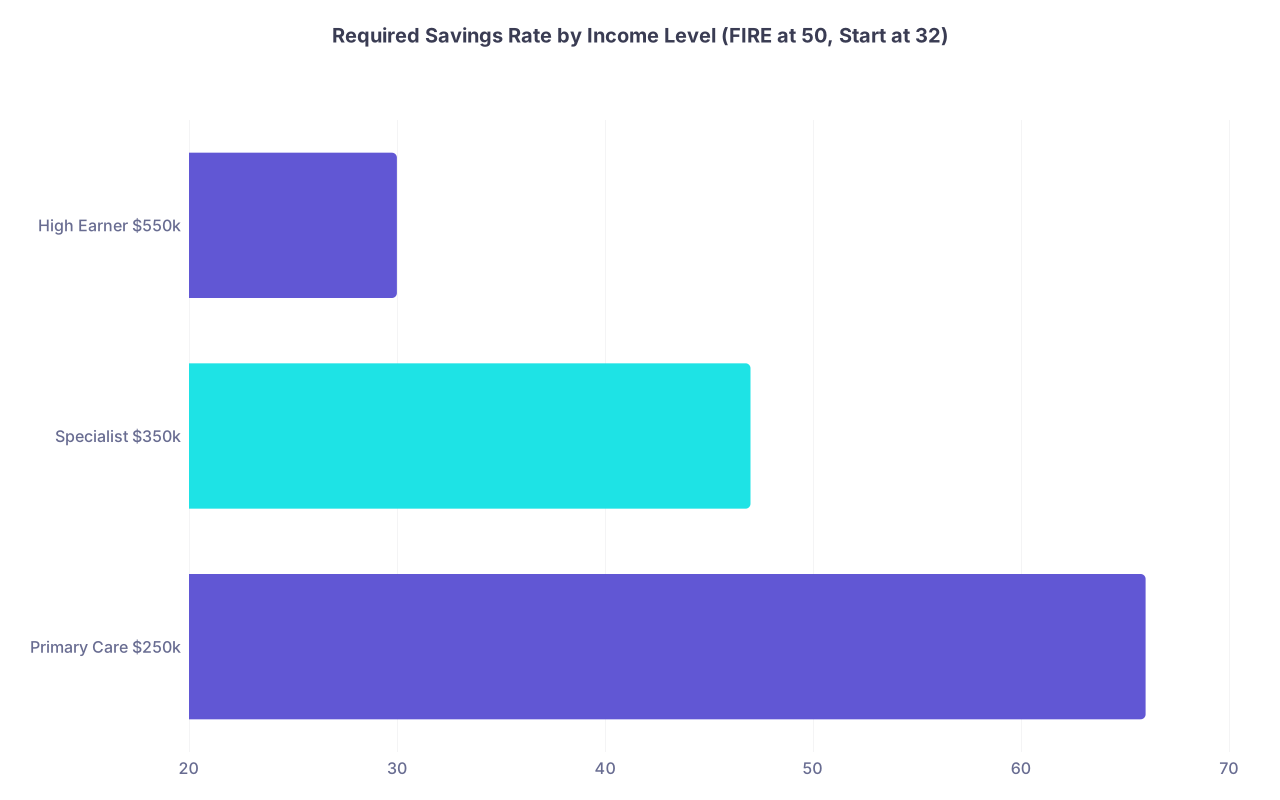
Now let us vary income instead of age. Take three physicians:
- Primary care: $250k gross
- Typical specialist: $350k gross
- High-earning specialist: $550k gross
Assume all want $160k real spending in FIRE at 50, same 4% real returns, starting from near-zero at 32.
What savings rate do they need?
We already know the required dollar savings: about $166k per year over 18 years (from earlier computation) to hit ~4.27M.
So:
- At $250k: 166 / 250 ≈ 66%
- At $350k: 166 / 350 ≈ 47%
- At $550k: 166 / 550 ≈ 30%
| Category | Value |
|---|---|
| Primary Care $250k | 66 |
| Specialist $350k | 47 |
| High Earner $550k | 30 |
No surprise: higher earners can hit FIRE with lower savings rates. But the key insight is the absolute dollar savings is similar. The FI math is driven by future spending, not your title.
Common misconception I hear in the lounge: “I am only primary care so FIRE is off the table.” False. What changes is:
- Your post-FIRE lifestyle or target spending number
- Your FIRE age or years worked at high savings rate
- Potential side income / geographic arbitrage options
Massive income helps. It is not mandatory. But a 20–25% savings rate is simply not an early retirement savings rate for a physician, regardless of specialty, if FIRE means 45–50.
6. Stress Testing: Lower Returns and Sequence Risk
All the above assumes a neat, tidy 4% real return annually. Reality is noisy.
You care about two main risk dimensions:
- Long-term average real return is lower (say 3% instead of 4%)
- Bad returns cluster early in your investing life or early in retirement (sequence risk)
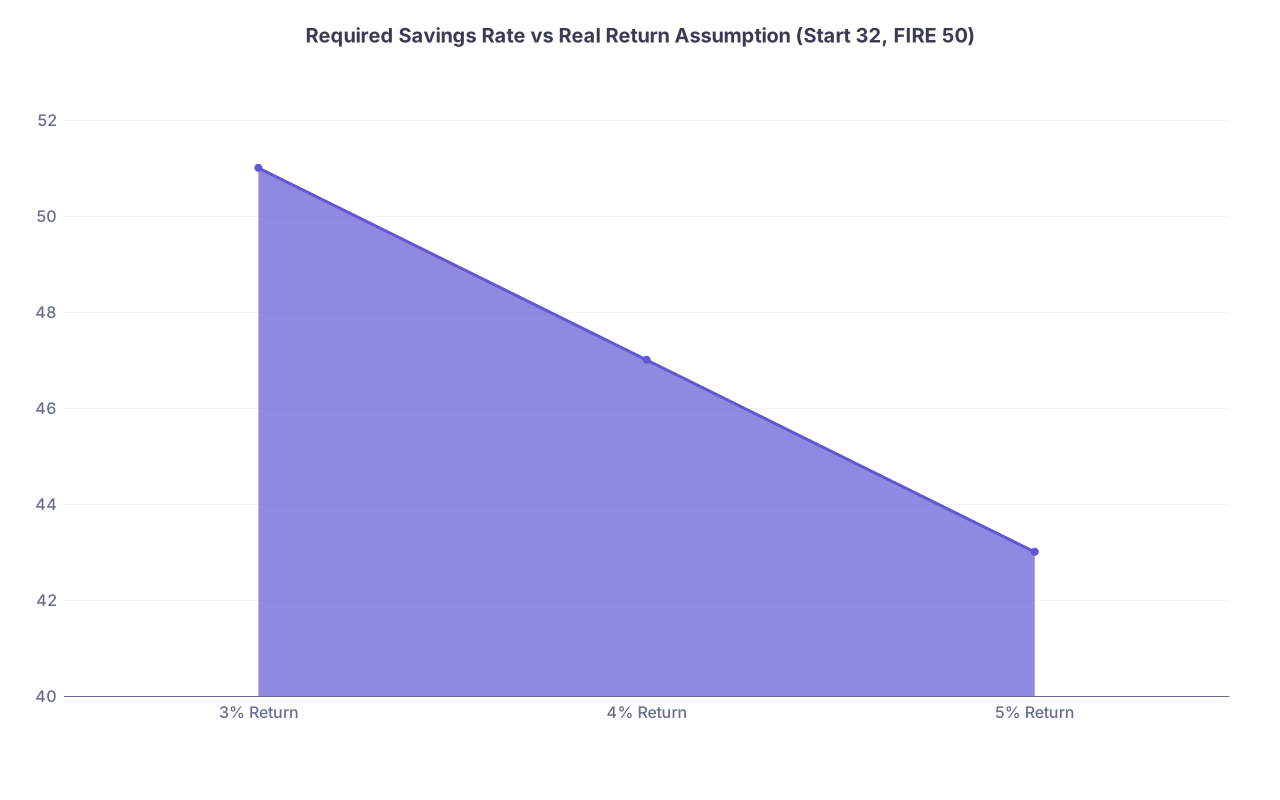
We can partially capture this by modeling different real return scenarios. Let us examine required savings at 3% and 5% real, starting at 32, retiring at 50, same $4.27M target.
Annuity factor (A):
At 3%: (A = \frac{(1.03)^{18} - 1}{0.03})
- ((1.03)^{18} ≈ 1.72) → A ≈ (1.72 - 1) / 0.03 ≈ 24.0
At 5%: (A = \frac{(1.05)^{18} - 1}{0.05})
- ((1.05)^{18} ≈ 2.41) → A ≈ (2.41 - 1) / 0.05 ≈ 28.2
Now annual savings P:
- 3% real: P = 4.27M / 24.0 ≈ 178k → 51% of $350k
- 4% real: 166k → 47% (from before)
- 5% real: 151k → 43%
| Category | Value |
|---|---|
| 3% Return | 51 |
| 4% Return | 47 |
| 5% Return | 43 |
The sensitivity to the average return assumption over 18 years is real but not insane. Moving from 5% to 3% real increases the required savings rate from 43% to 51%.
Sequence risk is harder to show without full simulation, but the high-level point is this: if bad returns cluster early, your balances stay depressed and compounding has less base to work with. That argues for:
- Front-loading contributions as much as possible
- Keeping a conservative withdrawal rate (3.25–3.75%) if you FIRE very early
- Option value: willingness to pick up part-time or locums work if the first 5 years of retirement deliver terrible markets
7. A Practical Framework: Building Your Own Physician FIRE Model
You do not need a PhD in quantitative finance to build a useful FIRE model. A competent spreadsheet and disciplined inputs are enough.
Here is a minimal but serious modeling structure:
Timeline
- Rows from current age through 90 (or 95 if you are conservative).
- Columns for: Age, Income (real), Spending (real), Savings, Portfolio Start, Return, Portfolio End.
Accumulation Phase (Pre-FIRE)
- Set income and real growth rate.
- Choose a savings rate (percentage of income).
- Compute savings each year as Income × Savings Rate.
- Apply return to prior year portfolio; add new savings.
Retirement Phase (Post-FIRE)
- Income switches to 0 (unless you model side gigs).
- Withdraw portfolio withdrawals as Spending column.
- Apply a constant or dynamic allocation/return assumption.
- See if portfolio hits zero before age 90–95.
Scenario Variations
- Different start ages, savings rates, return assumptions.
- Different post-FIRE spending levels.
- Shock scenarios: bear market early in retirement (e.g., -25% in year 1 or 2).
You can wrap this in a simple process map.

| Step | Description |
|---|---|
| Step 1 | Define FIRE Age |
| Step 2 | Set Income and Growth |
| Step 3 | Choose Savings Rate |
| Step 4 | Model Portfolio to FIRE |
| Step 5 | Model Retirement Withdrawals |
| Step 6 | Adjust Age or Savings |
| Step 7 | Scenario Acceptable |
| Step 8 | FI Target Reached by FIRE Age |
| Step 9 | Portfolio Lasts to 90 |
The technical piece is simple. The hard part is accepting what the modeling tells you about your current path.
8. What “Safe” Savings Rates Actually Look Like by Age
Let me synthesize the data into something most physicians can use without rebuilding all the math.
Assuming:
- Start at or near zero at a given age
- 4% real return long term
- FI target ≈ 25–28× annual real spending
- Post-FIRE real spending = 40–50% of pre-tax gross (typical for serious savers)
- FIRE age spectrum: 45–60 depending on when you start and what is “reasonable”
You get a rough “safe savings rate” band by age:
Early 30s (30–34)
- To FIRE at 50: 40–50% of gross
- To FIRE at 55: 25–35% of gross
Late 30s (35–39)
- To FIRE at 50: 55–70% of gross (rarely realistic)
- To FIRE at 55: 35–45% of gross
Early 40s (40–44)
- To FIRE at 50: 75%+ of gross (functionally impossible without massive income)
- To FIRE at 55: 45–55% of gross
- To FIRE at 60: 30–35% of gross
Late 40s (45–49)
- To FIRE at 55: 60–70% of gross (if starting from low base)
- To FIRE at 60: 35–45% of gross
Notice the pattern: safe savings rates are not static across ages. If you are 33 and starting from zero, a 20% savings rate is not “pretty good.” It is delayed-FIRE or traditional-retirement territory.
On the flip side, if you are 52 with a $5M portfolio and modest burn rate, a 20% savings rate is probably massive oversaving relative to any rational risk profile. You may already be past FI and just not emotionally ready to admit it.
FAQ (Exactly 4 Questions)
1. Is a 20% savings rate ever enough for a physician who wants FIRE?
For traditional retirement at 60–65, a 20% savings rate can be completely adequate, especially if you start in your early 30s and maintain it. For true FIRE—retiring in your 40s or very early 50s—the data shows 20% is not enough if you are starting from near zero. You are generally looking at 35–50% savings rates in your 30s if you want FIRE around 50.
2. How does student debt change the required savings rate?
Debt affects net saving capacity, not the math of compounding itself. If you must pay $3,000 per month to loans, that reduces how much of your gross income can flow to investments. Practically, it shifts your feasible savings rate band downward for the first 5–10 years. The rational approach is to treat required loan paydown plus investing as a combined “savings” allocation and aim to keep that total in FIRE territory (often 35–45% of gross in early years) if early retirement is a real goal.
3. Should I use 3%, 4%, or 5% real return in my plan?
For physicians targeting FIRE, I recommend modeling at 3–4% real as a base case, not 5%. A 5% real assumption (roughly 7–8% nominal with 2–3% inflation) is optimistic but not crazy over 30–40 years; over a compressed 15–20 year horizon to FIRE, it is risky to rely on that. Using 3–4% real forces higher savings and gives you margin if actual returns disappoint, or it creates upside optionality if markets do better.
4. How do pensions or social security factor into these FIRE models?
For very early FIRE (mid-40s to early 50s), pensions and social security are usually too far out to matter much in the initial FI decision. The conservative way to handle them: ignore them for your FI decision, and treat any future pension or social security as a safety buffer or a reason to gradually increase spending in your 60s. If you expect a meaningful pension starting at, say, 60, you can also model a step-down in required portfolio withdrawals at that age, which slightly lowers the required FI number. But I would not let a distant promise of benefits justify a lower savings rate in your 30s and 40s.
Two key points to leave you with.
First, the data is brutal but clear: for physicians targeting FIRE, time and savings rate are the levers that matter. Everything else is noise. Second, there is no universal “good” savings rate. There is only a mathematically consistent savings rate for your age, starting point, and FIRE target. Run the numbers honestly. Then either change the plan or change the inputs.