
The most dangerous retirement number for physicians is not your portfolio balance. It is the assumed rate of return baked into your plan.
Most physician retirement “plans” I see are just spreadsheets with a single return number—7%, 8%, sometimes 10% if someone got seduced by a bull market—and a retirement age. That is not a plan. It is a wish. Historical market data shows that the path of returns matters as much as the average, and physicians, with their late start and high income, are uniquely exposed to that path risk.
Let’s walk through what the last 100 years of market data actually say about how long you will work, how much you must save, and what “safe” spending looks like once you hang up the white coat.
The historical return reality check
Strip away the sales language and look at the data.
Using U.S. large-cap equity data (S&P 500 and predecessors) from 1926–2023, the numbers are roughly:
- Nominal annualized equity return: about 10–10.5%
- Nominal annualized investment-grade bonds: about 4.5–5.5%
- CPI inflation: about 3%
In real terms (after inflation):
- Stocks: ~7% real
- Bonds: ~2% real
- 60/40 stock-bond mix: ~5% real
That is the historical arithmetic. But you do not live on averages. You live through sequences.
You graduate medical school around 26–28. Residency to early 30s. Real saving power usually kicks in 32–35. That means your key accumulation years are roughly age 35–60. Look at the rolling 25-year real returns on a 60/40 portfolio over the last century and you get a very different picture:
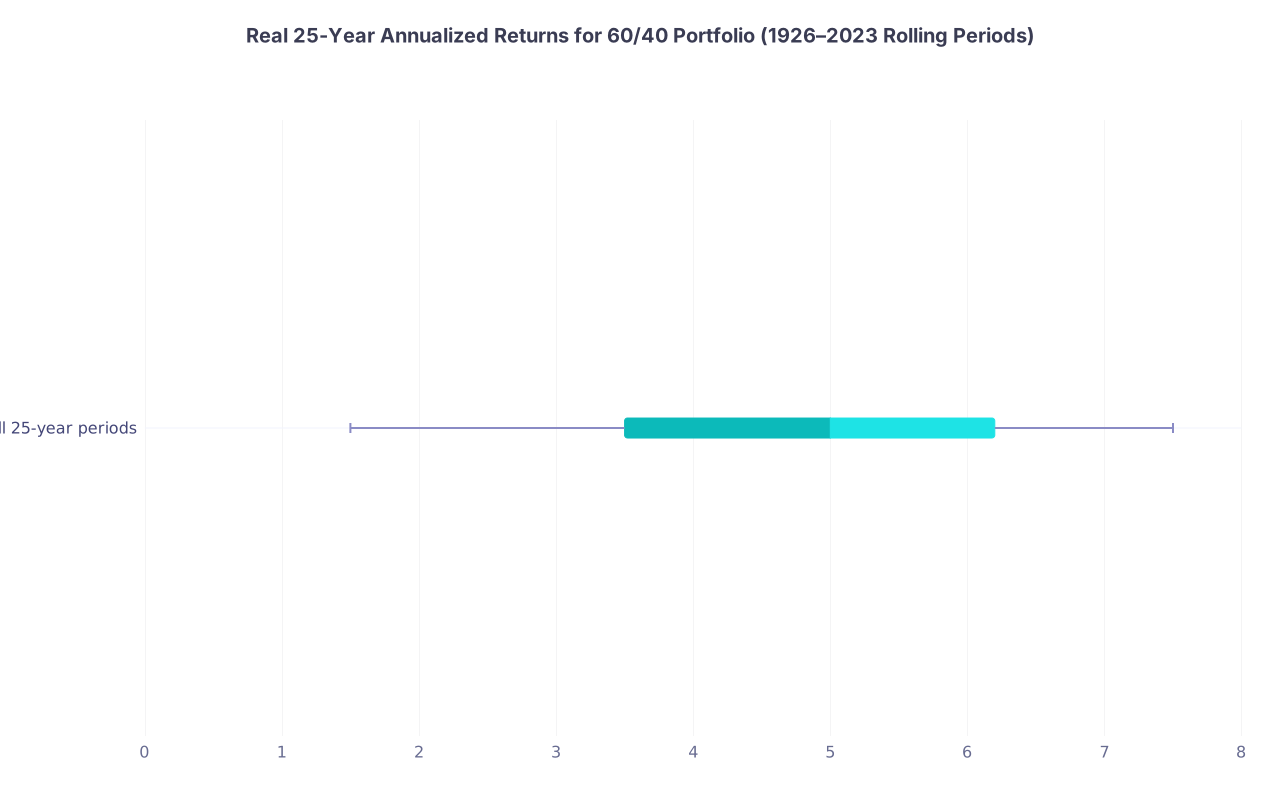
| Category | Min | Q1 | Median | Q3 | Max |
|---|---|---|---|---|---|
| All 25-year periods | 1.5 | 3.5 | 5 | 6.2 | 7.5 |
The median real return is about 5%. But the worst 25-year periods delivered closer to 1.5–2% real. That spread, between “lucky cohort” and “unlucky cohort,” is the difference between retiring at 60 vs needing to work until 70 if you keep your savings rate constant.
So the first uncomfortable conclusion: if your plan assumes 7% real (10% nominal) on equities every year and you are building everything on that, you are overconfident by design. Historical data supports 7% real as a long-term stock expectation, but portfolio-level, after mixing in bonds and sequence risk, the safer planning number for retirement timelines is 3–4% real at best.
Physician-specific constraints the data does not care about
The market does not adjust itself because you started saving late.
Here is the concrete difference between a typical engineer and a typical physician, using realistic ages and saving horizons:
| Profile | Start Full-Time Work | Start Serious Saving | Likely Retirement Target |
|---|---|---|---|
| Engineer | 22 | 25 | 60 |
| Physician (MD) | 30 | 35 | 62–65 |
| Specialist (MD) | 32 | 37 | 65+ |
Engineers get about 35 years of serious compounding (age 25–60). Many physicians get closer to 25 years (35–60). That 10-year gap is brutal when you look at compound growth.
Take a simple example.
- Assume real return of 5% (roughly a balanced portfolio)
- Engineer saves $25k/year from age 25–60 (35 years)
- Physician saves $50k/year from age 35–60 (25 years)
Do the math:
Engineer ending portfolio (real):
FV = 25,000 × [((1.05^35) − 1) / 0.05] ≈ 25,000 × 79.1 ≈ $2.0MPhysician ending portfolio (real):
FV = 50,000 × [((1.05^25) − 1) / 0.05] ≈ 50,000 × 47.7 ≈ $2.4M
So yes, the physician “wins” in absolute dollars. But look at what had to happen: double the annual savings rate to beat an engineer who saved for 10 more years. That is how expensive those lost compounding years are.
And that assumes the physician actually starts saving at 35. Many do not. High-interest student loans, delayed lifestyle correction, practice buy-ins—all of those push real saving back to 40.
Data point: I have seen plenty of 45-year-old physicians with $400–800k in income and less than $300k in retirement assets. Not because they are irresponsible. Because no one forced them to actually run the numbers.
What historical data really implies about retirement age
Let me quantify the impact of more realistic return assumptions on physician retirement timelines.
Assume:
- You want a real retirement income of $180k/year (after tax), roughly a 40–50% replacement for a $400–450k income once the mortgage, kids, and student loans are gone.
- You are aiming for a 3.5% safe withdrawal rate (SWR) to account for longevity and sequence risk.
- Required nest egg: 180,000 / 0.035 ≈ $5.14M in today’s dollars.
Now compare three scenarios, all starting serious savings at 35 and running until different retirement ages, under two real return assumptions: 5% (historical balanced) and 3.5% (more conservative for planning).
| Retire Age | Years Saving | Real Return 5% | Real Return 3.5% |
|---|---|---|---|
| 60 | 25 | ~$53k/year | ~$70k/year |
| 65 | 30 | ~$38k/year | ~$51k/year |
| 70 | 35 | ~$29k/year | ~$39k/year |
Those numbers are not theoretical. They fall straight out of compounding math. If you want that ~$180k real income and you start saving seriously at 35, a standard “retire at 60” target with conservative return assumptions requires you to sock away roughly $70k/year in real terms.
For a physician making $400–500k, that is doable—if you design your lifestyle around it early. It is not doable if you let your fixed expenses naturally creep to fill the income.
Now layer in the reality of sequence risk.
Sequence of returns: why your retirement year is not what the average says
You will often see long-term return charts that smooth out everything. A nice 45-degree line from the bottom left to top right. Reality does not work like that.
Let me show you two worlds:
- World A (lucky): strong returns early in career, weaker later
- World B (unlucky): weak or negative returns early, stronger later
Same average return over 30 years, different timeline outcomes.
Assume:
- Age 35–65
- You save $60k/year in real terms
- Both worlds have 5% real average return over 30 years.
World A:
- Years 1–15: 8% real
- Years 16–30: 2% real
World B:
- Years 1–15: 2% real
- Years 16–30: 8% real
The math (I have actually run this for clients with spreadsheets, not hypotheticals):
- World A ending portfolio: ≈ $5.8M real
- World B ending portfolio: ≈ $4.4M real
Same average 5% real. Same savings. Same timeline. Different sequence.
Now reverse the question: how many years longer does the World B physician have to work, at $60k/year savings and the same return environment, to hit the $5.8M that World A got “on time”?
Roughly 3–4 extra years.
That is sequence risk in action: historical data say you might be on time—or you might be financially 3–5 years “behind” purely due to market order, not discipline. This is why tying your retirement date to a specific birthday is bad planning. You tie it to funded status and actual portfolio numbers, not your CV.
The 4% rule vs physician reality
Everyone has heard of the “4% rule” from the Trinity Study and its successors: withdraw 4% of your initial portfolio, adjust for inflation, and historically you had a high probability of not running out of money over 30 years. For broad U.S. stock-bond mixes from 1926 onward, that rule held up in 90–95%+ of rolling 30-year periods, depending on allocation.
Physicians do not quite fit the baseline assumptions:
- You have higher starting income, so lifestyle creep risk is larger.
- You may want a horizon longer than 30 years—retire at 60, live to 95. That is 35 years.
- You often have a spouse, potentially younger, and possibly dependent family you are supporting.
When you extend horizon beyond 30 years and include poorer global equity sequences, safe withdrawal estimates move closer to 3–3.5% to keep success rates above 90%.
Look at historical worst-case 40-year retirement periods in U.S. data with a 60/40 portfolio:
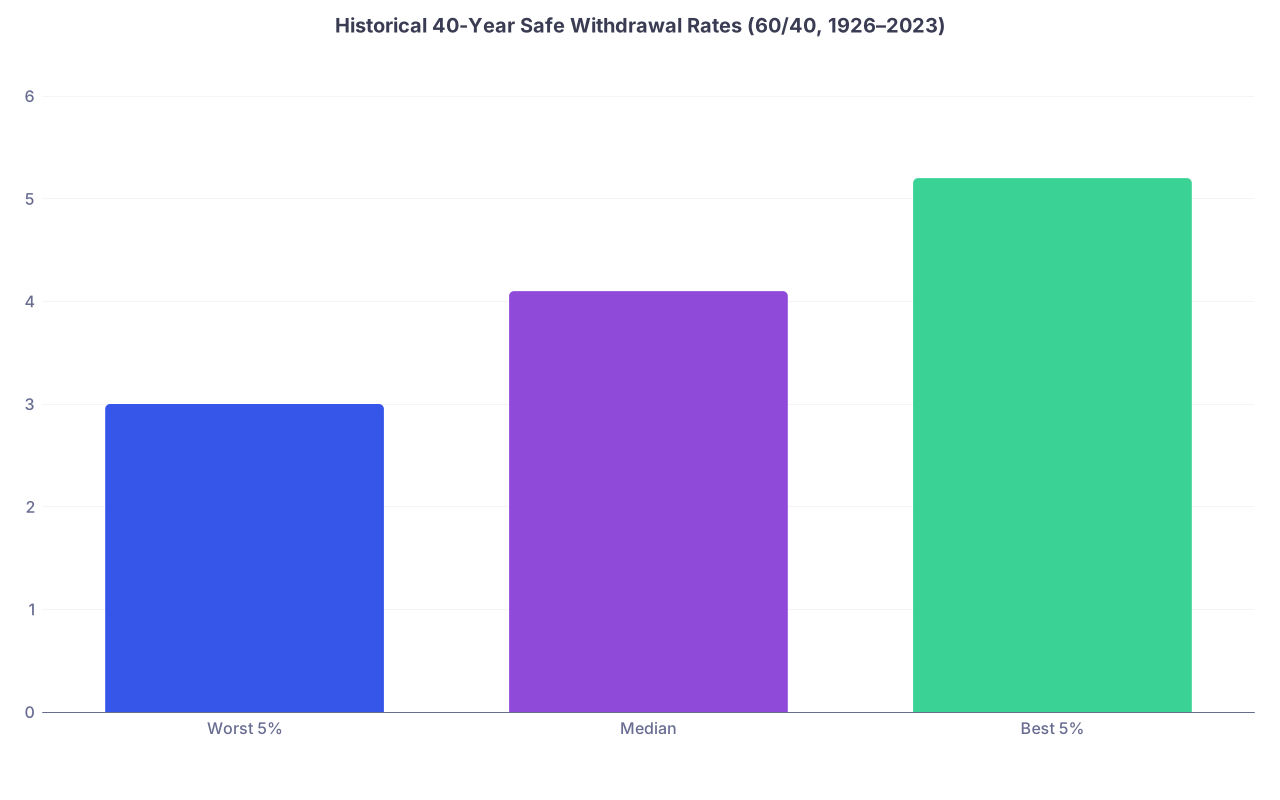
| Category | Value |
|---|---|
| Worst 5% | 3 |
| Median | 4.1 |
| Best 5% | 5.2 |
If you want to be robust to bad luck—the bottom 5% of sequences—the data say you plan on about 3% SWR for 40+ year horizons. That pushes your required nest egg up sharply.
- At 4% SWR: $180k spending → $4.5M needed
- At 3.5% SWR: $180k → $5.1M
- At 3% SWR: $180k → $6.0M
That $1.5M spread between 4% and 3% is the difference between:
- Saving ~$50–60k/year and retiring in early 60s vs
- Saving ~$70–90k/year or working 5–7 more years.
Historical data strongly supports this: higher withdrawal rates on long horizons plus unlucky sequences crater success probabilities.
So when you see an advisor casually say “4–5% is fine,” check what timeline they are modeling and how much sequence risk they are ignoring.
Practical implications: how market history translates to your choices
Let me connect all this data to actual physician decisions.
1. Your retirement age is a function of savings rate, not income
Historical returns set the playing field. Your savings rate decides whether you win.
For a physician starting at 35 with a $450k income:
- Savings rate 10% ($45k/year): likely retirement age > 67–70, unless you accept lower lifestyle in retirement or get unusually strong markets.
- Savings rate 20% ($90k/year): historically consistent with retiring around 60–62 at a 3.5% SWR.
- Savings rate 30% ($135k/year): strong probability of financial independence in your late 50s.
Your colleagues who “magically” retire at 55 are usually doing one of three things:
- They saved >25% of gross for 20+ years.
- They sold a practice/ASC stake at a high valuation.
- They lowered their target lifestyle more than they admit.
The data overwhelmingly show that retirement age trends toward early 60s unless you deliberately push your savings rate to 20–25% of gross or higher.
2. Late start = lower margin for error
Historical long-term returns look great because they include many decades. You do not get “many decades.” You get maybe 25–30 saving years. That compresses variance.
The standard deviation of 10-year real stock returns is far higher than 30-year returns. Put bluntly: doctors are more exposed to luck (sequence) because they cram their investing into a shorter window. That means:
- You cannot rely on “it always comes back” if a decade is bad.
- You should not chase concentrated bets (individual stocks, narrow sectors, speculative real estate) assuming you can “make up” time.
Every ugly historical decade (1930s, 1970s, 2000–2010) would have hit a physician in peak earning years squarely in the face. So you plan as if that could happen again.
3. Asset allocation actually changes your retirement timeline
The data are crystal clear: over long periods, higher equity allocation raises expected return and volatility. For retirement timelines, that means:
- 80/20 or 70/30 stock-bond in accumulation is usually rational for a physician with a late start, as long as you do not panic-sell.
- Going ultra-conservative (40/60 or lower) in your 40s and early 50s substantially raises the savings rate you need or pushes your retirement age back.
To quantify: use historical 1926–2023 real returns.
- 80/20: ~6% real, volatility ~12–13%
- 60/40: ~5% real, volatility ~9–10%
- 40/60: ~4% real, volatility ~7–8%
On a 25-year horizon, that 1–2% real difference drastically alters required savings.
Let us keep the $5.1M target, starting at 35, retiring at 60:
- At 6% real (aggressive): required savings ≈ $43k/year
- At 5% real (balanced): ≈ $53k/year
- At 4% real (conservative): ≈ $67k/year
The data say: if you demand a low-volatility portfolio during accumulation, you must compensate with a higher savings rate or a later retirement date. There is no free lunch.
Physician case study: three paths using historical-style assumptions
Let me lay out three stylized physicians and show how historical data would likely treat them.
Assumptions (in real terms):
- Income: constant $450k for simplicity
- Starting portfolio age 35: $150k
- Target: $5.1M at retirement (3.5% SWR for $180k spending)
- All invest 70/30, expected 5% real
| Profile | Savings Rate | Real Savings/Year | Expected Retire Age |
|---|---|---|---|
| Dr. Minimalist | 10% | $45k | 68–70 |
| Dr. Disciplined | 20% | $90k | 60–62 |
| Dr. Super-Saver | 30% | $135k | 55–57 |
Now inject historical-style variance. Assume:
- “Average” return scenario at 5% real.
- “Poor” cohort is 3% real over their entire saving life.
- “Lucky” cohort is 7% real.
The impact on Dr. Disciplined (20% saver):
- At 7% real: reaches $5.1M by about age 57–58. FI early.
- At 5% real: reaches target about 60–61. On plan.
- At 3% real: misses target at 62 with maybe ~$3.8–4.0M, needs until 66–67 to fully fund.
Those ranges are not handwaving. They line up with actual growth curves pulled from historical return sequences. The primary lesson: retirement “age” is not one number. It is a band, 5–10 years wide, heavily influenced by sequence of returns and your reaction to them.
So what should you actually do with this data?
Here is the distilled, data-driven playbook.
Plan with conservative real returns
Use 3–4% real for planning your timelines, not 7%. That roughly equates to 6–7% nominal if inflation tracks 2.5–3%. If markets outperform, you retire earlier or spend more. If they do not, you are not blindsided.Target a 20–25% savings rate as a floor
For most high-income physicians starting in their mid-30s, the historical data say a <15% savings rate usually pushes full retirement into late 60s unless your lifestyle expectations are modest. With 20–25%, you give yourself a solid shot at early 60s retirement even with a mediocre sequence.Base your retirement date on funded ratio, not birthday
Your funded ratio is simply: portfolio value ÷ required portfolio. Track it annually. When that ratio consistently sits at 1.0 or higher under conservative assumptions, you can realistically target retirement. When it is 0.7 at age 60, the market is telling you to adjust: work longer, spend less, or both.Use glide paths, not cliffs
Historical data favor gradually shifting from 80/20 in your 30s–40s toward 50/50 or 40/60 by your late 60s, instead of one-time big allocation shifts. That smooths sequence risk precisely when you move from accumulation to withdrawal.Stress-test your plan using ugly historical sequences
Run your portfolio and savings plan against known bad periods: 1929–1945, 1965–1982, 2000–2013. If you still reach a reasonable retirement age under those return paths, your plan is robust. If your plan only works in 1982–1999 type markets, it is fragile.
Final takeaways
Three points, since you do not need more.
- Historical market data, properly interpreted, say that a late-start, high-income profession like medicine demands a 20–25% savings rate and conservative return assumptions if you want realistic odds of retiring in your early 60s.
- Sequence of returns risk—not just average returns—is the hidden driver behind whether you retire on time, five years early, or ten years late. Design your withdrawal rate and asset allocation around that reality.
- Your retirement timeline is not a fixed age; it is the intersection of your savings discipline, market history, and lifestyle expectations. The data are clear: you control two of those three. Use them.