
The usual “it will all work out in retirement” attitude is exactly how you end up with one spouse at 65 and zero retirement savings.
You are not overreacting. This is a real problem. The good news: it is absolutely fixable if you stop treating your spouse’s empty accounts as an awkward detail and start treating it like a shared project with a deadline.
Below is the playbook I would use if I were in your chair—step by step, financially and legally.
Step 1: Get Completely Honest About the Numbers
You cannot fix what you will not quantify. No feelings, no blame yet. Just data.
Here is what you need on one sheet (or one spreadsheet):
- Your ages
- Target retirement ages for each of you
- Current savings for each person:
- 401(k)/403(b)/TSP balances
- IRAs / Roth IRAs
- Pensions (estimated benefit; get numbers, not “I think I have one”)
- Taxable brokerage earmarked for retirement
- HSAs, if you plan to use them in retirement
- Current income for each spouse
- Salary, bonuses, self-employment, side gigs
- Current retirement contributions
- Your deferrals (percentage and dollar)
- Employer match
- Anything your spouse is doing (which might be zero)
- Debts
- Mortgage balance and rate
- Car loans
- Student loans
- Credit cards / personal loans
Then identify the gap:
- Spouse A (you, presumably): has $X saved
- Spouse B: has $0 (or close to it)
- Years until desired retirement: Y
You are not doing this to shame the person with no savings. You are doing it to answer one question:
“What has to change in the next 5–15 years so that we both can retire without one person secretly resenting the other?”
That is the real problem here. Not the zero balance. The imbalance.
Step 2: Decide Your Realistic Retirement Target as a Couple
The second mistake people make: pretending that “we’ll just live on my accounts” means nothing else has to change.
No. If only one spouse has savings, then your original retirement vision is probably dead as written. You need a new one.
Have the uncomfortable conversation
Sit down and answer:
- When do you want to stop full-time work?
- When does your spouse want to stop?
- What does “retirement” actually mean for each of you?
- Fully stopped?
- Part-time consulting?
- Lower-paying but enjoyable work?
Be specific. “We’ll travel” is a fantasy line, not a plan. “We need $6,000/month after tax to live” is a plan.
Use a rough rule just to anchor the conversation:
- Many planners use 25x annual spending as a target (the so-called 4% rule).
- If you need $80,000 per year from investments → you want roughly $2 million invested.
- This is not perfect, but it gives you a ballpark.
Then map it to the current reality:
- Your current retirement assets
- Years left to save
- Your spouse’s zero
You are probably going to discover one of these:
- You both need to work longer than you thought
- You both need to save more aggressively than you thought
- Or both
Good. Now you have pressure. Pressure is useful.
Step 3: Stop Treating Their Lack of Savings as “Their” Problem
Legally and economically, if you are married, your spouse’s retirement gap is your problem. And your savings are their lifeline.
In a typical long-term marriage:
- If you retire, you will not say, “Your half of the mortgage is your problem.”
- Medical decisions, end-of-life care, housing—they are joint realities, not separate.
So you need to reframe:
- Not “My spouse has no retirement savings.”
- But “As a household, we have $X saved and need to reach $Y.”
That said, there is a financial and legal reason to deal explicitly with the imbalance:
- If you divorce or one of you dies early, that zero savings number suddenly matters a lot.
- If your marriage is solid, great—still protect yourself.
- If the marriage is shaky, then you need guardrails, not blind trust.
We will get to the legal side. First, fix the monthly cash flow.
Step 4: Build a Two-Spouse Savings Plan (Not One Hero, One Passenger)
One spouse with all the savings and the other with none usually means one of four things:
- Spouse with savings always had access to employer plans; the other did not
- One spouse paused career for childcare or eldercare
- One spouse is bad with money / avoidant
- The couple never decided, so inertia took over
You fix it by making both people part of the savings engine.
4.1. Max out every tax-advantaged option you reasonably can
Here is the order of attack in most cases:
Grab all employer matches (both spouses)
- If your spouse has a 401(k) with a match and is contributing zero, that is mistake #1.
- At minimum, they should contribute enough to get 100% of the match. This is mandatory.
If spouse with zero savings has no workplace plan → open an IRA
- Traditional or Roth IRA in their name. You can fund it from joint money; the account is still theirs.
- For a nonworking spouse married filing jointly, the working spouse’s income can qualify them for a so‑called spousal IRA.
Increase savings percentage across the household
- If you are saving 5–10% and your spouse is at 0%, you probably need to push combined savings closer to 15–25% of gross income, especially if you are starting late (40s or 50s).
Consider catch-up contributions (if 50 or older)
- These allow you to put more into 401(k)s and IRAs than younger workers.
| Account Type | Under 50 Limit | Age 50+ Limit |
|---|---|---|
| 401(k)/403(b)/TSP | $23,000 | $30,500 |
| Traditional IRA | $7,000 | $8,000 |
| Roth IRA | $7,000 | $8,000 |
| HSA | $4,150 (single) | $5,150 (50+) |
(Verify current-year limits, they change.)
4.2. Shift some of “your” savings into “their” name
If they have no accounts at all, I like a very straightforward protocol:
- Keep maxing your own 401(k) if possible
- Simultaneously open or ramp up their:
- 401(k) contribution (if offered)
- or IRA / Roth IRA
For example:
- You: Keep contributing 15% to your 401(k)
- Spouse: Start with 5% to 401(k) or $250/month to an IRA
- As raises or windfalls come in, bump their percentage aggressively until they are saving at least 10–15% as well.
No hero spouse and dependent spouse. Two savers. Different totals, but both moving.
Step 5: Fix the Behavior, Not Just the Account Balances
If your spouse has zero retirement savings and has been working for years, there is usually a behavioral pattern underneath:
- Avoids finances
- Spends to cope or impress
- Believes “I’ll never be able to catch up so why bother”
- Grew up poor and avoids thinking long-term
You will not solve this with lectures.
Here is what works better:
5.1. Use joint systems, separate responsibilities
Set up:
- Joint “household” accounts for shared bills and savings
- Individual “fun money” accounts for each spouse, no questions asked
But then:
- One person handles bill pay and automation
- The other person owns tracking and reporting (monthly quick check-in)
Your spouse who has zero savings should own some visible part of the money system—maybe tracking contributions or running the retirement calculator annually. They need to feel it.
5.2. Automate to remove willpower from the equation
Do not rely on “we’ll move money to your IRA when we remember.”
- Set automatic payroll contributions into their 401(k)
- Set automatic monthly transfers to their IRA (on payday)
- If your employer allows it, split direct deposit: part into checking, part into savings/investments
Automation beats self-discipline, every time.
Step 6: Get Very Clear on Social Security and Survivor Benefits
If one spouse has done most of the earning, Social Security can partially bail out the non-saver spouse—but only if you understand the rules and make smart choices.
6.1. Spousal and survivor benefits
Basic points (US-specific):
- A lower-earning or non-earning spouse can often receive a spousal benefit up to 50% of the higher earner’s full retirement benefit (if taken at full retirement age).
- If the higher earner dies first, the surviving spouse can receive a survivor benefit equal to the deceased spouse’s benefit (with some timing caveats).
Translation: your earning record may become your spouse’s main retirement income. That is both comforting and dangerous.
6.2. Why this matters for timing
If one spouse has no savings:
- It usually makes sense for the higher earner to delay Social Security to 70 if possible, because:
- It raises the benefit for you while alive
- It raises the survivor benefit your spouse would receive if you die first
For many couples in this situation:
- Lower earner (or non-saver) takes their benefit earlier (62–67, depending on health and need)
- Higher earner delays to 70 to maximize the overall household and survivor income
Run this through a calculator or planner; the wrong claiming strategy can cost you six figures over a lifetime.
Step 7: Address the Legal Side: Protection, Fairness, and Worst-Case Scenarios
Now we hit the area most couples avoid, but it is where the resentment and risk live.
If you are the one with all the savings, you need to think clearly about:
- What happens if you die first?
- What happens if you divorce at 60?
- What happens if your spouse needs long‑term care and has no savings?
7.1. Update beneficiary designations
Your wills do not control your:
- 401(k)/403(b)/TSP
- IRAs / Roth IRAs
- Life insurance policies
These pass by beneficiary designation. Check them.
Decide consciously:
- Do you want your spouse to be primary beneficiary of all retirement accounts?
- Do you want children (if any) to be contingent beneficiaries?
- Do you want a trust involved if you do not fully trust your spouse’s money decisions?
If your spouse has no savings and would be financially wrecked by your death, you probably want:
- Them as primary beneficiary on at least some major accounts and life insurance
- Enough life insurance to replace your income and fund their retirement somewhat
7.2. Consider a postnuptial agreement if there is serious imbalance or distrust
If:
- You came into the marriage with substantial assets and your spouse did not
- Or your spouse has a pattern of financial recklessness
- Or the marriage is not rock-solid
Then you might talk to an attorney about a postnuptial agreement.
Ugly? Maybe. But less ugly than a divorce where half your retirement gets split after you funded everything. A postnup can:
- Clarify what stays separate property
- Spell out how retirement assets are divided if you split
- Protect children from a prior relationship
You are not “planning to divorce.” You are planning not to be financially annihilated if you divorce.
7.3. Long-term care and incapacity
One spouse with no savings and one with all the savings is exactly the scenario where long‑term care can be devastating. Because every dollar for care comes out of your pile.
You deal with it by:
- At minimum, creating:
- Durable powers of attorney (for finances)
- Health care proxies / advance directives
- Updated wills
- Considering long‑term care insurance, especially if:
- Your family histories suggest high risk
- You have assets worth protecting but not enough to self‑insure comfortably
Talk to an estate planning attorney and, ideally, a fee-only financial planner. This is not DIY territory for most people.
Step 8: Use a Retirement Calculator—But Treat the Results Like a To‑Do List, Not a Prediction
Now that you have:
- Your ages
- Your savings
- Your spouse’s current zero (or low) savings
- Target retirement age
- Planned contributions for each of you
Plug it into a conservative retirement calculator.
You want something that takes into account:
- Social Security estimates for both of you
- Different retirement ages for each spouse
- Tax treatment of different account types
Then treat the output properly:
- If it says you are on track only if you work until 70 and save 25%—that is your reality check, not a suggestion.
- If it says you have a high probability of success with lower contributions, great. You just bought yourself some flexibility.
Use it to adjust three levers:
- Retirement age(s)
- Savings rates
- Expected spending in retirement
Here is what I see most often with one-saver/one-non-saver couples:
- You both need to push retirement back 3–5 years from your fantasy date
- You both need to ramp up savings aggressively for the next 10–15 years
- You need to aim for a simpler, cheaper version of retirement than the Instagram version you had in your heads
You will not love hearing that. But you will like it more than being broke at 72.
Step 9: Create a 12-Month Implementation Plan
Big plans die without short-term structure. So translate everything into a one-year action list.
Next 30 days
- Gather all account statements and income info
- Have the retirement expectations talk
- Run at least one decent retirement calculator with your real numbers
- Check and update beneficiary designations
- Open any missing accounts for your spouse (IRA, Roth IRA, 401(k) enrollment, etc.)
Next 90 days
- Set contributions:
- You: increase by at least 1–2% of salary if not already near the max
- Spouse: at least to employer match, ideally higher
- Automate IRA contributions for spouse from joint account
- Draft or update:
- Wills
- Powers of attorney
- Healthcare directives
Next 12 months
- Increase both spouses’ savings by 1–2% of income every 6 months until you hit your target rate (15–25% combined, depending on your situation)
- Review spending and cut what does not move the needle on your actual life
- If needed, meet with:
- Fee-only financial planner (one or two sessions is fine)
- Estate planning attorney
Re-run your retirement projection after 12 months. If it does not look meaningfully better, the answer is not another spreadsheet. It is bigger changes: more working years, downsizing housing, second career, etc.
Step 10: Keep This from Becoming a Silent Resentment Factory
The real danger here is not the missing dollars. It is the emotional imbalance:
- Saver spouse feels used or taken for granted
- Non-saver spouse feels guilty, ashamed, or defensive
- Money talk becomes radioactive
You keep that from poisoning the relationship by:
- Treating this as a joint problem and joint solution, even if one person created more of the mess
- Having scheduled, short money check-ins (20 minutes monthly), not random blowups
- Making visible progress:
- Watch your spouse’s accounts grow
- Celebrate milestones: first $10k, first $50k, etc.
One practical trick I like: once your spouse has an IRA/401(k) open and funded for a few months, sit down together and log in. Look at the balance. Compare it to what it was. Make the progress real.
You are resetting their identity from “person with no retirement savings” to “late starter who is building fast.” That mental shift matters more than any particular fund choice.
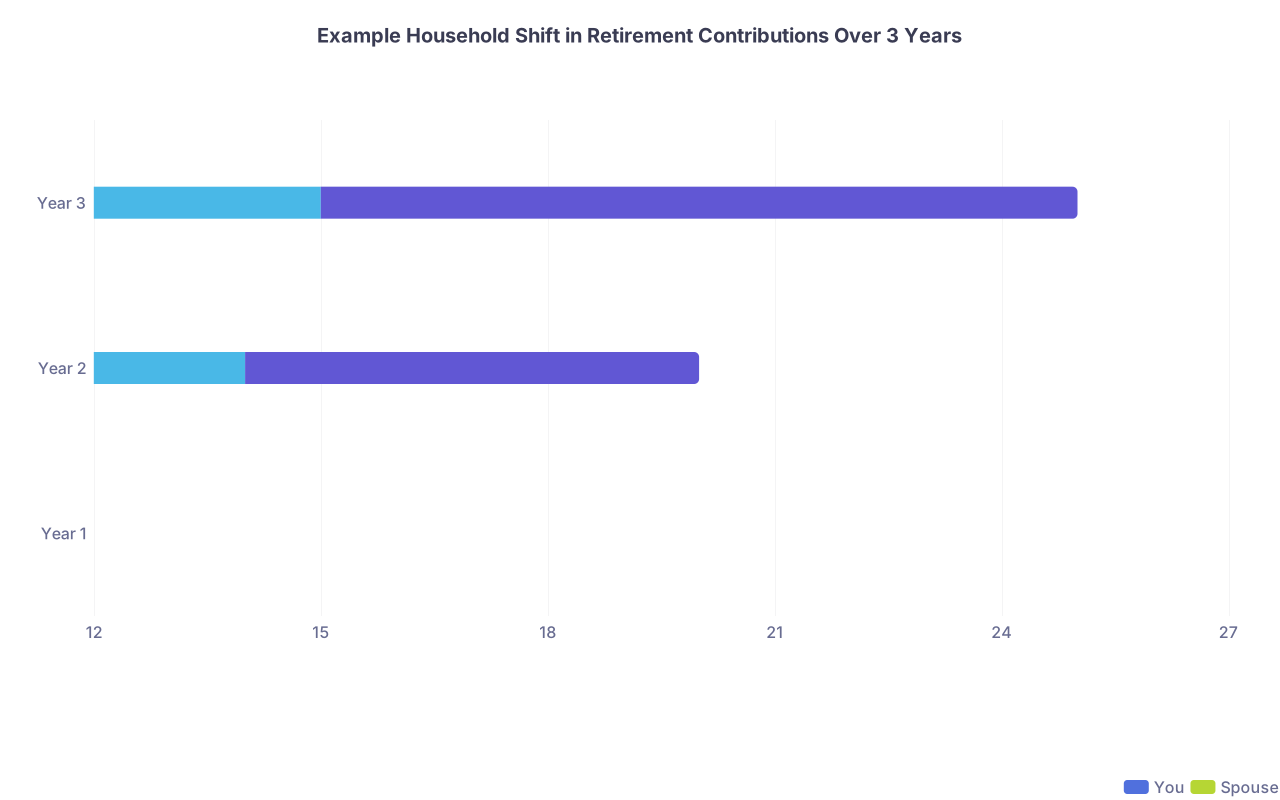
| Category | You | Spouse |
|---|---|---|
| Year 1 | 12 | 0 |
| Year 2 | 14 | 6 |
| Year 3 | 15 | 10 |
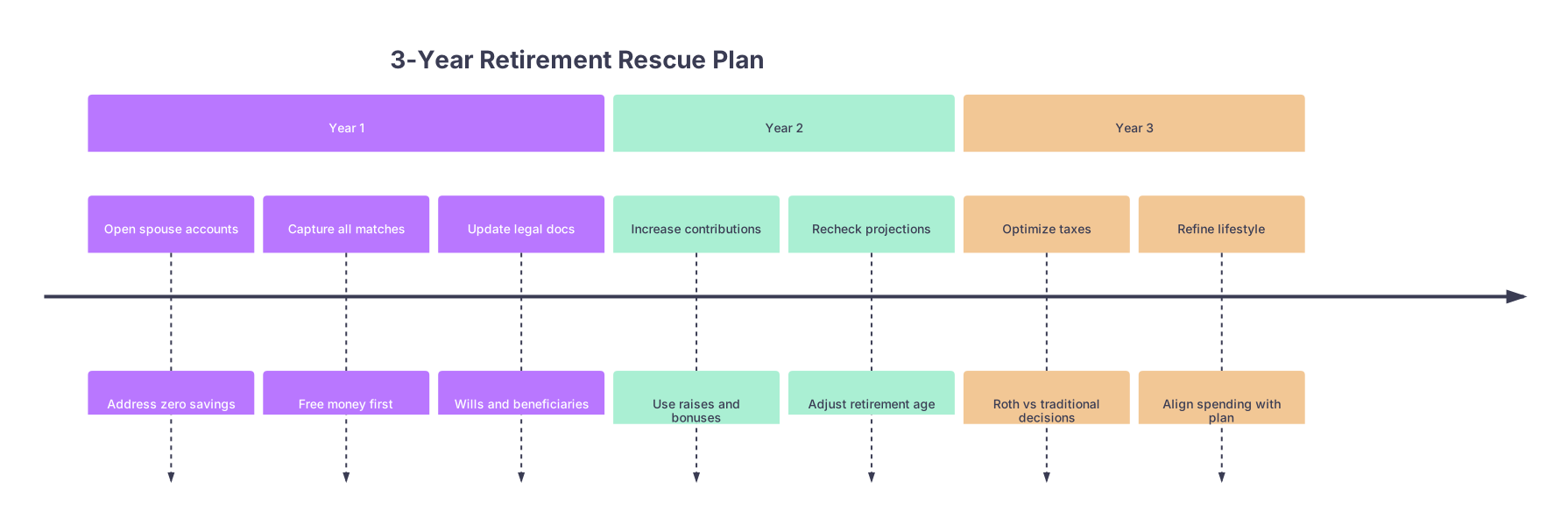
| Period | Event |
|---|---|
| Year 1 - Open spouse accounts | Address zero savings |
| Year 1 - Capture all matches | Free money first |
| Year 1 - Update legal docs | Wills and beneficiaries |
| Year 2 - Increase contributions | Use raises and bonuses |
| Year 2 - Recheck projections | Adjust retirement age |
| Year 3 - Optimize taxes | Roth vs traditional decisions |
| Year 3 - Refine lifestyle | Align spending with plan |
FAQs
1. Should I slow down my own retirement saving so we can fund my spouse’s accounts?
Usually no. You do not weaken the only strong pillar you have. What you do instead:
- Keep your own savings rate strong (especially if you have a good 401(k) with a match).
- Add spouse contributions on top by cutting spending, using raises/bonuses, or adding side income.
- If you must choose, at least capture both spouses’ employer matches before you go beyond that in either plan.
The goal is more total household saving, not just moving dollars from one name to another.
2. What if my spouse simply refuses to save for retirement?
Then you have a relationship problem dressed up as a money problem. Be blunt:
- Explain that you are unwilling to carry 100% of the retirement burden indefinitely.
- Lay out the facts: if they refuse to save, they are implicitly choosing:
- To work much longer
- To depend heavily on your assets and Social Security
- Or to accept a much lower standard of living
If they still refuse, you may need to:
- Protect more of your assets legally (postnup, separate accounts where appropriate)
- Reconsider how much risk you are willing to take on their behalf
You cannot force an adult to be responsible, but you also do not have to volunteer as their financial parent.
3. Is it too late to fix this if we are already in our 50s?
Late? Yes. Too late? Usually not.
People in their 50s still often have:
- 10–15 working years
- Peak earning potential
- Access to catch-up contributions
- The option to work part-time after “retirement”
What you lose is the luxury of half-measures. In your 50s with one spouse at zero, you should be thinking:
- Combined savings rate aggressively high (20%+ if you can manage it)
- Retirement age likely closer to 67–70 than 62
- A simpler, more modest retirement lifestyle than your 35‑year‑old self imagined
Three key ideas to remember:
- This is a household problem, not “their” problem, and it needs a joint plan.
- You fix it with specific actions: account openings, automatic contributions, legal documents—not wishful thinking.
- You are not just building balances. You are rebuilding trust and fairness in how your future together is funded.