
The worst retirement mistake after a divorce is pretending nothing has changed.
Your old plan is dead. The sooner you accept that, the faster you can build a new one that actually works for you as a single person.
This is not about “getting back on track.” It is about creating a brand‑new track with the reality you have now: different income, different obligations, different assets, and probably a different timeline.
Here is exactly how to reboot your retirement plan after a divorce, step by step.
Step 1: Freeze big decisions and stabilize your cash flow
Before you touch investments or make grand plans, you need a stable financial baseline. Post‑divorce, most people underestimate how messy the first 6–12 months can be.
For the next 60–90 days, your only goals are:
- Do not make irreversible financial decisions out of emotion.
- Get a clear, honest picture of money in vs. money out.
- Make sure you can reliably pay for basics plus minimum debt payments.
Concrete actions for the next 2 weeks:
- Set up your own bank accounts (if you have not already):
- One checking (bill pay).
- One savings (emergency buffer).
- Route your income correctly:
- Update direct deposit with your employer to your new account.
- If you receive alimony or child support, confirm:
- Amount.
- Due date.
- Payment method (direct deposit, check, state system).
- List your non‑negotiable monthly expenses:
- Housing (rent/mortgage, insurance, property tax escrow).
- Utilities.
- Groceries and transportation.
- Health insurance and medical costs.
- Child‑related expenses (daycare, activities).
- Minimum payments on every debt.
You need a cold, unemotional cash flow snapshot. Use whatever tool you will actually use: a simple spreadsheet, a legal pad, or an app like YNAB or Simplifi. Do not overcomplicate this.
Once you see the baseline, you can determine: how much is left for retirement savings and debt paydown, for real, not in your head.
Step 2: Inventory every retirement‑related asset and obligation
Post‑divorce, people often have a scattered mess of accounts—old 401(k)s, QDRO‑assigned pieces of an ex’s pension, a half‑interest in some IRA they barely remember.
You cannot plan for retirement on fuzzy guesses.
You need a clean inventory.
Make a table with four columns: Account / Institution / Owner / Current balance. Include:
- 401(k), 403(b), 457 plans (yours and any you received via QDRO).
- Traditional IRAs, Roth IRAs.
- SEP/SIMPLE IRAs if self‑employed.
- Pensions (defined benefit) and deferred comp plans.
- HSAs (they can be stealth retirement accounts).
- Cash value in life insurance policies (if any).
- Brokerage accounts earmarked for long‑term investing.
| Account Type | Institution | Owner | Current Balance |
|---|---|---|---|
| 401(k) | Fidelity | You | $185,000 |
| Roth IRA | Vanguard | You | $42,000 |
| 401(k) via QDRO | Schwab | You | $96,000 |
| Pension | State Plan | You | Vested, $1,200/mo at 65 |
| Brokerage | Vanguard | You | $25,000 |
Now add obligations that impact retirement:
- Alimony/spousal support you pay or receive (with end dates).
- Child support (with end dates based on youngest child).
- Mortgage and HELOC balances.
- Student loans, personal loans, credit cards.
- Required life insurance tied to the divorce decree.
This is not just paperwork. This is the raw material of your next 20–30 years.
Step 3: Confirm the legal mechanics — QDROs and titles
This is where people get burned, sometimes for life.
A divorce decree saying “Spouse A gets 50% of Spouse B’s 401(k)” is not enough. That is a statement of intent. You still need the legal machinery to move the money.
If your settlement involved dividing retirement plans, check these immediately:
QDRO status (for workplace retirement plans and pensions)
- A QDRO (Qualified Domestic Relations Order) is needed for:
- 401(k)/403(b)/457 plans.
- Many defined benefit pension plans.
- Call the plan administrator and ask directly:
- “Has a QDRO been received, approved, and processed on my account?”
- “Is there a separate account established for my ex / for me?”
- Do not assume your attorney handled this. I have seen QDROs sit unsigned for years.
- A QDRO (Qualified Domestic Relations Order) is needed for:
IRA transfers
- IRAs do not use QDROs. They use a “transfer incident to divorce.”
- This must be done correctly to avoid taxes and penalties.
- Call the IRA custodian and say:
- “I need to complete a transfer incident to divorce per my decree. What forms do you require?”
- The transfer should be custodian‑to‑custodian, not a check to you.
Account titling and beneficiaries
- Remove your ex as joint owner on:
- Bank accounts.
- Brokerage accounts.
- Update beneficiaries on:
- 401(k)/403(b)/457.
- IRAs.
- Life insurance.
- Pensions.
- Your divorce decree may require you to keep an ex as beneficiary on some policies (especially to secure support/child obligations). Do not violate the decree, but correct everything else.
- Remove your ex as joint owner on:
This is dry legal work. But if you get this wrong, your ex or their family can end up with your money if you die.
Step 4: Build your new solo retirement target number
Old rule of thumb: “You’ll need 70–80% of your pre‑retirement income.”
Post‑divorce, that rule can be garbage. Your expenses, housing, and lifestyle will be very different. Let’s do this the right way.
4.1 Estimate your “single‑life” retirement budget
Project a monthly budget in today’s dollars for life after work:
- Housing (rent or mortgage you expect to have, plus taxes/insurance).
- Utilities, internet, cell.
- Food.
- Transportation and car replacement.
- Health insurance and out‑of‑pocket medical.
- Basic fun (dining out, hobbies, travel within reason).
- Gifts, small emergencies, home repairs.
Do not plan for a luxury fantasy. Plan for a life you would actually accept.
Now multiply your monthly number by 12 for an annual figure.
Let’s say you land at $60,000 per year in today’s dollars.
4.2 Back into a retirement savings target
A simple, conservative guide is the “4% rule” (more like 3.5–4.5% depending on risk). If you want $60,000 per year from your portfolio:
- $60,000 ÷ 0.04 = $1,500,000 needed.
This ignores:
- Social Security.
- Pensions.
- Part‑time work in early retirement.
We will adjust for those shortly, but you need a ballpark number to work with.
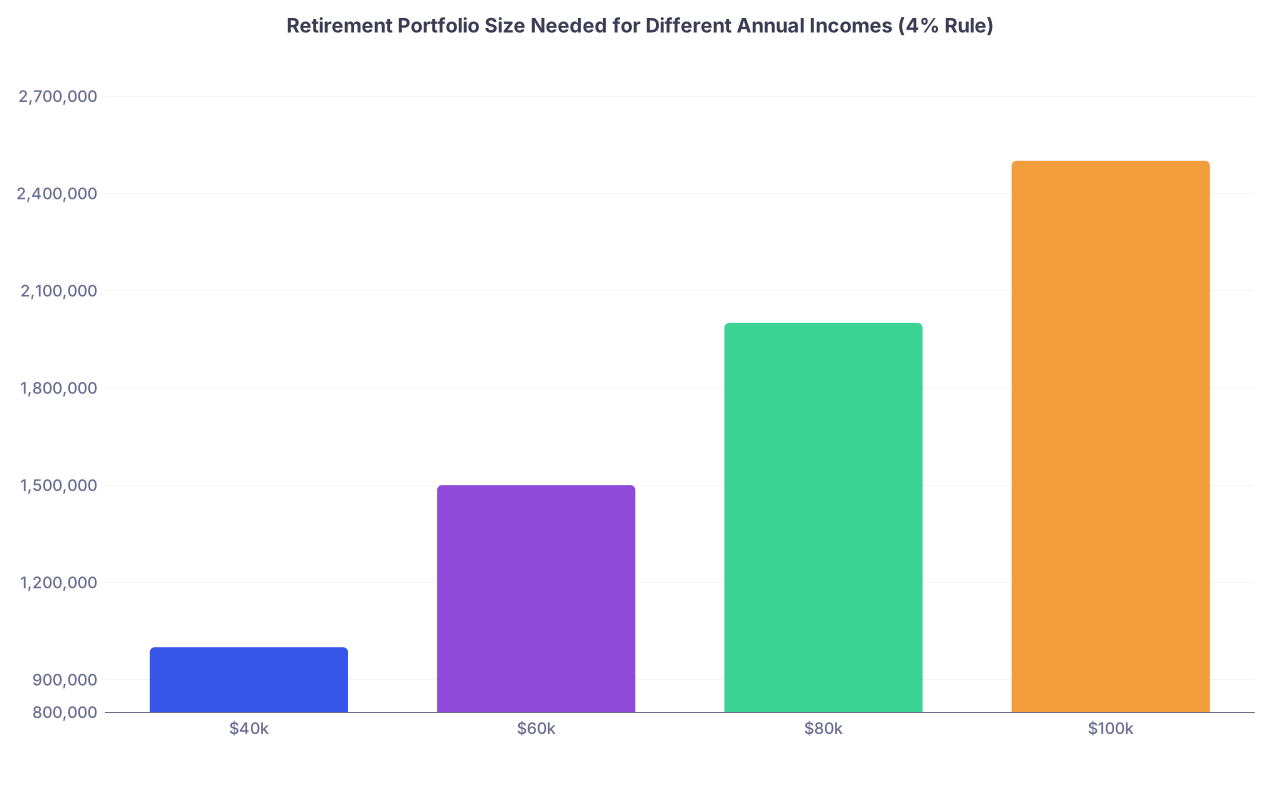
| Category | Value |
|---|---|
| $40k | 1000000 |
| $60k | 1500000 |
| $80k | 2000000 |
| $100k | 2500000 |
Step 5: Bring in Social Security, pensions, and reality
You are not starting from zero, and you are not 25. You have assets and you have time left. The question is how to make them work together.
5.1 Social Security — including spousal benefits
After a divorce, Social Security gets complicated, but there are rules you can use:
You may be eligible for divorced spousal benefits if:
- Your marriage lasted 10 years or more.
- You are currently unmarried.
- You are age 62 or older.
- Your own benefit is less than 50% of your ex’s full retirement age benefit.
This does not reduce your ex’s benefit. It is just a formula the SSA uses.
Also, if your ex dies, you may be eligible for divorced survivor benefits, which can be larger.
Action items:
- Create or log in to your mySocialSecurity account at ssa.gov and check:
- Your estimated benefits at 62, full retirement age, and 70.
- If your marriage lasted 10+ years and your ex had higher earnings:
- Call SSA and explicitly ask about divorced spousal and survivor rules.
5.2 Pensions
If you have a pension (or a QDRO portion of an ex’s pension):
- Get the official pension estimate:
- Ask for projections at ages 60, 62, and full retirement age.
- Note:
- Is there a cost‑of‑living adjustment (COLA)?
- Survivor benefit options?
This is guaranteed income. It reduces the amount your portfolio has to cover.
5.3 Recalculate your target with income sources
Say you need $60,000/year.
- Social Security (at your planned start age): $22,000/year.
- Pension at 65: $10,000/year.
Total guaranteed: $32,000/year.
Gap: $60,000 – $32,000 = $28,000/year from savings.
Portfolio needed at 4%: $28,000 ÷ 0.04 = $700,000.
That is a completely different problem than needing $1.5 million.
Now compare that target to what you have today. If you currently have, say, $270,000 saved, the question becomes: “How aggressively do I need to save and invest to get from $270k to $700k in my timeframe?”
Step 6: Set a realistic retirement age and savings rate
Here is where most people lie to themselves.
You cannot keep the old couple‑based retirement age just because you like the sound of it. The math has to work.
6.1 Use a simple projection first
You do not need fancy software to sanity‑check your path.
Let’s assume:
- Current retirement savings: $270,000.
- Annual contribution: $18,000 (401(k) + IRA).
- Investment return: 5–7% per year long term (use 5% to be conservative).
- Years to retirement: variable.
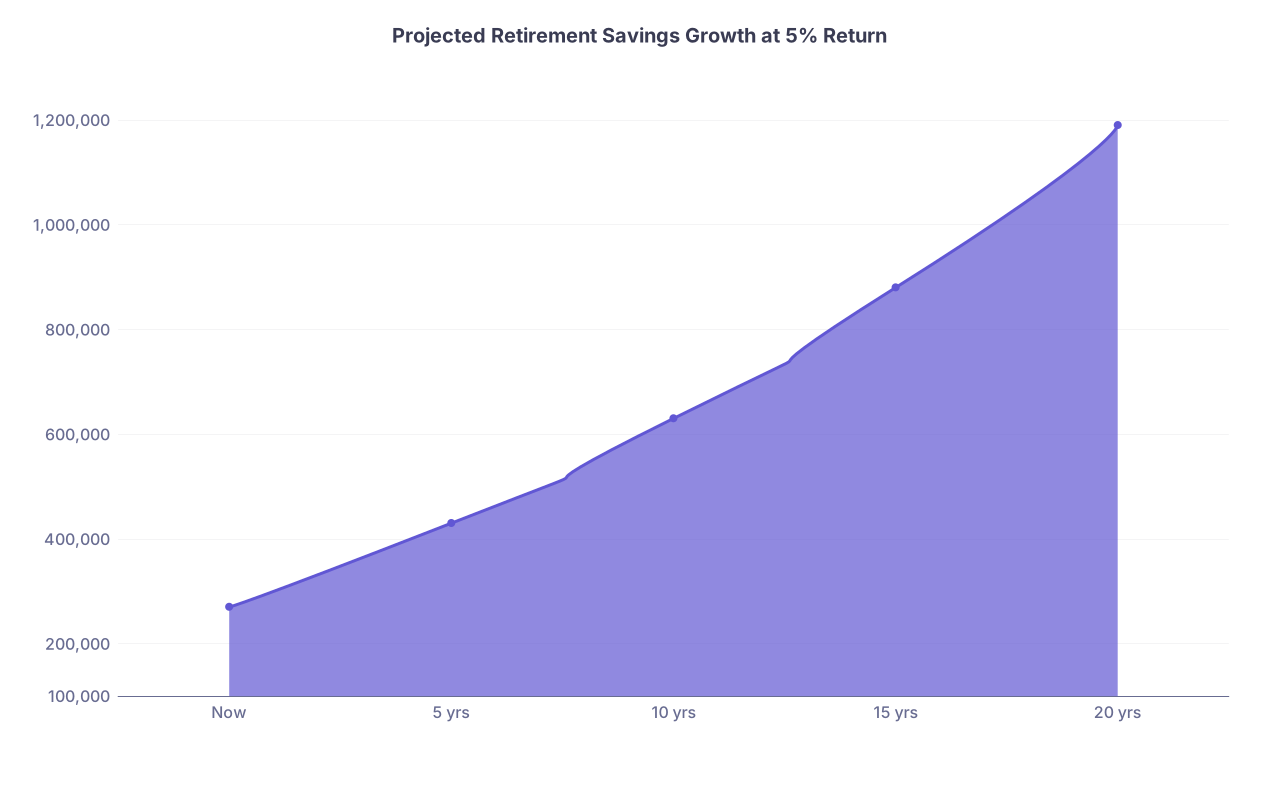
| Category | Value |
|---|---|
| Now | 270000 |
| 5 yrs | 430000 |
| 10 yrs | 630000 |
| 15 yrs | 880000 |
| 20 yrs | 1190000 |
Roughly, at 5%:
- 10 years: around $630,000.
- 15 years: around $880,000.
If you are 50 now:
- Retire at 60 → tight but maybe doable.
- Retire at 65 → much more margin.
The point: adjust either your retirement age, your savings rate, or your lifestyle target until the numbers line up.
6.2 Prioritize tax‑advantaged accounts
As a single filer, your tax picture changed. That affects where you should save:
Priority order for most people:
- 401(k)/403(b) up to employer match (never leave match money on the table).
- High‑interest debt payoff (credit cards, personal loans).
- Roth IRA (if you qualify by income; 2024 limit is $7,000 if under 50, $8,000 if 50+).
- Back to 401(k) up to annual max.
- Taxable brokerage for additional investing.
If you are older (50+), use catch‑up contributions aggressively. That is one of the few legal cheat codes left.
Step 7: Clean up and consolidate your retirement accounts
Post‑divorce, your accounts are probably a mess. Multiple 401(k)s, small IRAs, maybe a QDRO account at a different custodian. Scattered investments invite neglect.
Goal: Fewer accounts, clearer structure, consistent investments.
7.1 Smart consolidation moves
Often sensible:
- Roll old 401(k)s into:
- Your current employer’s 401(k), or
- A single rollover IRA at a low‑cost provider (Vanguard, Fidelity, Schwab).
- Consolidate multiple IRAs of the same type:
- Traditional IRAs into one.
- Roth IRAs into one.
Be cautious about:
- Rolling pre‑tax money into a plan if you might want to do backdoor Roth IRAs later (pro‑rata rules can bite you).
- Touching money still tied up in unresolved QDRO processes.
7.2 Reset your investment strategy
Your risk tolerance and timeline changed. So should your portfolio.
Simple, robust approach for many single investors:
- One target‑date index fund per account that matches your approximate retirement year.
- Example: retiring around 2035 → Vanguard Target Retirement 2035.
- Or a 3‑fund portfolio:
- US total stock market index.
- International total stock index.
- US total bond market index.
What you avoid:
- Chasing individual stocks.
- Overconcentration (e.g., 70% of your portfolio in one company’s stock).
- Letting old, random fund choices from 15 years ago dictate your future.
This is about automation and sanity, not bragging rights.
Step 8: Rebuild your safety nets as a single person
Retirement planning without risk management is fantasy.
Divorce changes who depends on your income and how vulnerable you are to shocks.
8.1 Emergency fund
Target:
- 3–6 months of core expenses if you have stable employment and no dependents.
- 6–12 months if:
- You are self‑employed.
- You are the sole provider for children.
- Your job is insecure or cyclical.
Do not confuse a HELOC or credit card with an emergency fund. Those are backup tools, not the primary safety net.
8.2 Insurance reality check
Post‑divorce, check:
- Health insurance
- Are you on your own employer’s plan, COBRA, ACA marketplace?
- COBRA is temporary and can be expensive; mark the end date now.
- Life insurance
- Court‑ordered coverage to secure alimony/child support?
- If no dependents rely on your income, you might reduce coverage.
- Disability insurance
- If you are single and rely solely on your income, long‑term disability is critical.
- Long‑term care
- In your late 50s or early 60s, start evaluating options (insurance, asset earmarking, or family plan).
- You cannot assume an ex will care for you, and you should not.
Step 9: Sync your estate plan with your new life
I routinely see divorced people walking around with wills and powers of attorney that name their ex as the primary decision‑maker. Years later.
That is not “romantic.” That is reckless.
Update:
- Will
- Who inherits your assets?
- Who is executor?
- Powers of attorney
- Financial POA – who handles your money if you become incapacitated?
- Medical POA / health care proxy – who makes medical decisions?
- Living will / advance directive
- Your preferences for life support, end‑of‑life care.
Your divorce decree may also require you to:
- Maintain certain life insurance with specific beneficiaries.
- Maintain retirement account beneficiaries for minor children via a trust.
Get a local estate attorney to align these with both state law and your decree. This is not a DIY area if your situation is at all complex.
Step 10: Build a 12‑month “post‑divorce financial reboot” plan
You have the pieces. Now you need a simple, time‑bound game plan.
Think 12 months, not 12 years. You can always course‑correct.

| Step | Description |
|---|---|
| Step 1 | Month 1-2 - Stabilize Cash Flow |
| Step 2 | Month 2-3 - Legal/Account Cleanup |
| Step 3 | Month 3-4 - Define Retirement Targets |
| Step 4 | Month 4-6 - Reset Investments |
| Step 5 | Month 6-9 - Build Emergency Fund |
| Step 6 | Month 9-12 - Maximize Contributions and Update Estate Plan |
Sample structure:
Months 1–2
- Finalize your budget and cash flow.
- Open new accounts and redirect income.
- List all retirement assets and debts.
Months 2–3
- Confirm QDRO processing and IRA transfers.
- Update beneficiaries where allowed.
- Start consolidation planning.
Months 3–4
- Estimate retirement income needs and target number.
- Pull Social Security and pension estimates.
- Decide a provisional retirement age.
Months 4–6
- Consolidate scattered accounts.
- Choose a simple investment strategy (target‑date or 3‑fund).
- Automate monthly contributions.
Months 6–9
- Build or refill emergency fund.
- Tackle highest‑interest debt.
- Review insurance and adjust coverage.
Months 9–12
- Increase retirement savings percentage if possible.
- Meet with a fee‑only planner or CPA for a tax and plan review.
- Update will, POAs, and beneficiary designations.
This is how you turn a chaotic life change into a concrete financial reset.
When to bring in professionals (and how not to get fleeced)
You probably should not do all of this alone.
The trick is to get help from people who are:
- Competent.
- Fiduciary (legally obligated to act in your best interest).
- Paid in a way that does not bias their advice.
Useful players:
- Certified Divorce Financial Analyst (CDFA) – best during divorce, but some also help with post‑divorce implementation.
- Fee‑only CFP® – ideally one who works hourly or flat‑fee, not just on assets under management.
- CPA/EA – to adjust withholdings, filing status, and long‑term tax projections.
- Estate planning attorney – to rewrite your legal documents.
What you avoid:
- “Advisors” who mainly want to roll your accounts into high‑fee annuities.
- Anyone who cannot (or will not) clearly explain how they are paid.
Emotional truth: retirement planning after divorce feels different
You are not just solving a math problem. You are rebuilding a future that probably looked very different 5 years ago.
Some days you will feel behind. Some days you will feel angry at the split of assets. Some days you will be tempted to say “screw it” and ignore the numbers.
Do not. You have more control than it feels like right now.
What I have seen, repeatedly:
- People who got divorced in their late 40s, panicked, then got serious about saving and ended up retiring at 67 with more independence than they ever had in their marriage.
- People who used the divorce as a clean slate to simplify their investments, cut lifestyle bloat, and realize they never needed half the stuff they were fighting over.
The point is not to “win” the divorce. That part is done.
The point now is to win your own retirement.
Quick reference: key levers you can actually pull
To reboot your retirement after divorce, your main controllable levers are:
- Retirement age – working 3–5 years longer can dramatically improve the math.
- Savings rate – even +5–10% of income is huge over a decade.
- Spending level in retirement – you do not need the same lifestyle you had as a couple.
- Investment risk level – enough risk to grow, not so much that you panic sell.
- Debt decisions – especially mortgages, car loans, and credit cards.
- Where you live – downsizing or relocating can be the single biggest unlock.
Everything else – past mistakes, what your ex got, the market last year – is sunk cost.
FAQs
1. I’m 55, recently divorced, and feel way behind. Is it even realistic to fix my retirement now?
Often, yes. You probably will not retire at 60 to a beachfront condo, but that is not the only definition of success. At 55, you still may have:
- 10–15 working years.
- Catch‑up contribution limits.
- Social Security timing options.
Your main moves are:
- Maximize all tax‑advantaged accounts (401(k), IRA, HSA if available).
- Delay Social Security to increase benefits, if your health allows.
- Consider working part‑time in “retirement” for a few years.
- Reduce your target lifestyle costs (housing especially).
The difference between saving nothing and saving 20–25% of your income from 55–67 is enormous. Do not let the feeling of being behind stop you from starting.
2. Should I pay off my mortgage before retirement or focus on investing more, now that I am single?
There is no one‑size answer, but a solid rule: you want either a paid‑off home or a very manageable fixed housing cost by retirement. As a single person, that stability matters more.
Guidelines:
- If your mortgage rate is low (e.g., 3–4%), it often makes sense to:
- Prioritize maxing tax‑advantaged retirement accounts.
- Make regular payments and maybe small extra principal payments.
- If your rate is high (e.g., 6–7%+), aggressive paydown can be effectively a high‑yield, risk‑free “investment.”
- Emotionally, many single retirees sleep better with a paid‑off home, even if the math slightly favors investing.
Run both scenarios with real numbers, not guesses. The right answer is the one that balances math and your stress level.
3. I received part of my ex’s 401(k) in the divorce. Can I cash some of it out to reset my life?
Technically, yes. Strategically, usually a bad idea.
With a QDRO, you can often take a distribution from the 401(k) without the 10% early withdrawal penalty, but:
- You will still owe income tax on the amount.
- You are permanently shrinking your retirement base at the worst possible time.
- That money, invested over 10–20 years, could easily double or more.
If you must use some for immediate essentials (legal bills, housing deposit), keep it as small as you can, and move the rest into an IRA or the plan as a long‑term asset. Your “fresh start” will not feel very fresh at 75 if you raided the only serious retirement money you had.
Open your latest account statement or log into one retirement account right now. Write down the balance, your current contribution, and your age. Then ask a simple question: “If I keep doing exactly this, where will I be at 65?” If you do not like the answer, today is the day you start the reboot.