

It’s 11:47 p.m. You’re home post-call, half-eaten takeout on the counter, and you just opened your 401(k) portal for the first time in… months. Maybe years. The number staring back at you is way smaller than you think it “should” be for an attending.
And your brain immediately goes there:
“I’m screwed.” “I’ll never be able to retire.” “Everyone else started in residency and I wasted years.” “What if I’m that 70-year-old hospitalist still grinding nights because I can’t afford to stop?”
You’re not thinking, “What’s my optimal asset allocation?”
You’re thinking, “Did I already ruin this?”
Let me say this clearly: starting late sucks. It does. It’s not ideal.
But being late is not the same as being doomed.
You’re not too far behind to fix this. But the window for pretending it will magically fix itself is closed. That part’s over.
Let’s walk through this like two people sitting in the residents’ lounge at midnight, trying not to spiral.
First: How “Behind” Are You Really?
Your brain is probably doing that catastrophic thing where it compares your worst-day number to someone else’s best-case fantasy.
You’re thinking of:
- The co-resident who bought a house 6 months into attendinghood
- The colleague who casually mentioned their “seven-figure portfolio”
- The FIRE blog you read where a 32-year-old has $1.5M invested
Meanwhile, you’re staring at:
- Maybe $0–$150k in retirement accounts
- Student loans you’d rather not think about
- A lifestyle that already feels stretched
Let’s put some rough numbers to “behind.”
| Age | Comfortable-ish Target* |
|---|---|
| 35 | 0.5–1× your annual income |
| 40 | 1–2× your annual income |
| 45 | 2–3× your annual income |
| 50 | 3–5× your annual income |
*Not commandments. Just ballpark ranges often used in financial planning.
So, if you’re:
- 40, making $350k, and have $150k saved → behind, but workable
- 45, making $400k, and have $100k saved → that’s more “uh-oh,” but still not game over
- 50 with less than $200k → yeah, that’s serious…but still not hopeless if you’re willing to be aggressive
The problem is, physicians love to go straight from “I’m behind” to “I’ll be working until I die” with no middle ground.
Reality is more boring:
You probably are behind.
You probably can catch up if you stop pretending you have infinite time.
The Harsh Truth: You Can’t Have Everything Now
The math of “starting late” is actually pretty simple, and no one likes it.
When you start late, you no longer get to have:
- Full-on attending lifestyle now
- Minimal savings now
- Fully funded, early retirement later
Pick two. That third one dies.
Everyone dreams of the combo:
“I want the six-figure house, private school, nice cars and a secure age-60 retirement.”
If you started saving in your mid-30s or 40s, that’s usually not realistic unless:
- Your income is unusually high (ortho, derm, some surgical subs) and
- You’re willing to live like a normal upper-middle-class person, not a TV doctor
You don’t have to live like a resident forever. But you probably can’t live like the hospital’s highest-spending attending and also magically “catch up” without consequences.
This is the tradeoff most late-savers secretly hope they can dodge.
You can’t.
But once you accept that, the path forward gets much, much clearer.
What “Catch-Up” Actually Looks Like (The Scary But Honest Part)
Let’s do some uncomfortable but useful math.
Say you’re 42, making $350k, with $100k in investments and you want to retire at 62.
Assume:
- 6–7% annual real (after inflation) returns
- Saving aggressively but not insanely
If you:
- Save ~20% of your gross income ($70k/year)
- Over 20 years
- Invested in a broadly diversified stock-heavy portfolio
You’re looking at something in the low seven figures. Ballpark $2–2.5M, maybe more if returns cooperate and you increase contributions.
Is that “you’re rich forever” money? No.
Is that “you won’t be destitute and can have a decent retirement” money? Yes.
If you bump that up to saving 25–30% of gross, the numbers get a lot nicer. Especially if your income increases over time and you keep lifestyle creep on a leash.
That’s what “catch up” actually means:
- Savings rate in the 20–30% of gross income range
- For 15–25 years
- Invested, not sitting in cash
- With lifestyle that feels a bit constrained compared to some colleagues
Not magical. Not impossible. Just…disciplined and a little uncomfortable.
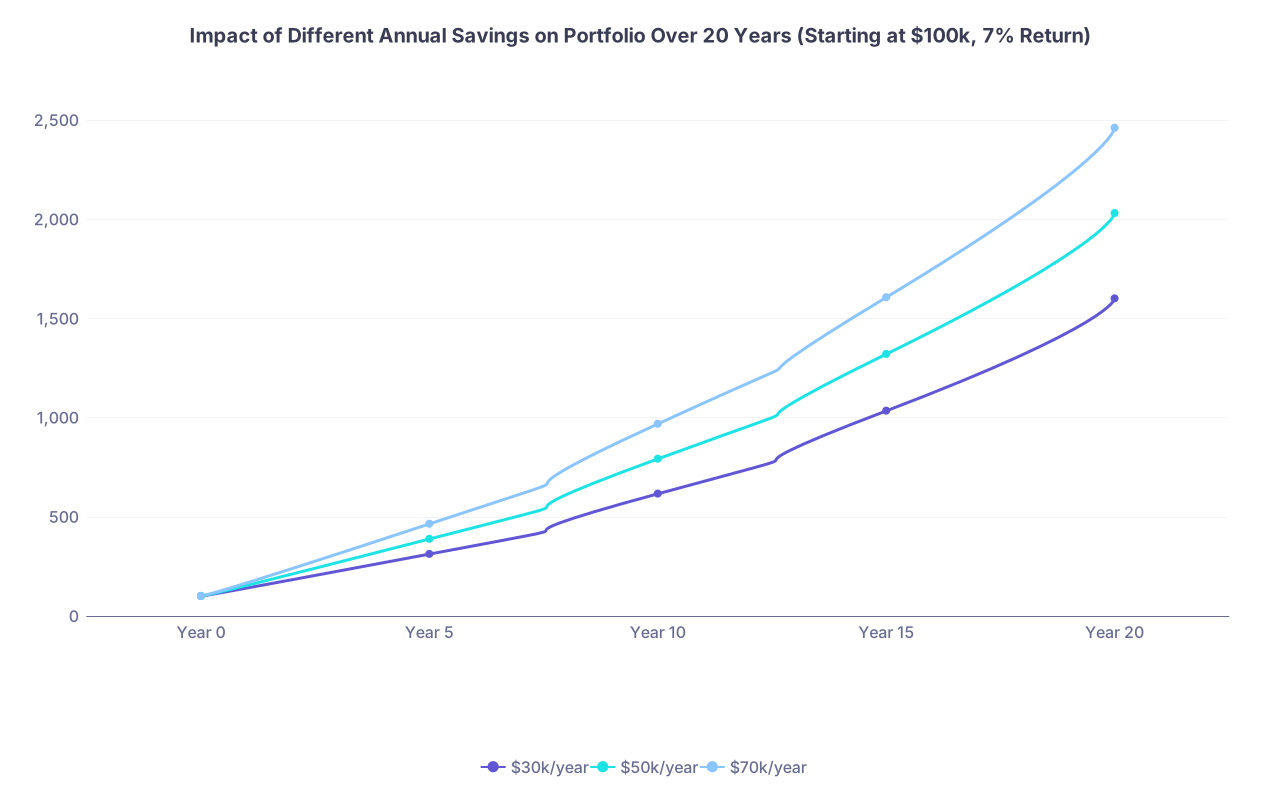
| Category | $30k/year | $50k/year | $70k/year |
|---|---|---|---|
| Year 0 | 100 | 100 | 100 |
| Year 5 | 312 | 388 | 464 |
| Year 10 | 616 | 792 | 968 |
| Year 15 | 1034 | 1320 | 1606 |
| Year 20 | 1600 | 2030 | 2460 |
(Values in thousands. Rough, not exact, but you get the idea.)
The later you start, the more your outcome depends on:
- How much you save
- How long you work
- How much lifestyle you’re willing to sacrifice
The Mental Spiral: “Everyone Else Is So Far Ahead”
This part is brutal because it’s invisible. Physicians don’t walk around with their net worth printed on their badges.
You see:
- BMWs and Teslas in the physician lot
- Instagram vacation photos from Maldives
- The surgeon with two kids in private school, nanny, and a second home
You don’t see:
- Their 401(k) balance
- Their brokerage account
- Their credit card debt
- The refinancing deal they regret
- The fact some of them are more broke than you
I’ve seen physicians making $600k with less in retirement than a hospitalist making $260k. Why? Lifestyle and denial. Period.
Starting late feels uniquely shameful because it’s one of those “I should have known better” things doctors torture themselves over.
Let’s be blunt: your training actively worked against you.
- You spent your 20s and early 30s underpaid
- Everyone around you normalized debt and delayed gratification
- You probably didn’t have decent financial education
- The system implicitly said, “Just survive now, you’ll catch up later”
Then “later” hits, and you realize no one handed you the playbook for how to catch up.
So no, you’re not some uniquely irresponsible disaster. You’re extremely normal for this profession.
Now you just have to stop being normal and start being intentional.
Concrete Moves If You’re Starting Late
This is where your anxiety wants a checklist. Fair.
Here’s the bare minimum I’d do if I were an attending who started late and was freaking out.
1. Stop Guessing. Actually Run the Numbers.
This part is painful, but you can’t fix what you refuse to look at.
You need:
- Current retirement/investment balances
- Current debts (student loans, mortgage, car, credit cards)
- Your real, after-tax income
- Your actual spending (not what you “think” it is)
Then either:
- Use a simple retirement calculator (Bogleheads, Vanguard, Physician on FIRE type tools)
- Or pay a fee-only fiduciary advisor for a one-time plan
Not an AUM advisor who wants 1% of your assets forever to rebalance a 3-fund portfolio. A flat-fee planner who’ll sit down and say: “Here’s what you need to save and by when.”
Is it scary? Yes.
Is it better than lying awake imagining worst-case scenarios with no data? Also yes.
2. Crank Up Your Savings Rate — Like, Uncomfortably High
If you’re starting at 40+ and worried, 10% savings isn’t a plan. It’s a wish.
For late starters, I’d be looking at:
- 20% of gross income as “minimum”
- 25–30% if you’re really behind or want flexibility later
Order of operations often looks like:
- Max 401(k)/403(b)/457(b) if available
- Backdoor Roth IRA (if appropriate)
- Taxable brokerage account
- Only after you’re hitting those, start upgrading lifestyle stuff again
You can absolutely do this gradually over 6–12 months. But the endpoint has to be serious.
3. Fix the Big Leaks First
Cutting Starbucks won’t fix being 10 years behind. You already know that.
Late-start physicians usually get killed by:
- Oversized housing (too much house, too soon)
- Car payments that could be a 401(k) contribution
- Private school when public was fine
- Lifestyle inflation every time comp goes up
If I were behind, I’d be questioning:
- Can I refi or downsize housing within 5 years?
- Do I really need $1,200/month in car payments?
- Are we saying “yes” to every big expense because “we’re attendings now”?
You don’t have to nuke your life. But if you’re serious about catching up, something’s gotta give.
What If It Really Is Too Late for a Perfect Outcome?
Here’s the part your brain doesn’t want to hear but might secretly need: you might not get the flawless retirement fantasy.
You might:
- Need to work until 65–70 instead of 60
- Need to cut back instead of fully retiring
- Need to accept less travel / smaller house / fewer “luxury” expenses later
That’s not failure. That’s reality.
A lot of physicians end up doing:
- 0.8 or 0.6 FTE in their early 60s
- Locums a few weeks a year
- Teaching, admin, low-stress clinic work
Not because they’re “broke,” but because full-stop retirement at 60 with a huge lifestyle is just mathematically tough when you started at 40+.
You’re allowed to:
- Redefine what “retirement” looks like
- Decide you’d rather have some work you like and more flexibility than grind yourself into the ground for 10 years to hit a magic number
The point is not to be perfect. The point is to not be trapped.

Red Flags That You’re Not Just Behind — You’re in Denial
Since you’re reading this, you’re probably already past the full-denial stage. But let me call out a few behaviors I see that scream “this person will be working forever and doesn’t know it yet.”
You might be in trouble if:
- You “don’t know” how much you save each year
- You think your house is your retirement plan
- You’re over 40 and have never run a retirement projection
- You assume an inheritance will bail you out (it often won’t or will come too late)
- You keep telling yourself, “I’ll save more when X happens” (loan payoff, kids older, next promotion) — but X keeps changing
Being anxious and reading this? Honestly healthier than confident and oblivious.
Anxiety, used correctly, is information. Your brain is saying, “We’re off track. Fix this.”
How to Not Let This Consume You
The hard part of starting late isn’t just the math. It’s living with the feeling that you’re perpetually “behind,” like you’re running a race where everyone else got a 10-lap head start.
A few things that actually help:
Anchor to your own numbers, not someone else’s flex.
Your savings rate + your timeline + your goals. That’s it.Automate everything you can.
Auto-transfers to investment accounts the day after payday so you’re not relying on “discipline” every month.Pick a review schedule and then stop obsessing daily.
Once a month or once a quarter: check in, adjust, move on. Watching day-to-day market swings when you’re already anxious is self-torture.Accept that discomfort is part of this.
It will feel tight sometimes. You’ll say “no” to things other attendings say “yes” to. That’s the price of compressing 25 years of saving into 15–20.

| Step | Description |
|---|---|
| Step 1 | Realize behind on retirement |
| Step 2 | Gather numbers |
| Step 3 | Run projection or hire planner |
| Step 4 | Increase savings to 25 to 30 percent |
| Step 5 | Increase savings to 15 to 20 percent |
| Step 6 | Cut big expenses and adjust lifestyle |
| Step 7 | Automate investing |
| Step 8 | Review plan yearly |
| Step 9 | Gap large or small |
FAQ (Exactly 6 Questions)
1. I’m 45 and only have about $150k saved. Is it even realistic to retire?
Yes, but probably not “traditional full-stop retirement at 60 with a big-spending lifestyle” unless your income is high and you’re willing to save aggressively now. More likely: working into your late 60s, or doing phased retirement (reduced hours, lower-stress work) once you’ve built enough of a cushion. The key is to stop guessing and get real numbers: what you spend, what you could save at 20–30% of gross, and what that grows to over 20+ years.
2. Should I pay off my student loans first or prioritize retirement since I’m late?
If you’re truly behind on retirement, doing “loans first, then savings later” is how you end up 50 with no investments. Usually a both approach works better: refinance loans if appropriate, pay them down steadily, but still put a meaningful percentage (at least 15–20% of gross) toward retirement. The time you lose in the market is way harder to get back than an extra year or two of loan payments.
3. Is maxing my 401(k) enough if I started late?
Usually no. Maxing a 401(k) is great, but if you’re 40+ and behind, that often won’t be sufficient by itself. You’ll probably need: 401(k)/403(b), maybe a 457(b) if available, plus a taxable brokerage account. Don’t let “I max my 401(k)” be the end of the conversation; you need to look at your total savings rate relative to income and your age.
4. What if the market crashes right when I’m trying to catch up?
It will. At some point. Probably more than once. That’s not a bug; that’s how long-term returns exist. If you’re 40–55 now, a crash actually helps you if you’re buying regularly — you’re scooping up assets on sale. The real risk is panicking and going to cash or never starting because you’re waiting for the “right time.”
5. Should I work more (extra shifts, locums) to catch up faster?
Temporarily, this can be a powerful lever — if you can actually force yourself to save the extra income instead of letting lifestyle expand with it. If you’re already burned out, though, adding more clinical hours just to pad your retirement may backfire. I’d treat extra work like a time-limited sprint: “I’ll do 12–18 months of locums / extra call, and every dollar net goes straight to investments or debt,” then stop.
6. How much do I really need to retire if I’m okay with a simpler lifestyle?
This is the one question everyone wants a magic number for. A rough rule is the 4% rule: if you have $2M, 4% is $80k/year, adjusted for inflation. Add Social Security and maybe some part-time work and you might be fine, especially with a paid-off house and modest spending. But the exact number depends on your expenses. That’s why tracking what you actually spend now (and realistically in retirement) matters more than chasing someone else’s arbitrary “you need $5M” number.
Bottom line, if you remember nothing else:
- Being late is fixable. Being in denial is not.
- Catching up means high savings rates, real tradeoffs, and time in the market — not magic.
- You don’t need a perfect retirement. You need one where you’re not trapped, and you absolutely still have time to build that.


