

It’s 11:37 pm on a Tuesday. You closed your work laptop an hour ago… then opened your bank app. Then your retirement account. Then that random online calculator that calmly tells you you’ll “need $2.1 million to retire comfortably.”
You feel like you can barely get through this week, and some cheerful calculator is telling you to keep doing this for another 15–20 years.
And the thought hits you, like a punch:
What if I burn out before I’m financially ready to retire?
Not a cute “I need a long weekend” tired. The real fear:
- What if my brain just… stops cooperating?
- What if I can’t keep doing this job at this pace?
- What if my body gives out?
- What if I get pushed out or laid off and it’s not my choice?
And the math doesn’t work yet. Your retirement account isn’t where “they” say it should be. The articles you read are talking about people maxing out 401(k)s from age 25 and “coasting” at 50. Meanwhile you’re thinking: coasting where? I’m barely staying upright.
Let’s be blunt: the fear is not irrational. People do burn out. People do get pushed out of jobs in their 50s. People do end up working longer than they wanted to because the money isn’t there.
But “not irrational” doesn’t mean “inevitable doom.” It means you need a plan that assumes you might hit a wall before a textbook-perfect retirement age.
I’m going to walk through this like someone who’s had the 2 a.m. spiral, not like some retirement brochure.
First: Let’s Name the Actual Fear (It’s Not Just “I’m Tired”)
There are a few specific flavors of panic hiding under “burnout” + “retirement.”
- “I won’t be able to tolerate this job for another 15–20 years.”
- “If I slow down, my income drops, and then I’ll never be able to retire.”
- “If I crash and can’t work, I’ll lose everything.”
- “I’m already behind, and I’m running out of time to catch up.”
All of that kind of collapses into one monster thought:
“If I don’t keep grinding at this level, my future is ruined.”
That belief is the problem. Not that burnout exists. Not that your job sucks right now. The all-or-nothing story.
The good news: that story is wrong. The bad news: it’s going to take actual choices and tradeoffs to change it. But there is a middle path between:
- “Work like a martyr until 67, then collapse”
- “Quit now, live under a bridge”
There are more levers than you think.
Reality Check: How Bad Is “Behind”?
I know you probably hate numbers right now, but we need a quick, grounded snapshot so we’re not fighting ghosts in your head.
You don’t need a 25-tab spreadsheet tonight. You just need the shape of the problem:
| Item | Target for Tonight |
|---|---|
| Emergency fund | 3–6 months bare-bones expenses |
| Retirement balance | Current total across all accounts |
| High-interest debt | Total of anything >8% interest |
| Monthly savings rate | % of gross income going to retirement |
| Burnout level | 1–10 scale (10 = non-functional) |
Don’t obsess over whether you “should” have 2x income saved by 40 or 3x by 45 or whatever rule of thumb you saw on Twitter. Those charts are averages, and half the people in those averages are lying to themselves anyway.
What actually matters:
- Do you have any safety buffer if you need to downshift?
- Are you saving something for future you (even if it’s not “ideal”)?
- How close are you to a short-term health/emotional breaking point?
If your burnout level is at like 8–10, that’s not a “try to squeeze out 20 more peak career years” situation. That’s “design a survivable Plan B while you still have some control” territory.
The Hard Truth: You Probably Can’t White-Knuckle It to 65
Let me be clear: most of the “just grind now and enjoy later” advice assumes your body and brain are infinite.
They aren’t.
I’ve watched way too many people do the exact same thing you’re thinking about:
- “I’ll just push hard for 5 more years, then reassess.”
- Suddenly it’s 10 years later, their health is wrecked, and they’ve had zero emotional bandwidth to actually fix their finances meaningfully.
- Or they get pushed out anyway – layoffs, industry change, health scare – but now they’re older, more exhausted, and have fewer options.
So no, I don’t think the answer is “suck it up and keep doing exactly this until your 60s.”
I think the answer is:
Assume burnout will put a cap on your highest-earning years sooner than you want.
Design around that now instead of pretending it won’t happen.
That sounds depressing, but it’s actually a weird kind of relief. Because then the question stops being, “Can I survive 20 more years of this exact nightmare?” and becomes:
“What mix of money + time + health gets me to a tolerable, realistic finish line?”
Your Real Goal: “Work-Optional” Before Full Retirement
You probably don’t actually need “never work another day starting at 55.” That’s the fantasy we cling to when we feel trapped. The real thing you want is:
- The ability to say no to toxic work
- The flexibility to downshift to less intense, lower-paid work
- The security to take breaks without panicking you’ll starve at 80
That’s work-optional, not work-zero.
You might not get complete retirement by 55. But you could absolutely aim for:
- 50–55: “I can leave this high-stress job and move to something easier with lower pay if I want to.”
- 60–65: “I can choose how much I work, and what kind.”
Think of it as staging your escape rather than holding out for one dramatic exit.
The Money Levers You Actually Have (Even if You Feel Stuck)
You can’t control the market. You can’t control layoffs. You can control a few key levers that directly relate to “what if I burn out early?”
1. Lower Your Future Minimum Lifestyle Requirement
The brutal part first: a lot of burnout-and-money panic is tied to lifestyle creep. Bigger house. Nicer car. Kids in 3 activities each. Eating like you’re already retired even though you’re working like you’re 25.
If you need $12K/month to feel “normal,” you’ll feel trapped at a toxic job for longer. If you can live okay on $6–7K/month, suddenly lower-paying, lower-stress work becomes viable.
That doesn’t mean “never have fun.” But it does mean:
- Stop assuming today’s lifestyle must be preserved forever.
- Treat some stuff as “temporary luxuries of peak earning years,” not permanent fixtures.
Because if the choice is:
“keep this house / these expenses” or “have the ability to walk away from burnout later”… I’d pick the second.
2. Increase Your “FU Cushion” (Even If It’s Small)
No, you don’t need a million dollars to have some breathing room. You need:
- A basic emergency fund (3–6 months bare-bones)
- Some retirement accounts that are actually growing, not zero
- As little high-interest debt as possible
That combo:
- Buys you time if you get laid off or need to quit
- Lowers the panic if you think about switching to something that pays less
- Makes disability leave or part-time work less terrifying
Right now, even adding $100–300/month more to savings or debt payoff has a disproportionate impact on your options later. It’s not about the exact compound interest math. It’s about freedom-of-movement insurance.
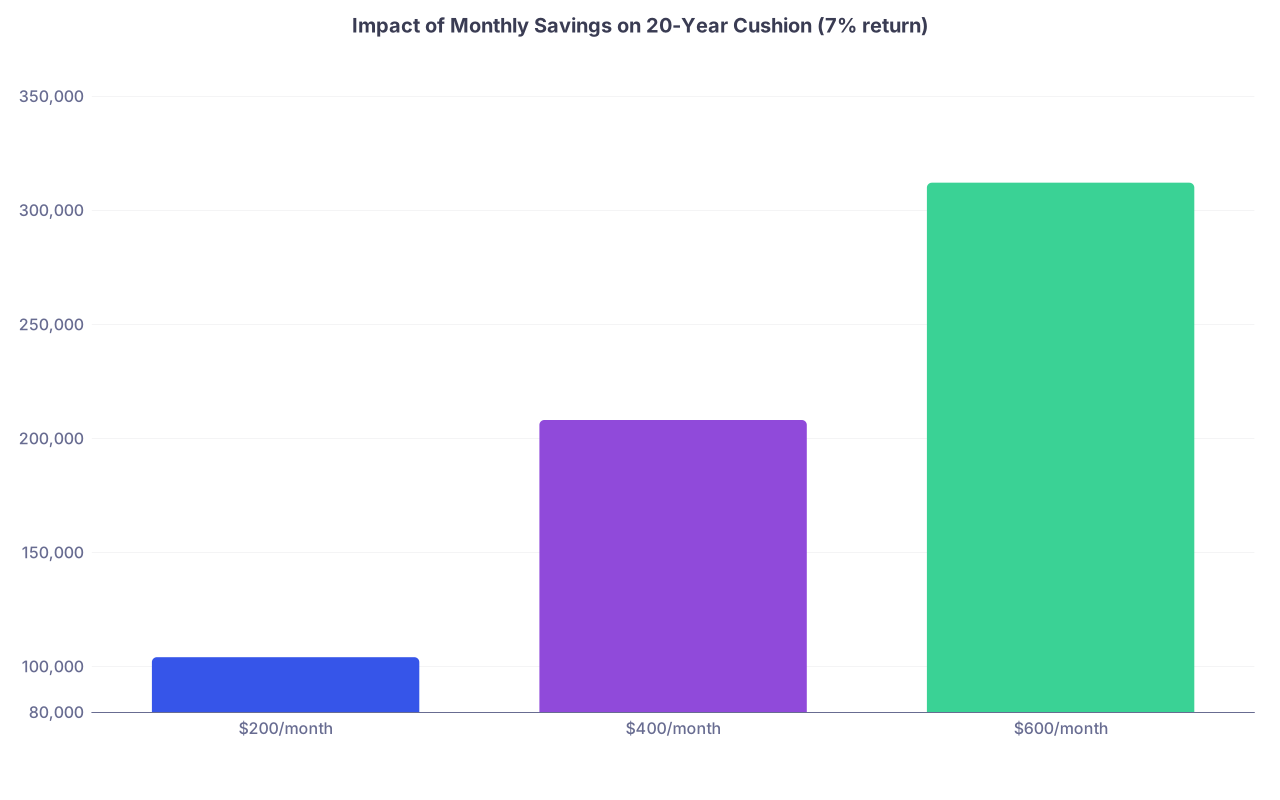
| Category | Value |
|---|---|
| $200/month | 104000 |
| $400/month | 208000 |
| $600/month | 312000 |
3. Protect Your Downside: Insurance and Legal Stuff
If you’re scared of “what if I just can’t work,” you need to stop ignoring the boring-but-critical stuff:
- Long-term disability insurance (through work or private)
- Life insurance if you have dependents
- Basic estate documents: will + beneficiary designations + power of attorney
Because worst-case burnout sometimes bleeds into actual medical issues: depression, anxiety disorders, heart problems. And those aren’t “push through it” situations.
If you lose the ability to work at full capacity, disability insurance can literally be the difference between “we had to move to a smaller place but we’re okay” and “our entire life blew up.”
Non-Money Levers: Make Work More Survivable (or Shorter)
Burnout is not only solved with money. It’s also solved with less brutal work.
Option A: Redesign Your Current Job
Before you mentally quit and move to a cabin, squeeze whatever flexibility exists:
- Can you push for partial remote?
- Can you reduce hours slightly (even at slightly less pay) to extend your career without breaking?
- Can you switch teams, managers, or roles within your company?
Think of this as extending your “usable” income-earning window. Even if you earn a bit less, 5–10 extra survivable years is way more valuable than 3 more years at 150% speed followed by a crash.
Option B: Plan a Controlled Downshift
Instead of fantasizing about walking out dramatically one day, map something like:

| Step | Description |
|---|---|
| Step 1 | Now - High stress job |
| Step 2 | 1-2 years - Save aggressively |
| Step 3 | Year 3 - Move to lower pay, lower stress role |
| Step 4 | Years 4-10 - Maintain work optional cushion |
| Step 5 | 55-60 - Decide on partial or full retirement |
That middle stage is key: keep working, but in a way that doesn’t grind you into dust. Lower pay, yes. Lower panic, also yes.
“But What If I Literally Break Before I Can Fix Any of This?”
That’s the ugliest fear, right? Not “eventually I can’t do this,” but “I might hit the wall next year while I’m still behind.”
Let’s do worst-case planning like adults:
If You Had to Stop Working This Year
What would actually happen?
- You’d live on:
- emergency fund (if any)
- unemployment (if laid off)
- disability (if you qualify)
- spouse/partner income (if applicable)
- downsizing / cutting back hard
That scenario sucks, yes. But it’s usually not “we’re homeless within 3 months” unless you’re already leveraged to the absolute edge.
So your job right now is to:
Make that scenario less catastrophic:
- Build some cash buffer
- Pay down high-interest debt
- Check disability options
- Clarify what expenses you could cut fast
Reduce the odds of that scenario:
- Take burnout seriously now, not when you’re already non-functional
- Use vacation days, therapy, boundaries, whatever you can to pull your burnout score down a notch
- Start quietly exploring less intense roles before you’re desperate
The terror comes from feeling like there’s a cliff and you’re blindfolded. The more you actually map out, “If X happens, we’ll do A, B, C,” the less power that cliff has over you.
Where Financial Planning Fits In (Without Being Overwhelming)
You don’t need a 40-page Monte Carlo simulation right now. You need a human-grade roadmap.
Here’s roughly what I’d want you to get to over the next 6–12 months:
| Priority Level | Focus Area |
|---|---|
| 1 | Emergency fund & debt control |
| 2 | Disability insurance & basic will |
| 3 | Steady retirement contributions |
| 4 | Job redesign / downshift plan |
| 5 | Optional: professional planner |
If you can afford it, a fee-only fiduciary advisor can be useful, but be picky. If they only want to talk about “maximizing returns” and nothing about your very real burnout limits, walk away. You need someone who understands that preserving your health is part of your financial plan, not opposed to it.
The Emotional Part Nobody Talks About
A lot of this fear is tangled with identity and shame:
- “I should be further along by now.”
- “Everyone else seems to be handling this.”
- “If I were stronger/more disciplined, I could just keep pushing.”
That internal script is garbage.
You’re not weak for not wanting to burn your life down to hit an arbitrary retirement number. You’re not a failure because you didn’t start maxing out your 401(k) at 23 while working 90-hour weeks and meditating daily.
You’re someone who wants:
- To not be constantly exhausted and miserable
- To not screw over future-you financially
- To not wake up at 60 and realize you traded your health for a lifestyle you barely enjoyed
That’s not unrealistic. It’s just… not automatic. You have to intentionally lower some expectations (especially around lifestyle and prestige) to buy back some margin for your mind and body.
What You Can Actually Do Today (Not in Theory, Not “Someday”)
Let’s get out of abstract mode. You’re tired. You probably don’t have the energy for a full financial overhaul tonight.
So here’s a one-evening plan that moves you from “vague dread” to “slightly more in control”:
Pull up:
- Your main checking account
- Your retirement accounts (401(k), IRA, etc.)
- Any debts (especially credit cards, personal loans)
Write down three numbers on a piece of paper (yes, actual paper):
- Total savings/cash
- Total retirement balance
- Total high-interest debt
Rate your burnout today from 1–10. Be honest.
Pick one of these to act on this week:
- Increase retirement contributions by 1–2% of pay (even if it feels tiny)
- Set up an automatic $50–100/month transfer to a basic savings account as your “burnout escape buffer”
- Schedule a meeting with HR to ask about disability coverage and how it works
- Send an email asking your manager for a conversation about workload, role changes, or flexible arrangements
Just one. Not all four. You’re not trying to fix your entire life tonight. You’re trying to prove to your brain that you’re not completely helpless.
FAQ – The 5 Questions I Know You’re Probably Still Asking
1. Am I just being dramatic? Plenty of people work until 65+.
No, you’re not being dramatic. Plenty of people also have heart attacks in their 50s, get put on antidepressants, or quietly hate their lives but feel trapped. You’re simply refusing to gaslight yourself. That’s progress, not weakness.
2. Should I pause retirement savings to deal with burnout right now?
If burnout is at a 9–10 and you’re genuinely close to breaking, yes, it can be rational to temporarily prioritize:
- cutting hours
- paying for therapy
- building a small emergency cushion
over maximizing retirement contributions. But “temporarily” is key. Don’t use burnout as an excuse to go to zero savings for 5 straight years if you can avoid it. Dial down, don’t flatline, if at all possible.
3. What if I have almost no retirement savings and I’m already in my 40s or 50s?
Then the fantasy of a full-stop retirement at 55 is probably dead. I’m not going to lie about that. But “full-stop retirement” isn’t the only win condition. You can:
- work longer in lower-stress roles
- reduce your lifestyle expectations
- use partial retirement (3–4 days/week) later on Late doesn’t mean hopeless. It means fewer options and more tradeoffs, but still options.
4. Is quitting a high-paying job for a lower-paying, lower-stress job always a mistake?
Not if the alternative is a mental or physical collapse that forces you out of the workforce entirely. Dropping from $180K to $110K in a sustainable role can be smarter than trying to hold $180K until you shatter and then end up at $0. The math changes when you factor in duration of earning and health costs.
5. How do I know if I should see a therapist vs. a financial planner?
If your thoughts sound like “I don’t care what happens, I just want out,” or you’re dealing with hopelessness, insomnia, panic, or thoughts of self-harm? Therapist first, no question.
If your main stress is “I don’t understand my numbers or my options,” and you’re mentally okay but overwhelmed? A fee-only planner can help. Honestly, both together is often ideal: therapist for your nervous system, planner for your spreadsheets.
Your next step, right now:
Grab a scrap of paper and write two headings: “Money” and “Work.” Under “Money,” write one action you can take this week (tiny is fine—1% contribution increase, $50 to savings, email HR). Under “Work,” write one action that makes your current situation even slightly more survivable (ask for a day off, schedule a workload talk, look at one job posting in a less intense area).
Then do one of those by the end of this week. Not someday. This week.


