

It’s 11:47 pm. You’re in bed, staring at the ceiling.
You should be relieved—you got out. You retired early from medicine like you said you would during that hellish intern year. But now the house is quiet, your inbox has no urgent messages, and this thought keeps drilling into your skull:
“What if I regret this? What if I made a huge mistake?”
You’re replaying every scenario.
What if you miss the identity? The income? The purpose? What if in five years, you want back in and can’t get hired? What if your skills decay and you’re stuck as “the doctor who left”? What if your money runs out exactly when you no longer can or want to go back?
Let’s talk about that. Not the Instagram version of “financial independence, retire early,” but the paranoid, what‑if‑everything‑goes‑sideways version. The version that actually lets you sleep at night because you planned for regret, instead of just hoping it doesn’t show up.
1. The Fear Behind “What If I Regret It?”
You didn’t spend a decade training, plus however many years practicing, just to casually walk away without a mental meltdown. Retiring early from medicine is not like quitting a gym membership.
You’re probably worried about at least three things:
Identity loss:
“If I’m not Dr. ___ seeing patients, who am I?”Financial “oh shit” moment:
“What if the market tanks, inflation spikes, and I live to 95?”Re‑entry risk:
“If I want to go back, will anyone still hire me? Will I remember how to be a doctor? Will credentialing destroy me?”
All of that is valid. None of that means you shouldn’t retire early. It just means your retirement plan has to be built for flexibility and reversibility, not just “walk away and hope.”
Let’s put some structure around the chaos in your head.
2. Financial Flexibility: Assume You Might Go Back
You don’t want to have to go back. You want to choose to go back, if you ever do.
That means your numbers can’t be razor‑thin. If you’re planning early retirement from medicine and you’re already anxious, a bare‑bones 4% rule with zero buffer will keep you up at night.
You want margins. Big ones.
Core idea: Build in “Return‑to‑Work Optionality”
Instead of asking, “What’s the absolute minimum I need to retire?” ask:
“How much do I need so that:
- If I never work again, it’s very likely enough
- If I do work again (even part‑time), it’s a bonus, not a rescue plan?”
That usually means one or more of:
- Closer to a 3–3.5% withdrawal rate than 4–5%
- A few years of cash or very safe bonds so you’re not forced back during a bear market
- A clear budget with worst‑case padding (healthcare spikes, unexpected dependents, divorce, etc.)
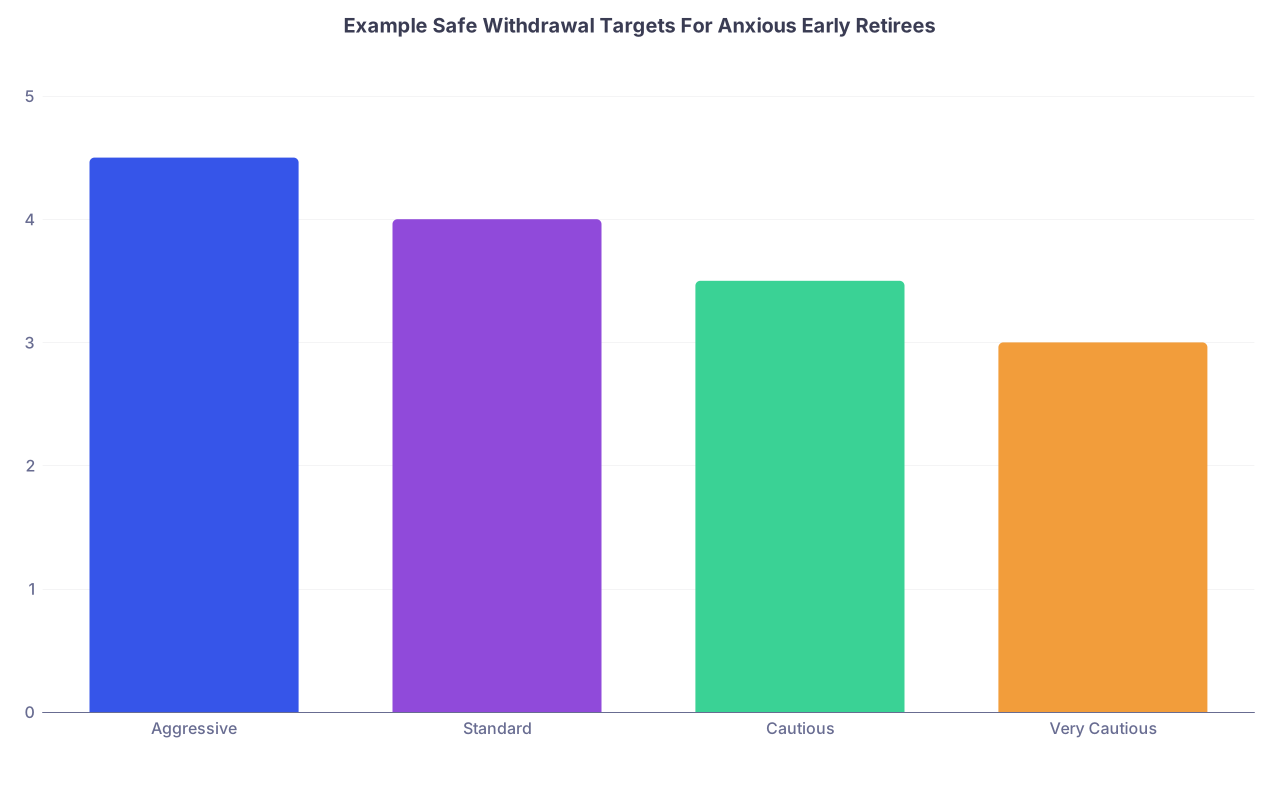
| Category | Value |
|---|---|
| Aggressive | 4.5 |
| Standard | 4 |
| Cautious | 3.5 |
| Very Cautious | 3 |
If you’re the type who worries, aiming “cautious” or “very cautious” is not overkill. It’s how you buy psychological safety.
Don’t Tie Up Everything
Huge mistake I see: people lock money into things that are hard to unwind—illiquid real estate, private deals, overfunded insurance products—then panic if they think they might go back or change directions.
At least some of your portfolio should be:
- Liquid
- Boring
- Easy to tap without huge penalties
You want the ability to pivot. To ramp spending down temporarily if you decide to retrain, take a locums gig, or move states.
Health Insurance: The Anxiety Multiplier
You know this already: losing employer health coverage is a shock.
If you’re not 65 yet, you need a real plan here, not “I’ll just figure out ACA.” And yes, the cost variability is terrifying.
| Option | Pros | Cons |
|---|---|---|
| COBRA | Same coverage temporarily | Expensive, time-limited |
| ACA Marketplace | Subsidies if income low | Complex, income planning vital |
| Spouse's Plan | Often stable, familiar | Depends on spouse's job |
| Part-time w/ Benefits | Keeps door to practice open | Limits schedule freedom |
If you’re planning to keep income low to qualify for ACA subsidies, that interacts directly with “going back” flexibility. Go back full‑time → income jumps → subsidies drop → expenses inflate. You want to model that now, while you’re still deciding.
3. Legal & Credentialing: Don’t Let Your License Die
Here’s the nightmare scenario that nobody thinks about until it’s too late:
You retire. You’re “done.” You stop worrying about CME and license renewals. Three years later you’re bored, you miss patients, your portfolio got punched by the market, and suddenly you want to return.
And then you realize:
- Your license lapsed
- Your DEA expired
- Your board certification is “not current”
- You haven’t done CME in years
Now you’re looking at reactivation, maybe remediation, maybe formal re‑entry programs. You’re not “taking a break from medicine” anymore. You’re trying to claw your way back into a profession that is—on paper—no longer sure you’re safe.
You do not want to be here.
Minimal Legal/Professional Maintenance (Even If You Think You’re Done)
Treat early retirement as a trial separation, not a legal divorce from medicine.
Bare minimum I’d keep active for at least 3–5 years after “retiring”:
- State license (or at least one state license)
- DEA (if you might ever prescribe again)
- Board certification if the maintenance requirements are tolerable
- Malpractice “tail” or clear documentation of coverage period for prior work
Yes, this costs money. Yes, you’ll resent paying license fees when you’re not practicing. But view it as an option premium. You’re buying the right—but not the obligation—to go back.
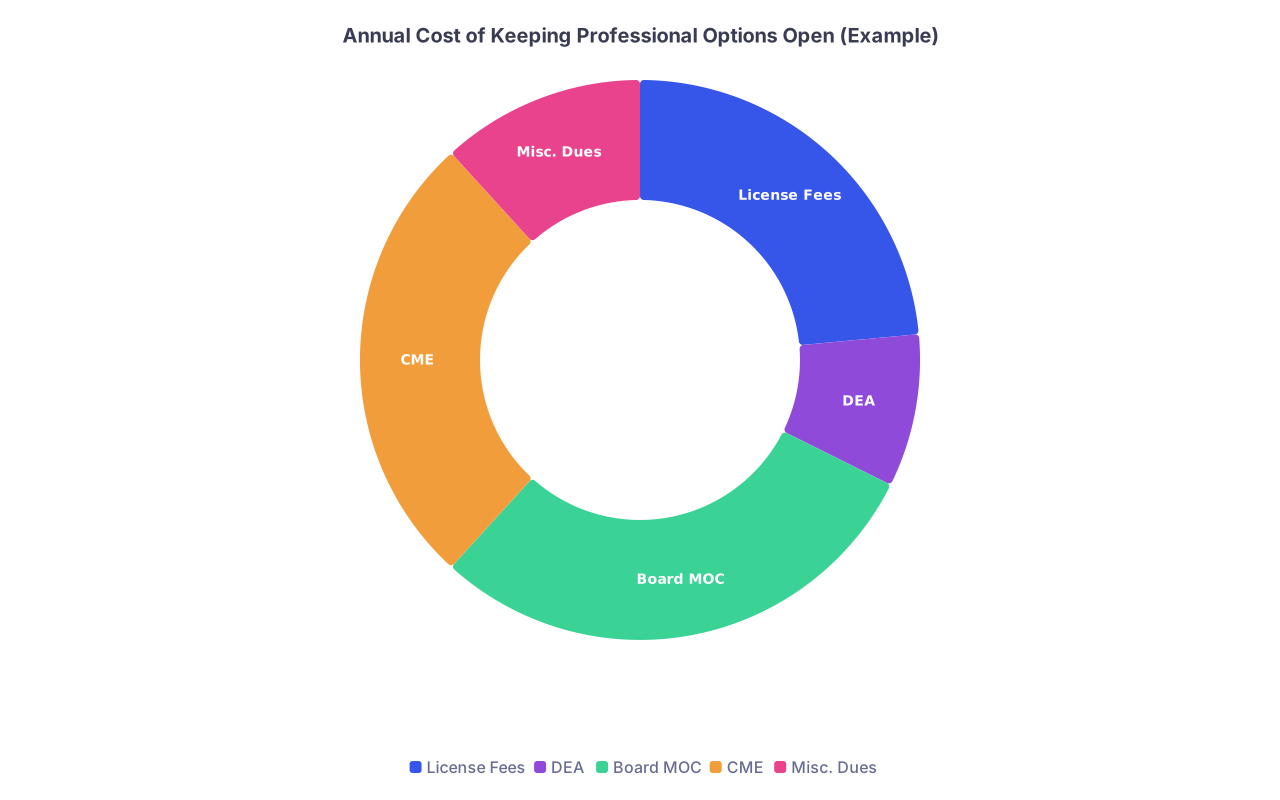
| Category | Value |
|---|---|
| License Fees | 800 |
| DEA | 300 |
| Board MOC | 1000 |
| CME | 900 |
| Misc. Dues | 400 |
Even at a couple thousand dollars a year, that’s nothing compared to the financial and emotional hit of having to re‑enter through a formal remediation path because you let everything lapse.
Documentation You’ll Be Glad You Kept
If you ever want to pick up locums, telemedicine, or part‑time clinical work, credentialing will ask for:
- Work history (often 5–10 years, no gaps)
- References from physicians who’ve seen your clinical work recently
- Procedure logs (for procedural specialties)
- Malpractice history and claims
- CME records
So when you “retire,” don’t just walk out the door. Before you leave, collect:
- Downloaded procedure logs and case lists
- Contact info for colleagues willing to be future references
- Copies of past evaluations, productivity reports, and any leadership roles
- Confirmation of malpractice coverage and tail policy
If you keep this stuff clean and organized now, a future version of you—who’s nervous and wondering if they can get back in—will be massively relieved.
4. Designing a “Soft Retirement” Instead of a Hard Stop
This is the part people get wrong. They think “retirement” means one day they’re full‑time call, the next day they’re golfing.
That kind of hard cutoff is exactly what makes you spiral about regret.
The alternative: treat early retirement like a several‑year experiment, not a one‑way door.
Some ideas that keep the door open:
- Drop to 0.3–0.5 FTE instead of zero
- Pick up occasional locums in your old group or a nearby system
- Do telemedicine a few hours a week
- Keep a voluntary unpaid teaching role (medical students, residents)
- Do chart review, utilization review, or expert witness work
Is it still “retirement” if you’re working 6–8 hours a week? I don’t care what label you slap on it. If your portfolio can support you, that small amount of work is about optionality and identity, not money.

| Step | Description |
|---|---|
| Step 1 | Full time clinical |
| Step 2 | Reduced FTE |
| Step 3 | Locums or telemed only |
| Step 4 | Teaching or nonclinical only |
| Step 5 | Fully retired but licensed |
You can stop at any node. Or move backwards. That’s the point.
5. Protecting Your Skills So You Can Actually Return
Here’s the other thing your brain is whispering at night: “What if I forget how to be a doctor?”
Skill decay is real. Especially procedural skills. Especially if you’re out more than 1–2 years.
So if you even suspect you might want to go back—clinically or even in a hybrid role—build in some light maintenance:
- Keep doing a trickle of CME that’s actually relevant
- Do a focused board review once a year, even if you’re not taking an exam
- If you’re procedural (surgery, EM, anesthesia, etc.), consider a low‑volume role rather than 0; doing 1–2 shifts a month can keep you functional
- Join specialty societies’ retired or semi‑retired sections; they often know the re‑entry expectations and common pitfalls
There are formal re‑entry programs out there, but they’re expensive, time‑consuming, and kind of humiliating when you know you were a safe, competent attending two years ago. Planning ahead is just less painful.
6. Expect Emotional Whiplash (And Plan for That Too)
Nobody really prepares you for how loud the silence is after you stop practicing.
You go from being urgently needed—pagers, consults, notes, “can you just take a quick look”—to… nothing. Your phone doesn’t ring. The EMR doesn’t own your life. Some part of your brain goes, “Wait, am I even useful?”
So yes, you might feel:
- Guilt (“I abandoned my patients”)
- Shame (“Everyone will think I couldn’t hack it”)
- Boredom (“Was I actually just addicted to being busy?”)
- Identity loss (“If I’m not a doctor, what am I?”)
None of those feelings mean you made the wrong financial move. They mean you didn’t retire into something, you just retired away from something.
That’s fixable.
Build into your early retirement plan:
- Structure: days that have anchors, not just empty time
- Contribution: teaching, mentoring, volunteering, or nonclinical work where your medical brain still matters
- Community: other physicians who are retired or semi‑retired so you’re not white‑knuckling this alone
You might still decide to go back to some version of work. But if you do, it will be from a place of “I miss parts of it and I choose this,” rather than, “I’m panicking and my life feels meaningless.”
7. Contingency Scenarios: Worst‑Case Planning (So You Can Relax)
Let’s just say the quiet part out loud and build around it.
Scenario A: The Market Craters, And You’re 48
You retired early, you have a solid but not bulletproof portfolio, and suddenly we hit a multi‑year bear market. Your withdrawal rate creeps higher than you like.
If you’ve protected your license, your skills, and your relationships, your options are:
- Locums a few weekends a month for 1–2 years
- Telemedicine from home
- Short‑term contracts in less desirable locations (which often pay very well)
You don’t have to go back to full‑time hospital grind. You can patch the hole.
Scenario B: You Realize You Miss Patient Care More Than You Expected
You’re 2 years out. Financially you’re fine. Emotionally… less so.
If you’ve kept everything active:
- You can rejoin your old group in a negotiated part‑time role
- You can join a concierge or direct primary care practice with more sane volume
- You can shift to urgent care or outpatient‑only work
If you let everything lapse, now you’re calling board offices, state boards, and hospitals trying to find out what hoops you have to jump through. It’s doable, but it’s a slog.
Scenario C: Major Life Change You Didn’t Plan For
Divorce. Sick partner. Adult child who needs support. Parent moving in. You know medicine: life detonates on its own schedule.
If your plan assumed everything would be stable and perfect, those events are financially and emotionally catastrophic. If your plan assumed something will go wrong eventually, then:
- Your portfolio has margin
- Your credentials are live
- Your work‑identity is bruised but not dead
You can step back into work in a way that supports the new reality, instead of being trapped.
FAQ (Exactly 5 Questions)
1. How long can I be out of practice before it becomes really hard to return?
There’s no universal cutoff, but once you’re out more than 2–3 years, many hospitals and groups start getting nervous. They may require re‑entry programs, supervised practice, or extra documentation. If you keep even minimal clinical activity (a few shifts a month, telemedicine, or teaching with some patient contact), you look much safer on paper. I’d treat the first 3–5 years as a “trial retirement” where you expect to keep credentials and some form of engagement.
2. Is it overkill to keep my license if I’m “sure” I’ll never practice again?
If you’re truly, deeply sure and not even a little anxious? Fine, let it go. But you’re reading an article about regretting early retirement, so you’re not that person. For someone who worries, yes—letting your license lapse is a big psychological and practical point of no return. I’d keep at least one state license active for several years after stopping, even if it annoys you.
3. What if I can’t stand my current job but I’m scared to fully retire?
Then don’t make it binary. The middle ground is your friend. Negotiate lower FTE, switch to a less toxic practice, or move into a hybrid role (clinic plus admin, telehealth plus teaching). You can dramatically reduce burnout without slamming the door on medicine. Early “retirement” can start as “intentional downshifting” instead of vanishing from the workforce.
4. Should I delay retiring until I’m 100% certain I’ll never want to go back?
If you wait for 100% certainty, you’ll probably die with your pager on. Medicine trains you to want perfect information before acting. Life doesn’t work that way. The better approach is: retire earlier, but build a flexible structure—extra financial margin, maintained credentials, and soft landing roles—so that changing your mind doesn’t ruin you.
5. How do I know if my anxiety is a real warning sign or just fear of change?
Look at your numbers and your infrastructure. If your financial plan is tight, your license is already lapsed, and you have zero idea how you’d cover health insurance or re‑enter if you needed to—that’s your gut telling you there’s structural risk. Fix the structure. If your plan is solid but you’re still restless, that’s more “identity withdrawal” and fear of the unknown. That tends to ease if you retire in stages and give yourself a year or two to test the new life before making anything irreversible.
Bottom Line
- Don’t build an early retirement that depends on you never changing your mind.
- Pay the relatively small cost—financial and mental—of keeping your options open for several years.
- Treat retirement as an experiment with off‑ramps, not a one‑way, all‑or‑nothing jump off a cliff.


