

Last week a friend told me her dad still logs into his retirement account every single morning. He’s 72, has more than enough saved, and still whispers, “What if it all runs out?” like the money might evaporate because he dared to buy groceries.
If you’re anything like me, that fear doesn’t sound irrational at all. It sounds familiar. The kind of thought that hits you at 2 a.m.: What if I live to 95 and the money’s gone by 78? What if healthcare wipes me out? What if I become a burden on my kids?
Let’s talk through this like two anxious people who are tired of being scared all the time.
First: You’re Not Crazy for Being Terrified
Let me just say this bluntly: the system almost trains you to be scared.
Every headline screams some version of “You’ll need $2 million to retire” or “Most Americans are way behind.” Then you log into your 401(k) and see a number that does not look even remotely like $2 million. Cue panic.
Here’s the thing though: fear tends to flatten the nuance. Your brain goes straight to “I’ll run out of money and die broke,” and completely skips the messy middle where smart, boring decisions actually keep you afloat.
There are three different fears swirling together that I see over and over:
- Fear of the unknown: “I literally don’t know how long my money has to last.”
- Fear of big shocks: “One bad diagnosis, and it’s all gone.”
- Fear of losing control: “What if the market crashes right when I retire?”
You’re not going to get rid of these fears by reading one article. But you can go from “I have no idea what’s happening” to “I know my numbers and I have a plan.” Fear hates specifics.
So let’s get specific.
The Core Question: Will I Run Out of Money?
Most of the time when people say “I’m scared of running out,” they don’t actually know what they’re spending, what they’ll need, or what their savings can realistically support.
They just see a pile of money and think, “That doesn’t look like enough for 30 years.”
So start here—even if it scares you.
Step 1: Roughly estimate how much you’ll need per year
Not a perfect budget. Just a ballpark. Take what you’re spending now and adjust.
Ask yourself:
- What does my bare-bones life cost? (housing, food, utilities, basic transport, insurance, meds)
- What does my realistic life cost? (add eating out, travel, gifts, hobbies)
- What does my comfortable life cost? (more travel, more fun, more generosity)
I know the temptation: “If I write this down and it’s bad, then I’ll have to admit I’m screwed.”
But right now, the fear already owns you. Writing it down is you taking some power back.
Let’s say—just for an example—your realistic retirement spending is $60,000 per year before tax.
Step 2: See what income you already have coming
Things that count as income:
- Social Security
- Pensions
- Rental income
- Annuities
- Part-time work (if you want/need it)
Maybe you and a spouse will get $40,000 combined from Social Security and a small pension.
Suddenly that $60,000 need becomes: “I have to pull $20,000 a year from savings,” not “I have to fund my entire life from a pile of money.”
That’s a different level of terror.
Step 3: Use a real withdrawal rule, not vibes
There’s that old “4% rule” you’ve probably heard of. It’s not perfect, but it’s a solid starting point:
If you withdraw about 4% of your portfolio in year one of retirement, then adjust that amount for inflation each year, historically you’d have been okay for a 30-year retirement in most scenarios.
Is it guaranteed? No. Nothing is. But it’s a more rational guide than your 3 a.m. panic.
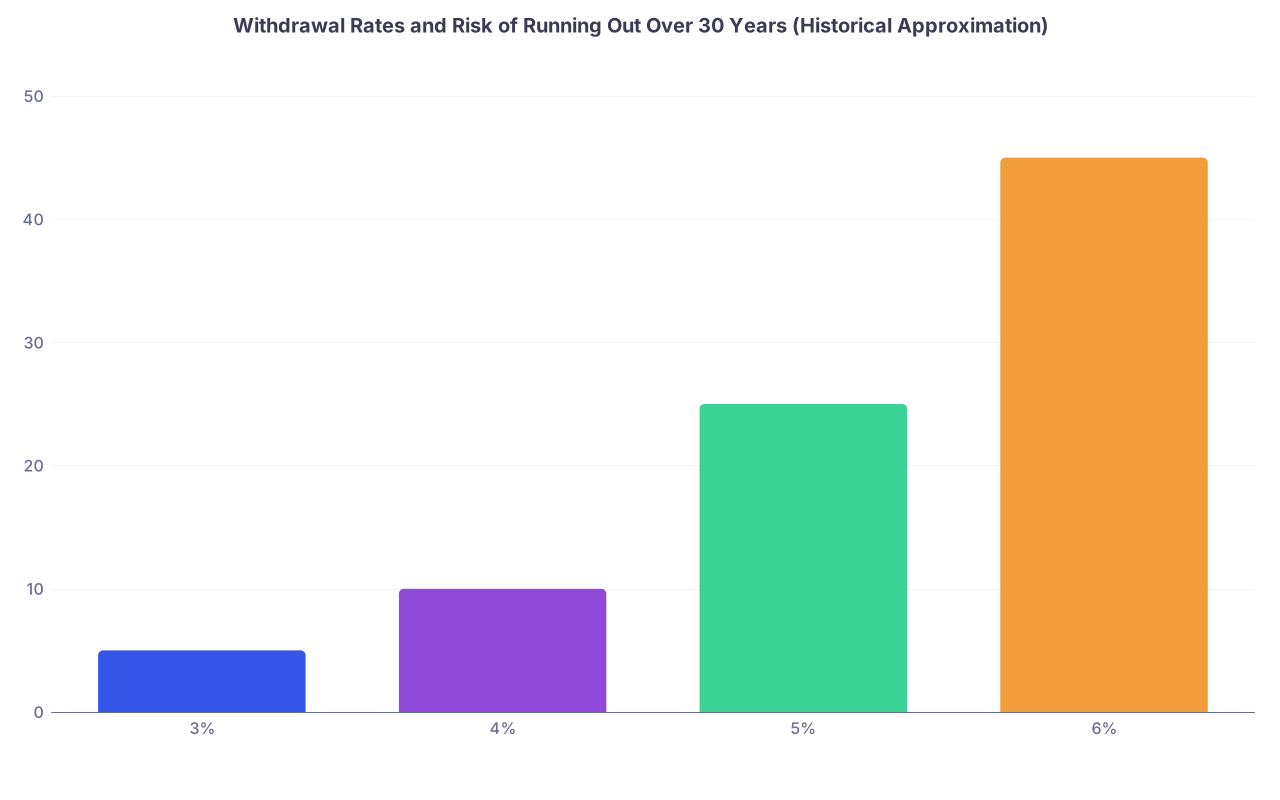
| Category | Value |
|---|---|
| 3% | 5 |
| 4% | 10 |
| 5% | 25 |
| 6% | 45 |
Now combine this with the earlier example.
You need $20,000 per year from savings.
At a 4% withdrawal rate, that implies roughly:
$20,000 ÷ 0.04 = $500,000 invested.
Does that feel like a lot? Maybe. Does it at least give you a clear target? Yes.
If you have more, maybe you’re safer than you think. If you have less, then we talk about actual levers you can adjust instead of just living in vague dread.
The Ugly Stuff: What About Healthcare and Long-Term Care?
This is usually the “yeah but” that lives in the back of your head:
“Yeah okay withdrawals, Social Security, all that, but what if I get cancer? What if I need a nursing home at 86? That blows up everything.”
You’re not wrong to worry. Medical and long-term care costs are brutal.
Here’s what I’ve seen helps people sleep slightly better:
Healthcare before and after 65
Before 65, you’re dealing with ACA plans, COBRA, or employer coverage if you keep working. That’s its own nightmare, but it’s temporary.
After 65, Medicare becomes your base. Then—annoying but necessary—you probably add:
- A Medigap / Medicare Supplement plan, or
- A Medicare Advantage plan
- A Part D drug plan (if not included)
So no, Medicare doesn’t make healthcare “free,” but it does cap some of the worst disasters.
The truly scary part: long-term care
Nursing homes, assisted living, home health aides. This is the silent monster in every retirement conversation.
Here’s the sobering part: not everyone ends up needing years of expensive long-term care. Some do. Many don’t. The fear is that you’ll be in the unlucky group.
Your options:
- Traditional long-term care insurance (expensive, often messy, can be worth it if bought younger and carefully vetted)
- Hybrid life/long-term care policies (more flexible, usually pricey)
- Deliberate “self-insuring” (you intentionally set aside a chunk of assets as your “if I need care” bucket)
- Accepting that Medicaid will be the backstop if things go terribly wrong
None of these options feels great. But pretending long-term care won’t be an issue doesn’t work either.
This is where talking to a fee-only fiduciary planner actually matters. Not some salesperson trying to shove annuities down your throat the second you mention “scared of running out.” Someone who’ll walk through scenarios without treating you like a commission.
Sequence of Returns Risk: The Nightmare Timing Problem
There’s a particular horror story your brain might be replaying without knowing the name:
“What if I retire, start taking money out, and then the market tanks right then?”
That’s called sequence of returns risk. Losses early in retirement hurt way more than losses later, because you’re withdrawing while your portfolio is already down. You sell low to pay the bills, and it snowballs.

| Step | Description |
|---|---|
| Step 1 | Retire |
| Step 2 | Portfolio grows |
| Step 3 | Portfolio shrinks |
| Step 4 | Withdrawals lock in losses |
| Step 5 | More cushion for later |
| Step 6 | Higher risk of running out |
| Step 7 | Market up or down |
No sugarcoating: this is a real risk. Ignoring it is dumb. But you’re not helpless.
Some ways people reduce this:
- Holding a few years of safer money (cash, short-term bonds) so you’re not forced to sell stocks during crashes
- Flexible spending: cut back a bit in bad market years instead of blindly taking the same inflation-adjusted amount
- Delaying retirement or doing part-time work at the beginning, so you’re withdrawing less while the portfolio is still getting its footing
The point is not “you’ll be fine.” The point is: there are tools. There are levers. This isn’t pure luck.
The Money Psychology Problem: Scarcity vs. Safety
Here’s something nobody tells you: some people never stop feeling poor.
I’ve seen folks with $3 million in retirement accounts living like they’re one grocery trip away from bankruptcy. And I’ve seen people with $150,000 and Social Security who feel calm and okay.
The difference? They’ve defined “enough” and actually believed their plan.
Your brain defaults to scarcity: What if it’s not enough? What if I outlive it?
You fight that by:
- Knowing your actual numbers instead of guessing
- Stress-testing them (bad markets, high inflation, living to 95+)
- Writing down a plan that says: “If X happens, I do Y”
That last part matters way more than anyone admits. For example:
- If the market drops 20+% → pause big travel, cut discretionary spending by 10–15%, use cash reserves.
- If health costs spike → temporarily reduce other categories, tap HSA funds, or consider part-time work if it’s early in retirement.
- If portfolio hits “floor number” (say $300k) → no more large gifts, reset withdrawals to a lower, safer percentage.
When you already know the playbook, the panic dial turns down a little. Not off. But down.
Turning Vague Panic into a Concrete Plan
If your brain is screaming “I’ll run out of money,” do this in the next week. Not someday. This week.
- List your expected monthly retirement expenses in three tiers: bare-bones, realistic, comfortable.
- Pull your latest Social Security estimate (from SSA.gov) and any pension details.
- Add up all retirement savings: 401(k)s, IRAs, brokerage accounts, HSAs, savings.
- Run a basic retirement calculator with conservative assumptions (3–4% withdrawal, modest market returns, living to at least 90).
You’ll probably hate this process. Do it anyway.
Because there are only three real outcomes when you do:
- You’re actually on track or better than you thought → your fear is lying to you.
- You’re not on track yet, but now you know your gap → you can adjust saving, spending, work plans.
- You’re way behind and it feels awful → but now you can stop living in denial and start making deliberate tradeoffs instead of drifting.
| Item | Example Amount |
|---|---|
| Realistic annual spending | $60,000 |
| Social Security + pension | $40,000 |
| Needed from savings yearly | $20,000 |
| Current retirement savings | $400,000 |
| Implied withdrawal rate | 5% |
In that example, 5% is a bit high. Not disaster territory yet, but not “I can ignore this.” That might mean working 2–3 more years, tightening spending expectations, or increasing savings now.
It’s not about being perfect. It’s about not flying blind.
When the Fear is Louder Than the Math
I’ll be real here: you can run all the numbers, work with a planner, have a rock-solid plan, and still feel terrified.
Because the deeper fear isn’t “what if the money runs out.”
It’s “what if I lose control, become dependent, and nobody catches me.”
That’s not a spreadsheet problem. That’s an emotional and relational one.
You can ease that by:
- Making a clear estate plan: will, powers of attorney, healthcare proxy. So if something happens, someone you trust can act.
- Talking—actually talking—with family about your wishes, your fears, and what help might look like.
- Choosing where you live with intention: community, support, walkability, access to care. Isolation amplifies fear.

You’re allowed to be scared. You’re also allowed to build a system around yourself so you’re not alone with that fear.
Quick Reality Checks That Help When You Spiral
When your brain starts screaming “You’ll end up homeless at 88,” run through a few facts:
- Social Security is a baseline floor. It’s not generous, but it’s there, indexed to inflation.
- Most people adjust their lifestyle over time. You won’t retire spending exactly like you do now forever.
- You have more levers than you think: working longer, part-time income, downsizing, relocating, changing spending expectations, delaying Social Security, etc.
- Catastrophic outcomes are possible but not guaranteed. You’re not automatically the worst-case scenario.
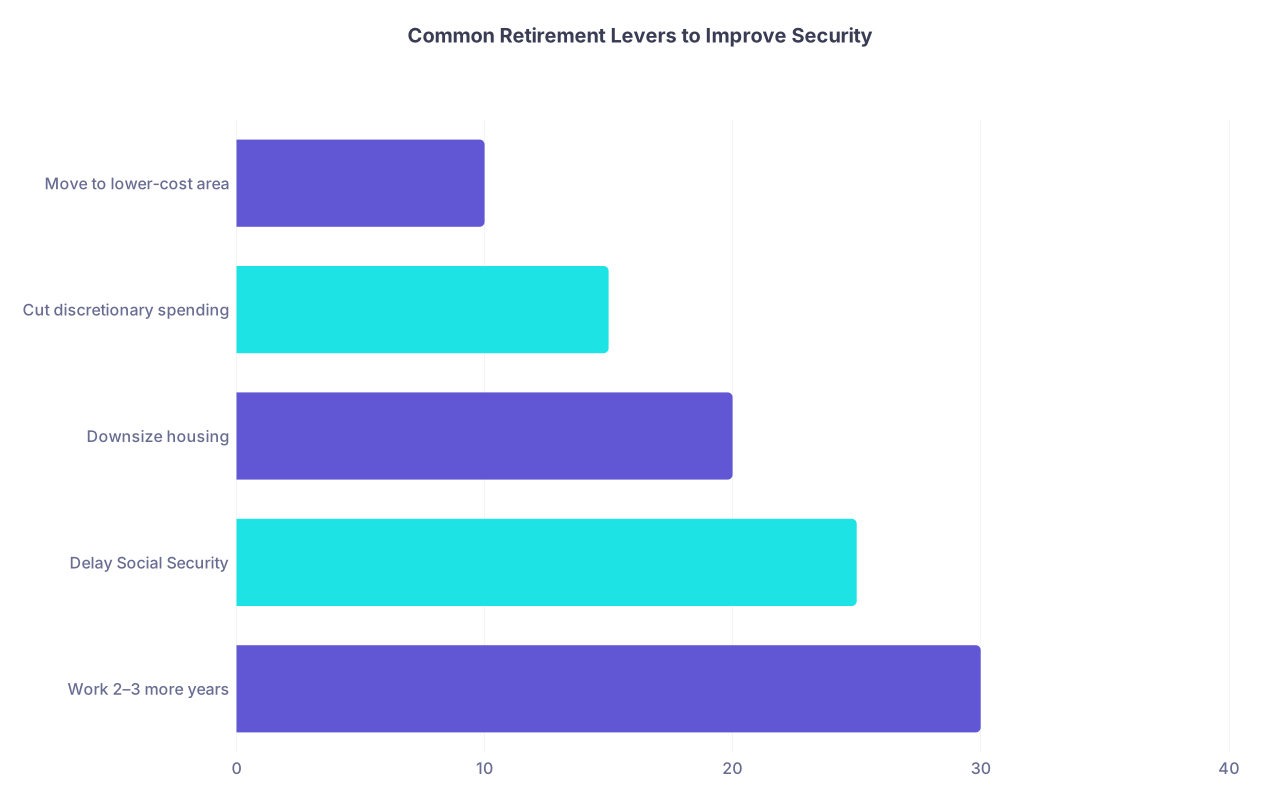
| Category | Value |
|---|---|
| Work 2–3 more years | 30 |
| Delay Social Security | 25 |
| Downsize housing | 20 |
| Cut discretionary spending | 15 |
| Move to lower-cost area | 10 |
None of these levers feels fun. But knowing they exist is power. It means you’re not stuck on a track you can’t change.
The Action You Can Take Today
Don’t try to “fix” all of retirement in your head tonight. That’s why you can’t sleep.
Instead, do one concrete thing before you go to bed:
Write down three numbers on a piece of paper:
- Your best guess at your realistic annual retirement spending.
- Your expected Social Security and pension income.
- The difference between them.
That difference—the gap—is the number your savings has to cover. That’s it. No more mysterious, infinite fear cloud. Just one number you can start to plan around.
Then tomorrow, open one retirement calculator and plug in that gap and your current savings. See what it says. Don’t click away when it feels scary. Sit with it. Let it inform you.
You don’t have to be fearless about retirement. You just have to be slightly more informed than your fear.

FAQ: Constantly Afraid of Running Out of Money in Retirement
1. What’s a “safe” withdrawal rate if I’m terrified of running out?
If you’re very anxious and want more safety, aiming closer to 3–3.5% instead of 4% gives you extra cushion, especially if you might live a long time or worry about bad markets early on. That means for every $100,000 invested, you’d plan to withdraw $3,000–$3,500 per year. You can always adjust later if things go better than expected.
2. Is it crazy to keep working part-time in retirement just to feel safer?
Not crazy at all. In fact, it’s one of the smartest tools you have. Even a modest part-time income—say $10,000–$15,000 a year—can dramatically reduce how much you need from your portfolio and lower your withdrawal rate. Plus it can help with structure, purpose, and social connection, which matter just as much as the money.
3. Should I buy an annuity so I don’t run out of money?
Sometimes. Sometimes it’s a terrible idea. Annuities can provide guaranteed lifetime income, which is emotionally comforting if your biggest fear is outliving your money. But fees, terms, and surrender charges can be ugly. If you look at them, do it with a fee-only fiduciary planner, not someone whose paycheck depends on selling it to you. And never put all your money into an annuity—diversifying income sources matters.
4. What if I’m already in my 60s and way behind—am I just doomed?
No. You may not get the version of retirement you imagined at 30, but you’re not automatically doomed. You still have levers: postponing retirement, working part-time, delaying Social Security to increase benefits, tightening spending, downsizing housing, even relocating to a lower-cost area. The earlier you stop ignoring the problem and actually run the numbers, the more options you’ll still have.
5. How do I know if I should talk to a financial planner?
If you’re losing sleep over this regularly, that’s already enough reason. Look for a fee-only, fiduciary planner—someone who’s legally required to put your interests first and charges a flat fee or hourly rate, not a commission. Tell them your actual fear: “I’m scared I’m going to run out of money and be a burden.” If they brush that off instead of building a plan around it, find someone else.
Open your notebook or notes app right now and write: “My estimated annual retirement spending is ______.” Don’t leave it blank. Even a messy guess is better than letting fear keep you in the dark.


