

What if one stupid financial decision you don’t fully understand today quietly nukes your retirement 20 years from now?
That’s the fear, right? You sign one form, nod along to one “it’s only 2%” fee pitch, chase one “can’t-miss” private equity deal… and suddenly your future self is screwed, working extra call at 68 because Present You trusted the wrong person.
You are not crazy for being terrified of that. You’re right to be suspicious. Physicians are prime targets. High income, low time, and most of us were never really taught this stuff.
Let me give you a framework that’s boring, safe, and repeatable — something you can run every single investment decision through, so you don’t have to rely on vibes, charisma, or glossy pitch decks.
This isn’t about maximizing returns. It’s about not blowing yourself up.
The Core Fear: “What If I Don’t Even Know What I Don’t Know?”
Here’s the part that gnaws at you at 1 a.m.:
- “Everyone else seems to be investing in something — real estate, surgery center, startup — and I’m just sitting in index funds. Am I falling behind?”
- “My colleague ‘made a killing’ on a deal I don’t even understand. Am I being stupidly conservative?”
- “What if I pick wrong — like 2008-level wrong — right before I retire?”
The worst part isn’t losing money. It’s the not knowing whether you’re being careful or being cowardly.
So I’ll say something harsh first, then reassuring:
Harsh: You will absolutely make some bad investments over a 30-year career. That’s not avoidable.
Reassuring: Catastrophic damage is almost always caused by a small set of predictable mistakes — the kind physicians repeat because nobody gave them a straightforward filter.
That’s what this is: a filter. A framework to keep “regrettable” from turning into “irreversible.”
The SAFE Physician Investment Framework
Think of this as your default checklist before you say yes to any investment: private placement, rental property, surgery center, taxable account, whatever.
SAFE = Simple • Aligned • Fixed-risk • Enough
We’ll go piece by piece.
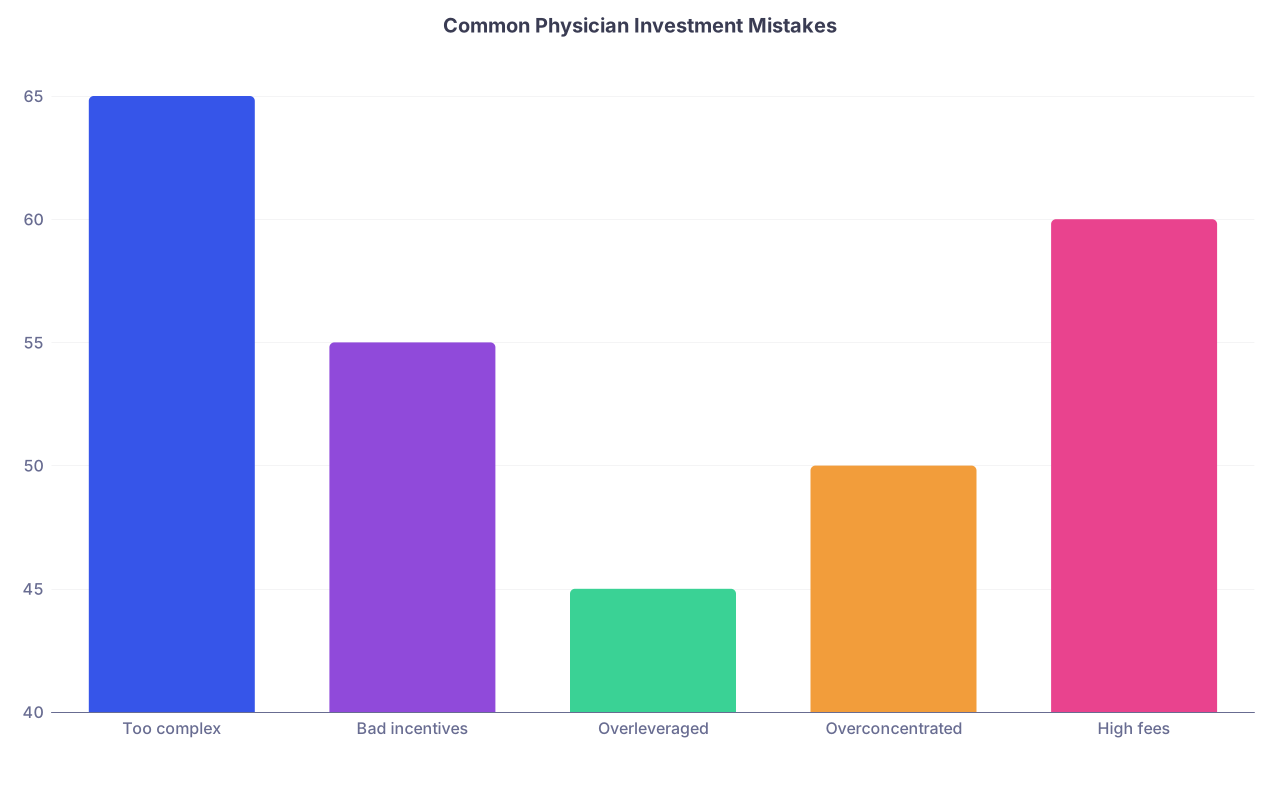
| Category | Value |
|---|---|
| Too complex | 65 |
| Bad incentives | 55 |
| Overleveraged | 45 |
| Overconcentrated | 50 |
| High fees | 60 |
S – Simple Enough You Could Explain It On Call
Rule: If you can’t explain how it makes money and how you could lose money in 3–4 sentences, you don’t invest.
Not “I sort of get it.” Not “the guy from my group is really into this stuff.” I mean: you, out loud, on a post-call brain, can explain:
- What’s the actual asset?
- Who’s paying whom, and for what?
- How do returns show up — cash flow, appreciation, equity, something else?
- How, specifically, could this go badly?
Example of “simple enough”:
- “I own low-cost index funds in a 401(k). The fund owns thousands of stocks. Companies grow and pay dividends; over decades, the value tends to rise. I can lose money when markets drop, but unless I panic-sell, it’s just volatility.”
Example of “too complex”:
- “It’s a structured note with downside protection linked to a volatility index and some options overlay that caps losses… I think… but the guy said it can’t go below X and I get ‘enhanced yield.’”
If you’re relying on “the guy said” instead of you understanding the mechanism, that’s not investing. That’s faith.
Safe move: Default to saying no to anything you can’t explain clearly yourself.
A – Aligned With Your Actual Life, Not Someone Else’s Narrative
You’re not a hedge fund. You’re a human with call, burnout risk, maybe kids, maybe aging parents.
An investment that’s fine for a 28-year-old single EM doc might be terrible for a 57-year-old surgeon 5 years from retirement.
Ask these, every time:
- When do I actually need this money? (10, 20, 30 years?)
- Can this investment lock up my money where I can’t reach it?
- If it tanks 50%, does my life change — or just my ego?
Real talk: You do not need to chase 15–20% returns to have a solid retirement if you’re a typical physician with:
- Decent savings rate
- Normal spending
- Long career
You do need to avoid one or two massive, concentrated, ego-driven bets blowing a hole in your plans.

Here’s what alignment looks like:
- Early career (0–10 years out): Mistakes are recoverable. Volatility is tolerable. Focus on simple, diversified, tax-advantaged growth.
- Mid-career (10–20 years out): More responsibilities, more life complexity. You cannot afford thin-margin, highly-leveraged “trust me, bro” deals.
- Late career (5–10 years to retirement): Capital preservation matters more than bragging rights. You’re transitioning from “grow it” to “don’t break it.”
If a deal only makes sense if everything goes right, it’s misaligned with a physician’s real risk capacity.
F – Fixed Maximum Damage: “How Much Can This Actually Hurt Me?”
This is where most doctors get wrecked.
They think in absolute numbers — “It’s just a $150k buy-in” — instead of damage percentage — “That’s 40% of my investable assets.”
You want a pre-decided rule, so your fear doesn’t have to negotiate with FOMO in the moment.
Example of a sane guardrail:
- No single investment (outside broad index funds) gets more than 5–10% of my total invested wealth.
- No illiquid, private, or opaque investment gets more than 5% total, across all such deals.
- No deal where my personal liability can exceed my initial investment, period.
Let me be blunt: I’ve seen physicians dump:
- 30–60% of their net worth into…
- One surgical center
- One private real estate syndication
- One “doctor-only” fund
- One buddy’s startup
And then get blindsided when:
- Distributions stop
- Partners sue each other
- Recession hits and the debt load explodes
- The GP takes their fees while the project burns
Could the deal have worked? Sure. Some do. But that’s not the point.
The point is: No single failure should be able to cripple your retirement.
Fixed maximum damage means: “If this goes fully to zero, it’s deeply annoying, but my retirement math still works.”
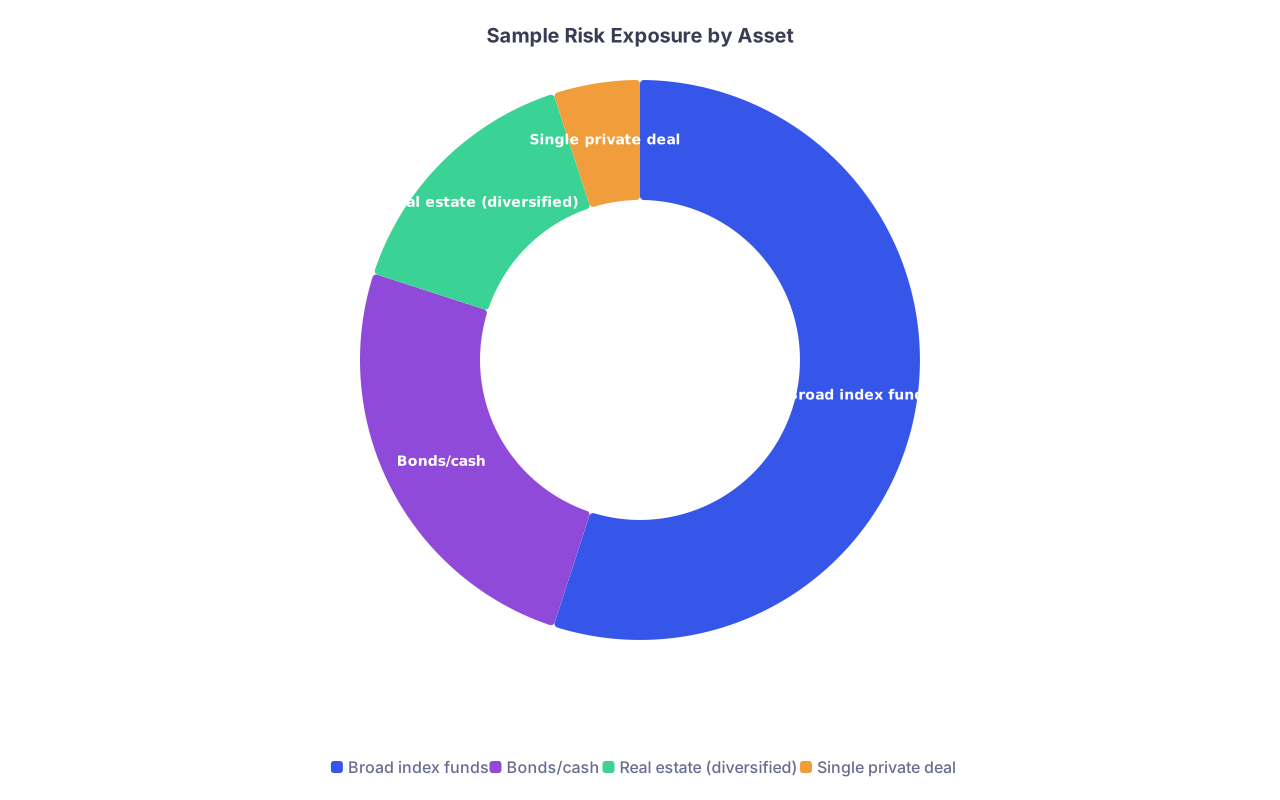
| Category | Value |
|---|---|
| Broad index funds | 55 |
| Bonds/cash | 25 |
| Real estate (diversified) | 15 |
| Single private deal | 5 |
If your current layout looks like: 25% index funds, 10% cash, 65% “some real estate fund my colleague runs”… that’s not a portfolio. That’s a hostage situation.
E – Enough: Define “Enough” So Greed Doesn’t Drive the Bus
Nearly every disastrous story I’ve heard had this subtext:
“I already had enough, but I wanted more, faster.”
You need a working definition of “enough” that’s at least semi-quantitative, or you’ll keep ratcheting risk every time your net worth grows.
Basic, back-of-the-envelope way to frame “enough” for retirement:
Take your expected annual spending in retirement and multiply by 25.
- Spend ~$200k/yr → target portfolio ≈ $5M
- Spend ~$300k/yr → target portfolio ≈ $7.5M
- Spend ~$400k/yr → target portfolio ≈ $10M
Is this perfect? No. But it’s solid, conservative ballpark.
Once you’re on track to hit that number with plain, boring index-fund-type returns and reasonable savings… you don’t need to “swing for it” with high-risk stuff.
You want to stop thinking:
“How do I turn 1M into 5M fast?”
and start thinking:
“How do I avoid turning 5M into 1M stupidly?”
That mental flip is where people actually sleep better.
How to Use SAFE in Real Decisions (Concrete Scenarios)
Let’s run through a few things that might be sitting in your inbox or group chat right now.
| Investment Type | Simple? | Aligned? | Fixed Damage? | Likely Safe If… |
|---|---|---|---|---|
| 401(k) index funds | Yes | Usually | Very | Low fees, diversified |
| Backdoor Roth into index | Yes | Yes | Very | Done yearly, boring |
| Single rental property | Medium | Maybe | Moderate | Not >10% of net worth |
| Private RE syndication | No | Often no | High | Tiny fraction of net worth |
| Surgery center buy-in | Low | Maybe | Very high | Small %, you understand books |
Scenario 1: “Doctor-Only” Real Estate Syndication
Pitch: “8% preferred return, 15–20% projected IRR, tax advantages, we’ve never lost money.”
SAFE pass/fail:
- Simple? Probably not. Waterfall structures, pref returns, promote, recourse vs non-recourse debt, cap rates… if those aren’t crystal clear, it fails S.
- Aligned? Maybe. But it’s illiquid and can go off the rails right when you need cash.
- Fixed damage? Usually fails. Physicians often toss in $100–250k, which might secretly be 20–40% of their investable assets.
- Enough? If you’re doing this to “catch up fast,” that’s greed and fear talking, not math.
Verdict: For most docs, this should be a tiny percentage play, if at all. If it doesn’t clear S and F, I’d skip.
Scenario 2: Increasing 401(k) Contributions into Index Funds
Not glamorous. Zero brochure. No steak dinner pitch.
SAFE check:
- Simple? Yes. Broad funds, auto-invest, low cost.
- Aligned? Perfect for long-term retirement.
- Fixed damage? Fully diversified, no single-company risk.
- Enough? This alone, plus maybe a 403(b)/457/Backdoor Roth, probably gets you to retirement “enough” over a 20–30 year career.
Verdict: Boring? Yes. Wrong move? No. This is your baseline “I will not ruin my life” move.
Scenario 3: Private Practice Equity Buy-In
This one is tricky.
Sometimes it’s great. Sometimes you’re paying six figures to be last in line while the senior partners milk distributions and line up a buyout.
SAFE check:
- Simple? You should understand the actual financials: buy-in terms, distributions, overhead, payer mix, debt. If you’re just nodding at a 200-slide PDF, it fails.
- Aligned? Do you want to be tied to this location and group long-term? If you hate the call schedule now, equity won’t fix that.
- Fixed damage? How much total of your net worth is this? If it goes south — reimbursement cuts, hospital contract lost — is your entire retirement plan anchored to this one business?
- Enough? Are you doing this because it meaningfully improves your long-term picture, or because “that’s what everyone does at year 3”?
Verdict: Could be good, but only after a brutal, honest SAFE review. People overestimate upside and downplay concentration risk here.
How to Protect Yourself From Being Rushed, Pressured, or Guilt-Tripped
The investment world loves urgency. Physician time scarcity is their weapon.
- “We’re closing the round next week.”
- “Everyone else from your group is already in.”
- “Minimum is 100k, so you really don’t want to miss this.”
Here’s your literal script to slow things down:
- “I have a personal rule not to commit money to anything I haven’t sat on for at least 2 weeks. Send me all the documents; I’ll circle back.”
If that alone breaks the deal? Red flag.

| Step | Description |
|---|---|
| Step 1 | New Investment Pitch |
| Step 2 | Do not invest |
| Step 3 | Optional small allocation |
| Step 4 | Reasonable invest |
| Step 5 | Understand how it makes and loses money? |
| Step 6 | Aligned with my time and goals? |
| Step 7 | Max loss small % of net worth? |
| Step 8 | Still needed to reach enough? |
Second script, when your own anxiety whispers “what if this is the once-in-a-lifetime one?”:
- “If I pass on this and it turns out amazing, I’ll be annoyed, not ruined. I only chase opportunities that still make sense after I protect my downside.”
You will miss some good deals using SAFE. That’s fine.
You will also sidestep the ones that blow up other people’s careers.
How to Keep Yourself From Constantly Second-Guessing
The real torture isn’t just fear of loss. It’s the permanent second-guessing.
“Should I have invested more? Should I have waited? Should I have gone all-in?”
Here’s how you calm that down:
Decide on a written, simple investment policy for yourself.
Example: “90% of my portfolio will be in low-cost, broad index funds (70% stocks, 20% bonds). Max 10% in any speculative or private deal, never more than 5% in a single one.”Run new decisions against that, not against your mood.
“Do I feel brave today?” is not a strategy.Accept in advance: you will never perfectly time anything.
The goal is not perfection. It’s staying in the game long enough that the math works in your favor.

You don’t have to outsmart Wall Street. You just have to refuse to be the easy mark.
FAQ – The Anxious Physician’s Investment Questions
1. What if I stick to “safe” stuff and end up with not enough for retirement?
Then you adjust inputs (save more, spend less, work a bit longer), not blow up the strategy by chasing higher-risk investments you don’t understand. Boring, diversified investing with a decent savings rate very rarely leads to catastrophic shortfalls. Massive concentrated bets absolutely can. If you run the numbers and you’re behind, that’s a cash-flow problem, not an “I need exotic investments” problem.
2. Is it dumb to say no to every private deal my colleagues do?
No. What’s dumb is matching someone else’s risk tolerance and life situation when you don’t share their timeline, obligations, or actual net worth. You only hear about the wins at lunch, not the quiet K-1s from deals that went sideways. If a deal passes your SAFE framework, you can put a small amount into it. But saying “no thanks” across the board is a perfectly legitimate, rational choice.
3. How much should I worry about timing the market with index funds?
Less than you think. If you’re investing for retirement 10–30 years away, the specific month or even year you invest matters far less than whether you’re consistently putting money in. If you’re anxious about a lump sum, you can dollar-cost average over 6–12 months. But don’t let “waiting for the perfect entry point” turn into sitting in cash for years while inflation quietly erodes your future.
4. I already made what feels like a bad investment. Did I ruin everything?
Probably not, unless you went all-in with most of your net worth. Step one: stop adding more money to “rescue” it. Step two: re-evaluate your overall allocation and make sure any single bad outcome can’t sink you going forward. Step three: treat it like tuition — expensive, unpleasant, but only truly wasted if you don’t change your behavior. Even seasoned investors have graveyard positions. The key is that they’re small.
5. Are financial advisors worth it, or just another risk?
Some are worth it; many are very expensive salespeople. The main questions: Are they a fiduciary at all times? How are they paid (flat fee, AUM, commissions)? Can they explain their fee structure in one short paragraph? If you use one, you can still apply SAFE to what they recommend. “My advisor said so” is not a substitute for you understanding the basics. If they get annoyed when you ask questions, that’s your sign to leave.
6. How do I know when I’ve hit “enough” and can back off the risk?
You won’t get a blinking green light. You’ll get a range. When your reasonably safe projections (4–5% withdrawal rates, diversified portfolio) cover your desired retirement spending with a margin of safety, you’re functionally at “enough.” At that point, you start asking a different question: “Does taking this additional risk materially improve my life, or just give me a bigger number on a screen?” If the answer is mostly ego, that’s your cue to stay boring.
Key points:
- You don’t need genius investments; you need to avoid catastrophic ones. SAFE — Simple, Aligned, Fixed-risk, Enough — is your filter.
- No single deal should ever be able to wreck your retirement. If it can, it’s already too big, no matter how “can’t-miss” it sounds.
- Boring, diversified, fee-aware investing plus a decent savings rate beats 99% of high-gloss pitches — and it lets you actually sleep.


