

What happens if you hit 55, your back hurts, medicine’s changed beyond recognition, and you realize you can’t afford to stop working?
That’s the nightmare, right? Not just “will I have enough?” but “what if I literally never get to retire?” What if I’m 75, still on call, still charting till midnight, because I can’t step away?
You’re not crazy for thinking this. I’ve heard versions of this exact fear from pre-meds, residents, attendings, even people who seem “rich” on paper. The income looks big, but the loans, lifestyle creep, kids, aging parents, taxes, burnout—it all eats away at that fantasy of “someday.”
Let’s be blunt and then we’ll walk it back.
First: Could You Actually End Up Never Retiring?
Short answer: yes, you could. But not for the reasons you’re probably imagining.
Most physicians who “never retire” fall into one of three buckets:
They don’t want to retire.
The old cardiologist doing half-days at 78? He’s not trapped. He’s bored when he’s home. He likes the identity, the structure, the staff that’s basically his second family.They can retire, but they’re scared to pull the trigger.
I’ve seen attendings with $5–7M net worth still seeing patients because they’re convinced one market crash will put them under a bridge. That’s anxiety, not reality.They really are behind and need to work longer than average.
Usually because of:- Late start (IM → fellowship → another fellowship; first real attending paycheck at 35+)
- Huge lifestyle overhead (massive house, private schools, expensive city, family obligations)
- No real savings plan until mid-career
- Divorce, illness, bad business/investment decisions
So yes, it’s possible to be stuck. But it’s not random. It’s a predictable consequence of certain patterns. Which also means: you can change course.
The scarier, quieter truth is this: plenty of doctors hit their 60s and realize they technically can stop, but only if they slash their lifestyle so hard it feels like failure. That’s the version that really freaks me out. “Retired” but miserable, watching every dollar, resenting every Starbucks.
Let’s put some numbers around this instead of just vibes.
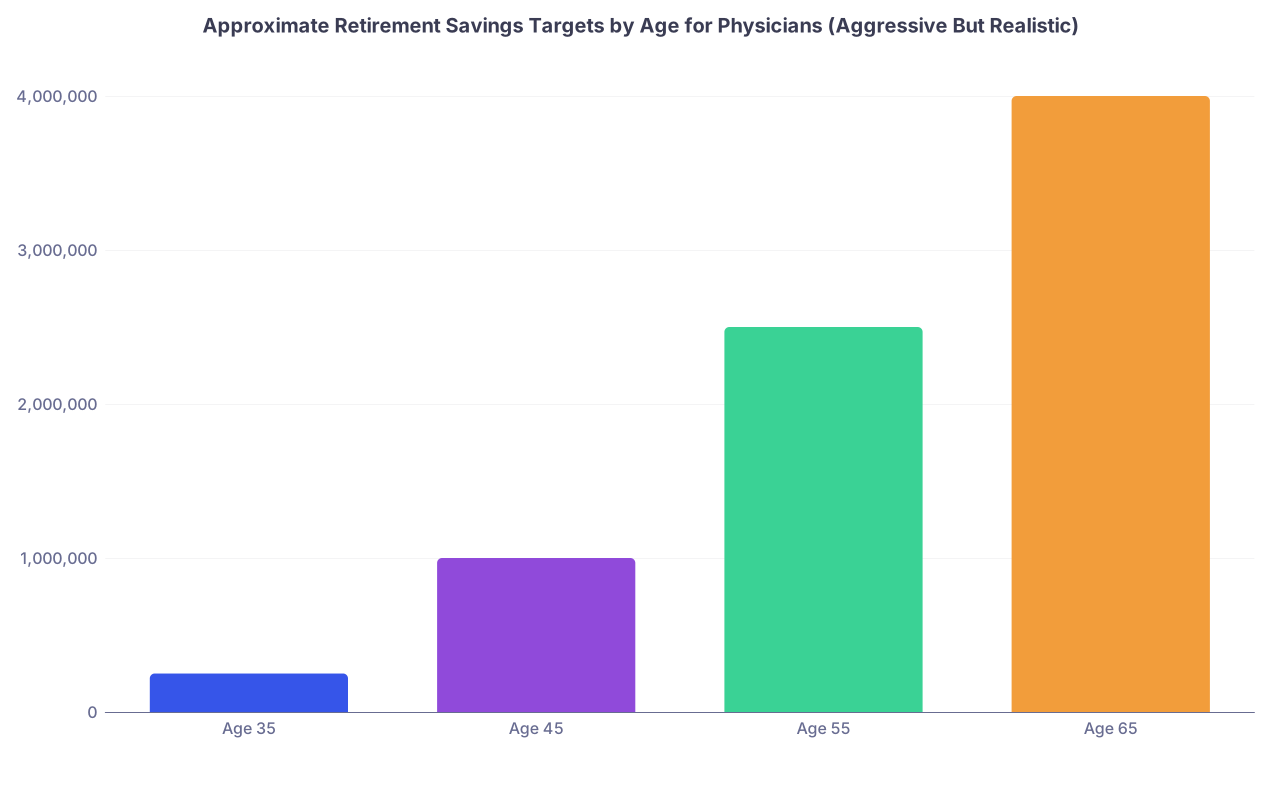
| Category | Value |
|---|---|
| Age 35 | 250000 |
| Age 45 | 1000000 |
| Age 55 | 2500000 |
| Age 65 | 4000000 |
These are not official rules. But this is the ballpark I keep seeing for docs who feel “able to retire” without panic, assuming:
- Started as an attending in early 30s
- Saves 15–25% of gross income
- Lives at least somewhat below their means
If you saw those numbers and your stomach dropped, you’re not alone. Almost no one in training is “on track” for this. That’s not failure. That’s just reality of late earnings + student loan debt.
The Ugly Math: Why “High Income” Doesn’t Automatically = Retirement
The thing no one tells you when you’re obsessing over Step scores and match lists is that being a doctor is financially weird:
You start late.
You’re 30–35 before you’re fully practicing. While your college classmates in tech or finance have had 8–12 years of compounding, you’ve had ramen and call rooms.
You’re in debt.
$200K–$400K+ in loans is not unusual. I’ve seen $600K+ for people who did out-of-state private med + unpaid research years. That’s a mortgage strapped to your back before you even buy a house.
Everyone expects you to look rich.
Family, friends, your own brain. You’ve “earned” it. The house. The car. The vacations. Private school. Suddenly that $280K salary turns into $0 leftover because everything scales up.
The government takes a big chunk.
High marginal tax brackets, plus payroll taxes, plus maybe state income tax. A “$300K” income is not $300K you actually spend or save.
Here’s the thing I didn’t get until I started watching attending finances closely: the window where you have to save is smaller than you think. If you don’t start in your 30s or early 40s, you’re basically expecting compound interest to perform miracles starting from behind.

Signs You’re On the Path to “Never Retire” Territory
This is the part that hurts. But skipping this is how people stay in denial until it’s too late.
You’re setting yourself up for real trouble if:
Your savings rate is under 10% of gross income long-term.
Forget gimmicks. If you’re making $250K and only putting $10–15K/year away for retirement, that’s not enough unless you love the idea of working into your 70s.Every raise = lifestyle raise.
The “ratchet effect.” New car when you make partner. Bigger house when you pay off loans. You keep thinking “I’ll save later when things calm down.” Spoiler: they don’t.You don’t actually know your net worth.
If I asked you, “What’s your net worth within $100K?” and your brain goes blank? You’re flying blind. People who “accidentally never retire” almost always have this in common.You’re counting on selling a practice or inheritance to rescue you.
I’ve seen practices sell for pennies on the dollar. I’ve seen parents’ money evaporate from long-term care, remarriage, medical bills. Banking on this is fantasy.You’re telling yourself, “I’ll just work part-time later.”
Part-time is not a retirement plan. It’s a bridge. And if your full-time income barely lets you save now, scaling your income down later without a base is dangerous.
This isn’t to shame you. It’s to give you a clear “danger zone” map, so if you see yourself in this, you know you’re not crazy to worry. You actually have a real problem worth solving.
Reality Check: What “Never Retiring” Actually Looks Like
The fear in your head is probably: “I’ll be 80, working full-call trauma nights.” That’s… not really how it goes.
More realistic worst-ish cases I’ve seen:
- The 68-year-old outpatient doc who wants to cut back but can’t fully stop because they still have a mortgage and support adult kids.
- The hospitalist in her 60s doing a brutal 7-on/7-off because she didn’t start saving until mid-40s, then had a divorce.
- The surgeon who keeps doing clinic-only or more minor procedures, mostly to cover ongoing high-cost life plus helping with grandkids’ expenses.
Are these lives tragic? No. But here’s the part that stings: none of them thought this would be them. Every single one assumed “my income is high, I’ll figure it out later.”
“Later” is a trap.
Let’s flip this now. Because you’re not stuck watching some disaster unfold in slow motion. You’re early enough to change the script, even if you feel behind already.
Step One: Stop Guessing—Know Your Numbers
You can’t fix what you won’t look at. This is the scary part, but also the part that gets the anxiety to back off a little.
You need exactly three things to start:
Your net worth.
Assets (retirement accounts, savings, home equity, investments) minus debts (student loans, credit cards, car loans, mortgage).Your annual savings rate.
How much you’re putting toward retirement and investments per year, not counting loan payments or random savings that you dip into constantly.A rough retirement number.
Not perfect. A rough “I want to spend about $X per year later, so I’ll probably need around 25x that in investments.”
So if you’d like to live on $160K/year in retirement (today’s dollars), you’re staring at something like $4M in invested assets. Terrifying? Maybe. But ignoring that doesn’t make the math softer.
| Desired Annual Spending | Ballpark Portfolio Needed (25x Rule) |
|---|---|
| $100,000 | $2.5M |
| $140,000 | $3.5M |
| $160,000 | $4.0M |
| $200,000 | $5.0M |
| $250,000 | $6.25M |
Again: not perfect. But this gets you out of fantasy land and into “ok, what do I do from here?”
Step Two: Accept That Something Has To Give (But It’s Not Your Whole Life)
This is the part that makes high-income people weirdly fragile. They hate the idea of dialing back anything.
You can move three levers:
Save more now.
Increase your savings rate—401(k), 403(b), 457, IRA, brokerage. If you’re under 15% of gross, you’re light. Under 10%, you’re cruising toward “work longer.”Spend less later.
Maybe you actually don’t need $250K/year in retirement. Maybe the kids are out, mortgage is gone, no childcare, no loan payments, fewer work-related expenses.Work longer—but on your terms.
Work until 70 is a nightmare if it means full-time nights. It’s much less awful if it’s 2–3 days a week, outpatient, no call, mostly by choice.
The sweet spot is usually a mix of all three. But you can’t choose intelligently if you won’t admit where you are.

| Step | Description |
|---|---|
| Step 1 | Start - Worried About Retirement |
| Step 2 | Calculate Net Worth |
| Step 3 | Estimate Retirement Spending |
| Step 4 | Compare Savings To Goal |
| Step 5 | Maintain Course |
| Step 6 | Adjust Levers |
| Step 7 | Increase Savings |
| Step 8 | Reduce Future Lifestyle |
| Step 9 | Plan For Longer Career |
| Step 10 | Recheck In 12 Months |
Step Three: Build an “Escape Valve” Future You Will Be Grateful For
Here’s what calms my own worst-case brain: not some mythical “never have to work again at 50” fantasy. Just knowing I won’t be trapped.
That means designing your career so that if full retirement at 60 isn’t realistic, you’ve got softer landing spots:
- Shift to part-time or flexible roles: outpatient, telemedicine, urgent care, academic/non-RVU teaching, locums with control over schedule.
- Build non-clinical income slowly: consulting, medical writing, expert witness work, teaching, industry gigs. Not “get rich quick.” Just give yourself optionality.
- Aggressively destroy “fixed” obligations in your 40s and 50s: pay off your house, kill the loans, don’t chain yourself to permanent high overhead.
This is why I hate the idea of “I’ll just always work.” Bodies break. Minds burn out. Healthcare systems implode. Reimbursement changes. You can choose to work as long as you want, but you have to design for being able to stop if you need to.

If You’re Still in Training or Early Career, Here’s What Actually Moves the Needle
If you’re a med student, resident, or fresh attending freaking out reading this, here’s the uncomfortable blessing: you are absurdly early. You have time. Not infinite time, but enough.
Biggest needle-movers:
Avoid maxing lifestyle immediately as an attending.
People blow their entire future on the first 3–5 years post-residency. If you live like a resident (or just slightly above) and bank the difference, you give compounding a head start that future-you will worship you for.Make savings automatic, not optional.
401(k)/403(b)/457 contributions, Roth/backdoor Roth, automatic investments from your checking. If you leave it “to see what’s left over,” there will never be anything left over.Get boring, not clever.
Low-cost index funds, consistent contributions, no wild options trading, no “friend’s startup investment” as a main strategy. Doctors get preyed on for their ego and their lack of time.Actually read one solid book or resource on physician finance.
Not TikTok. Not your co-resident who’s into crypto. Something like The White Coat Investor. One book can set the foundation that keeps you from decades of mistakes.
The Hard Truth That Might Actually Reassure You
Your nightmare version—physically broken, utterly trapped, working until you drop—is mostly what happens when people never look up, never ask these questions, and never adjust.
You’re already ahead of that by being scared now.
Fear isn’t fun, but it’s information. It’s your brain saying: “I don’t feel like we have a plan.” Once you start building one, even a rough one, the fear shifts from “doom” to “annoying background anxiety,” which is… a lot more livable.
You don’t need perfection. You don’t need to retire at 45. You just need:
- A somewhat rational savings rate.
- Some guardrails on lifestyle.
- A few backup options for how you work later in life.
- The willingness to look at your numbers instead of hiding from them.
Do that, and “never retire” goes from “inevitable collapse” to “only if I choose to keep going because I want to.”
And that’s a completely different story.
FAQ (Exactly 5 Questions)
1. How much should I be saving as a doctor if I actually want to retire someday?
If you want a real shot at a comfortable, flexible retirement, aim for 15–25% of your gross income going toward retirement/investments once you’re an attending. That includes 401(k)/403(b)/457, IRAs, and taxable brokerage accounts. Below 10% long-term, you’re almost certainly signing up for working longer or cutting lifestyle later. You don’t have to hit 20% on day one, but that should be the trajectory.
2. Is it already “too late” if I’m in my 40s and haven’t saved much?
No. It’s not ideal, but it’s not game over. Your advantage is your income. If you’re willing to:
- Cap lifestyle growth,
- Aggressively pay down high-interest debt,
- Push your savings rate up into that 20% range (or higher for a while), you can still build a meaningful retirement portfolio. You may work a bit longer than the fantasy age in your head, but that’s not the same as “never retire.” The worst move is pretending everything’s fine and doing nothing.
3. What if I actually like medicine and don’t want to fully retire? Should I still save hard?
Yes. Liking your job today doesn’t guarantee you’ll like it at 63 with a herniated disc and a new EMR rollout. Saving isn’t about forcing yourself to stop—it’s about buying options. If you love working at 70, great. But if burnout, illness, or family needs hit, you’ll be incredibly grateful you’re not dependent on full-time income.
4. Should I pay off my student loans first or focus on retirement savings?
You almost always need to do both. For high-interest private loans, aggressive payoff makes sense. For federal loans with reasonable interest, it’s usually best to:
- Contribute at least enough to get any employer match (free money),
- Then allocate extra between loan payoff and more retirement savings. Waiting to start retirement saving “until the loans are gone” is how people wake up at 45 with no portfolio and no compounding history. That’s when the “never retire” fear gets very real.
5. How do I actually start if I feel overwhelmed and clueless about money?
Start tiny and concrete:
- List your debts and assets to get a rough net worth.
- Check your current retirement contributions (even if it’s $0).
- Pick one basic physician finance resource (book, blog, podcast) and go through it.
- Increase your retirement contribution by something (even 1–2%) and set a reminder to bump it every 6–12 months. If you can, hire a fee-only, fiduciary planner who understands physicians—not someone selling you insurance-first. The point isn’t to become a finance nerd. It’s to have enough of a framework that you’re not blindly drifting toward the “never retire” scenario you’re so afraid of.
Key points:
- “Never retire” is mostly the result of no plan, low savings, and unchecked lifestyle—not some mysterious curse on doctors.
- You reduce that risk dramatically by knowing your numbers, saving intentionally (15–25% of gross), and designing flexible career options for later life.
- You’re already ahead of the worst-case group simply because you’re worried early enough to actually do something about it.


