

What if you end up broke at 70 because you spent your whole 40s and 50s taking care of everyone else?
That’s the fear, right? You’re trying to juggle aging parents, kids (maybe little, maybe in college), and your own retirement… and it feels like the math just doesn’t work. Like there’s not enough money, not enough time, and way too many people depending on you.
Let me say the quiet part out loud: this is hard. You’re not imagining it. You are in what people love to call the “sandwich generation,” but honestly it feels more like a panini press.
Let’s pick this apart in a way that’s actually useful — not “just budget better” or “start a Roth IRA” generic nonsense — but how to think about tradeoffs when you’re terrified of failing your parents, your kids, and your future self all at once.
The Ugly Truth: You Can’t Fully Protect Everyone
I’m going to start with the thing nobody wants to say.
You probably cannot:
- Fully support your parents
- Fully fund your kids’ everything (activities, college, weddings)
- Fully fund a comfortable, early-ish retirement
…on a normal income, at the same time.
Someone is going to be disappointed. Something will be underfunded. That doesn’t mean you’re failing. It means you’re human and the system is broken and expensive.
The key question isn’t “How do I do it all?”
It’s: “Who must be protected first so I don’t cause an even bigger disaster later?”
Short answer: your future 70‑year‑old self has to come before everyone else. Not because you love your parents or kids less. Because if you don’t, you eventually become the next person someone else has to rescue.
I’ve seen this play out:
- Adult child spends 15–20 years sending $800–$1,200/month to help parents with rent/medical.
- They skip retirement savings except for maybe a small 401(k) match.
- They hit 60 with aging kids, elderly parents now gone, and… barely anything saved.
- Now they are the ones asking: “Can my kids help me with bills?”
That’s the generational trap. Someone has to break the cycle.
The Brutal Priorities: Who Comes First, Financially?
Let’s rank this in the order that protects you from worst-case scenarios. Not in the order that feels nicest in the moment.
Your survival and basic security
- Emergency fund
- Health insurance
- Housing stability
Your retirement savings (at least baseline)
- Hitting employer match
- Consistent contributions, even if small
- Not raiding retirement accounts unless it’s a true life-or-death emergency
Critical support for parents (life & health needs, not comfort luxuries)
- Medications
- Essential housing (not “keeping the big house” if it’s unaffordable)
- Food, utilities, safety
Critical support for kids (their survival, not their dream lifestyle)
- Food, safety, healthcare, a stable home
- Minimal educational support (doesn’t have to mean private school or debt-free Ivy League)
Everything else
- College funding beyond what’s realistic
- Extra help for adult kids who could work
- Helping parents keep expensive habits or legacy homes they can’t afford
- Vacations, upgrades, “nice to haves”
The part that makes you sick to your stomach: sometimes “no” to parents or kids is the only way to avoid a train wreck later.
You’re not choosing between kindness and cruelty. You’re choosing between temporary discomfort now vs. catastrophic dependence later.
The Numbers Reality: What You’re Up Against
Let’s get concrete. Not to scare you, but to stop the vague dread and give your brain something solid to work with.

| Category | Value |
|---|---|
| Parent Support | 800 |
| Childcare | 1200 |
| College Savings | 400 |
| Retirement Savings (Goal) | 1500 |
This is the kind of pileup I see all the time:
- $500–$1,000/month: helping parents with rent, medications, or utilities
- $800–$2,000/month: childcare or kid expenses (daycare, after-school, sports, braces)
- $200–$500/month: trying to save for college
- $1,000–$1,500/month: what calculators tell you to save for retirement if you’re starting in your 40s or 50s
There is no world where the average person comfortably pays all of that without tradeoffs.
So instead of asking, “How do I pay all of this?” try:
- “What’s the minimum I need to put to retirement so I don’t end up ruined later?”
- “What support for parents is truly necessary vs. driven by guilt or old family expectations?”
- “What can my kids reasonably take on themselves — loans, work, cheaper schools — so I don’t destroy my 70-year-old self to give them a ‘perfect’ start?”
Hard Truths About Parents: What If They Didn’t Save?
This is where it gets emotionally gross.
You might be dealing with parents who:
- Didn’t save enough
- Refused to downsize
- Avoided talking about money for decades
- Maybe spent money on things they couldn’t afford… and now you’re being asked to “honor your parents” with your paycheck
There’s a line between compassion and financial self-destruction.
Here’s the basic framework I push people toward:
Get brutally clear on their situation
Not “we think they’re okay-ish” but: income, debts, assets, benefits.
Key Parent Financial Questions Category Questions To Answer Clearly Income Social Security? Pensions? Work? Housing Own or rent? Mortgage? Property tax? Debts Credit cards? Medical bills? Loans? Insurance Medicare? Medigap? Long-term care? Assets Savings? Home equity? Retirement? If they’re resistant, that’s a problem, but the math doesn’t care about feelings. You need data.
Draw a line between “needs” and “wants”
Needs: medications, safe housing, basic utilities, food.
Wants: staying in an unaffordable house, cable packages, eating out constantly, helping their siblings, etc.Put boundaries around your contribution
Something like: “We can commit $300/month. Beyond that, we’ll help you apply for benefits, look at downsizing, or find other options.”
Not open-ended: “We’ll just fill whatever gap you have.”
Use the system that exists, even if it feels awful
This is where people hesitate because of pride or stigma: Medicaid, Section 8 housing, subsidized senior living, food assistance.
But here’s the harsh question: is it better that your parents get some government help… or that you destroy your own retirement and repeat their story in 20 years?
I’ve watched families wait too long because they were ashamed to explore these options. The result was worse. Everyone ends up more stressed and broke.
Kids: How Much Are You Really Responsible For?
Your kids didn’t ask to be born. So yes, you owe them safety, love, stability, and a shot at a decent life.
But “a decent life” doesn’t equal:
- Private school you can’t afford
- Travel teams and activities that eat into retirement
- College with zero loans regardless of cost
- Subsidizing lifestyle creep for adult kids who won’t adjust
You’re allowed to say:
- “We’ll help with some college costs, but not all.”
- “We can’t pay for that program without cutting retirement. The answer is no.”
- “You’ll need to work during school or choose a cheaper option.”
Here’s something no one told my generation clearly:
There are loans for college. There are no loans for retirement.
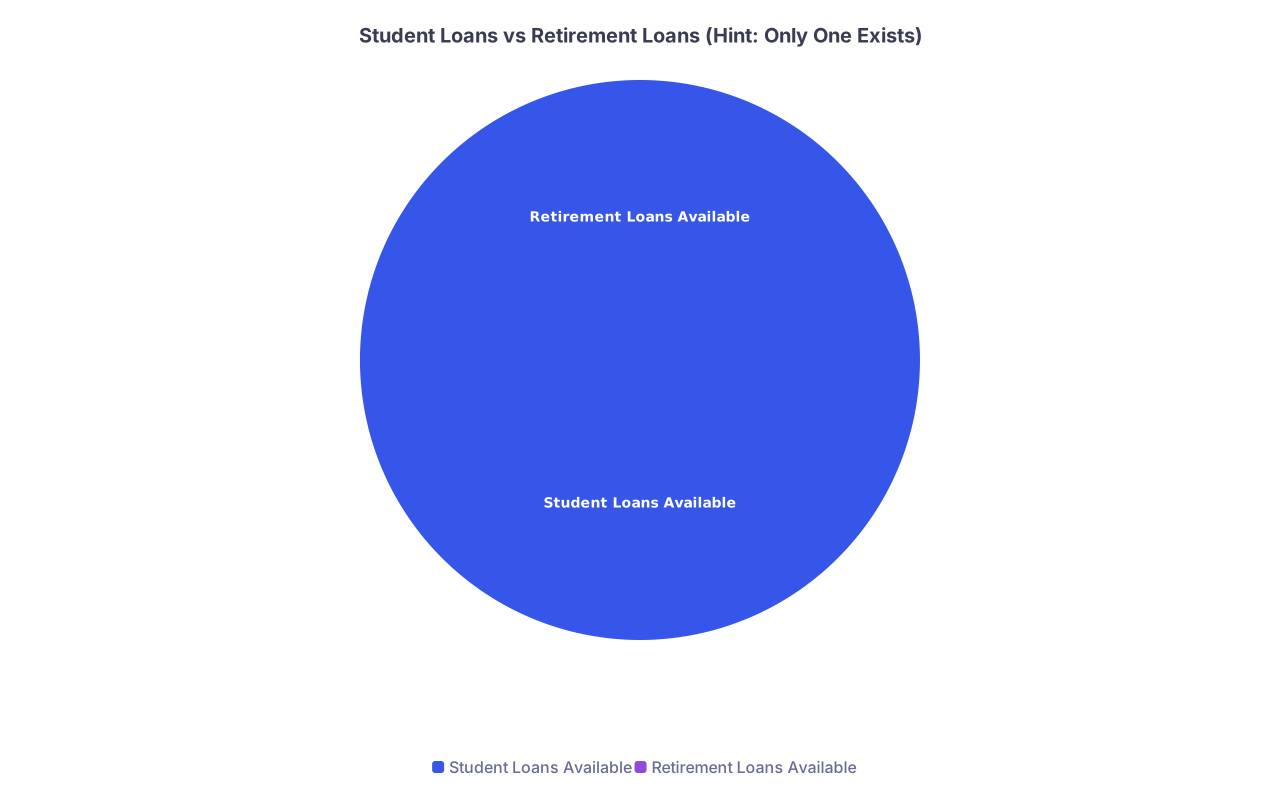
| Category | Value |
|---|---|
| Student Loans Available | 100 |
| Retirement Loans Available | 0 |
If you pay fully for college by skipping retirement, you’re basically saying:
“I’d like my child to graduate with less debt… and a higher chance of financially supporting me in 25 years.”
Not better. Just delayed.
The Legal and Structural Stuff You’re Probably Avoiding
This is the dry, scary side that everyone procrastinates on. But this is where a lot of catastrophes get prevented.
1. Get the will and documents done. No more excuses.
You need:
- A will (who gets what, who takes care of minor kids)
- Healthcare proxy / medical power of attorney
- Financial power of attorney
- Beneficiaries correctly listed on retirement accounts and insurance
If you support parents and kids, this isn’t optional. If you die or become incapacitated without this stuff:
- Your kids could end up in a mess of confusion
- Your spouse or siblings could fight over your parents’ care
- Your retirement accounts may not go where you think
Honestly, pay a lawyer for a basic estate plan if you can. It’s not fun. But neither is a probate nightmare.
2. Talk to your parents about their documents
This is where people freeze. But you need to know:
- Do they have a will?
- Who’s their power of attorney?
- Any long‑term care planning at all?
- What’s their plan if they can’t live independently?
You’re not being nosy. You’re trying to prevent a crisis where everything collapses on your shoulders at once.
A Simple, Not-Perfect, Actually-Usable Plan
Let’s stitch this together into something that won’t fix everything, but might stop the 3 AM panic spirals.
Step 1: Decide your non-negotiable retirement minimum
Something like:
- Always get 100% of employer 401(k) match
- Plus X% on top (maybe 5–10% of income if you’re behind)
This is “untouchable.” Kids’ colleges, parent support, everything else has to work around this.
Step 2: Calculate how much you’re already giving away each month
Add:
- Money to parents
- Money to adult kids
- Kid activities that go beyond basics
- College savings or tuition
Then ask, bluntly:
“Does this number make sense given where our retirement is?”
If not, start trimming. Not everything at once. But trim.
Step 3: Commit to hard conversations
- With parents: “We can do X per month. Past that, we need to look at other resources.”
- With kids: “We’ll help, but here’s what we realistically can’t do.”
- With partner: “We have to agree on what’s more important: this immediate thing, or not being financially wrecked at 70.”
These conversations feel awful at first. Then they feel like oxygen.
Step 4: Put legal guardrails in place
- Update or create your will, POAs, beneficiaries
- Make sure life insurance is aligned with who depends on your income
- If you own a home, think through what you actually want to happen with it
This Still Feels Overwhelming. Are You Screwed?
No. You’re not screwed. You’re just in a very tight spot that a lot of people are in, silently.
Some grounding realities:
- You don’t need a perfect retirement. You need a not-disastrous one.
- Helping parents and kids “less than ideal” does not make you selfish. It makes you realistic.
- The fact that you’re even worrying about this puts you miles ahead of the many people who just… don’t think about it.
And yes, there will be guilt. You’ll second-guess every boundary. You’ll wonder if you’re being too harsh, too soft, too late.
That’s normal. The goal isn’t to get rid of the anxiety completely.
It’s to make sure that the decisions behind the anxiety are grounded in math and long-term thinking, not just panic and guilt.
FAQs
1. Is it wrong to prioritize my retirement over helping my parents more?
No. It’s actually the responsible thing long-term. If you bankrupt your future to plug every hole for your parents now, you likely become dependent on your own kids later. That just shifts the problem down a generation. Help where you can, but within hard limits that still allow you to consistently fund retirement.
2. What if my parents refuse to downsize or accept help programs?
Then you set a firm cap on what you can provide financially and let the consequences be theirs, not 100% yours. You can say, “We can give $X/month. Past that, we can help research options, but we can’t pay more.” Adults are allowed to make stubborn choices. You’re not required to fund those choices indefinitely.
3. Should I pause college savings to focus on retirement?
If you’re behind on retirement, yes, I’d usually pause or shrink college savings first. Your kids can combine: cheaper schools, scholarships, work, and loans. You cannot borrow for retirement. You can still support them in non-financial ways and maybe help with loans later if your situation improves.
4. How much should I be saving for retirement if I’m starting late?
There’s no magic number, but if you’re in your 40s or 50s and behind, 15–20% of income (including employer match) is a solid target if you can manage it. If that sounds impossible, start with what you can and increase yearly. The key is consistency and refusing to let other people’s needs completely wipe out your future.
5. What if I feel guilty every time I say no to my family?
You probably will. Guilt doesn’t mean you’re wrong. It means you care. When it hits, remind yourself: “I’m saying no now so I don’t become a crisis for them later.” You’re protecting future them from having to financially rescue future you. That’s not selfish. That’s the long game.
Key points to hang onto:
- Your future self must be in the priority list, not as an afterthought.
- You’re allowed – and honestly required – to set hard limits on what you can give to parents and kids.
- Imperfect planning with real boundaries beats endless guilt-fueled giving that leaves you broke at 70.


