

It’s 11:47 pm. You’re still in your work clothes, sitting at the kitchen table, staring at your checking account and a half-finished retirement calculator on some random website. You type in your income, your loans, your age. Hit “calculate.” And your stomach drops.
“Wait. That can’t be right.”
You start thinking:
What if I get sick?
What if reimbursements get cut again?
What if my spouse can’t work or stops working?
What if I’m 70… and still rounding because we literally can’t afford for me to stop?
If that’s where your brain lives at night, you’re not weird. You’re just a single-income physician household in a world that quietly assumes there are two high earners, a family office, and maybe a trust fund.
Let’s talk about what you’re actually up against—and how to build a plan that doesn’t rely on magical thinking.
The Core Fear: “What If It’s All On Me… And I Blow It?”
Here’s the ugly thought most people are too embarrassed to say out loud:
“I’m terrified that despite busting my ass for this career, I’ll still end up the burned-out 68-year-old working because we can’t afford for me to stop.”
One income. One disability. One burnout episode. One bad investment.
It feels like everything is just one disaster away.
And in a single-physician home, it kind of is. If you’re the:
- Only W-2 earner,
- Person with the retirement accounts,
- One with the “good benefits,”
then you’re not just planning for your retirement. You’re planning for your partner’s, your kids’, and possibly your parents’ by default.
That’s why the classic “you’re a doctor, you’ll be fine” advice feels like gaslighting. You see the loan payments, the daycare, the malpractice, and the tax bill.
You’re not crazy to worry.
But “worry” without a plan is just torture. So let’s turn the worst-case scenarios into something you can actually do something about.
Step One: Know Your “Enough” Number (Not the Fantasy Version)
The reason those online retirement calculators freak you out? They assume nonsense.
They assume you’ll magically save 25% starting at 30.
They assume steady market returns.
They assume no giant life curveballs.
You need numbers that are ugly, honest, and specific to a single-physician household.
Let’s simplify.
You really have two “enough” numbers:
- Today’s lifestyle survival number (what you must cover every month to not feel like everything is crumbling)
- Retirement “bare minimum” number (what Future You needs so you’re not forced to keep working)
Don’t overcomplicate at first. Rough is better than nothing.
Break it down into:
- Non-negotiables: mortgage/rent, utilities, food, insurance, minimum debt payments, childcare.
- Strong wants: travel, nicer car, activities for kids, house upgrades.
- True extras: luxury travel, second home, private school, etc.
Now here’s the harsh but freeing thing:
Your retirement number is based on your non-negotiables + strong wants, not your full “Instagram life” picture.
So if your monthly must-have in retirement (in today’s dollars) is $10,000/month ($120k/year), a very rough rule:
- Multiply annual need by 25.
$120,000 × 25 ≈ $3 million invested.
That 25x number assumes a ~4% withdrawal rate. Is it perfect? No. Is it way better than “I have no clue, I hope this works”? Yes.
You can refine later, but having a ballpark like “we probably need around $3M in actual retirement investments” gives your anxiety a target. Vague fear is brutal. Specific fear is actionable.
Reality Check: Is One Physician Income Actually Enough?
This is where you want me to say: “Yes, absolutely, no problem.”
I’m not going to lie to you.
It can be enough.
It’s just not enough by default.
On one income, you can’t:
- Mindlessly upgrade the house every 5–7 years,
- Max out lifestyle creep,
- Avoid hard choices on cars/schools/vacations,
- Under-save for a decade and expect to “catch up later.”
That’s how single-physician families end up with $500k+ income and almost nothing invested at 50 except home equity. I’ve seen it. Too often.
But when a one-income household hits their stride, it usually looks something like this:
| Career Stage | Household Income | Annual Retirement Savings Goal |
|---|---|---|
| Early (0–5 yrs) | $250–350k | $40–60k |
| Mid (6–15 yrs) | $300–500k | $70–120k |
| Late (16+ yrs) | $350–600k+ | $100–150k |
Is that aggressive? Yes. Is it possible? Also yes.
The point: One income is enough if you intentionally build around it. It is absolutely not enough if your plan is “we’ll save later when things calm down” (they never do).
The 3 Catastrophes Single-Physician Homes Must Plan Around
There are three nightmares that actually deserve space in your head:
- You can’t work (temporarily or permanently).
- You burn out and step back.
- The system shifts and you earn significantly less.
Instead of pretending they won’t happen, you build assuming at least one will.
1. “What if I get disabled or sick?”
If your brain lives in worst-case land, you must address this one clearly or you’ll always feel like you’re walking on a tightrope with no net.
Non-negotiables:
Own-occupation disability insurance.
Not hospital’s watered-down version. True own-occupation from a major carrier. Enough monthly benefit to cover your core expenses + retirement saving if possible.Life insurance.
If someone depends on your income and you die, are they… okay? Or completely screwed?
For most one-income physicians, I like:
- Term life (20–30 years),
- Coverage of 5–10x your annual income, adjusted for debt and kids.
This is boring, unsexy stuff. But it’s what lets you sleep at 2 am when your brain starts playing “what if I get cancer” on loop.
2. “What if I burn out and can’t keep this pace?”
You already know this one is real. I don’t need to explain that.
The key shift: stop planning like you’ll always be at your peak income and peak capacity. That’s fantasy.
Build your plan so:
- If you need to drop to 0.8 FTE
- Or switch to a lower-paying but tolerable job
- Or take 6–12 months off to not implode
…you don’t completely blow up your retirement trajectory.
Practically, that means:
- Front-loading savings in your earlier years (before kids/aging parents/other chaos explode),
- Keeping your fixed expenses low enough that you could live on less if needed,
- Avoiding giant irreversible anchors (way-too-expensive house, private school you can’t back out of without drama).
3. “What if my income drops?”
Reimbursement cuts. Group dissolves. Contract changes. Hospital gets bought. This isn’t theoretical; this is… normal.
So you quietly plan like this:
- Live one or two steps below what the bank says you can “afford.” If they’ll loan you for the $1.4M house, aim for the $900k one.
- Avoid building your entire life around bonuses and overtime. Treat bonus as “supercharge savings” money, not “this is how we pay the bills.”
- Keep at least 3–6 months of expenses in cash, ideally closer to 6–12 for single-income families.
Is it overkill? Maybe. But you know what else is overkill? Crying in your car because your group cut your hours and there’s no slack in the system.
Where Your Money Actually Needs to Go (So You’re Not Guessing)
You’ve got retirement options everywhere—401(k), 403(b), 457(b), backdoor Roth IRA, HSA, taxable brokerage. It feels like a menu written to induce paralysis.
Here’s a sane priority list for most single-physician homes:
Get the employer match first.
If your hospital matches 4–6% in a 401(k) or 403(b), take every penny. That’s free money. You don’t leave free money.Max tax-advantaged retirement accounts.
Aim for:- 401(k)/403(b): up to annual limit (often in the $23k+ range; check current IRS limit),
- Backdoor Roth for you (and spouse if eligible, even if they don’t work),
- 457(b) if you fully understand the risks and structure.
Fund HSA if you have a high-deductible plan.
HSAs are stealth retirement accounts—triple tax-advantaged. Use cash for expenses now, let the HSA grow invested for later.Then taxable brokerage.
Once you’re doing the above, extra savings go into a simple, boring, low-cost index fund taxable account.
To calm the “am I saving enough?” anxiety, look at a simple time/value snapshot.
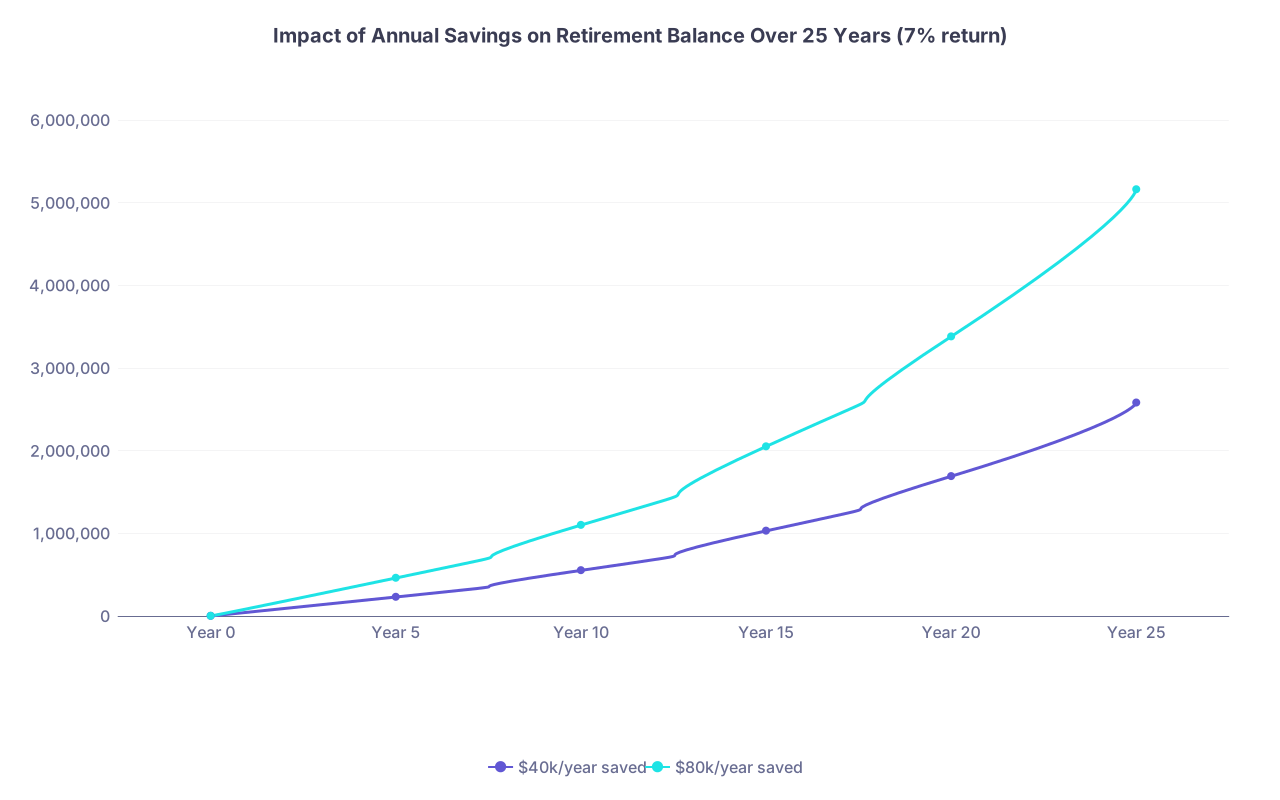
| Category | $40k/year saved | $80k/year saved |
|---|---|---|
| Year 0 | 0 | 0 |
| Year 5 | 230000 | 460000 |
| Year 10 | 552000 | 1100000 |
| Year 15 | 1030000 | 2050000 |
| Year 20 | 1690000 | 3380000 |
| Year 25 | 2580000 | 5160000 |
That second line is the “we took this seriously early” line. Single-income homes don’t get as many do-overs. Which is why your anxiety is screaming at you to do something now.
The Spouse/Partner Question: What If They Don’t Work?
This one’s awkward to talk about. But it matters.
If you’re the physician and your partner doesn’t work (or earns much less), you’re probably thinking:
- “Is it unfair for me to be this stressed about money?”
- “What happens if we split up?”
- “What if they never really understand that this entire structure rests on my license and my back?”
Financially and legally, you need some guardrails. Not because you’re planning to separate, but because ignoring this makes you more anxious, not less.
Basic protections to think about:
- Make sure your spouse is protected if you die. Term life insurance sized so they can grieve, not scramble.
- Own accounts in your name and some joint. Retirement accounts (401(k), 403(b), etc.) are in your name, but you can also have joint taxable investment accounts.
- Estate documents. Will, healthcare proxy, maybe a trust depending on kids/assets. Get an actual attorney who knows physicians, not some random template online.
And emotionally: have a real conversation.
Not the casual “yeah we should save more” one. The “here’s what happens if my income vanishes for a year” conversation. It’s uncomfortable. But shared reality is less lonely than silent panic.
A Simple Mental Model: 3 Buckets for Single-Physician Security
When your fears are all over the place, you need a simple frame. Think of your money in three buckets:
Today Stability Bucket
- Emergency fund (3–12 months expenses)
- Basic checking for bills
- Short-term savings (upcoming car, home repair, etc.)
Retirement & Freedom Bucket
- 401(k) / 403(b) / 457(b)
- Roth IRAs
- HSA (if you invest it)
- Taxable investments meant for long-term
Disaster Protection Bucket
- Own-occupation disability insurance
- Term life insurance
- Umbrella liability policy
- Basic estate planning
If you’re feeling behind, don’t try to fix all three buckets at once overnight. But don’t ignore any of them completely either.
A decent starting path:
- Stabilize Bucket 1 (emergency fund to at least 3 months).
- Lock in Bucket 3 (disability + term life; you’re usually insurable now, but not guaranteed later).
- Then ramp up Bucket 2 aggressively and automate it.
What This Actually Looks Like For a Real Single-Physician Home
Let me make this concrete.
Take a mid-career hospitalist, age 38, single-income, married with two kids, HHI ~$320k.
They might do something like:
- Max 403(b) at ~$23k/year.
- Backdoor Roth IRA for self and spouse: ~$7k + $7k.
- Put an extra $25–40k/year into taxable index funds.
- Pay down remaining student loans at a steady pace but not obsessively if rates are low.
- Keep ~6 months expenses in cash because only one income.
- Own: $10–15k/month own-occupation disability, $2–3M term life policy.
Are they “rich”? No.
Are they building toward a real retirement and serious flexibility by their 50s? Yes.
And they’re doing it without a second six-figure income.
You Don’t Need Perfect. You Need “In Motion.”
The scariest version of your future isn’t “we didn’t hit $5M.”
It’s “we did nothing for ten years because I was too overwhelmed to start.”
You don’t need the perfect allocation or the perfect plan right now. You need to:
- Decide roughly how much you’re going to save annually.
- Automate it into real accounts, not vague “we’ll transfer at the end of the month” promises.
- Cover your catastrophic risks so you’re not white-knuckling every what-if.
Then refine.
Your anxiety probably won’t evaporate. It’s trying to protect you. But if you can point to:
- “We’re saving $X/year,”
- “We’re protected if I get disabled/die,”
- “We’ve talked honestly about our situation,”
…that anxiety has less room to own you.
Years from now, you won’t remember the exact numbers you ran on that retirement calculator at midnight. You’ll remember whether you stayed paralyzed by fear—or used that fear as the push to start building something solid under your one income.


