

What if you do everything right as a physician…and then the market crashes right before you retire and wipes out your savings?
That’s the nightmare loop, right? You survive med school, residency, 80‑hour weeks, codes at 3 a.m., and then some line on a chart goes down and your retirement plan just…evaporates.
You’re not crazy for worrying about this. Honestly, more physicians should.
Let’s walk through this like someone who is scared of the stock market, assumes the worst, and still wants to retire without being chained to night call at 68.
Step 1: Admit the Fear Is Rational (And Still Work Around It)
You’re not just “bad with money.” You’re trained to look for worst‑case scenarios.
You’ve internalized:
- “What if this is the one time the protocol fails?”
- “What if it’s not GERD, it’s an NSTEMI?”
So of course you look at the S&P 500 and think:
- “What if I retire in 2008 or 2020 or whatever the next disaster is?”
- “What if I buy at the top and it crashes 40%?”
- “What if I have to go back to work because I ran out of money?”
You’ve also heard horror stories:
- The attending whose 401(k) dropped 50% in 2008.
- The doc who “lost everything in tech stocks.”
- The older partner who kept delaying retirement because “the market is too volatile right now.”
Here’s the uncomfortable truth:
Yes, the market will crash multiple times in your career. Not maybe. Will.
The question isn’t “how do I avoid downturns entirely?”
The real question is: “How do I design a plan that survives downturns so I still retire on time?”
That’s the frame shift.
Step 2: Accept You Don’t Actually Need to Be a “Stock Market Person”
You can retire securely without:
- Picking individual stocks
- Timing the market
- Reading earnings reports
- Watching CNBC scream at you all day
You do not need to become “that guy” in the physician lounge bragging about options trades between consults.
What you actually need is boring:
- A high savings rate
- Simple, diversified investments
- A plan that assumes bad stuff happens regularly
- Guardrails so you don’t panic‑sell at the worst time
The main enemy isn’t volatility.
It’s your own fear when volatility shows up.
So we build a system knowing you’re scared, not pretending you’ll suddenly become Zen when the S&P drops 30%.
Step 3: Understand Your Real Risks (They’re Not What You Think)
You’re focused on “market crash risk.”
But that’s only one of several things that can wreck retirement.

Here are the big threats:
- Longevity risk – You live longer than you think. Great medically, brutal financially if you under‑saved.
- Inflation risk – $10,000/month today is not $10,000/month in 25 years.
- Lifestyle creep – Your spending quietly inches from $10k to $18k/month and you call it “normal.”
- Market sequence risk – The market crashes early in retirement while you’re withdrawing.
- Single‑asset risk – Too much tied up in one stock, one practice, one property.
- Behavior risk – You panic‑sell in a downturn or chase hot trends at the top.
The anxious doc brain tends to hyper‑focus on #4 (market crashes) and ignore #1–3, which are often worse.
The goal is to build a plan that:
- Admits markets will crash.
- Accepts that you might live into your 90s.
- Accounts for your tendency to upgrade houses, cars, schools.
If a plan only “works” when everything goes right? It’s a bad plan.
Step 4: Use the “Buckets” Approach So Crashes Don’t Terrify You
This is where a lot of anxious, market‑phobic physicians finally relax a bit.
Instead of “all my money is in the market,” think in time buckets.
Bucket 1: Cash / Very Safe (0–3 years of spending)
Purpose: So you don’t care what the market does this year.
- 1–3 years of core retirement expenses in:
- High‑yield savings
- Money market funds
- Short‑term Treasuries / CDs
If you know the next 2–3 years of living costs are sitting in boring cash‑like stuff, a 30% drop in stocks doesn’t automatically mean, “we can’t pay the mortgage.”
Bucket 2: Middle‑Term (3–10 years)
Purpose: More growth than cash, less volatility than pure stocks.
- Short/intermediate‑term bond funds
- Conservative allocation funds (like 30–50% stocks)
This bucket refills Bucket 1 over time. When markets are decent, you shift gains from this bucket and Bucket 3 into Bucket 1. When markets are awful, you can live off Buckets 1 and 2 while you let Bucket 3 recover.
Bucket 3: Long‑Term Growth (10+ years)
Purpose: Outrun inflation and support a 20–30+ year retirement.
- Broad, low‑cost stock index funds
- Maybe some real estate if you actually know what you’re doing
You don’t touch this in a downturn. This is where people blow up their plan: they see a big drop here, freak out, and sell low. Your rule: this bucket is for future you, not this year you.
This structure doesn’t magically prevent losses. It just creates a psychological firewall so every downturn doesn’t feel like “I’m going to be broke in 6 months.”
Step 5: Mix Stocks and Bonds Based on Fear, Not Fantasy
Stop pretending you’re “aggressive” if you know you’ll panic at a 40% drop.
Your allocation should be honest about your anxiety.
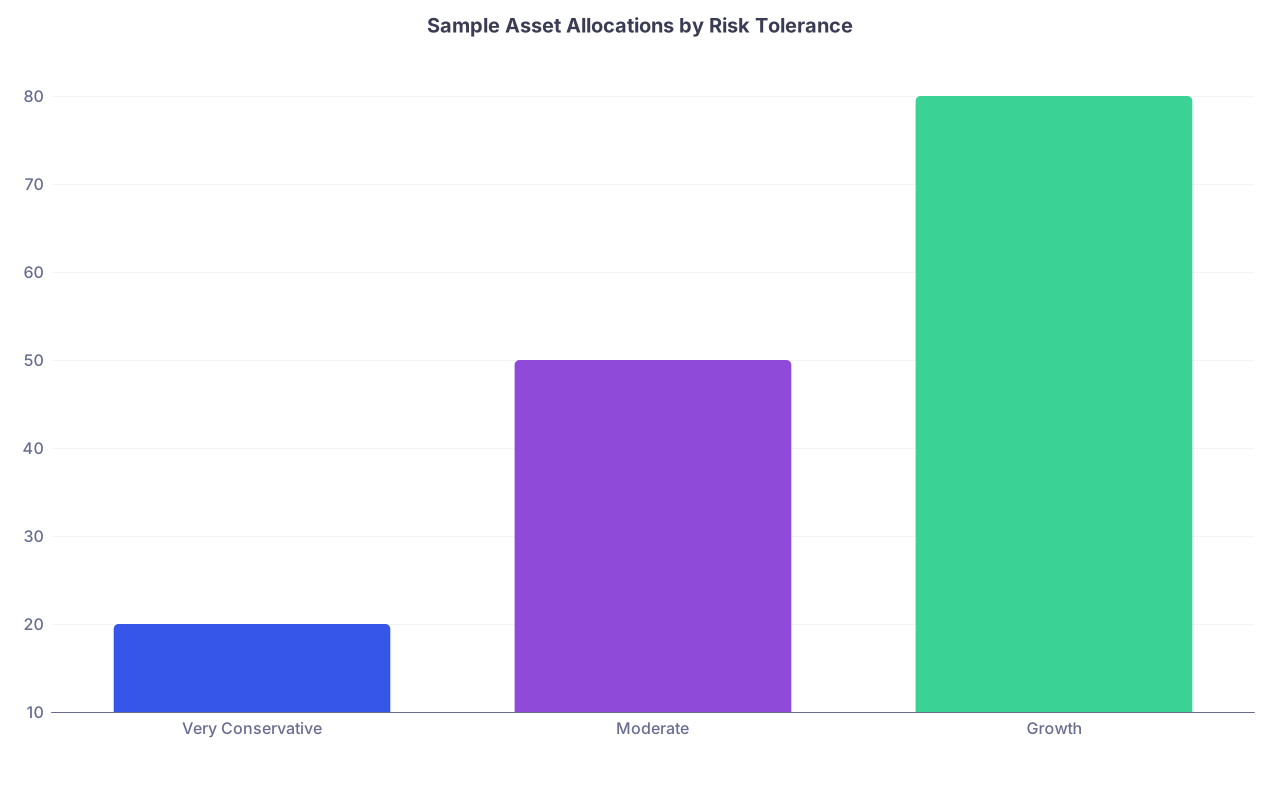
| Category | Value |
|---|---|
| Very Conservative | 20 |
| Moderate | 50 |
| Growth | 80 |
Think like this (rough idea, not a prescription):
- If you are terrified of volatility and already behind:
- Maybe 40–50% stocks, 50–60% bonds/cash
- If you can tolerate some drops and you’re 10–20 years from retirement:
- Maybe 60–70% stocks, 30–40% bonds
- If you’re early career and scared but rational:
- You probably still need something like 70–80% stocks, but you can glide slowly instead of all‑at‑once
Key point:
It’s better to pick a slightly more conservative allocation you can actually stick with in bad times, than an aggressive one you abandon at the worst possible moment.
Step 6: Protect the Downside With Boring, Unsexy Tools
You’re a physician. You like protocols and safeguards. Use them here too.
Here are tools that reduce “retirement blowing up” risk:
Disability insurance while working
You are your biggest asset until retirement. If you lose your income and can’t work, no investment plan matters.Term life insurance (if you have dependents)
So your family isn’t wrecked financially if you die before you’ve saved enough.Maxing tax‑advantaged accounts first
- 401(k) / 403(b) / 457(b)
- Backdoor Roth IRA
- HSA (if available)
These reduce taxes and give your investments more room to compound, which is your friend if you’re nervous and want a margin of safety.
Reasonable debt strategy
Not “live like a resident for 30 years,” but also not “seven‑figure house three years out of residency while carrying $350k at 7%.”Avoid concentrated bets
No, putting 50% of your net worth into your hospital’s stock or a “friend’s real estate deal” is not safer than an index fund. It just feels more understandable.
Step 7: Aim for Flexible Retirement, Not a Fixed Magic Number
Here’s what really spikes anxiety:
“I need exactly $5 million and if I only get to $3.8 million I’m doomed.”
That kind of all‑or‑nothing thinking is paralyzing.
A better frame: “I want to build enough that I have options.”
So instead of a single magic number, think in ranges:
| Readiness Level | Portfolio Size (Example) | What It Means |
|---|---|---|
| Minimum | $2.5M | Can retire with frugality |
| Comfortable | $3.5M | Normal lifestyle, some slack |
| Ideal | $4.5M+ | Travel, extras, big buffer |
These numbers will vary based on your spending, but the concept holds:
- You’re not either “set for life” or “completely hosed.”
- You can adjust:
- Work part‑time a few extra years
- Lower spending in the first 5 years
- Delay Social Security
- Downsize housing later
The plan is not a single rigid bridge that either stands or collapses. It’s more like a series of stepping stones. If one is a little wobbly, you adjust your footing.
Step 8: Use a Simple, Boring, Autopilot Approach
If you’re scared of the market, complexity will kill you.
Because when things drop, you won’t even understand what you own.
What usually works best for anxious-but-trying physicians:
- A three‑fund portfolio in your accounts:
- Total US Stock Market index fund
- Total International Stock Market index fund (optional but healthy)
- Total Bond Market index fund
Or even lazier:
- A target‑date retirement fund with an allocation you actually agree with.
You don’t need:
- Hedge funds
- Active mutual funds with 1%+ expense ratios
- Crypto anything
- “Structured products” sold by a smooth “advisor” in a nice suit
Complex stuff is usually there to justify high fees or sound smart in a pitch meeting. It doesn’t reduce your anxiety long‑term.
Step 9: Decide When to Get a Professional (And How Not to Get Fleeced)
Lots of physicians are secretly embarrassed they don’t already know this. So they avoid getting help and just…do nothing.
If you’re feeling paralyzed, a good fee-only, fiduciary financial planner can be worth it. But you have to be picky.
Look for:
- Paid by flat fee or hourly or a transparent percentage of assets.
- No commissions on products.
- Willing to explain things in plain language until you really get it.
- Focused on planning, not just “we’ll manage your portfolio and send statements.”
Avoid:
- Anyone who leads with annuities or fancy insurance products.
- People who dodge the “How are you paid?” question.
- Advisors who brag about “outperformance” or “beating the market.”
You’re not hiring a wizard. You’re hiring someone to:
- Help structure your buckets
- Build a withdrawal strategy
- Stress-test your plan against crappy market periods
- Talk you off the ledge when CNN runs “MARKET BLOODBATH” banners
Step 10: Stress-Test the Worst-Case Scenarios On Purpose
Instead of imagining the worst‑case in a vague way and spiraling, you actually model it.
A good plan will answer questions like:
- “What happens if we get a 2000‑2002 + 2008 style decade right around my retirement?”
- “What if inflation averages 4–5% instead of 2%?”
- “What if I live to 95?”
- “What if we spend $5k/month more than we’re planning now?”
You can do rough versions of this with online calculators, but a planner with decent software can plug in historical bad sequences and show you: “Okay, here’s how your withdrawals hold up.”
You want to see:
“Even in a genuinely crappy sequence, we might have to tighten spending or work 2 more years, but we’re not on the street.”
That’s what calms anxiety: not “nothing bad will happen,” but “even if bad stuff happens, we’re still okay.”
A Simple, Honest Mental Checklist
If you’re scared of the stock market and want to know if you’re at least moving in the right direction, run through this:
- Am I saving 20%+ of gross income toward retirement (counting employer match)?
- Do I have at least 3–6 months of emergency cash now, and a plan to grow this into 1–3 years of expenses by retirement?
- Are my investments mostly boring, low‑fee index funds?
- Do I have a reasonable stock/bond mix that I won’t abandon in a crash?
- Am I keeping lifestyle creep somewhat under control?
- Do I have disability insurance and simple term life if needed?
- Have I talked through my fears with someone who actually knows this stuff—planner, financially savvy friend, or even just forced myself to write down a plan?
If you’re hitting most of those, you’re not as doomed as your 2 a.m. brain keeps insisting.

| Step | Description |
|---|---|
| Step 1 | Start Working |
| Step 2 | Pay Off High Interest Debt |
| Step 3 | Build Emergency Fund |
| Step 4 | Get Insurance Protection |
| Step 5 | Max Tax Advantaged Accounts |
| Step 6 | Choose Simple Allocation |
| Step 7 | Build Buckets Near Retirement |
| Step 8 | Stress Test Bad Markets |
| Step 9 | Adjust Work or Spending |
| Step 10 | Maintain Discipline in Crashes |
FAQ: Exactly 5 Questions
1. What if I start saving late as a physician—is it already too late?
No, but you lose the luxury of being sloppy. If you’re 45 and haven’t seriously started, you’ll probably need:
- A higher savings rate (maybe 25–30% of income)
- Less lifestyle inflation
- A slightly higher stock allocation (that you can tolerate)
You may not hit the “dream” number, but you can absolutely build a “we’re actually fine” retirement if you start now and stop pretending the problem doesn’t exist.
2. Should I just avoid stocks completely if I’m that scared?
You can, but there’s a cost. If you go ultra‑conservative (cash and bonds only), you:
- Protect yourself from big drops
- But increase your risk of running out of money later due to inflation and low returns
So you’re swapping “market crash fear” for “outliving my money fear.” Usually the fix is not zero stocks, but fewer stocks plus a strong cash/bond cushion and a reality check on spending.
3. Are rental properties safer than the stock market for retirement?
Safer? Not automatically. Just different. With rentals you’re trading:
- Market volatility
for - Tenant risk, vacancy risk, repair surprises, local economic risk, and the joy of a 2 a.m. plumbing call. Yes, real estate can be great, but it’s not a magic low‑risk alternative. If you’re already working 55+ hours a week, becoming a part‑time landlord may add more stress than stability unless you’re very deliberate about it.
4. How do I handle a major crash right when I’m about to retire?
This is exactly what the bucket strategy is for. If you’re 1–3 years from retirement and heavily in stocks with no safe bucket, that’s a problem. But if you:
- Shift some money into cash/bonds in the last 5–10 working years
- Plan to be flexible on your retirement date by 1–3 years
- Keep 1–3 years of expenses in very safe assets
Then a crash becomes an annoyance, not a life‑ruining event. You might delay full retirement or spend a bit less temporarily, but you don’t have to “unretire” in panic.
5. Can I really do this without becoming a “finance person”?
Yes. You don’t need to love this. You just need:
- Basic understanding of risk, time horizon, and diversification
- A simple, written plan
- Either the discipline to stick with it or a trustworthy planner to keep you on track
Think of it like managing a chronic condition: a straightforward protocol, check in periodically, adjust when needed. You don’t obsess over it daily, but you also don’t ignore it for 15 years and hope it’s fine.
Years from now, you won’t remember every market headline or the exact percentage your portfolio dropped in 2027; you’ll remember whether you built a life where work became a choice instead of a necessity—and how early you gave yourself permission to take that seriously.


