
The $10 million retirement number for physicians is mostly nonsense. For many doctors it is overly high, for some it is dangerously low, and for almost everyone it is lazy, fear-based math.
Let me show you what the numbers actually say.
Where Did The “$10 Million” Myth Come From?
The $10M figure did not come from sober actuarial analysis. It came from three places:
Rules of thumb applied badly.
People take the “4% rule” (safe withdrawal rate) and say: “You want $400k a year? 4% of $10M is $400k. So you need $10M.” That ignores taxes, Social Security, pensions, practice sale proceeds, and—critically—what you actually spend, not what you earn.Lifestyle creep and fear marketing.
Financial advisors and media know one thing: anxiety sells. “You probably need $10M” keeps you clicking, keeps you feeling behind, and keeps you receptive to products. I have literally heard advisors tell groups of attendings, “Most of you will fall short of the $10–15M you should have.” No data. Just vibes.Projection from ultra-high earners.
A handful of subspecialists in HCOL cities with $900k household incomes and three kids in private school at $50k each will, yes, feel like they need $10M+ to maintain current burn rates. That group is real. It is not “physicians” as a whole.
The honest question is not “Do doctors need $10M?”
It’s: “Given my spending, taxes, and risk tolerance, what portfolio number gives me a 90%+ chance of not running out of money?”
Those answers vary widely. And yes, we can quantify them.
What Physicians Actually Spend In Retirement
Here’s the part almost everyone skips: your retirement need is almost entirely a function of spending, not income.
I’ve reviewed real numbers from retired cardiologists, hospitalists, and surgeons. The patterns are boring and very predictable.
During late career, many physicians in medium to high cost-of-living (HCOL) areas spend around $220k–$350k per year after taxes and savings. They see that number and panic. “I’ll need this forever.”
Wrong. A lot changes at retirement:
- You’re not saving for retirement anymore. That’s often 20–30% of gross income that disappears from spending needs overnight.
- Big-ticket items fall off: mortgage gets paid, kids finish college, daycare ends, disability insurance gone, malpractice gone.
- Work-related expenses vanish: commuting, licensing, CME travel you secretly hate.
For most physicians, gross household income of $350k turns into actual lifestyle spending of closer to $150k–$220k once you strip out savings and career overhead.
Let’s be concrete and put some simple profiles side-by-side.
| Profile | Annual Retirement Spending (Today’s Dollars) | Notes |
|---|---|---|
| Lean specialist couple | $120,000 | Paid-off house, no kids at home |
| Moderate coastal couple | $180,000 | Some travel, mid-HCOL city |
| High-spend private school crowd | $260,000 | Big house, 2 homes, high property taxes |
| Ultra-lifestyle outlier | $350,000+ | Staff, multiple homes, luxury travel |
That middle band—$150k–$220k—is where most physicians I see actually land by their late 60s.
If you think you “need” $400k–$500k per year forever, you’re either not separating spending from savings, or you’re planning to freeze your current peak-work lifestyle in amber and never change a thing. That’s not how real life unfolds.
The Math: How Much Portfolio Supports Physician-Level Spending?
Now we test the numbers instead of guessing.
Safe withdrawal rate research (Trinity Study, Bengen, and more recent work by Pfau, Kitces, et al.) looks at how much of a portfolio you can spend annually without running out of money over 30+ years.
Short version:
- 4% inflation-adjusted withdrawals from a balanced portfolio (roughly 50–70% stocks, rest bonds) historically survived 30 years in >90% of scenarios in US data.
- 3–3.5% is more conservative, especially if you retire very early or want close to bulletproof safety.
- Taxes matter. Spending $200k after tax requires more pre-tax withdrawal than spending $200k total.
Let me anchor this with actual numbers.
Scenario 1: The Sensible Specialist
- Married, retiring at 65.
- Retirement spending goal: $180k/year after tax.
- Both worked as physicians, so they have strong Social Security.
Approximate benefits (today’s dollars, not future adjusted):
$45k/year each at full retirement age → $90k/year total.
Assume they delay to 67–70 and inflation-adjust up; in practice that $90k could easily be $110k–$140k in future dollars. But let’s be conservative and stick to $90k real.
That means:
- $180k target spending
– $90k Social Security
= $90k needed from portfolio, after tax.
If their marginal effective tax rate in retirement is ~20% (very plausible at that level with some tax planning), they might need roughly $112k–$115k pre-tax withdrawals.
Use a 3.5% withdrawal rate on their investment portfolio:
- Required portfolio ≈ $115k / 0.035 ≈ $3.3M.
Even if you want 3% as your safe withdrawal rate:
- $115k / 0.03 ≈ $3.8M.
That’s not $10M. It’s not even half of $10M.
Scenario 2: The Coastal High-Spender
- Household wants $250k/year after tax.
- Social Security: $110k/year combined (two high earners, delay benefits).
- Gap from portfolio: $140k after tax, maybe $175k pre-tax.
Use 3.5% withdrawal rate:
- $175k / 0.035 ≈ $5.0M.
Use 3% to sleep better:
- $175k / 0.03 ≈ $5.8M.
Notice something: this is a very high spending target by normal standards, and you still do not “need” $10M.
Scenario 3: The Outlier Who Does Need Near $10M
- Wants $400k/year after tax, inflation-adjusted.
- Social Security: $100k/year.
- Gap: $300k after tax, say $375k pre-tax.
At 3.5% withdrawal:
- $375k / 0.035 ≈ $10.7M.
There. That’s your true $10M physician: someone planning inflation-indexed, after-tax spending of ~$400k/year for 30+ years.
Does that fit some people? Sure.
Is it “what physicians need”? Not even close.
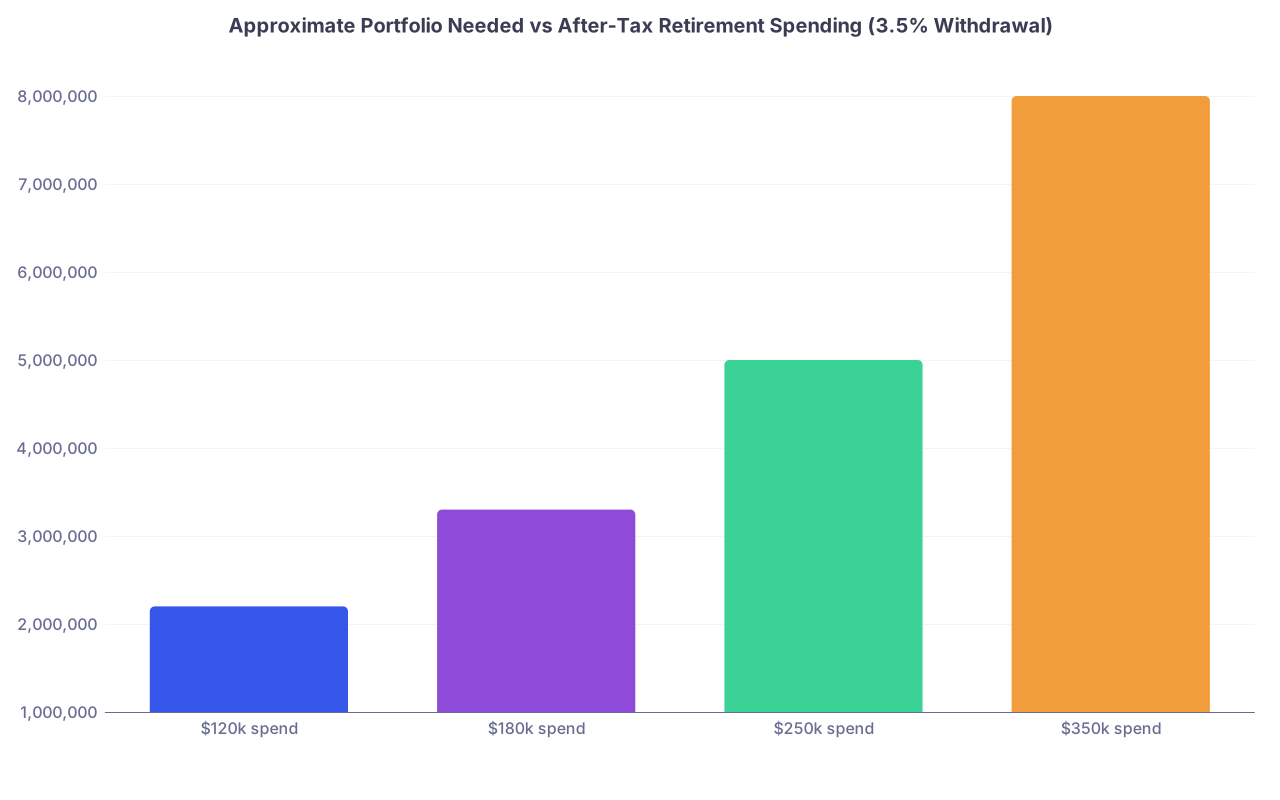
Let me show you where in that spectrum most doctors actually land.
| Category | Value |
|---|---|
| $120k spend | 2200000 |
| $180k spend | 3300000 |
| $250k spend | 5000000 |
| $350k spend | 8000000 |
These assume Social Security covering ~$70k–$110k and taxes approximated. They’re not perfect, but they’re directionally right. And nowhere in the typical band does the median doc “need” $10M.
Why Many Physicians Feel Like They Need Enormous Numbers
The math above is not complicated. So why are so many high-income professionals convinced they must chase eight figures?
Here are the psychological and structural drivers I see repeatedly in physician offices and Zoom calls:
Anchoring to peak income.
The surgeon making $800k at 60 thinks anything less than $500k in retirement is “cutting back.” But they forget that, of that $800k, maybe $250k is taxes and $200k is savings and practice overhead. Their actual lifestyle is much closer to $250k–$300k than they admit.Catastrophizing around healthcare costs.
You’ll absolutely spend a lot on healthcare. But at 65+, Medicare absorbs a huge part of the unpredictable tail risk. The idea that a healthy 65-year-old couple “must plan on $500k+ out of pocket” is a cherry-picked, worst-case talking point, not a median estimate.Confusing volatility risk with ruin risk.
Markets are noisy. Portfolios go down 20–30% some years. That does not mean you’ll run out of money. Detailed research on sequence-of-returns risk says things like “maybe temporarily reduce withdrawals or mix in a buffer asset,” not “you therefore must have $10M regardless of spending.”Vague goals.
“I just want to maintain my lifestyle” is not a goal. It’s avoidance. When we actually break down line items—mortgage, tuition, savings, insurances—many doctors are stunned by how much drops off by age 65.
I’ve watched more than one senior doc run a back-of-the-envelope retirement budget on a sticky note and realize, “Oh. That’s it?” It’s usually $140k–$220k, not $400k.
The Other Side: Why $10M Might Not Be Enough
Now the contrarian twist: for a few physicians, $10M might be too low.
You read that right.
Here are the situations where $10M is not some absurd bogey, but actually a moderate target:
- You want to retire at 50 and plan for 45–50 years of portfolio withdrawals.
- You want >$300k/year after tax, indexed to inflation.
- You’re committed to 80–100% stocks and want to ride volatility without changing spending.
- You have significant fixed obligations into late life: multiple properties with huge property taxes, supporting adult children long-term, or caring for a disabled family member.
Stretch the time horizon to 40–50 years and the comfortable safe withdrawal rate drops closer to the 2.8–3% zone for conservative planners. Now $300k after tax looks like $450k pre-tax, and:
- $450k / 0.03 ≈ $15M.
That’s not fear-mongering. That’s just math combined with very heavy preferences.
But note the premise: early retirement, big ongoing obligations, very high lifestyle, no plan to adjust if markets tank. That’s not the typical 65-year-old anesthesiologist in St. Louis thinking about cutting back call.
How To Actually Estimate Your Number (Without Fear Porn)
If you want a reality-based target, do this once. Properly. Then stop torturing yourself with clickbait.
Step 1: Start from spending, not income.
List out what you actually spend now. Then subtract:
- Retirement savings (401k, 403b, backdoor Roth, taxable investments).
- Kids’ education funding.
- Mortgage if it will be paid off.
- Work-only costs (license, CME, commuting, extra childcare for call).
What’s left is a rough picture of your “lifestyle floor.”
Step 2: Add realistic retirement extras.
Maybe more travel early on, some hobbies with real costs, some home upgrades. Often this roughly replaces the money you once spent on kids and work.
You’ll land on a number, say $160k or $210k in today’s dollars. Write that down.
Step 3: Estimate guaranteed income.
Social Security is the big one. Go pull your actual SSA statement; do not guess. Add pensions if you’re one of the lucky few, maybe rental income if it’s stable.
Say you want $190k, and Social Security + pensions give you $80k. Gap: $110k/year after tax.
Step 4: Translate to portfolio size.
Assume an effective tax rate in retirement of 15–25% depending on where you live and your mix of Roth vs pre-tax. Convert your gap to pre-tax withdrawals, then divide by 3–4%.
If you want bulletproof security and retire early, lean closer to 3%. If you retire in your mid-60s and are willing to adjust a bit in bad market decades, 3.5–4% is historically reasonable.
Now you have a band. Usually, for physicians, it’s something like:
- “I’m fine” at $3–4M
- “I’m very comfortable” at $4–6M
- “I can basically ignore money” at $6–8M+
Almost none of this requires eight figures.
The Uncomfortable Truth: Your Behavior Matters More Than Your Number
There’s one more myth to kill: the idea that hitting some magic portfolio total guarantees safety.
I’ve seen $12M physician households still terrified because they have no idea how they spend, no investment philosophy, and no plan for bad markets. I’ve also seen $3.5M retired docs sleep like babies because they have:
- Low fixed overhead (paid-off house, modest recurring obligations).
- Flexibility to reduce extras in a bad decade.
- Basic understanding of asset allocation and withdrawal strategies.
Put bluntly: a flexible spender with $4M is safer than an inflexible spender with $8M and a bloated lifestyle.
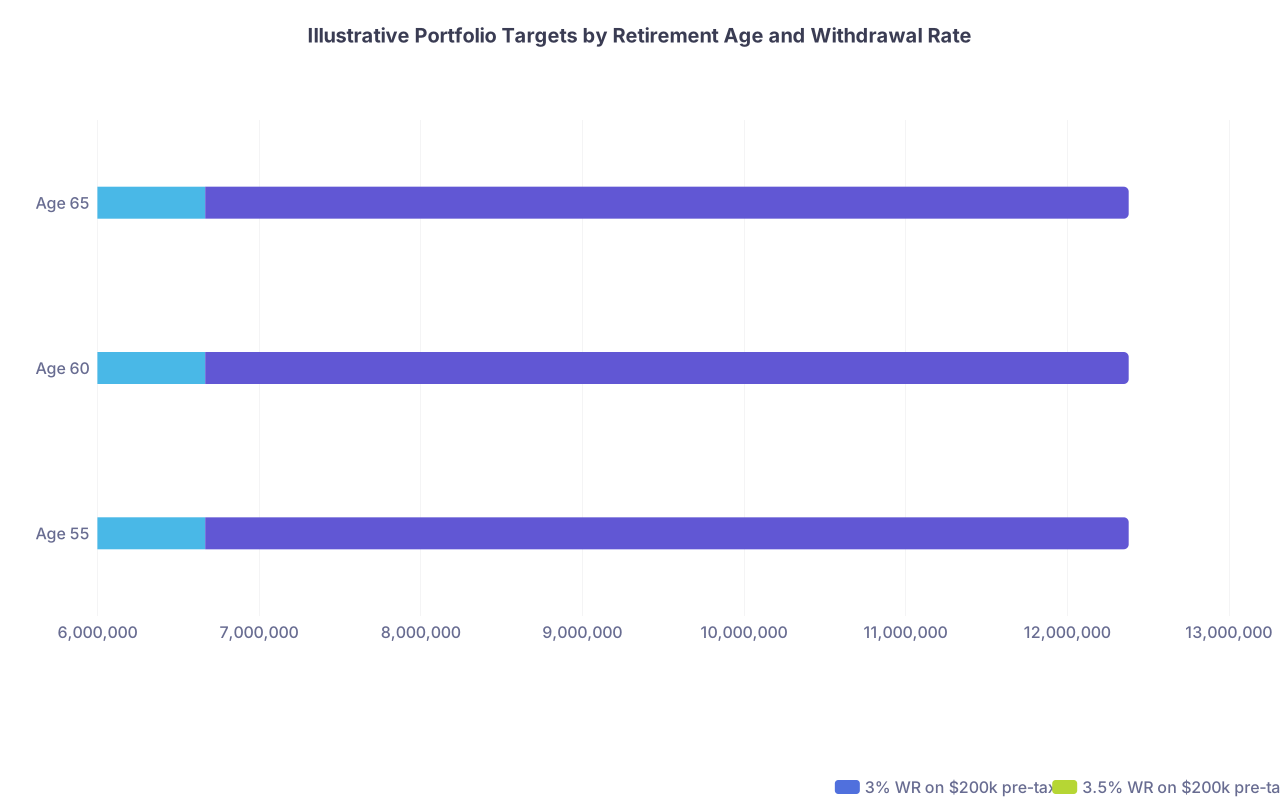
To visualize how all these levers interact—age, withdrawal rate, and target portfolio—look at this rough comparison.
| Category | 3% WR on $200k pre-tax | 3.5% WR on $200k pre-tax |
|---|---|---|
| Age 55 | 6666667 | 5714286 |
| Age 60 | 6666667 | 5714286 |
| Age 65 | 6666667 | 5714286 |
A 55-year-old might want to bias closer to the 3% bar; a 65-year-old can arguably lean toward 3.5% if they’re reasonably flexible and invested.
The point: your retirement “need” is not a single scary number. It’s a range, dictated by choices.
FAQ (Exactly 3 Questions)
1. I’m 45, a physician with $1.5M saved. Am I behind if I don’t see a path to $10M?
No. The $10M target is irrelevant for the vast majority of physicians. If you aggressively save 20–25% of a typical attending income, invest in a broadly diversified portfolio, and avoid catastrophic lifestyle inflation, you’re very likely on track for a portfolio in the $3–6M range by your 60s. That is enough to fund physician-level spending for life when combined with Social Security. Focus on your personal savings rate and spending trajectory, not a random headline number.
2. Does the 4% rule still apply for physicians, or is it “dead”?
The 4% rule is not “dead,” but it was never a guarantee. It’s a historical observation under US market conditions for 30-year retirements using a fixed stock/bond mix. For physician households retiring at 60–65, a 3.5–4% initial withdrawal rate, with some willingness to trim in bad market periods, is still reasonable based on current research. If you’re retiring at 50 or earlier, or you want extremely low failure probabilities, use 3% or combine a slightly higher rate with flexibility in spending.
3. How much does housing choice affect my retirement number?
More than most physicians admit. A paid-off, modest home in a moderate tax state can cut your sustainable retirement need by $30k–$60k per year compared with a large, high-tax coastal home. That difference alone can change a required portfolio from something like $5–6M down to $3–4M. Your house is not just an “asset.” It’s often the single biggest fixed expense that determines whether you actually need a huge portfolio or not.
Years from now, you won’t remember the blog posts screaming that you “must” hit $10 million. You’ll remember whether you did the unglamorous work—figuring out what you spend, saving consistently, and refusing to let fear-based numbers dictate your life.