
The idea that “just picking a high-paying specialty” is your best retirement plan is fantasy. A comforting, dangerous fantasy.
If big income automatically led to secure retirement, orthopedics and derm would be full of financially independent 55‑year‑olds quietly bowing out. They are not. The data shows something far less flattering: specialty choice explains surprisingly little about who actually retires well. Behavior, savings rate, and time in the market do most of the heavy lifting.
Let’s dismantle the myth.
The Myth: "I’ll Just Match Something High-Paying and Be Fine"
Here’s what I hear from students, residents, even attendings:
- “I’m going into ortho because I don’t want to worry about money.”
- “If I can hit $600k+ as an attending, retirement will take care of itself.”
- “Primary care docs have to stress about retirement. Specialists don’t.”
Sounds logical. Higher income = more savings = better retirement. Right?
Except that’s not what actually happens in the real world.
What the income data actually shows
Yes, some specialties pay much more. Typical ballpark attending median incomes (US, recent surveys):
| Specialty | Median Income (USD) |
|---|---|
| Orthopedic Surgery | 600,000+ |
| Cardiology | 500,000+ |
| Dermatology | 480,000+ |
| General Surgery | 420,000+ |
| Internal Medicine | 280,000–300,000 |
| Pediatrics | 230,000–260,000 |
Huge gap. Nobody disputes that.
The problem is the next jump people make: “Therefore, those at the top of this chart are set for retirement.”
That leap is where the myth lives. And dies.
Why High Income ≠ High Retirement Readiness
I’ve seen $700k surgeons stressing about money and $260k pediatricians coasting toward FI at 55. Same country. Same tax code. Same stock market.
The differences are not in their CPT codes. They’re in how they handle:
- Savings rate
- Lifestyle creep
- Debt
- Investing behavior
- How long they actually practice
1. Savings rate dwarfs specialty choice
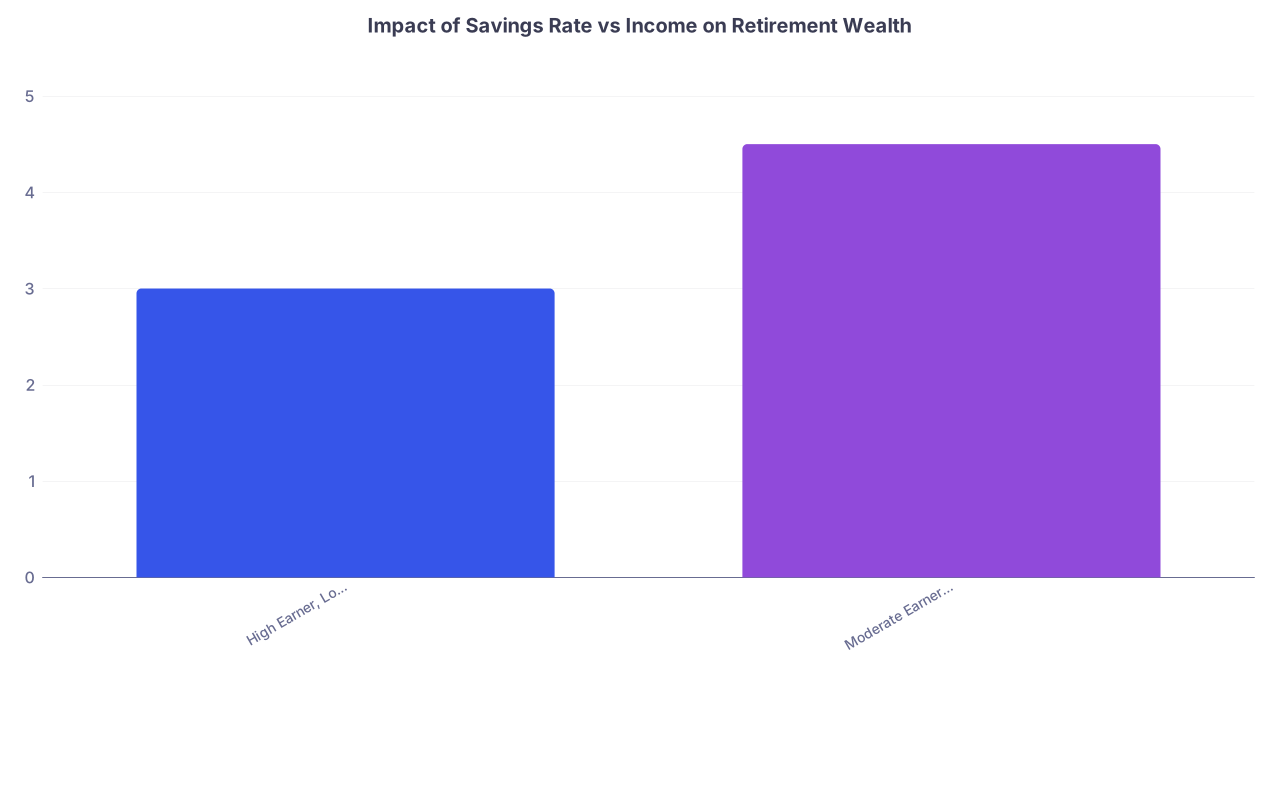
Let’s quantify this. Two physicians, both 30, planning to retire at 65. Same investment return (assume 6% real after inflation). Only two variables: income and savings rate.
| Category | Value |
|---|---|
| High Earner, Low Saver | 3 |
| Moderate Earner, High Saver | 4.5 |
(Values here represent very rough millions at 65, assuming long-term consistent behavior.)
Scenario A – “High-paying specialty will save me”
- Ortho attending net after tax: ~$350k
- Saves 10%: $35k/year
- 35 years at 6%: ends near ~$3.0M in today’s dollars
Scenario B – “Boring income, aggressive saver”
- Outpatient IM net after tax: ~$200k
- Saves 25%: $50k/year
- 35 years at 6%: ends near ~$4.5M in today’s dollars
Lower income. Bigger nest egg.
Not because of some clever hedge fund. Just a higher savings rate, started early, maintained consistently. That’s it.
This is why leaning on “I’ll earn more later” is a terrible retirement strategy. Savings rate and time in the market do far more work than the specific number on your contract.
2. Lifestyle creep eats surgeons for breakfast
There’s a reason the phrase “golden handcuffs” exists. And no, it doesn’t refer to the family doc driving a 6‑year‑old Camry.
What typically happens in high-paying fields:
- Longer training → more delayed gratification
- Higher peer norms → bigger house, private schools, second home, “deserve it” vacations
- Higher expectations from family (often silently negotiated as “it’ll be worth it once we’re attendings”)
So the ortho who could save $150k+/yr… doesn’t. The baseline lifestyle silently grows until spending is 80–90% of net take‑home.
I’ve looked at budgets where:
- Mortgage + property tax + insurance > $10k/month
- Car leases > $2k/month
- Private school + daycare > $3–4k/month
- Travel + dining out > $3k/month
That’s $18–20k/month before you touch groceries, utilities, student loans, or savings.
At that point, it doesn’t matter that the W2 says $700k. The effective savings rate is still dismal.
The Data on Who Actually Retires Well
There’s a quieter set of data that doesn’t get as much attention: surveys on physician retirement readiness, burnout, and financial stress. They paint a pretty consistent picture.
- A significant chunk of physicians approach their 60s with < $1M in retirement accounts.
- Burnout rates are high in both primary care and high-paying procedural specialties.
- Many intend to retire later than they originally planned, not because they “love the work too much,” but because they cannot afford to stop.
If high income were a reliable retirement strategy, you’d expect:
- The highest-earning specialties to have the lowest financial anxiety about retirement.
- Those specialties to have earlier planned retirement ages.
That is not what shows up.
Instead you see:
- Plenty of high earners trapped by expensive lives they’ve grown to hate but can’t afford to leave.
- Modest earners in low cost-of-living areas quietly hitting FI by their late 50s.
Put differently: the correlation between pay and retirement security is much weaker than people want to believe.
The Time Cost of Chasing the “Top” Specialties
Here’s the part almost nobody factors into their “I’ll just pick a higher income” logic: you’re not comparing incomes over the same time span.
High-paying specialties almost always:
- Take more years of training
- Delay real attending-level earnings
- Come with higher risk of burnout that can cut your career short
Let’s lay it out simply.
| Path | Training (Post-MD) | Attending at Age* |
|---|---|---|
| Pediatrics | 3 years | ~31–32 |
| Internal Medicine | 3 years | ~31–32 |
| Cardiology | 6–7 years | ~34–36 |
| General Surgery | 5 years | ~33–34 |
| Ortho/Neurosurgery | 5–7+ years | ~34–37 |
*Assumes med school completion around 28–29; lots of you are older.
Let’s compare two simplified, real-world‑ish paths:
- Peds: Starts attending at 32, earns $250k, saves 20% ($50k/yr), from 32–65 → 33 years of compounding
- Ortho: Starts attending at 36, earns $600k, saves 10% ($60k/yr), from 36–65 → 29 years of compounding
Which one wins?
At 6% real growth:
- Peds: $50k/yr for 33 yrs → ≈ $4.5M
- Ortho: $60k/yr for 29 yrs → ≈ $4.6M
Basically a tie, and that assumes the orthopod actually saves 10% and doesn’t retire early from burnout.
All that extra training, call, stress, and risk… for essentially the same retirement pile as the “lowly” pediatrician who simply saved more, earlier, consistently.
You don’t see that on med school interview day brochures.
The Real Risk: Burnout + High Overhead = Fragile Retirement
The ugliest version of this story goes like this:
- Student picks high-paying specialty expecting money to fix everything.
- Accumulates large lifestyle overhead—big house, kids in expensive schools, luxury everything.
- Burnout hits mid‑50s. Sleep is wrecked. Joints hurt. Dread before every clinic.
- Financial reality: cannot cut back hours without blowing up cash flow; practice buy‑in loan still hanging around; not enough in retirement accounts.
- Trapped. Golden handcuffs in full lock.
I’ve heard “I thought by 55 I’d be financially set and scaling back. Now I’m 57 and I still can’t see the exit” from people in specialties students drool over.
That’s not a specialty problem. It’s a planning problem. But the illusion that specialty choice was the plan stopped them from doing the real work: managing lifestyle and building a resilient balance sheet from day one.
How Physicians Actually Build Strong Retirement Plans
Let’s get very concrete. The people who end up fine – or better than fine – in retirement tend to share the same behaviors across wildly different incomes and specialties.
1. They treat retirement planning as a system, not a side effect
They don’t say “my specialty is my plan.” They:
- Decide a target savings rate (often 20–30% of gross) early in attending life.
- Automate contributions into tax-advantaged accounts: 401(k)/403(b), 457(b) where it makes sense, Roth or backdoor Roth IRAs, HSA.
- Use a boring, low-cost index fund strategy instead of chasing hot tips and private placements they do not understand.
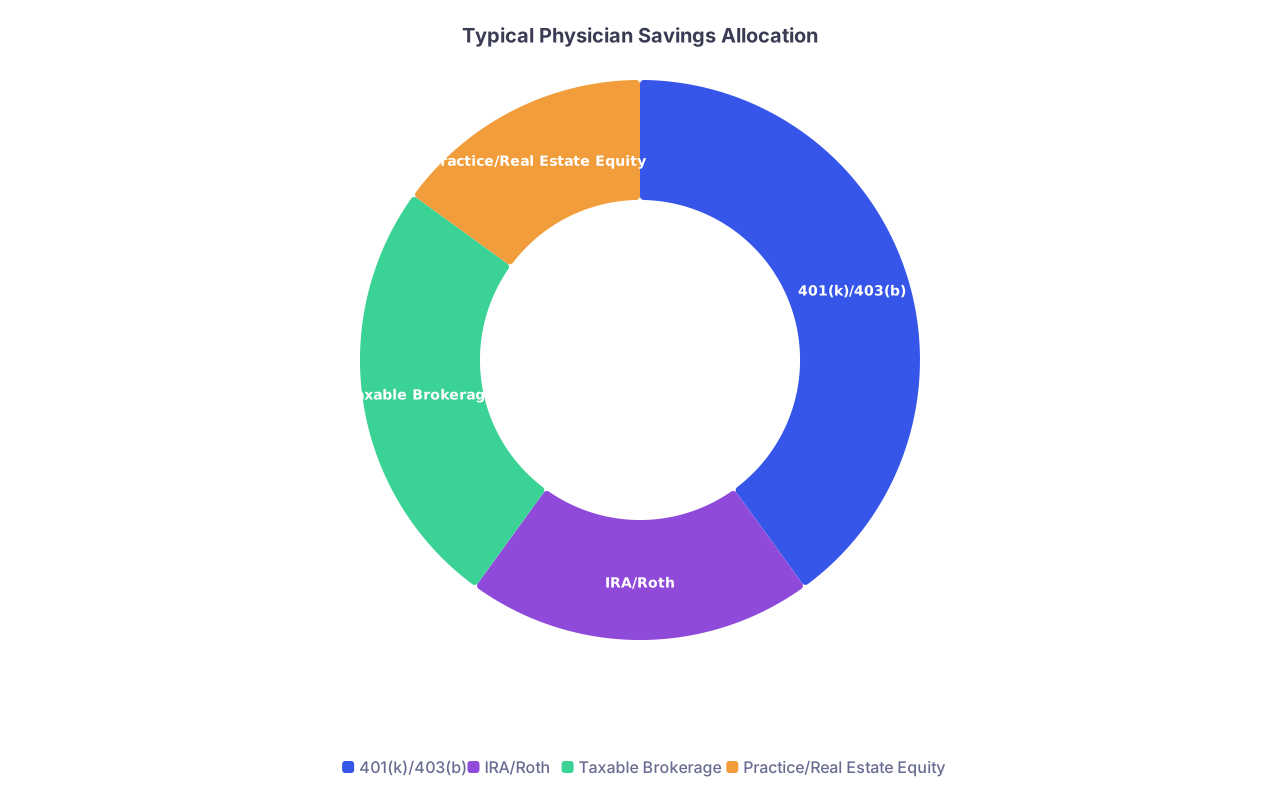
| Category | Value |
|---|---|
| 401(k)/403(b) | 40 |
| IRA/Roth | 20 |
| Taxable Brokerage | 25 |
| Practice/Real Estate Equity | 15 |
Is this exact breakdown universal? No. But the shape is similar. Diversified, tax‑aware, not all-in on one asset or business.
2. They choose cost of living strategically
This is the most underappreciated lever.
A pediatrician in a low‑cost Midwestern city who:
- Buys a reasonable $400–500k house
- Drives paid‑off cars
- Avoids private K‑12 unless they truly want it and can afford it
…can end up wealthier than a subspecialist in the Bay Area or NYC making 1.5–2x as much but bleeding cash on housing and taxes.
Psychologically, this is hard because prestige and “cool city” bias are strong in medicine. Financially, it’s straightforward: high income in a high-cost metro is not nearly as powerful as people pretend.
3. They resist identity-based spending
A lot of physician spending is really about signaling: to colleagues, to family, to themselves.
- The “doctor house”
- The vacation photos that telegraph success
- The luxury car in the hospital garage
Retirement‑ready physicians are almost boring from the outside. I’ve heard “You’re a cardiologist and you live there?” more than once from colleagues. Those are usually the people who can afford to walk away.
Specialty Still Matters — But Not the Way You Think
I’m not saying specialty choice is irrelevant. It matters. Just not as a retirement “strategy.”
It matters for:
- How tolerable a 25–30 year career is for you personally.
- How much control you have over your schedule and exit velocity.
- What kind of practice models are feasible (employed vs private vs hybrid).
- The flexibility you have if you want to cut back in your 50s.
An anesthesiologist who enjoys the OR, keeps overhead modest, and saves 25% of income will be in spectacular shape. A psychiatrist who does the same will also be in spectacular shape. Different absolute dollar figures, same relative security.
What does not work is:
“I will pick the highest-paid specialty I can match into, suffer for a decade, inflate my lifestyle to compensate, and assume that income alone will rescue my retirement.”
That’s wishful thinking dressed up as a plan.
A More Honest Framework: Use Specialty to Support the Plan, Not Replace It
Here’s the direct version:
- Pick a specialty you can tolerate – maybe even like – for decades, not because you think it’s a cheat code to wealth.
- Then build an actual retirement system around that reality:
- Aggressive, automated savings.
- Sensible housing and lifestyle.
- Boring, diversified investing.
- Protection against burnout and forced early retirement (disability insurance, sane schedule, boundaries).
Use the income from your chosen specialty as fuel for that system. That’s it. That’s the relationship.
To make this fully explicit, here’s what people think the trade-off is vs what it actually is:
| Aspect | Common Belief | Reality |
|---|---|---|
| High-paying specialty | Guarantees strong retirement | Helps only if savings and lifestyle are managed |
| Low-paying specialty | Doomed to weak retirement | Can achieve FI with high savings rate & COL |
| Extra training years | Automatically “worth it” financially | Only worth it if used to save, not just spend |
| Burnout risk | Irrelevant if pay is high | Can destroy retirement plans completely |
So, Is a High-Paying Specialty Your Best Retirement Strategy?
No. It is a tool that can accelerate a good strategy or magnify a bad one.
The best retirement strategy, for physicians, is painfully unsexy:
- Start saving early – even in residency if you can.
- Hit a double-digit savings rate as an attending and ramp it up.
- Keep lifestyle a step behind your income, not sprinting alongside it.
- Use simple, low-cost, tax-efficient investing.
- Protect your ability to keep working with sane career choices.
A high-paying specialty can make that easier. It can also make it much easier to lie to yourself and avoid doing any of it.
Years from now, you will not care whether your name badge once said “orthopedic surgeon” or “pediatrician.” You’ll care whether you bought yourself enough freedom to decide when you are done—and enough margin to enjoy getting there.