
There is no “correct” retirement age for physicians. The idea that there is one is not just wrong—it is financially dangerous and psychologically harmful.
You’ve heard the script: work hard until 65 (or 67), then you “get to” retire. For doctors, there’s a bonus myth: you should work longer because you trained so long, you “owe” it to society, and your identity is too wrapped up in medicine to step away earlier.
That whole narrative is built on outdated pension rules, Social Security charts, and cultural guilt. Not on data. Not on what actually leads to good health, solid finances, or a sane life trajectory for physicians.
Let’s dismantle it properly.
Where the “Perfect Retirement Age” Myth Came From
The magic number 65 didn’t fall out of the sky. It’s a political artifact.
When Social Security started in the 1930s, 65 was chosen as the “full benefit” age. Back then, average life expectancy in the US was in the low 60s. In blunt terms, the system was designed so a lot of people would never collect for long.
Medicine kept extending life. Retirement norms? Not nearly as fast.
Hospitals, practice groups, and even physician culture just absorbed “65” as the “normal” endpoint. Add in Medicare eligibility at 65, and the number ossified. I still hear attendings mutter: “I’ll hang it up when Medicare kicks in.”
But for physicians, this is structurally absurd:
- You start earning late. Many do not make a full attending salary until early–mid 30s.
- You often peak late. For many cognitive specialties, peak skill and earnings are in the 40s–50s.
- Your burnout risk is high and rising in your 40s and 50s.
- Your longevity is better than the general population on average, but not in a way that justifies automatic “work to 70.”
So anchoring your entire financial and life plan to a number set almost a century ago for a coal miner economy is lazy planning.
What the Data Actually Shows About Physician Retirement
When you look at real numbers instead of folklore, a very different picture emerges.
| Category | Value |
|---|---|
| <60 | 18 |
| 60-64 | 27 |
| 65-69 | 32 |
| 70+ | 23 |
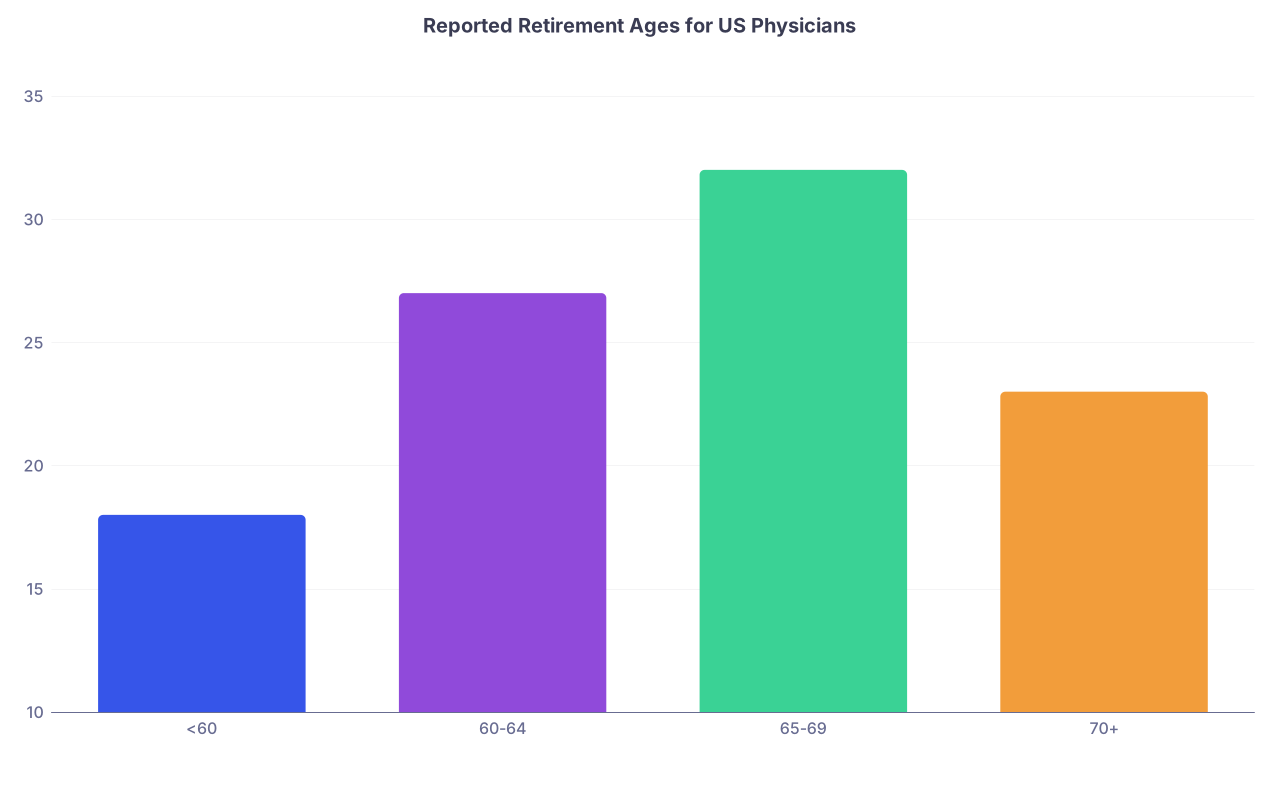
Roughly speaking (varies by survey and specialty), US physicians tend to retire somewhere between late 50s and late 60s, with a wide spread:
- A nontrivial chunk leave clinical practice before 60.
- Many scale down or go part-time rather than a hard stop.
- A solid minority still work past 70, especially in certain subspecialties and concierge practices.
The pattern that actually matters isn’t the age itself. It’s why they stop:
- Burnout and moral injury
- Health issues (their own or a spouse’s)
- Administrative misery / EMR fatigue
- Financial independence making continued misery feel optional
- Shifts to non-clinical roles (administration, consulting, teaching)
When you talk to real retired or semi-retired physicians, they almost never say, “I retired at 65 because that’s the biologically optimal age.” They say, “I hit the number where I didn’t have to put up with this anymore,” or “My back couldn’t do call,” or “My spouse was done waiting.”
The important myth to kill: physicians are not all marching to 65 in lockstep. The reality is fragmented and individual—and that’s exactly how your planning should be.
Financially, Age Is a Terrible Primary Target
Here’s the core problem: “I’ll retire at 65” is not a financial plan. It’s a vibe.
A financial plan that serves a physician’s life should be built around capability, not chronology: “When will I be financially independent enough to choose what I do with my time?”
That’s FI—financial independence. Not RE—retire early. Huge difference.
For a physician, FI is mathematically straightforward even if emotionally complicated:
- How much do you spend per year—really?
- How much guaranteed or semi-guaranteed income will you have (pensions, Social Security, annuities, rental cash flow)?
- What size portfolio do you need so that a 3–4% withdrawal rate covers the rest?
| Age | Portfolio | Other Annual Income | Safe Withdrawal (3.5%) | Total Annual Income |
|---|---|---|---|---|
| 55 | $3.0M | $0 | $105,000 | $105,000 |
| 60 | $2.5M | $30,000 (rental) | $87,500 | $117,500 |
| 65 | $2.0M | $50,000 (SS/pension) | $70,000 | $120,000 |
You can see the problem with obsessing over a single retirement age. The income math can work at different ages through different combinations of:
- Portfolio size
- Other income streams
- Expected Social Security / pensions
- Spending levels
A 55-year-old with $3M and sane spending might be more secure than a 65-year-old with $1.2M, a big house, and four dependents.
But physicians routinely ignore this. They keep repeating “I’ll retire at 65” without ever running the numbers. I have literally watched people push themselves through an extra decade of call because they assumed they couldn’t afford to cut back—while sitting on a $4M portfolio and a paid-off house.
That’s not discipline. That’s financial illiteracy dressed up as virtue.
The Real Tradeoffs: Money, Health, and Mortality
The other part of the myth is the health angle. People throw around ideas like: “If you retire too early, you’ll die sooner,” or “Working keeps your brain sharp.” Sounds plausible. Half-true at best.
What do we actually see in the data?
- Retiring involuntarily due to health is associated with worse mortality and mental health. No surprise—people already sick do worse.
- Voluntary retirement with adequate financial security? The data is messier, but there’s no clear evidence that this shortens your life. Some studies suggest better self-reported health and life satisfaction, especially when people retire from high-stress roles.
- Cognitive decline is more about meaningful engagement than W-2 income. People who stay mentally active—whether through work, hobbies, teaching, or volunteering—do better. That does not require a full clinic schedule.
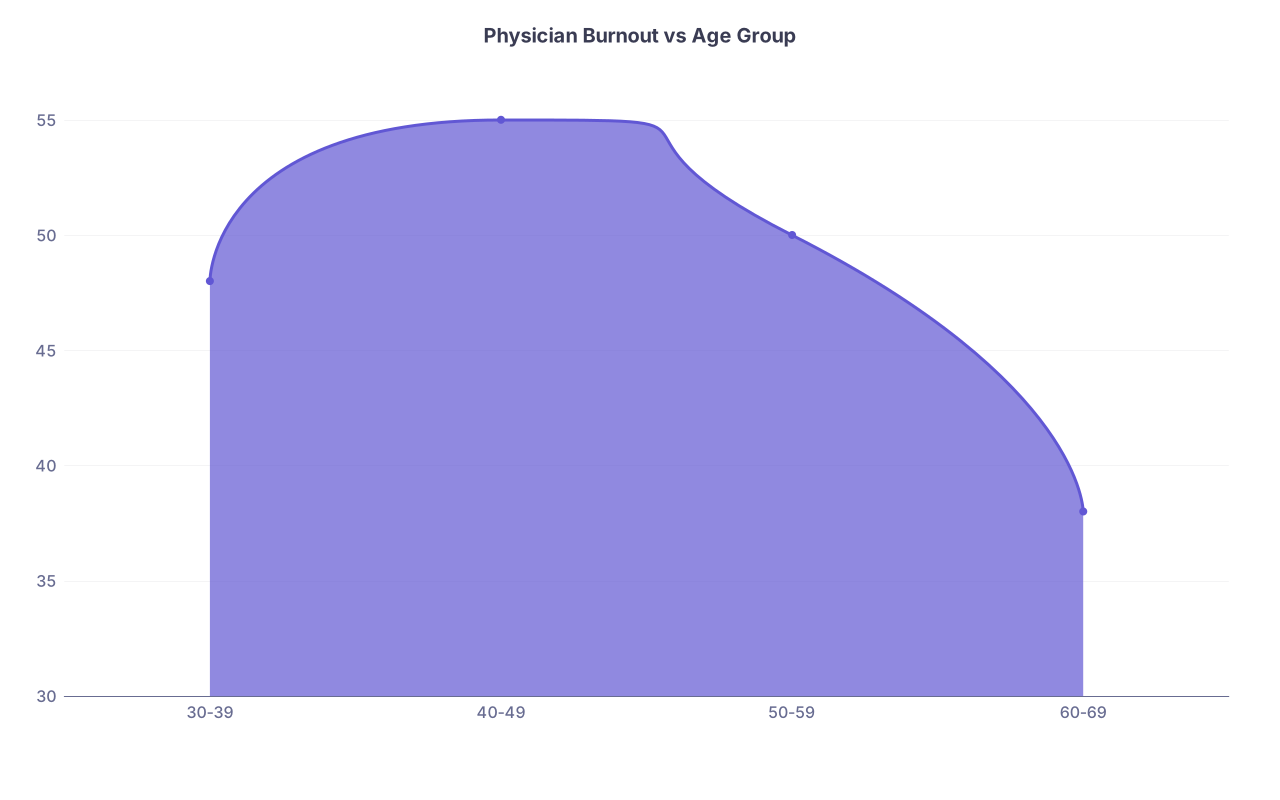
For physicians, there’s another layer: burnout and suicide risk. Surveys show burnout rates in many specialties north of 50%. Physician suicide risk is higher than the general population. The idea that grinding yourself to some arbitrary age “for your health” is often backward.
Staying active is good. Staying trapped is not.
| Category | Value |
|---|---|
| 30-39 | 48 |
| 40-49 | 55 |
| 50-59 | 50 |
| 60-69 | 38 |
Notice the drop in burnout in the 60s. That’s often not magic. It’s the doctors who’ve gained control—reduced hours, dropped night call, moved to concierge, or semi-retired.
The point: there is no health-based “perfect age” that fits everyone. There is only a tension: delay retirement long enough to fund your life; don’t delay so long that you sacrifice the years when you’re healthy enough to enjoy it.
Law, Contracts, and the “You Must Work to X” Illusion
From a legal and structural standpoint, very little forces you to work to a specific age. What you do have are constraints that people lazily interpret as destiny.
Typical things that get misread as “I have to stay until X”:
- Partnership agreements with vesting schedules for retirement benefits
- Defined benefit pensions that increase at specific age milestones (say, 62 and 65)
- Social Security full retirement age rules
- Health insurance tied to employer until Medicare eligibility
None of these are absolute shackles. They’re just numbers that change the math.
I’ve seen physicians keep working to “get the full pension at 65” when the difference from leaving at 62 was maybe $10–15k a year—on top of a seven-figure portfolio. That is not optimizing; that is anchoring.
Here’s what actually matters legally and contractually:
- When do you vest in any pensions or deferred comp?
- Do you have any tail obligations (malpractice tail coverage, restrictive covenants) if you leave earlier?
- What’s the cost of bridging health insurance until Medicare (COBRA, ACA marketplace, spouse’s plan)?
- Do you have any golden handcuffs (forgivable loans, signing bonuses with clawbacks) that expire at set dates?
Once you quantify those, you can frame them properly: “Is another 3 years of this job worth an extra $X per year for life?” Sometimes yes. Often no.
Identity, Ego, and the Physician Retirement Trap
The biggest barrier to a rational retirement decision isn’t math or law. It’s identity.
Medicine has done a very good job convincing doctors that they are their job. You’re not John who practices cardiology; you’re a cardiologist named John. Small difference in language. Massive psychological difference at 62 when you’re thinking about stopping.
You hear:
- “I wouldn’t know what to do with myself.”
- “I’ll lose my purpose.”
- “My patients need me.”
- “My spouse will kill me if I’m home all day.” (Said half-jokingly, half-serious.)
The “perfect age” myth gives a neat escape hatch—you can punt the whole messy identity problem to a socially sanctioned number. “Doctors retire at 65. I’ll worry about that then.”
Except you eventually are 65. And if you’ve done zero work on who you are beyond your NPI number, retirement feels like annihilation.
That’s how you end up with 74-year-olds doing full clinic plus call, not because they love it, but because they’re terrified of stopping and have no idea what else to do.
From a planning standpoint, here’s the pivot: your goal isn’t “retire at 60” or “retire at 70.” It’s to become financially independent early enough that you can experiment with what a lower-clinical or post-clinical life looks like without blowing up your security.
The Smart Alternative: Financial Independence + Phased Freedom
The data supports a far better model than chasing some mythical perfect retirement age: aim for early financial independence, then taper.
That usually looks like:
- Aggressive saving and debt payoff in your 30s and 40s
- Rational lifestyle (not monk-like austerity, but not constantly growing your overhead to match your income)
- Hitting FI somewhere between 50 and early 60s, depending on specialty and spending
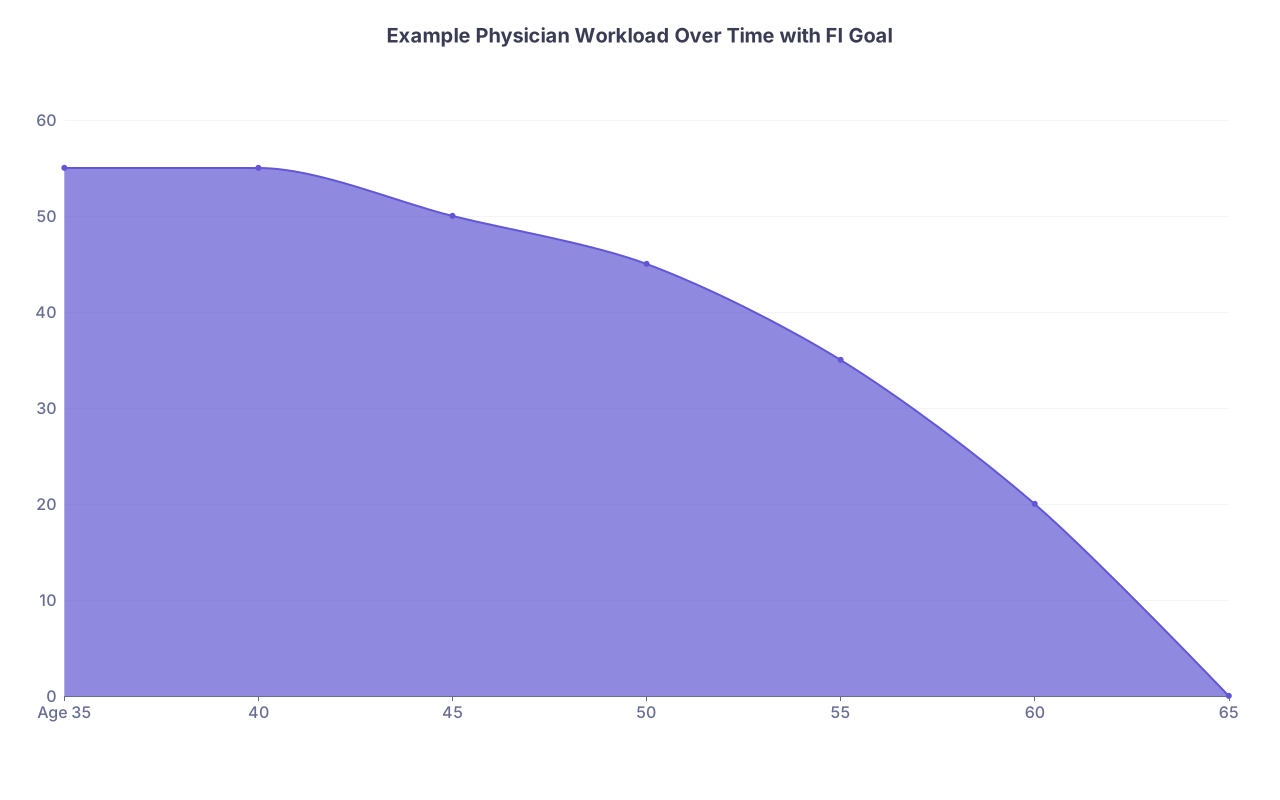
- Gradually dialing down your clinical load once work is optional—dropping call, cutting clinic days, moving to telemedicine, teaching, or consulting
| Category | Value |
|---|---|
| Age 35 | 55 |
| 40 | 55 |
| 45 | 50 |
| 50 | 45 |
| 55 | 35 |
| 60 | 20 |
| 65 | 0 |
Notice: the only reason you can drop from 50–60 hours a week down to 20 in your late 50s is if you decoupled your spending from your maximum income earlier. If you inflated your lifestyle to match your peak pay, you’ve effectively handcuffed yourself to the job.
I’ve seen two 60-year-old attendings, both burned out, same specialty, same income history. One has a $4M portfolio and a paid-off house; she drops to 2 days a week, no call, teaches residents, and actually enjoys medicine again. The other has $600k saved, a $1.5M house with a huge mortgage, two luxury car leases, private college bills, and no real plan. He insists he “has to” work to 70.
Same profession. Same training. Completely different lives. The difference wasn’t the “right retirement age.” It was the decades of decisions before that.
The Real Questions You Should Be Asking
Instead of obsessing about whether 60 or 65 or 70 is “right,” ask questions that actually map to reality:
- What number (FI) lets me choose how much I work?
- How much of my current stress is financial versus cultural/guilt-driven?
- Am I staying in full-time clinical work because I want to, or because I never ran the numbers?
- What non-clinical roles would I enjoy if I weren’t chasing maximum income—teaching, volunteering, writing, admin, consulting, advocacy?
- If I knew I’d die at 78, would I still plan to work full-time until 70?
Those questions blow up the myth at its root, because they reveal what the “perfect retirement age” really is: a lazy substitute for doing the uncomfortable work of figuring out what you actually want your 50s, 60s, and 70s to look like.
Visualizing Your Own “Enough” Point
If you like diagrams more than pep talks, here’s the real decision-making process for a physician thinking about stopping or slowing down:

| Step | Description |
|---|---|
| Step 1 | Current Age and Job |
| Step 2 | Calculate Spending |
| Step 3 | Calculate FI Number |
| Step 4 | Compare to Current Assets |
| Step 5 | Work Optional |
| Step 6 | Adjust Plan |
| Step 7 | Gradually Reduce Hours |
| Step 8 | Plan Retirement or New Role |
| Step 9 | Increase Savings or Delay Change |
| Step 10 | Still Enjoy Clinical Work |
You’ll notice what’s missing: any reference to 65.
That’s not an accident.
Key Takeaways
- There is no “perfect” retirement age for physicians. The 65 myth is a historical artifact, not a biologically or financially optimal target.
- The only meaningful threshold is financial independence—the point where work becomes optional. For many physicians, that can be well before or after 65, depending on choices.
- The best strategy is to reach FI early enough to choose your clinical load, then phase out on your own terms instead of letting culture, habit, or outdated rules dictate when you stop.