
“I’ll just do locums until I die” is not a retirement plan.
It’s a stall tactic dressed up as strategy.
I’ve heard that line from more than a few physicians in their 40s and 50s, usually right after they admit they’ve barely started saving for retirement. The fantasy goes like this: you pull back from full-time, do some high-paying locums a few weeks or months a year, and coast indefinitely. No pressure to save aggressively. No fear of outliving your money. You just keep working “a bit.”
The problem is, the data on physician health, locums pay trends, licensing, and the job market absolutely wreck that narrative.
Let’s walk through what actually happens when “I’ll just work locums forever” meets reality.
What Doctors Think Locums-in-Retirement Looks Like (vs What Actually Happens)
Here’s the fantasy model:
- Rate stays high or goes higher
- Work remains available when you want it
- Your skills, stamina, and credentials look the same at 65 as they do at 45
- Credentialing, licensing, and malpractice are minor annoyances, not real barriers
- Hospitals are desperate and flexible forever
Now contrast that with how the world actually behaves.
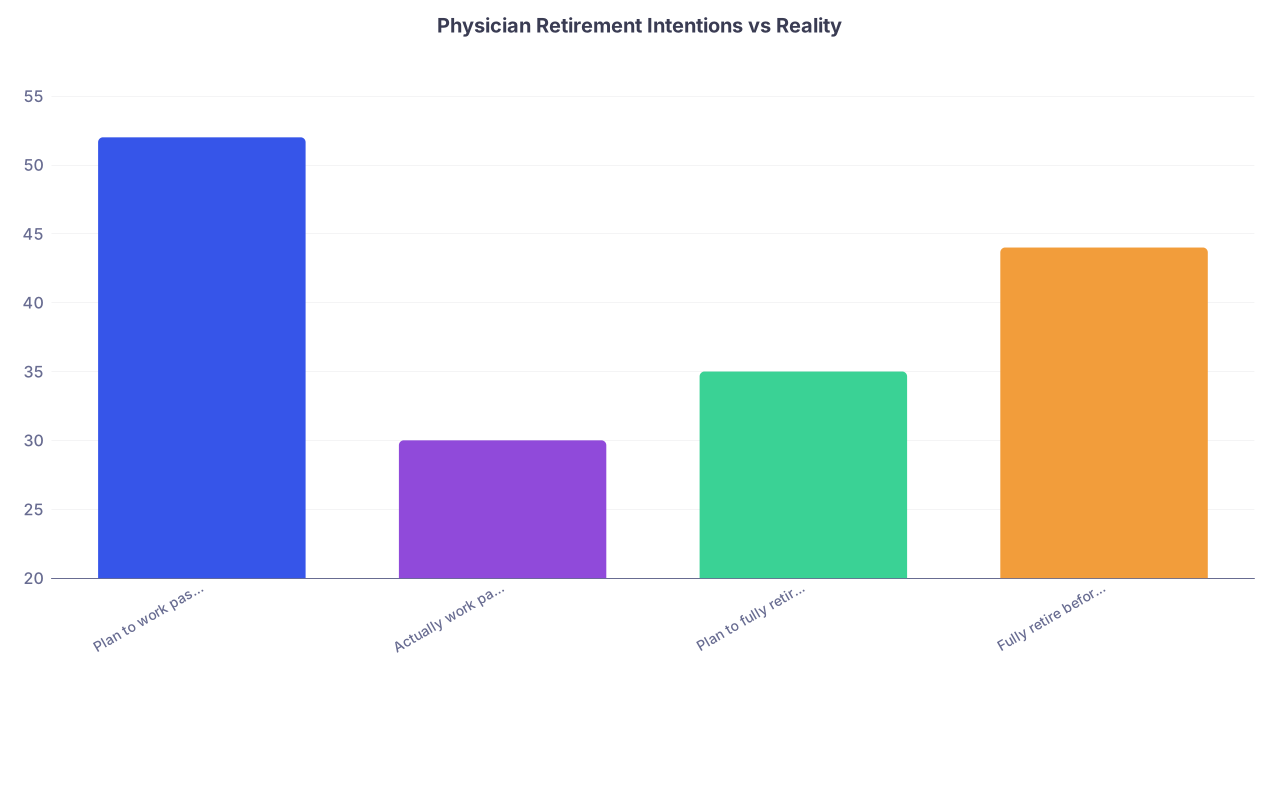
| Category | Value |
|---|---|
| Plan to work past 65 | 52 |
| Actually work past 65 | 30 |
| Plan to fully retire before 65 | 35 |
| Fully retire before 65 | 44 |
Those are representative ballpark figures from multiple physician surveys over the last decade (percentages vary slightly by specialty and year). The pattern is consistent: far more doctors plan to work later than actually do. Health, burnout, administrative burden, and family needs derail that plan. Repeatedly.
When I ask late-career docs what surprised them most, it’s almost always one of two things:
- “I didn’t realize how fast my energy and tolerance for nonsense would fall off after 60.”
- “I assumed there’d always be plenty of shifts. Then the hospital merged / group changed / younger docs undercut the rate.”
Banking your financial future on your 70-year-old self being eagerly employable in a consolidating healthcare system is not conservative planning. It’s optimism bias.
The Four Fragile Pillars of the “Locums Forever” Plan
Most “I’ll just do locums” thinking quietly rests on four assumptions. All four are shakier than people admit.
1. “Locums pay will always be this good”
You’re seeing today’s desperation pricing and projecting it 20 years out. That’s dangerous.
Right now, yes, some hospitalist and ED locums are absurdly well paid. COVID and post-COVID staffing chaos blew rates up. But this is cyclical. Travel nursing pay spiked, then got hammered as soon as systems reorganized. Locums is not immune.
| Risk Factor | Direction of Risk | Impact on Late-Career Docs |
|---|---|---|
| Hospital consolidation | Negative | Fewer independent contracts |
| APP role expansion | Negative | Downward pressure on rates |
| Telehealth expansion | Mixed | Could replace some in-person |
| Younger physician supply | Negative | More competition, rate sensitivity |
| Government reimbursement | Negative | Trickle-down to locums pay |
I’ve watched more than one group go from “we’ll pay you $250/hr, name your schedule” to “we’re cutting all locums and hiring full-time with RVU comp” inside 18–24 months. Often after a merger or the arrival of a new CMO obsessed with “cost optimization.”
If your retirement “plan” requires that $250/hr to still exist on your terms 15 years from now, you do not have a plan. You have a rate bet.
2. “Work will be available when I want it”
Locums isn’t Uber. You don’t open an app and pick a shift anywhere.
You’re dealing with:
- State licensure timelines
- Hospital credentialing (60–180+ days, easily)
- Privileging committees that can be picky about gaps, volume, malpractice history
- The simple reality that a site’s need changes quarterly
Now layer age on top of that. A 68-year-old anesthesiologist with a gap in recent complex cases, or a 70-year-old hospitalist who has cut down their panel and procedures, is not a slam dunk for privileging committees. Age discrimination in medicine is rarely written, but it’s very real in practice.
You might want 6 weeks of work at a high-paying rural ED each winter. The site might want three full-time bodies instead or decide to outsource to a staffing firm that fills shifts with younger, cheaper labor.
3. “I’ll be healthy enough to work as long as I want”
This is the ugliest assumption, and the least discussed.
Physicians have lower mortality than the general population, but not immunity from disability. Mid-to-late career, issues that matter a lot for clinical stamina start showing up: cognitive speed, night vision, back/neck problems, tremor, chronic pain, sleep disorders.
Here’s roughly how disability risk creeps up with age in white-collar workers (physicians are actually on the better end, but still):
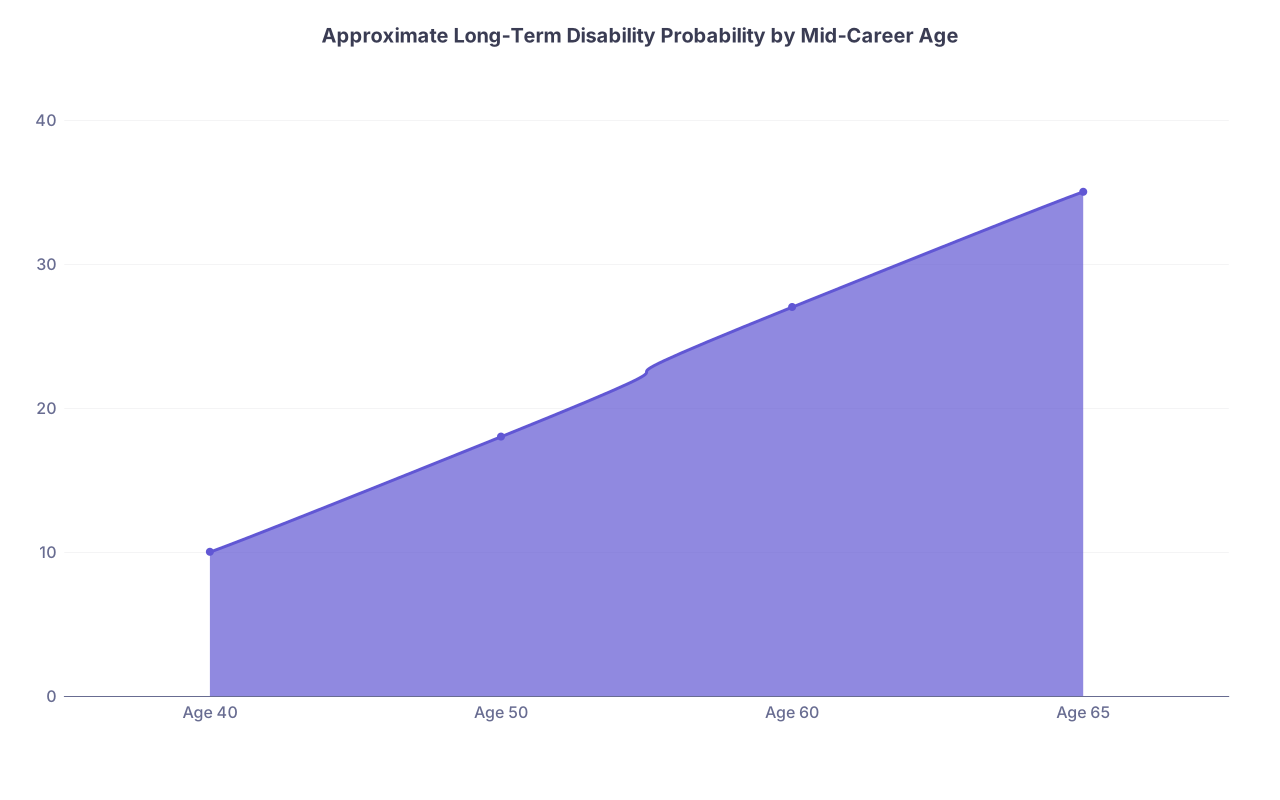
| Category | Value |
|---|---|
| Age 40 | 10 |
| Age 50 | 18 |
| Age 60 | 27 |
| Age 65 | 35 |
The exact numbers vary by source, but the direction is clear: past 55–60, your odds of being forced to cut back due to health go up fast.
And that’s just “formal disability.” I see more of the “soft” version: the 63-year-old surgeon who still could operate but is slower, more fatigued, and quietly getting sidelined by the group… while rates and case volume shift away from them. Try building a retirement around “I’ll probably still be okay” at 70 in that environment.
4. “Regulatory and tech changes won’t box me out”
EPIC. Cerner. New quality metrics. Mandatory online modules. Ever-changing CME and MOC requirements.
The more you “casually” work locums on the side and dip in and out, the more out of sync you become with:
- The latest EHR configs and workflows
- New practice guidelines and documentation rules
- Evolving quality metrics tied to privileges or contract renewals
Credentialing committees are increasingly looking at recency and volume of practice, not just accumulated years. A 67-year-old physician doing 6–8 weeks of locums a year, in multiple states, with gaps between, will have more friction with each new re-credentialing cycle.
If your entire retirement flexibility hinges on jumping through those hoops indefinitely, you’re making your future self run a maze with less energy and more red tape.
The Math Problem Nobody Wants to Do
The real flaw in the “locums forever” mindset isn’t emotional; it’s arithmetic.
People choose locums-future instead of saving now because it feels easier. Higher hourly rate, no call, some travel. Great. But you’re often trading current high income that could be invested for a “maybe” income later when you’re physically and cognitively less robust.
Let’s run a simplified, conservative example.
Say you’re 45, making $350k W-2 as a hospitalist. You’re saving only 10% ($35k/year). You tell yourself, “It’s fine, I’ll just work some locums later instead of saving more now.”
Now compare two paths.
| Scenario | Age 45–60 | Age 60–70 |
|---|---|---|
| A: Increase saving now | Save extra $40k/yr | Work optional, can retire if needed |
| B: Keep saving low, rely on locums | Save baseline $35k/yr | Must earn ~$80–120k/yr via locums |
Assume:
- Extra $40k/year invested from 45–60 at 5% real return → roughly $1.0M extra by age 60
- That $1.0M can safely support ~$35–40k/year indefinitely (using a ~3.5–4% withdrawal rule), plus Social Security, plus whatever else you’ve saved
Compare to: needing to earn $80–120k/year with locums from 60–70 because your nest egg is too small. Now imagine those locums rates fall 20–30%, or your health wobbles, or work dries up for a couple years. You’ve removed the safety net in exchange for… a slightly nicer house and more restaurant meals in your 40s and 50s.
This is why I call “I’ll just do locums later” a stall tactic. Most of the time, it’s covering up a simple truth: “I don’t want to confront lifestyle cuts or serious saving today.”
Where Locums Does Fit in a Real Retirement Plan
Locums isn’t the villain here. The delusion is.
Locums can be an excellent tool for late-career physicians — if it’s layered on top of a solid retirement base, not in place of one.
Used intelligently, locums can:
- Bridge a gap if you retire from full-time earlier than expected
- Fund discretionary extras: big travel, helping adult kids, accelerating mortgage payoff
- Provide purpose and identity in partial retirement without locking you into full schedules
- Smooth the first 3–5 years of retirement so you can delay Social Security or preserve more of your portfolio
The distinction is simple: locums as optional enhancer vs locums as necessity.
If your 65-year-old self must work 6–9 months of locums a year to pay basic bills, you’re in a fragile position. Health issue? Rate cut? Credentialing change? You’re cornered.
If your 65-year-old self does 2–3 months of locums because you like the money and the work, and if that disappeared tomorrow you’d still be fine? That’s power.
The Legal and Structural Risks Everyone Ignores
Since you specifically care about the financial and legal aspects, let’s look at the parts that blow up quietly.
Employment status and lack of protection
Most locums work is 1099. That means:
- No employer retirement match
- No long-term disability through an employer
- No job protection if ill, injured, or sidelined
- You’re on the hook for your own malpractice tail if the contract is structured poorly
If you’re treating “locums forever” as retirement, ask yourself: what happens if you get mildly disabled at 62?
Many individual disability policies end or downgrade at 65. If you haven’t bought robust individual coverage early and kept it, you’re exposed. And no, you won’t be buying a generous new policy in your late 50s without exclusions or grotesque premiums.
Contract fragility and renewals
Most locums agreements are deliberately easy to terminate. 30–90 days without cause. That works fine in your 40s when demand is high and your options are broad.
In your late 60s with declining stamina and fewer licenses? “We’re going a different direction” is much more than an inconvenience; it can be catastrophic if you depended on that income.

| Step | Description |
|---|---|
| Step 1 | Depend on Locums for Core Income |
| Step 2 | Need Ongoing Contracts |
| Step 3 | Forced to Stop Working |
| Step 4 | Sudden Income Drop |
| Step 5 | Short Term Stability |
| Step 6 | Portfolio Must Cover All |
| Step 7 | Health stable? |
| Step 8 | Contract Renewed? |
If H (your portfolio) is weak because you under-saved, you’ve built your entire late life on other people’s staffing decisions.
Malpractice and legal exposure
One more thing nobody loves to talk about: late-career cognitive slip + less familiarity with systems + episodic locums work = higher risk of errors.
If you’re working in multiple states and hospitals, juggling different EHRs, formularies, and local norms, your exposure is fragmented. Yes, malpractice carriers cover you per contract, but they don’t cover the stress, the reputational damage, or the very real impact of “this doc has a recent claim and is 69” on future credentialing.
That matters when your continued employability is your “retirement plan.”
What a Sane, Evidence-Based Plan Actually Looks Like
If you strip away the wishful thinking, the outline of a durable plan is pretty simple:
- Assume you may not be able to work clinically past 60–65, even if you want to.
- Build a portfolio by 60 that can support your core lifestyle without any clinical income.
- Treat any locums or consulting income after that as bonus — nice, but not required.
That means, for most physicians:
- Pushing your savings rate well above 10% of gross early and mid-career. Twenty percent is a decent target; 25–30% if you’re a late starter.
- Actually using the tools available: 401(k)/403(b), backdoor Roth IRAs, defined benefit plans in some cases, and a boring, diversified investment strategy.
- Protecting your ability to earn (disability insurance, license maintenance) as if your entire retirement depends on the 45–60 decade. Because it does.
If you do that, then yes, locums in your 60s and maybe early 70s can be fantastic. You’ll have negotiating leverage, clear boundaries, and the option to walk away.
Locums becomes a lever you pull, not a lifeline you cling to.
The Reality Check, Boiled Down
Let me be blunt.
- “I’ll just work locums forever” is usually code for “I don’t want to save aggressively now.”
- The four pillars that would make that plan work — stable high pay, endless demand, perfect health, gentle regulation — are all statistically shaky past 60.
- Locums should be a tool on top of a real retirement plan, not a substitute for one.
If your spreadsheet says you’re “fine” only if you’re doing $150k of locums each year in your late 60s and 70s, that’s not a retirement plan. That’s a hope. And hope is a lousy strategy when your future 80-year-old self is the one who pays for your 45-year-old denial.