
The worst time to design your call system is at 10:37 p.m. with an angry patient on the phone.
You need this built before you open the doors, and it needs to be engineered for one brutal constraint: there are only two of you.
Let me break this down specifically.
1. Start With Non‑Negotiables: What Your Call System Must Do
Forget apps, vendors, and fancy answering services for a moment. A two‑physician clinic has a handful of non‑negotiable requirements for after‑hours coverage. Miss these, and you will either burn out, get sued, or both.
Your system must:
- Provide 24/7 access for urgent issues to a licensed clinician (you or your partner).
- Make it extremely clear to patients what is emergent vs urgent vs routine.
- Protect you from constant low‑value interruptions (refills, forms, “results?” calls).
- Document who called, when, and what you advised.
- Comply with payer, hospital, and regulatory requirements (especially if you are on any hospital medical staff or in certain insurance networks).
Define “Call” for Your Practice
This sounds trivial. It is not.
You and your partner must explicitly agree on what counts as:
- “On‑call” responsibility
- “Office hours” responsibility
- “Hospital call” (if you still admit or do consults)
- “Cross‑coverage” (covering for each other’s panels)
In a pure outpatient two‑physician clinic, you usually have:
- Clinic hours: e.g., Monday–Friday, 8–5
- After‑hours: weekdays 5 p.m.–8 a.m., all day weekends and holidays
- On‑call periods: all after‑hours time is assigned to one of you, with clear backup rules if calls become unsafe (e.g., you are scrubbed in, driving, or exhausted).
Put bluntly: someone is always “it”. You decide how to share that pain in a way that does not wreck your life.
2. Call Schedule Design for Two Physicians: Patterns That Actually Work
Most two‑physician practices improvise call. That is how resentment starts. You need a written schedule and policy from day one.
Here are the main models that work in two‑physician clinics.
| Model | Who Uses It | Pros | Cons |
|---|---|---|---|
| Week-on / Week-off | Outpatient IM/FM | Simple, predictable | Intense weeks |
| Alternate Days | Mixed clinic styles | Shared weekly burden | Harder to swap |
| Block + Weekend | Higher acuity groups | Protect weekends | More complex to manage |
| Outsourced Hybrid | Burnout-sensitive docs | Lowest burden | Higher cash outlay |
Model 1: Week‑On / Week‑Off
- Physician A covers all after‑hours calls for 7 days straight.
- Physician B covers the next 7 days.
- Swap Sunday night at, say, 8 p.m.
Why it works:
- Predictable. Your spouse and kids can memorize it.
- Cleaner mental boundaries. A week “on” and a week “off”.
- Easier for staff: one name to give patients for that week.
Downside:
- A bad week (flu surge, COVID outbreak, an unstable patient population) can crush you.
- If you are also doing hospital call, this becomes dangerous unless the hospital call is shared externally.
This model works best when:
- Patient volume is moderate.
- You do not take hospital call, or hospital call is separate and light.
- You trust each other’s clinical judgment, because you will be handling each other’s patients a lot after hours.
Model 2: Alternate Days
- A covers Monday, Wednesday, Friday, Sunday
- B covers Tuesday, Thursday, Saturday
- Or strict “every other day” rotations.
Benefits:
- No one gets annihilated by a full high‑volume week.
- You can recover every other night.
- More even distribution of ugly nights.
Costs:
- More complex for staff to remember and communicate.
- Tough if you have strong preferences (e.g., “I never want Sunday night.”).
- If you each have robust personal schedules, the swapping and trades can go off the rails quickly.
This works well if:
- You have relatively stable, low‑acuity panels.
- Most night calls are quick triage, not “drive to the hospital” situations.
- You both value frequent off‑nights over long uninterrupted off‑weeks.
Model 3: Blocks + Protected Weekends
Example:
- A covers weekday nights; B covers Friday 5 p.m.–Monday 8 a.m.
- Swap those roles every month.
Or:
- Each physician keeps their own weekday after‑hours for their panel, but they alternate weekend coverage for the full practice.
This is a decent compromise when:
- Weekday after‑hours call is light.
- Weekend calls are heavier, and you want your weekends “owned” by one person.
But be careful: if your panels differ significantly in complexity (say one of you has more peds, the other has more geriatric / high‑acuity patients), this can feel very imbalanced fast.
Model 4: Hybrid with Outsourced Coverage
For some two‑physician practices, the only way to make call humane is to not take all of it yourselves.
Common variations:
- You cover all calls until 10 p.m.; an outsourced physician call group covers 10 p.m.–7 a.m.
- You cover weekdays after hours; a call group covers Friday evening to Monday morning.
- A triage nurse line filters and handles low‑acuity calls; only escalations reach you.
This is where money replaces sleep. Reasonable trade if you want to make it to year 10 without hating everyone.
We will talk numbers under vendors, but if you are each making even a modest attending income, paying for partial call coverage is often cheaper than the burnout and errors from chronic sleep disruption.
3. Structural Decisions: How Patients Actually Reach You
The structure is usually where private practices mess up. They either:
- Give out personal cell numbers (disaster), or
- Throw everything at a generic voicemail (legally risky, clinically sloppy).
You need a layered system: gatekeeping without stonewalling.
Step 1: One Central After‑Hours Number
You want a single clinic phone number on everything: cards, website, voicemail. That number then routes based on time of day.
- During business hours: front desk / phone tree / live staff.
- After hours: goes to a professional answering service or a dedicated VoIP call‑routing solution.
Non‑negotiables for that after‑hours number:
- Never goes straight to a physician cell.
- Always has a backup failover if your primary service dies.
- Logs calls with time stamps and caller ID.
Step 2: Smart Phone Tree or Trained Answering Service
You have two main approaches.
- Automated IVR (phone tree) using your VoIP system.
- Live operator answering service trained on your practice algorithms.
For a two‑physician practice, I strongly prefer a good medical answering service over DIY phone tree for after hours. Why?
Because a real human can:
- Screen out obvious non‑urgent stuff (“I need my FMLA form corrected”).
- Calm down upset callers.
- Gather a usable history before paging you.
You instruct them to categorize calls into:
- Emergencies → direct to 911 / ED, with documentation that you instructed this.
- Urgent clinical issues → paged to on‑call physician.
- Routine matters → routed to secure voicemail for staff to handle next business day.
You do not want to be calling CVS at 11:30 p.m. to refill a chronic med because the patient “forgot”. Your policies need to preempt this.
Step 3: The On‑Call Device Setup
Never route calls directly to your personal cell number that patients can see. Set it up like this:
- Answering service pages or calls a dedicated on‑call number.
- That number is a call‑forwarding line (Google Voice, Doximity Dialer, or your VoIP system) that rings whichever physician is on call that day/week.
- Outgoing calls to patients show the clinic caller ID, not your personal phone.
Result: you can switch who is on call in 10 seconds by changing the forward number. Patients never learn your private cell.
And if you both get sick? You can forward that on‑call line to an outside coverage group instantly.
4. Clinical Rules: What You Will and Will Not Do After Hours
If you do not define this early, patients will write the rules for you. You will not like their version.
You and your partner need to agree—in writing—on after‑hours clinical policies. This is as important as your call schedule.
Core Policies You Must Decide On
Refills after hours
My recommendation: no routine refills after hours unless clear emergency (e.g., insulin, seizure meds, anticoagulant for high‑risk AFib and patient cannot access any supply). Everything else waits.Lab / imaging results
No routine results after hours. If life‑threatening critical labs come in, that is different—and usually the lab or hospital has its own escalation path that reaches you.Telehealth vs “go to ED / urgent care”
Spell out when you are willing to do a brief video visit after hours (if at all). Do not wing this based on how guilty you feel that night.Pain meds and controlled substances
Hard‑stop policy: no new controlled substance prescriptions after hours except under strict documented criteria (and frankly, I advise close to zero).Return‑call time expectations
Common: calls returned within 15–30 minutes. Tell patients explicitly in your recorded message and written policies.
Put It in Your On‑Call Script
You should have a written, shared script for frequently encountered scenarios. Not because you are robots, but because consistency protects both of you.
Example snippets for the on‑call doc:
- “I cannot safely manage this over the phone tonight. With your symptoms, I recommend going to the emergency department now.”
- “This is not something we handle after hours. I will send a message to our staff, and they will contact you tomorrow to schedule a visit.”
- “I am on call for urgent issues only. Prescription refills for chronic medications are handled during office hours. Please call the clinic tomorrow morning.”
Use the same phrases. Every time. That way your patients learn the boundaries.
5. Patient Education: Training Your Panel Not to Abuse Call
You have more power here than you think. Patients will mostly do what you train them to do.
You need a multi‑channel communication strategy:
- New patient packet with a one‑page “How to reach us and what is urgent.”
- Clinic website page labeled “After‑Hours and Emergencies.”
- Waiting room / exam room signage.
- Front desk staff that repeat the same script for every new patient.
- Discharge instructions for high‑risk conditions.
Spell Out Examples
Patients understand concrete examples better than vague words.
On your written materials, list:
- Examples of emergencies: chest pain, shortness of breath, stroke symptoms, severe trauma → call 911 or go to the emergency department.
- Examples of urgent after‑hours issues: fever in young child, severe new pain, vomiting with inability to keep fluids down, new rash with systemic symptoms.
- Examples of routine issues: med refills, forms, chronic stable problems, paperwork, non‑urgent questions → call during office hours.
Make it visually obvious: bold headings, not dense paragraphs.
And then you and your staff must enforce it. If someone calls three times in a month after hours for refills, they get a direct conversation at their next visit about proper use of the on‑call system. Documentation included.
6. Legal, Risk, and Documentation: Protecting Yourselves
The liability exposure in after‑hours care is not mostly from exotic rare cases. It is from:
- Poor documentation (“I told her to go to the ED,” but no record).
- Confusion about who was on call.
- Delays in responding to calls.
You want three layers of defense.
1. Answering Service Logs
Choose a service that:
- Time‑stamps each call.
- Records basic reason for the call.
- Logs when they paged you and when you responded (some systems confirm receipt via text or app).
If a family later says, “We called five times and no one called back,” the log matters.
2. Immediate EMR Documentation
Every substantive after‑hours call should generate:
- A brief telephone encounter / message in your EMR
- With: symptoms, assessment, advice, and disposition (home care vs urgent care vs ED vs follow‑up in clinic)
Do it the same night. It takes one minute if you have a template. You do not want to be reconstructing a vague memory 14 months later in a deposition.
Create a template like:
- Reason for call:
- Key history:
- Assessment:
- Recommendation:
- Return precautions given:
- Patient verbalized understanding: yes/no
Use it ruthlessly.
3. Clear Coverage Agreements
You and your partner must have a written internal coverage policy, and if you ever let an external group cover call (e.g., hospitalists, locums, or a call‑pool), you need a written coverage agreement defining:
- Who is responsible for what hours.
- How and when they will communicate with you.
- Who is responsible for follow‑up of issues raised overnight.
Sloppy arrangements are where follow‑up gets lost. Which is exactly what plaintiffs’ attorneys like to see.
7. Outsourcing Pieces: When and What to Buy
You do not need to build everything from scratch. But you can absolutely waste money on services that look nice and do very little.
Here is where it makes sense to spend money.
Medical Answering Service
A good medical answering service is not just a call center. They should:
- Be HIPAA compliant.
- Have specific medical scripting experience.
- Offer customizable escalation rules per physician.
- Provide access to call logs and recordings.
Evaluate them with test calls at different times. If you sit on hold as a pretend patient, your actual patients will too.
Approximate costs: often in the range of $100–$400/month depending on volume, sometimes per‑minute billing. For a two‑physician clinic, this is usually worth it.
Nurse Triage Line
Nurse triage is where a trained RN uses protocols (Schmitt/Thompson, etc.) to assess severity and give advice, escalating to you only when needed.
Best use cases:
- High pediatric volume
- High chronic disease burden (heart failure, COPD, complex geriatrics)
- You are getting crushed by calls that do not require physician‑level decision‑making
These services cost more, but they significantly cut physician call volume and improve patient satisfaction. You must integrate their notes into your EMR or at least into your documentation workflow.
Physician Call Group / Locums Coverage
If you are in a market where an independent call group exists (not common everywhere), you can buy partial or full night/weekend coverage. Alternatively, you might arrange coverage with a few other similar subspecialty clinics.
Realistically, for a tiny private practice, most of you will not have access to a perfect external physician call group, or it will be cost‑prohibitive.
But you can:
- Use temporary locums to cover extended vacations.
- Negotiate reciprocal coverage with a trusted colleague from another small clinic for limited periods.
Any such arrangement must be carefully spelled out and vetted for malpractice coverage.
8. Integration With Inpatient / ED Systems (If You Still Admit)
If you are purely outpatient, skip this section. If you are one of the dwindling group that still rounds or admits, you have extra complexity.
You must coordinate:
- Hospital call schedules vs clinic call schedules.
- Which number the ED uses to reach you.
- Who is responsible for cross‑coverage of inpatients if one of you is off or out of town.
Avoid the “Shadow Call List” Problem
Hospitals often maintain their own call rosters. If these do not match your clinic’s understanding of who is on call, you will get middle‑of‑the‑night calls when you thought you were “off.”
Solution:
- Designate one of you to be the call coordinator for hospital rosters.
- Update hospital lists monthly or sooner with any change.
- Make sure both your clinic and the hospital are using the same primary on‑call and backup numbers.
Decide How Clinic Call and Hospital Call Interact
Two common patterns:
- Unified call: whoever is on for the clinic is also on for hospital/ED.
- Split call: hospital call rotates on a shared schedule with other community physicians; clinic call stays internal between the two of you.
Unified call is simpler but brutal if your inpatient/ED volume is nontrivial.
Split call requires very clear rules:
- If you are on hospital call but not clinic call, will you still get calls from your own outpatients whose names ED staff recognize?
- If you admit someone at 5 p.m., and your partner starts clinic call at 5:01 p.m., who fields calls about that inpatient overnight?
You want rules, not vibes.
9. Practical Workflows and Real‑Life Scenarios
Let’s walk through a few common scenarios to show how a well‑designed system functions.
Scenario 1: Non‑Urgent Refill Request at 10 p.m.
- Patient calls main number at 10 p.m. → routed to answering service.
- Service script: “This line is for urgent medical concerns. For prescription refill requests, please call during business hours. I can take a message for the office for tomorrow.”
- Message logged to EMR in a non‑urgent queue.
- No page to on‑call doctor.
- Next morning, MA or nurse handles refill per standing refill protocols.
Outcome: patient learns your system. You do not wake up for nonsense.
Scenario 2: Child With Fever and Cough at 8:30 p.m.
- Parent calls; answering service gathers symptoms using brief script.
- Flags as urgent; pages on‑call physician.
- You call back within 15–20 minutes using your on‑call number (clinic caller ID).
- You document history: age, duration, symptoms, red flags, home treatments, sick contacts, vaccination status.
- Template helps you decide: home care + strict return precautions vs ED / urgent care recommendation.
- You create a quick EMR encounter with your advice.
If you are doing telehealth, you might convert this to a brief billable visit if your state and payer allow it. But you do not improvise the billing rules; you set them in your policies beforehand.
Scenario 3: High‑Risk Cardiac Patient With New Chest Discomfort
- Call hits answering service → immediate page as “chest pain.”
- You call back ASAP.
- Very low threshold: refer to ED with explicit language, “I recommend you call 911 now due to possible heart emergency.”
- You document thoroughly in EMR: risk factors, your concern, your explicit ED recommendation.
- You fax or electronically send a quick note to the ED if feasible: “I am Dr. X, PCP for Y, I recommended ED evaluation for chest pain.”
If the patient ignores you and delays, your documentation is your protection.
10. Monitoring, Metrics, and When to Redesign
Your first version of this system will not be perfect. That is fine. What is not fine is never reviewing it.
Track a few basic metrics monthly:
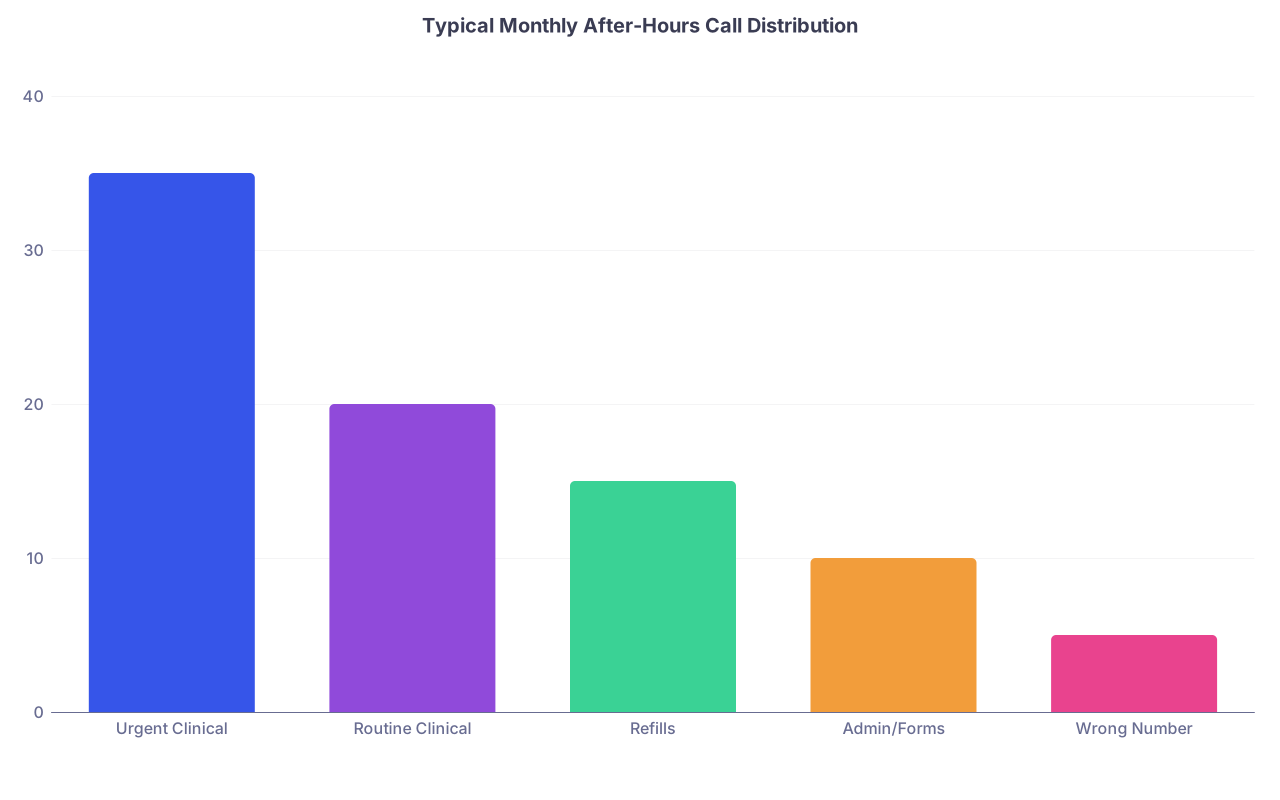
| Category | Value |
|---|---|
| Urgent Clinical | 35 |
| Routine Clinical | 20 |
| Refills | 15 |
| Admin/Forms | 10 |
| Wrong Number | 5 |
Ask yourselves every 3–6 months:
- How many calls per night on average?
- How many are truly urgent vs inappropriate?
- Is one of us getting more complex after‑hours cases because of panel differences?
- Are we actually documenting all substantive calls?
If:
- Urgent calls are low and manageable → your schedule model is probably fine.
- Routine/admin calls are high → you need stronger patient education and staff enforcement.
- Call volume is repeatedly crushing (e.g., 10+ calls/night, multiple nights/week) → it is time to:
- add nurse triage, or
- buy partial physician coverage, or
- reconsider your practice size and high‑acuity patient load.
Also, directly ask a handful of patients (especially high‑users) how clear your after‑hours instructions are. You will hear phrases like, “I did not think it could wait” that reveal mis‑education or poor messaging.
11. Operational Blueprint: How to Build This in 30–60 Days
If you are post‑residency and actively building or reshaping a small clinic, here is the actual sequence I recommend.
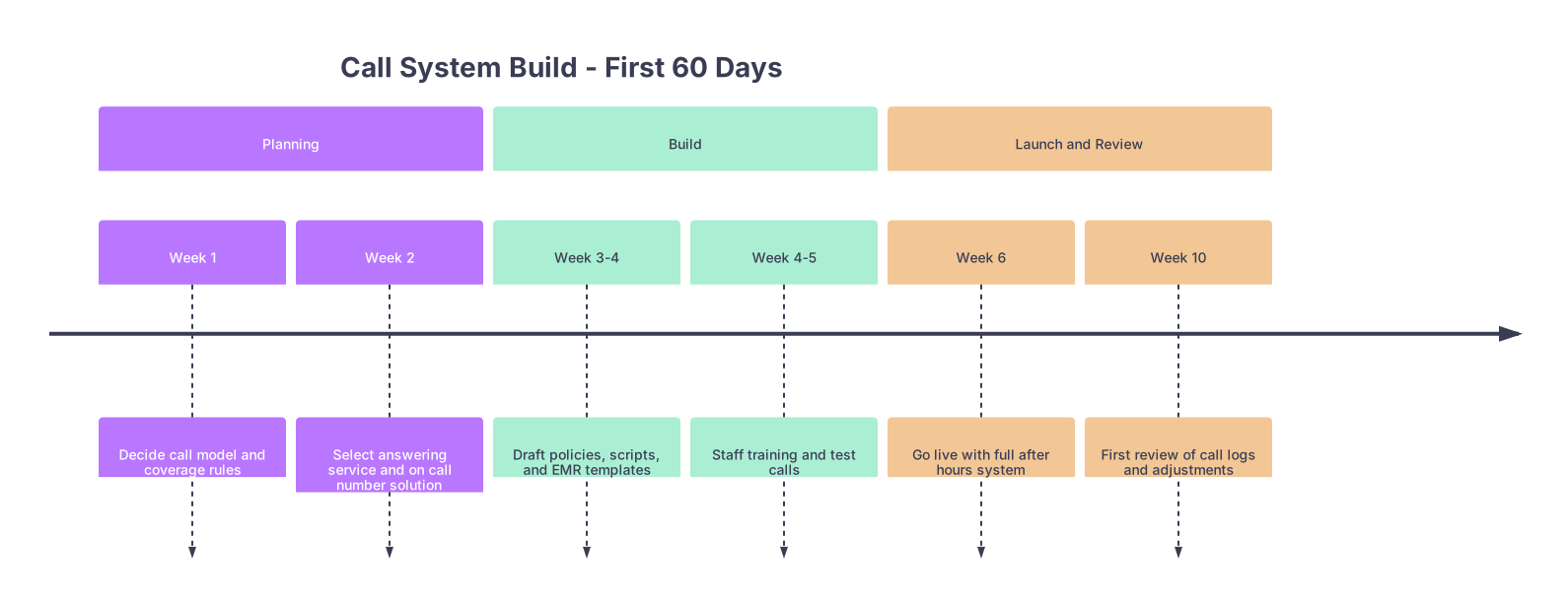
| Period | Event |
|---|---|
| Planning - Week 1 | Decide call model and coverage rules |
| Planning - Week 2 | Select answering service and on call number solution |
| Build - Week 3-4 | Draft policies, scripts, and EMR templates |
| Build - Week 4-5 | Staff training and test calls |
| Launch and Review - Week 6 | Go live with full after hours system |
| Launch and Review - Week 10 | First review of call logs and adjustments |
Week 1–2:
- Agree on your call rotation model (week‑on/week‑off vs alternate days, etc.).
- Select your answering service and sign a short‑term contract (12 months at most initially).
- Choose your on‑call forwarding setup (VoIP system, Doximity, Google Voice with BAA if needed, etc.).
Week 3–4:
Draft:
- Patient‑facing after‑hours policy handout and website text.
- Answering service scripts and escalation rules.
- On‑call documentation template in EMR.
- Internal policy on refills, results, telehealth, controlled substances after hours.
Train staff on:
- What to tell patients about after‑hours access.
- How to flag chronic abusers of the call system.
Week 4–5:
- Do multiple test calls outside business hours: you, your partner, a spouse, a friend.
- Time how long it takes to get a callback.
- Review the logs and see if documentation flows correctly into your EMR.
Week 6:
- Officially “go live” with your final after‑hours system.
- Stop any informal “text me if you need something” behaviors.
Week 10–12:
- Pull call logs: tally urgent vs non‑urgent.
- Adjust scripts and patient education.
- If still high call volume from inappropriate reasons, tighten boundaries and reinforce policies at visits.
12. Mental Health and Sustainability: Protecting the Two of You
A final point that rarely gets said out loud: two‑physician clinics are fragile. One burnout, one divorce, one illness, and the entire call structure collapses.
You both need to:
- Be brutally honest about your tolerance for sleep disruption.
- Protect each other’s true off‑time. If one of you is on vacation, the other does not also double clinic volume.
- Budget financially for some purchased coverage down the line, even if you “tough it out” in year one.
You cannot scale your way out of call with just two people. You can only:
- Engineer it intelligently.
- Offload the low‑value noise.
- Spend money strategically on outside help.
If you do this well, your patients feel well‑supported, your risk is controlled, and you can actually enjoy running a small, sane practice.
Key Takeaways
- A two‑physician clinic needs a deliberate, written call structure—schedule, scripts, and policies—not ad‑hoc phone coverage.
- Use a central number, a real answering service, and a dedicated on‑call line so patients reach you appropriately without knowing your personal cells.
- Ruthlessly separate urgent from routine issues, enforce boundaries through patient education and staff training, and document every substantive after‑hours interaction in your EMR.