
The advice you’ve heard about “just follow your passion and the money will come” will wreck you if you’re starting private practice while paying for childcare and a mortgage.
You do not have the margin for vague optimism. You need a plan that survives daycare invoices, rising interest rates, and slow first-month referrals.
Let’s build that plan.
1. First Reality Check: Can You Actually Afford To Do This?
You’re not a resident anymore. A 40% income drop while you “see how it goes” is not an option when daycare is $1,800/month and your mortgage is $3,000.
So we start with hard numbers, not dreams.
Step 1: Know your non‑negotiable life burn rate
Pull up your last 3 months of spending and strip it to what must be paid for your family to stay afloat:
- Mortgage (or rent)
- Childcare
- Groceries (be realistic, not fantasy)
- Utilities, phone, internet
- Insurance (health, disability, life, malpractice if already paying)
- Minimum loan payments
- Transportation (gas, payment, insurance, public transit)
- Basic recurring expenses (kids’ activities, necessary subscriptions)
Add it up. Then add 10–15% buffer because kids get sick, cars break, HVAC dies at the worst time.
Call that number “Baseline Family Nut.”
Now you know the minimum monthly after‑tax income you need while the practice ramps.
Step 2: Model the first-year practice income honestly
New practices do not pay like employed jobs for at least 6–18 months.
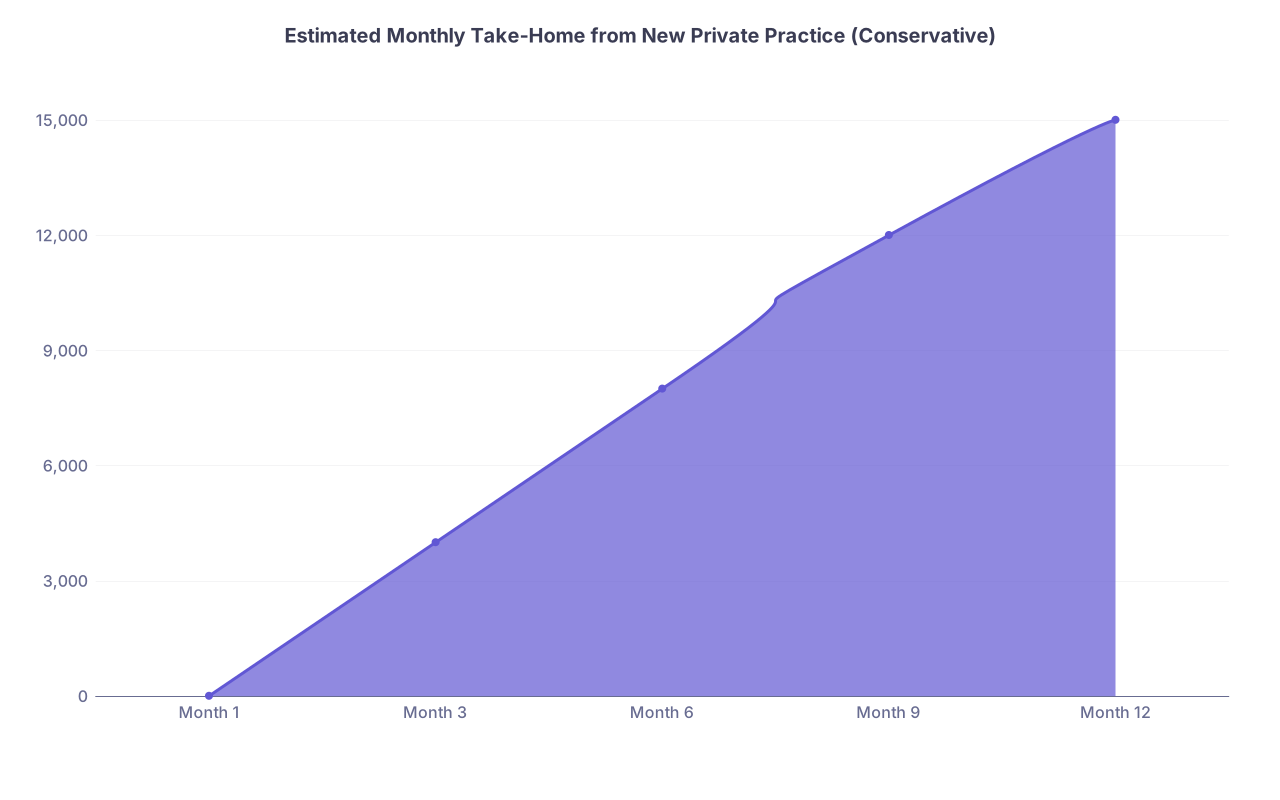
A fairly realistic, conservative ramp (insurance-based outpatient, reasonable demand, you hustle):
| Category | Value |
|---|---|
| Month 1 | 0 |
| Month 3 | 4000 |
| Month 6 | 8000 |
| Month 9 | 12000 |
| Month 12 | 15000 |
That’s take-home to you, after practice expenses but before your personal taxes. Your actual numbers will vary by specialty and region, but if your projection assumes full panels and perfect collections in month 2, you’re lying to yourself.
Step 3: Compare the two
If your Baseline Family Nut is $10,000/month after tax, and your practice is likely to pay:
- Months 1–3: $0–$4k/month
- Months 4–6: $4–$8k/month
You’ve got a gap. You either:
- Reduce the nut,
- Bridge the gap (savings, spouse income, side work), or
- Don’t start yet.
That’s the harsh filter. Better to feel the discomfort now than with a delinquent mortgage notice in your mailbox.
2. The Hybrid Model: The Only Sane Way For Most Parents
If you’ve got childcare and a mortgage, the smartest move in 90% of cases is not jumping straight to full-time private practice. It’s a hybrid model.
You keep predictable income while building your own thing on the side—deliberately structured to grow.
The basic structure
You pick a stable “anchor” job and slice protected time for private practice.
| Day | Morning Job | Afternoon/Evening Job |
|---|---|---|
| Mon | Employed clinical (0.6FTE) | Private practice |
| Tue | Employed clinical | Private practice |
| Wed | Employed clinical | Admin / practice building |
| Thu | Employed clinical | Off / family |
| Fri | Private practice | Private practice |
You can flip which side is which, but the principle holds: a floor of guaranteed income + carved-out growth time.
Picking the right “anchor” job
You’re not just looking for money. You’re buying:
- Predictable hours
- No extra call (or as little as possible)
- Short commute or remote options
- Minimal after-hours EMR misery
This can be:
- A 0.5–0.8 FTE employed clinic role
- Hospitalist shifts (7-on/7-off can actually work well)
- Telemedicine
- Urgent care with set shifts
What you’re not doing: a “full-time plus evenings and weekends of admin” job. You will not have the bandwidth to launch a practice properly on top of that.
3. Childcare Strategy: Design It Around Your Schedule, Not The Other Way Around
Here’s the part everyone pretends will “work itself out.” It won’t. You need a childcare model that fits the hybrid setup.
Decide your coverage pattern first
Ask:
- When will you see private patients? Early mornings? Late afternoons? Saturdays?
- What are your anchor job hours?
- When do you need to be home (bedtime, school drop-off, one protected evening)?
Then build childcare against that schedule, not the opposite.
Common workable models:
- Full-time daycare + occasional sitter for late clinics
- Nanny share for flexible hours (costlier but more control)
- Part-time daycare + grandparent help + sitter gaps
The mistake: “I’ll just squeeze patients in when I can.” That kills both your practice growth and your sanity.
Budget the real childcare cost
Stop estimating. Call or email 3–5 actual providers in your area today. Get numbers.
Then plug it into your monthly nut. Don’t forget:
- Late pickup fees
- Extra days when your partner is on call
- Backup plan when daycare is closed and you still have clinic
You absolutely must design your private practice schedule so you don’t constantly pay premium last-minute backup care.
4. Practice Design: Build For Profit, Not Ego
Here’s where a lot of new owners sabotage themselves: they build their dream clinic aesthetic before they have dream clinic revenue.
You don’t need exposed brick and designer furniture. You need margin.
Go lean on fixed costs
The goal for year 1 is maximum flexibility. That means:
- Start with subleased space or shared office before signing a full lease
- Avoid long-term, high-rent commitments
- Keep staff to the minimum you can operate safely and sanely with
If you can start with:
- 1 shared front desk (paid hourly or outsourced service)
- 1 exam room (possibly shared)
- Cloud EMR with no long-term contract
you’re in a much safer place than the doc who locked into 3,000 sq ft because it “felt like a real practice.”
Opening with telehealth vs in-person
If your specialty allows some or all telehealth (psych, psych NP, some IM, some subspecialties), seriously consider front-loading with telehealth to reduce overhead.
You can still add in-person days later once volume justifies space.
5. Financing the Ramp: How To Not Blow Up Your Household
You will have a gap period where:
- Your practice expenses are real and
- Your practice income is not.
Let’s structure how you fill that gap without gambling your house.
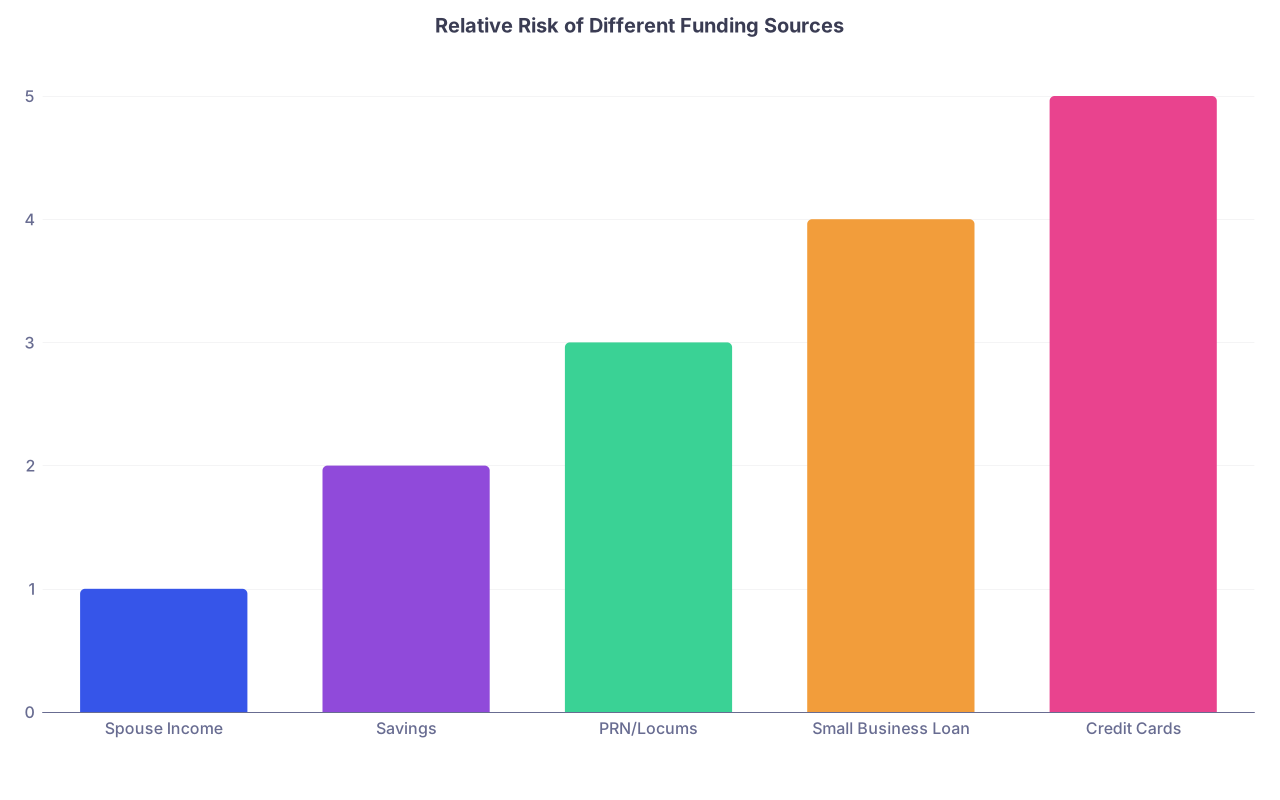
The hierarchy of funding (from best to worst)
| Category | Value |
|---|---|
| Spouse Income | 1 |
| Savings | 2 |
| PRN/Locums | 3 |
| Small Business Loan | 4 |
| Credit Cards | 5 |
1 = lowest risk to your long-term financial stability, 5 = highest risk.
1. Spouse/partner income
If your partner has stable income that can cover at least 70–80% of the Baseline Family Nut while you build, you’re in the best position. That does not mean you can ignore costs—but you have more latitude.
Have an explicit, written agreement (yes, seriously) about:
- How long you’re both comfortable subsidizing the ramp (12, 18, 24 months?)
- What milestones trigger a rethink (e.g., “If by month 12, practice isn’t bringing in X/month, we pause or adjust.”)
2. Your own savings
If you’ve got $30–60k saved, that can be your runway. Do not just vaguely “use savings.” Put numbers on it.
Example:
- Monthly family gap (after anchor job income): $3,000
- Monthly practice expenses: $4,000
- Total monthly shortfall: $7,000
- Savings: $42,000
You’ve got ~6 months of runway. That tells you how aggressively you must grow volume or cut expenses.
3. PRN / locums work
Good option if:
- You can choose shifts
- Pay is solid
- It doesn’t cannibalize your practice days
Bad option if:
- It regularly pulls you on the same days/times you’re trying to build your own panel
- You start depending on it so much you never free bandwidth to grow the practice
Use PRN/locums as a temporary bridge, not a permanent half-job.
4. Small business loans
These are not automatically evil, but they’re also not “free money to dream.” I’ve watched physicians dig a $200k hole on buildout and furniture for a practice that never cleared the monthly nut.
If you use debt:
- Keep it as small as possible (think $20–80k, not $300k+)
- Use it for revenue-generating essentials (EMR, minimal equipment, initial marketing, modest buildout), not vanity decor
- Know the monthly payment and add it to your practice nut, not your personal
5. Credit cards
This is where practices—and marriages—go to die. Stop swiping to keep a fantasy alive. If you’re floating payroll, rent, and supplies on credit cards for more than 2–3 months, you don’t have a practice problem; you have a business model problem.
6. Time Blocks: The Only Way This Works With Kids
Your real constraint isn’t just money. It’s time and energy.
The physicians who pull off starting a practice with kids and a mortgage do one thing differently: they’re brutal about time blocking.
You need three distinct types of blocks
- Revenue blocks – face-to-face or telehealth patient hours
- Growth/admin blocks – marketing, contracting, systems, finance, not charting at 11pm
- Protected family/mental health blocks – actually off, not half-working, half-parenting
A sample week for a hybrid setup with young kids:
Mon–Wed:
- 8–4: Employed job
- 5–8: Family / kid bedtime
- 8–10: Practice admin 2 nights/week, one night fully off
Thu:
- 8–2: Private practice clinic (revenue)
- 3–5: Admin / marketing block
Fri:
- 8–12: Private practice clinic
- 12–3: Admin / systems
- 3–7: Family
Sat: Either ½ day clinic (if demand) or fully off
Sun: Off, or 1–2 hours of planning max
You’re not going to “find” time randomly. You pre‑decide when you are a clinician, when you are a small business owner, and when you are a parent. Then you defend those blocks.
7. Fastest Ways To Get Paying Patients In The Door
You do not have the luxury of slow organic growth over 3 years. You need a decent panel in 6–12 months.
Here’s what actually works instead of “build it and they will come”:
1. Insurance panels (if you’re not cash only)
Get credentialing started as soon as humanly possible. It can take 3–6 months. While you wait, you can:
- See cash-pay patients
- Offer superbills for out-of-network reimbursement
- Do free or low-cost consults with referral sources (PCPs, therapists, community clinics)
Do not wait until you’re “perfectly set up” to begin credentialing. Mistake I see constantly.
2. Narrow and name your niche
“Family medicine for everyone” is marketing death.
“Women’s preventive and metabolic health, ages 25–55, with evening telehealth visits” is something people can talk about and refer to.
Make yourself the obvious answer to a specific problem. Parents do this instinctively when searching: “child psychiatrist ADHD telehealth” / “back pain sports medicine clinic near me.” Help them find you.
3. Make referring to you stupidly easy
For PCPs, therapists, other specialists:
- Simple 1-page referral form they can fax or secure email
- Clear list of conditions you handle and don’t handle
- Short introductory letter or visit to nearby clinics: “Here’s who I see. Here’s how to send someone. Here’s my typical wait time.”
Do not show up with a box of donuts and no clarity. They’ll forget your name in 24 hours.
4. Online presence that doesn’t suck
You need:
- A clean, simple website (one page is fine to start)
- Online booking if possible
- Clear answers to:
- Who you see
- How appointments work
- Insurance and fees
- Location / telehealth rules
Parents are the ones googling at 11pm between feedings. Make it effortless for them to decide, “Yes, this doc understands my problem.”
8. Risk Management: Protecting Your House, Marriage, and Sanity
You’re not 26 and single. Your mistakes have collateral damage now.
Legal/structural basics
- Put the practice in an entity (LLC, PLLC, PC depending on state)
- Separate business and personal accounts from day one
- Keep malpractice coverage continuous and appropriate for your work setting
- Get disability and term life insurance in place if you haven’t already
Protect the relationship
This part gets ignored until it’s ugly. Starting a business is stressful. Combine that with young kids and money fluctuations, and you have a recipe for resentment.
Be explicit with your partner about:
- Expected income drops / fluctuations for the first 12–24 months
- What you will not sacrifice (e.g., one consistent family night, one date night a month, no phone during dinner)
- What support you need (space to work certain evenings, emotional backing when it’s slow)
Schedule monthly “business + family” check-ins. 30–45 minutes. Look at:
- Practice finances
- Family budget
- Schedule stress points
Adjust together instead of silently stewing.
Watch your own burnout
Starting a practice while raising kids is not cute hustle culture. It’s heavy. If you feel:
- Constantly irritable with your kids or partner
- Dread before every clinic day
- Numb about work you used to enjoy
You’re over the line. Don’t wait until you’re clinically depressed to adjust. Scale back something: patient volume target, locums shifts, or unrealistic growth expectations.
9. A Simple 12–18 Month Timeline That Actually Works
Here’s a realistic, not-fantasy arc for someone post-residency with childcare and a mortgage, going hybrid:

| Period | Event |
|---|---|
| Months 0-3 - Lock anchor job schedule | Done |
| Months 0-3 - Set childcare plan and budget | Done |
| Months 0-3 - Form entity, open business accounts | Done |
| Months 0-3 - Start insurance credentialing | In progress |
| Months 4-6 - Open for limited private hours | Active |
| Months 4-6 - Build website and referral materials | Active |
| Months 4-6 - Adjust family and work schedule | Active |
| Months 7-12 - Grow patient panel steadily | Active |
| Months 7-12 - Reassess anchor job FTE vs practice volume | Decision point |
| Months 7-12 - Stabilize monthly income above family nut | Goal |
| Months 13-18 - Consider reducing anchor job further | Optional |
| Months 13-18 - Add staff or space if justified | Optional |
| Months 13-18 - Strengthen systems and delegate tasks | Ongoing |
You may accelerate or slow this depending on:
- How aggressively you market
- How much risk you can tolerate
- How much anchor job you keep
But this is the general shape that doesn’t detonate your personal life.
10. When You Should Not Start Yet
Yes, there are times the correct move is not yet.
You should pause and delay launching private practice if:
- You have less than 3 months of runway (savings + reliable income) and no backup
- Your relationship is already barely holding together from residency
- You’re in the middle of a major life event (newborn in the last month, major illness, divorce in progress)
- You’re looking at private practice mainly as an escape from a toxic job, not a business you actually want to run
In those situations, stabilize first:
- Get to a less toxic but stable job
- Build 3–6 months of runway
- Clean up the worst personal crises
Then revisit private practice with a clear head.
FAQ (Exactly 5 Questions)
1. How much savings do I realistically need before starting private practice with a mortgage and kids?
I like 6 months of total shortfall covered. That means: calculate your family’s Baseline Nut, subtract any reliable income (spouse + anchor job), add expected practice overhead, and see the gap. If the gap is $5k/month, I want you walking in with at least $30k in accessible cash or equivalent support. If you’re more risk‑tolerant and have strong anchor income, you can get away with less, but starting with under 3 months runway is asking for panic and bad decisions.
2. Should I tell my employed job I’m starting a private practice on the side?
You need to read your contract first. Non‑compete clauses, moonlighting provisions, and conflict‑of‑interest language matter more than what feels fair. If the contract is strict, talk with a healthcare attorney and see if your practice can differ by geography, population, or modality (telehealth, niche focus). Once you’re clear on what’s allowed, then you decide what to share. I prefer a brief, factual heads‑up once you’re actually launching, not when it’s still a fantasy. But never volunteer info that contradicts your contract.
3. Is it better to start all-cash or take insurance when I have big fixed expenses?
If you have serious financial pressure (mortgage + childcare + loans), going all-cash is usually too risky unless you’re in a very affluent area with clear demand for your niche. Insurance will slow your setup but dramatically expand your patient pool. A hybrid model—take 2–3 major plans plus offer cash rates—often works best early on. Once your mortgage is a non-issue and the practice is breathing comfortably, then you can decide whether to lean more cash.
4. How many clinical hours in my own practice do I need before I can safely drop my employed job?
I care less about hours and more about consistency of income. When your practice can (for at least 4–6 consecutive months) reliably cover:
- Your Baseline Family Nut
- Your practice overhead
- Taxes and a bit of savings
without you depending on anchor job income, you can start cutting that job back. For some, that’s 20–25 patient hours/week. For others, more. But don’t quit just because you had one good month.
5. What’s one high-yield marketing move for a new parent–physician starting private practice?
Pick 10–15 nearby practices (PCPs, therapists, midwives, school counselors—depends on your niche). Create a one-page referral sheet that clearly states: who you see, what problems you handle, how to send someone, and your current wait time. Then personally visit or call them over 2–3 weeks. Offer yourself as an easy, fast-access option. That single, focused outreach often beats months of passive social media posting.
Open a blank note (or spreadsheet) right now and write two numbers: your Baseline Family Nut and your realistic first-year monthly take-home projection from private practice. If you can’t write both today, that’s your first assignment this week.