
The playing field is not level—and pretending it is will hurt you.
If your class is mixed, with some students having numerical Step 1 scores and others (you) sitting on a plain “Pass,” you’re in a weird, transitional era. Programs are still mentally in the old world but forced to operate in the new one. That gap is where people get blindsided.
You are not going to fix the system. But you can run circles around your peers if you understand exactly what’s happening in program directors’ heads and adjust accordingly.
This is the “here’s what to do if you’re in this exact situation” guide.
1. Understand the Reality You’re Competing In
Forget the press releases. Focus on behavior.
Step 1 is officially pass/fail. But for a few years, residency programs are dealing with three types of applicants sitting in the same stack:
- People with strong Step 1 scores (pre-pass/fail)
- People with mediocre or weak Step 1 scores (but still passed)
- People with no Step 1 score at all, just “Pass” (you)
Programs hate uncertainty. So they’re doing exactly what you’d expect: over-weighting every other signal they can quantify.
Right now, for mixed classes, the unspoken sorting often looks like this:
, Clerkship Grades, School Reputation, Research, Letters, Step 1 (if numeric)](https://cdn.residencyadvisor.com/images/articles_svg/chart-relative-weight-of-application-components-in-mixed-8711.svg "Relative Weight of Application Components in Mixed Step 1 Classes")
| Category | Value |
|---|---|
| [Step 2 CK](https://residencyadvisor.com/resources/step1-pass-fail-era/clerkship-grades-vs-step-2-what-pds-privately-say-they-trust-most) | 35 |
| Clerkship Grades | 25 |
| School Reputation | 10 |
| Research | 10 |
| Letters | 15 |
| Step 1 (if numeric) | 5 |
Do not obsess over the exact percentages; they change by specialty. But get the hierarchy:
- Step 2 CK is the new Step 1 whether anyone likes it or not
- Clinical performance and narrative comments matter more than they used to
- Letters from people programs know and trust are gold
- A strong Step 1 number still helps your classmates, especially in competitive fields
Your situation in one sentence:
You aren’t “behind” because you have a Pass; you’re behind if that Pass is sitting next to a 248 with nothing else to distinguish you.
So you fix that.
2. Diagnose Your Position: Where You Actually Stand
You cannot build a strategy in a vacuum. You need to know which bucket you’re in.
Use this brutally honest self-check:
| Area | Strong Position | Weak Position |
|---|---|---|
| Step 1 | Clean Pass, no remediation | Remediation, delay, or multiple attempts |
| Step 2 CK | 245+ for competitive, 230+ for core fields | Below that or not yet taken with risk |
| Clerkship Grades | Mostly Honors / High Pass | Mostly Pass, few (or no) Honors |
| Research | 1+ pubs/abstracts in your target field | Nothing or unrelated minor experiences |
| Letters | Faculty know you *very* well | Generic “hard-working” letters likely |
If you’re weak in more than two boxes, you do not get to play the same game as your classmate with a 255 Step 1, straight Honors, and three ortho publications. Apply differently. Plan differently.
This is where most people screw up: they apply like the person they wish they were instead of the person they actually are. That’s how you get 3 interviews and a panic attack in January.
3. How Programs Compare You to Classmates With Scores
Let’s walk through the comparison that actually happens in selection meetings. I’ve sat in rooms where this was basically the script.
Two applicants from the same school:
- Student A – Step 1: 248, Step 2 CK: 246, mostly High Pass, 1 ortho case report
- Student B – Step 1: Pass, Step 2 CK: 248, mostly Honors, strong ortho research, glowing letter from the program’s former fellow
What happens?
If orthopedics is flooded (it is), the committee still feels more comfortable with A at first glance because that Step 1 number is a known entity. But B starts to look better when someone who actually reads the file points out:
- Higher Step 2 (arguably more relevant now)
- Better clinical grades
- Clearer commitment to the field
- Stronger letter connection
In a lot of programs, B wins that comparison—or at least gets the interview.
Now tweak the scenario:
- Student C – Step 1: 248, Step 2 CK: 255, mostly Honors, 3 pubs
- You – Step 1: Pass, Step 2 CK: 238, mixed HP/Pass, 1 poster
You’re not losing because you lack a Step 1 score. You’re losing because at every other objective metric, you’re behind. If Step 1 didn’t exist for either of you, the outcome would be the same.
That’s why obsessing about your classmates’ scores is a distraction. You need to overbuild every other part of your file to the point that someone in that room says: “We would be idiots not to interview this person.”
4. The Non-Negotiable: Step 2 CK Strategy in a Mixed Class
If you take nothing else from this: Step 2 CK is now your flagship score. You don’t get to treat it like an afterthought.
You’re in one of three situations:
- You have not taken Step 2 CK yet
- You took it and did well
- You took it and it’s mediocre or bad
Let’s go one by one.
4.1. If You Haven’t Taken Step 2 CK Yet
Your Step 2 target depends on your goal:
| Target Specialty Level | Rough Step 2 Goal |
|---|---|
| Most competitive (Derm, Ortho, ENT, Plastics, Ortho, IR) | 250+ |
| Mid-high (EM, Anes, Radiology, General Surgery) | 240+ |
| Core (IM, Peds, Psych, FM, OB/GYN) | 230+ |
Yes, there are exceptions. No, you should not plan on being the exception.
Concrete moves:
- Schedule Step 2 CK early enough that you have a score in before ERAS opens (or at least before programs really start reviewing in October)
- Treat studying like a job: UWorld, NBME, practice exams with clear score trajectories
- If your practice scores are consistently below your target by more than ~5 points, delay the exam if your school and timeline allow
Do not let ego push you into taking Step 2 underprepared just to “stay on the regular schedule” if that regular schedule ends your chances at the specialty you want.
4.2. If You Already Have a Strong Step 2
Good. This is the closest thing you get to replacing a missing high Step 1.
Now your job is alignment:
- Make sure your clerkship performance and narrative evaluations do not contradict your score (if they say “disengaged” and you have a 255, programs will doubt the score or your professionalism)
- Push for at least one away rotation or home rotation in your intended specialty where you can:
- Clinically perform like someone with that score
- Get a letter that mentions both your clinical ability and how your test performance shows up on the wards (e.g., “knowledge base is clearly reflected in exam performance”)
You’re trying to give Step 2 a story: “This is who I am clinically, not just a good test day.”
4.3. If Your Step 2 Is Mediocre Or Weak
This is where people panic in a mixed class, because they feel doubly exposed: no Step 1 score to rescue them, and Step 2 is underwhelming.
Here’s the brutal approach:
- Stop aiming for fields that use CK as a primary screen at stratospheric cutoffs unless you have truly elite compensating strengths (like serious, multi-year derm research with big-name mentors)
- Lean heavily on:
- Clinical excellence – Honors where you can still affect them, strong sub-internship performance
- Fit-heavy specialties – Family medicine, psych, peds, some IM programs care more about “Would I want this person on my team at 3 a.m.?” than the raw three-digit number
- Program familiarity – Rotate where you want to match, do an acting internship, show up, be reliable
Also: fix what you can short-term. If your test-taking is the issue, get help now. Shelf exams, in-service exams, even internal testing for fourth-year rotations will still matter and will still be talked about in letters.
5. Beating the Comparison on the Wards: Clerkships & Rotations
On paper you’re a “Pass” where your classmate might have “250.” On the wards, none of that matters. You can absolutely outcompete them there—and that’s where your file gets its soul.
Your targets:
- Honors in rotations relevant to your specialty
- Strong narrative comments that mention: work ethic, teachability, initiative, communication
- Faculty who remember your name and your face when letter season comes
Here’s how you actually do that:
- Be the person who knows the patients better than anyone else on the team
- Anticipate: if your resident always needs vitals trended for a certain patient type, have it ready
- Read on your patients’ conditions and mention one or two relevant points casually, not in a “look at me I studied” way
- Take feedback without getting weirdly defensive or crushed
One blunt truth: programs trust the pattern. If your internal medicine, surgery, and OB comments all read “hard-working, reads, great team member,” that is far more powerful than one random attending who says, “She’s brilliant,” but everyone else hints you’re unreliable.
In a mixed Step 1 class, those patterns are how you jump ahead of the “248 but lazy” crowd.
6. Letters of Recommendation: Where You Can Outplay Your Scored Peers
A strong Step 1 score is easy. A strong letter is not. This is where you can absolutely beat classmates who were “better” standardized test takers.
You want:
- At least one letter from your target specialty that is specific and detailed
- At least one letter from someone with name recognition or direct connections to programs you care about
- No “damning with faint praise” letters (short, generic, lukewarm)
The difference between a mediocre and powerful letter is in the details:
Weak:
“Did a good job on the rotation, got along well with peers, will be a solid resident.”
Strong:
“On our service, she routinely stayed late to call families personally, handled high-acuity patients with appropriate escalation, and by the end of the month was functioning at the level of an intern.”
You can influence this by:
- Asking for letters only from people who have seen you work enough
- Saying: “Would you feel comfortable writing me a strong letter?” and watching their reaction
- Giving them a short, focused CV and a one-page ‘highlights’ summary that includes:
- Your specific contributions
- A reminder of specific cases or situations you handled
- Your career goals
Your classmate’s 255 Step 1 will not help them if their letter basically says, “Smart, but quiet, hard to read, did fine.”
7. Choosing Where to Apply When Your Class Is Mixed
Your specialty choice and application strategy need to acknowledge the era you are in, not the era that just ended.
A rough breakdown:
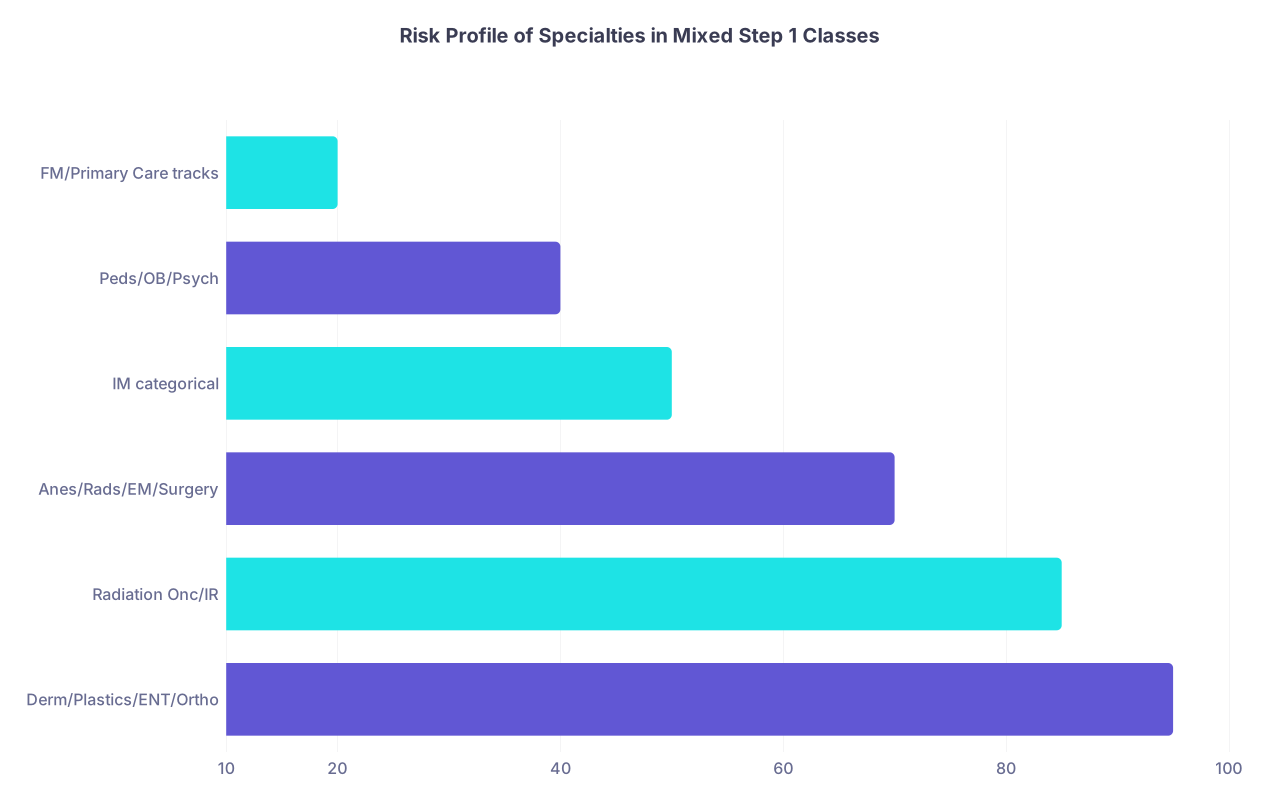
| Category | Value |
|---|---|
| Derm/Plastics/ENT/Ortho | 95 |
| Radiation Onc/IR | 85 |
| Anes/Rads/EM/Surgery | 70 |
| IM categorical | 50 |
| Peds/OB/Psych | 40 |
| FM/Primary Care tracks | 20 |
Higher number = higher risk of Step-score obsession and hyper-competitive pools.
If you want a top-tier competitive specialty and you have only a Pass on Step 1 and your Step 2 and CV are just “fine,” the math is bad. You can still apply, but do not build your entire fourth year and identity around a 3% shot.
If you’re aiming mid-range or core specialties, your mixed class status matters less than you think—if you do the following:
- Apply broadly enough (most people underestimate this; yes, 40–60 applications is normal in many fields)
- Include a sensible mix of:
- Programs with lots of home candidates and few spots (harder)
- Mid-tier university programs
- Strong community programs
- Use your personal statement and experiences section to tell a clear, consistent story of who you are—not random disjointed “volunteering” thrown in to look busy
In a mixed class, the worst thing you can do is assume programs will “give you the benefit of the doubt” because Step 1 is pass/fail now. They won’t. They’ll just shift that doubt onto something else: Step 2, class rank, research, or the vibe of your file.
8. Handling the Psychological Garbage: Watching Classmates Flash Numbers
You will hear it:
- “I got a 252 on Step 1, so I’m not even worried about Step 2.”
- “My advisor said with this score I can go anywhere for gas.”
- Group chats dissecting average Step 1s of matched seniors at specific programs.
This can absolutely get in your head, especially when all you have is a bland “Pass” and no concrete validation yet.
A few practical ways to not let this derail you:
- Curate your input. Mute group chats that are just score-bragging and speculation. You are not obligated to marinate in other people’s anxieties.
- Anchor to metrics you control now: your practice NBME scores for Step 2, your daily performance on the wards, your research output.
- Use their numbers as data, not identity. A classmate’s 250 tells you their doors; it does not close yours. You’re just playing a different game with different levers.
And yes, it stings to hear someone casually dismiss the exam that still keeps you up at night. Acknowledge that privately, then get back to work. Residencies are full of people who never had a Step 1 score listed and are now fantastic physicians. That’s not motivational-poster nonsense, it’s already happening.
9. The Future: How Long This Mixed-Class Chaos Lasts
You’re in the messy middle.
Within a few years, every applicant in the pool will:
- Only have Pass/Fail Step 1
- Have Step 2 CK as the primary objective metric
- Be coming from a system where schools have (hopefully) adapted evaluation and ranking schemes for the new world
Right now though, programs are doing this juggling act:

| Step | Description |
|---|---|
| Step 1 | Review Applicant |
| Step 2 | Weigh Step 1 plus Step 2 |
| Step 3 | Focus on Step 2 and grades |
| Step 4 | Comfortable invite |
| Step 5 | Check letters and school |
| Step 6 | Borderline or reject |
| Step 7 | Step 1 numeric? |
| Step 8 | Scores align with grades? |
How long until this stops? Roughly:
- 2–3 cycles where mixed cohorts are the norm
- After that, numeric Step 1 will mostly be a historical quirk, not an active comparison point
So if you’re reading this now, yes: you’re one of the cohorts that has to deal with all the awkwardness. You can resent that, or you can recognize the upside: chaos usually benefits the people who adapt fastest.
10. Your Action Plan If Your Class Is Mixed
Let me put it all in “do this next” form.
- Clarify your target specialty with brutal honesty about its competitiveness
- Plan Step 2 CK as your make-or-break test:
- Study like it decides your specialty (because it might)
- Time it so you have a score for ERAS
- Overperform on the wards where it counts for your specialty:
- Aim for Honors where they’re still in play
- Be the reliable, teachable, prepared student, not the “brilliant but flaky” one
- Invest in relationships for letters:
- Prioritize rotations with faculty who like teaching and mentoring
- Ask deliberately for strong letters, not last-minute favors
- Apply strategically:
- Build a list that matches your actual profile, not the one you wish you had
- Include a real safety net—programs where your current stats and experiences are solidly above average, not barely scraping the bottom
- Ignore the noise:
- Filter out score-flexing, rumor mills, and “my advisor said X specialty is fine with a 220” anecdotes
- Pay attention to actual match data and honest faculty input
You do not need a Step 1 number to be competitive. You need a coherent, strong application somewhere, in some specialty. That’s the only game that matters.
FAQ (Exactly 4 Questions)
1. If I only have a Pass on Step 1, should I mention it anywhere or “explain” it?
No. A clean Pass with no remediation does not need explanation. Do not draw attention to something that is not a problem. The only time you address Step 1 directly is if there was a failure, a major delay, or a leave tied to it—then you handle it briefly, factually, and pair it with evidence of improvement (good Step 2, strong clinical work).
2. Does a classmate’s high Step 1 score hurt my chances at my own school’s residency?
Indirectly, only if you’re both applying to the same tiny specialty with very few spots, and you’re otherwise similar candidates. Programs do not take someone just because they have a high Step 1; they take them because their overall profile fits. If you differentiate yourself with clinical excellence, strong letters, or a slightly different niche (e.g., more interest in education, QI, underserved care), you’re not fighting a pure score battle.
3. Should I rush to take Step 2 CK early just to have a score for applications, even if I feel underprepared?
No. A mediocre or low Step 2 score will hurt you across the board more than a late (but strong) score in many specialties. The balance point: you want your score back by the time programs start serious file review (usually October). If taking in June/July means a 10–15 point drop from your potential, it’s usually smarter to push a bit later, assuming your school and graduation timeline allow.
4. For competitive specialties, is research more important now that Step 1 is pass/fail?
Research was already important in competitive fields; the pass/fail shift just made it one of the clearer differentiators. In derm, ortho, ENT, plastics, etc., substantial, field-specific, and ideally productive research (posters, abstracts, publications) matters a lot. It will not fully compensate for a weak Step 2, but in a world where you don’t have a Step 1 score at all, it becomes one of the strongest signals of genuine commitment and capability in that field.