The assumption that simulation can fully replace live surgical case volume is wrong. The data are very clear: simulation can close some gaps fast, but it does not buy you unlimited equivalence to real cases.
Let me walk through the numbers.
What We Actually Know From the Data
Most conversations about “sim hours vs case numbers” are hand‑wavy. “High‑fidelity simulation is just as good as the OR,” someone says in a faculty meeting. Then nobody asks: “According to what effect size? Over what time horizon? On which outcomes?”
The published data, when you strip out the marketing gloss, consistently show three things:
- Simulation is highly effective for early technical skill acquisition and error reduction.
- Transfer to real OR performance is measurable but partial.
- Beyond a certain point, marginal benefit of extra simulation drops off faster than the marginal benefit of additional live cases.
A few anchor numbers.
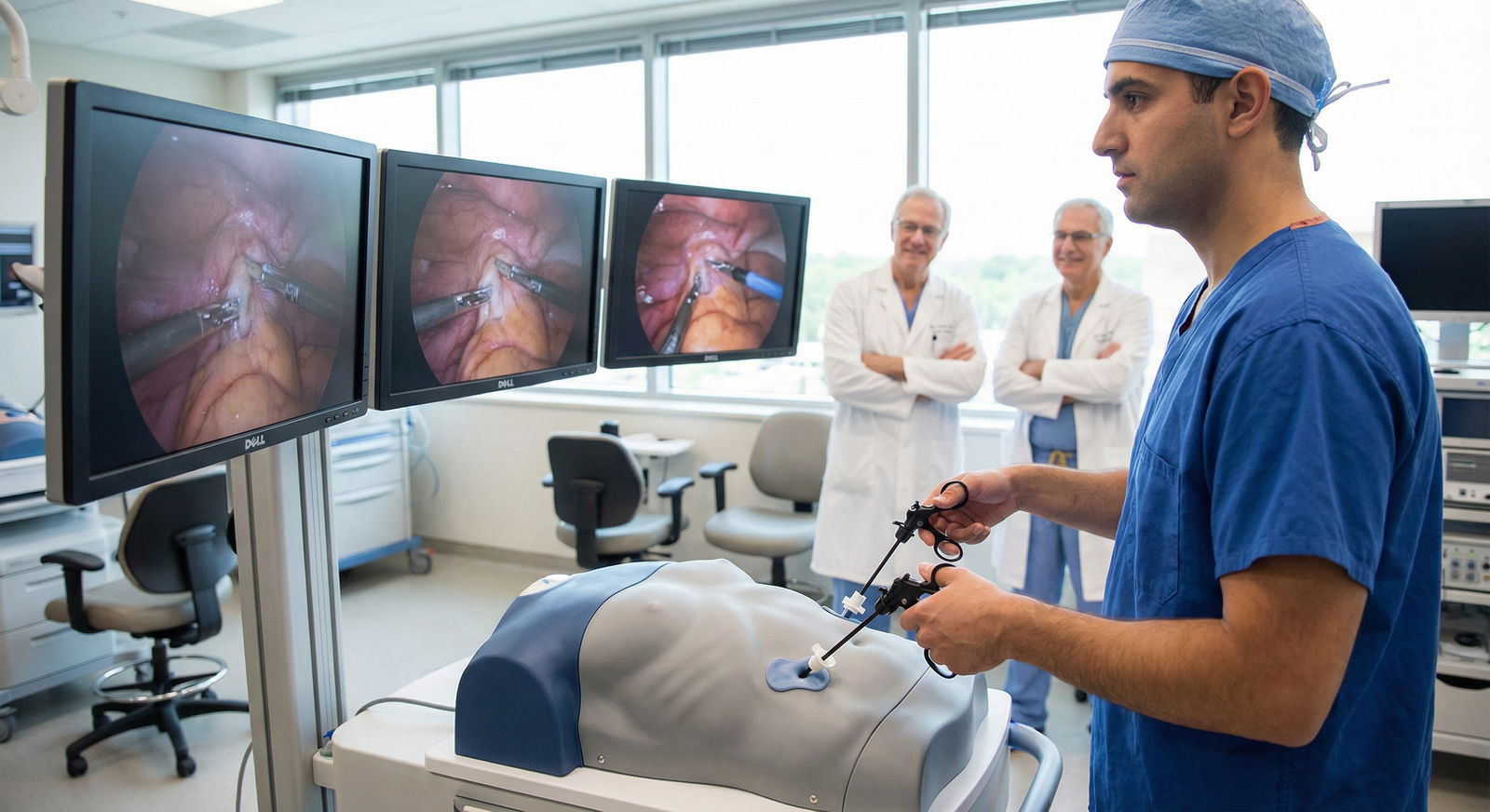
- FLS (Fundamentals of Laparoscopic Surgery) training: multiple randomized trials show residents with structured FLS training perform 20–40% faster and with 30–50% fewer technical errors on basic laparoscopic tasks in the OR compared to controls with no sim curriculum.
- Time to basic proficiency on core tasks (e.g., peg transfer, intracorporeal knot tying) is typically around 8–15 hours of deliberate simulator practice for most PGY1–2 residents, with wide inter‑individual variance.
- Complex decision‑making, situational awareness, and complication management show much smaller effect sizes from sim‑only training unless scenarios are specifically designed and repeated.
To make it concrete, here is how typical structured curricula map out.
| Training Component | Approximate Volume |
|---|---|
| Basic simulator lab (PGY1) | 20–40 hours |
| Advanced sim & team training | 30–60 hours |
| Total structured sim hours | 50–100 hours |
| Live operative cases (ACGME minimum for general surgery) | 850+ cases |
Fifty to one hundred hours of structured simulation is not designed to replace 850 live cases. It is there to compress the slow, painful part of the learning curve and to reduce preventable errors.
The key question is not “Can sim replace the OR?” It is: “For each competency domain, how many sim hours buy how much reduction in required live case volume, if any?”
Parsing Competency: What Are We Actually Measuring?
When people conflate “competency” into one number, the conversation is lost. Competency is multi‑dimensional. The data behave differently across domains:
- Psychomotor technical skill (dexterity, camera navigation, tissue handling)
- Procedural choreography (knowing the sequence, steps, and landmarks)
- Cognitive decision‑making (what to do when anatomy is distorted, when bleeding obscures view)
- Non‑technical skills (communication, leadership, prioritization under stress)
- Judgment and adaptability (when to bail out, when to convert, when to call for help)
Simulation hits some of these very hard, others only weakly.
To show the contrast, think in terms of effectiveness percentages—how much of the performance delta between novice and competent can simulation close, compared with live cases. The rough ranges below synthesize results across multiple meta‑analyses and skill transfer studies.
| Competency Domain | Sim Effectiveness vs Live Cases (Approx.) |
|---|---|
| Basic psychomotor skills | 60–80% of benefit of early live cases |
| Procedural choreography | 50–70% |
| Cognitive decision‑making | 20–40% |
| Non‑technical skills | 30–50% |
| High-level judgment | <20% |
These are not perfect numbers. But the pattern is consistent across specialties: simulation is powerful at the “bottom” of the pyramid (basic skills, task familiarity), weaker at the top (judgment in messy reality).
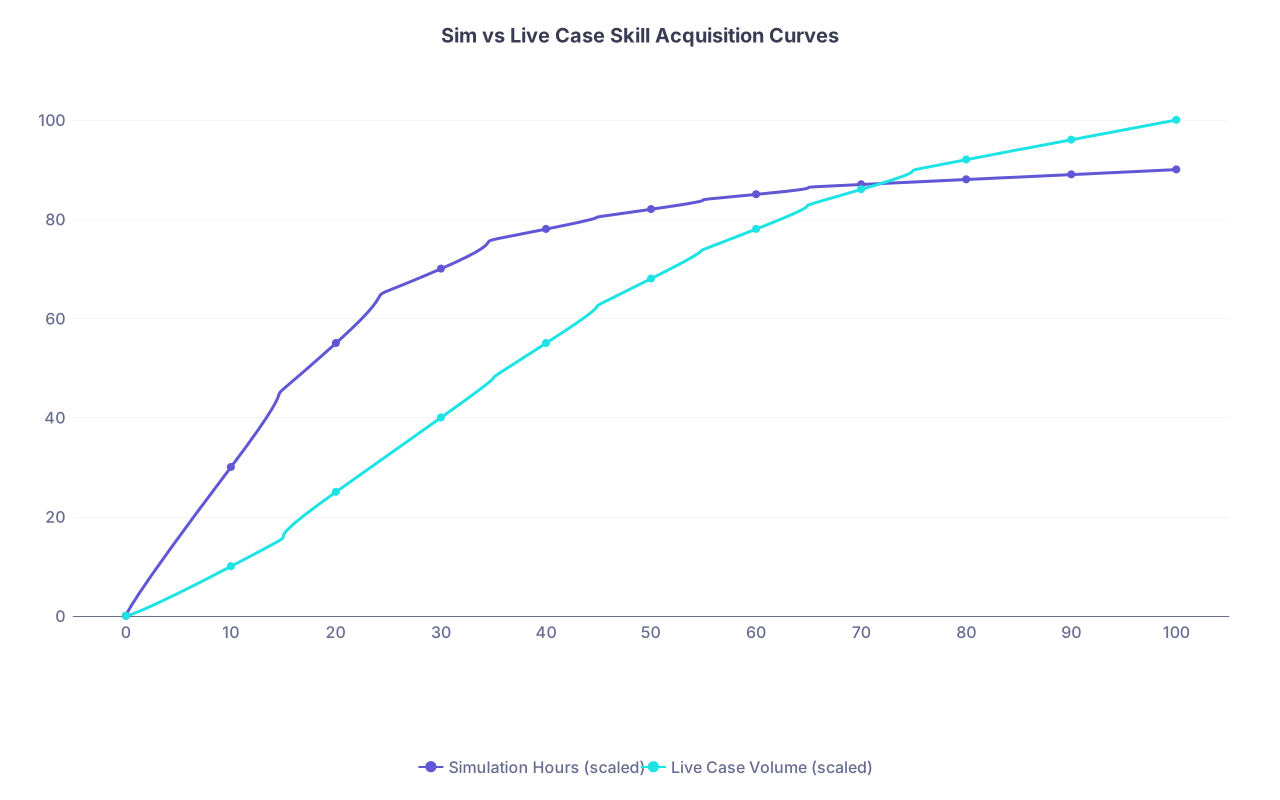
To visualize the different growth curves, imagine performance on a 0–100 scale, where 100 is a safe, independently practicing surgeon.
| Category | Simulation Hours (scaled) | Live Case Volume (scaled) |
|---|---|---|
| 0 | 0 | 0 |
| 10 | 30 | 10 |
| 20 | 55 | 25 |
| 30 | 70 | 40 |
| 40 | 78 | 55 |
| 50 | 82 | 68 |
| 60 | 85 | 78 |
| 70 | 87 | 86 |
| 80 | 88 | 92 |
| 90 | 89 | 96 |
| 100 | 90 | 100 |
The shape is the point:
- Rapid early gains with simulation that plateau around “upper intermediate.”
- Slower early gains with live cases, but sustained progression into the expert range.
So if a program director wants to replace something, the smart target is not “cases” generically. It is the low‑yield first 20–50 cases of a routine procedure where most errors are motor or sequence based, not judgment based.
What Does One Hour of Simulation Actually Buy?
Residents often ask: “How many sim hours equal one live case?” That sounds naive, but it is the right instinct. They are doing a cost‑effectiveness calculation.
The honest answer: it depends on the stage of learning and the metric.
Take a simplified example from basic laparoscopic skills:
- Study A: Residents doing 10 hours of FLS training vs 0 hours. Those with training needed about 5–10 fewer supervised live cholecystectomies to achieve the same OR performance metrics (time to completion, error rates) as controls.
- Study B: Increasing FLS training from 10 to 20 hours showed smaller incremental benefit—maybe another 2–4 live cases “saved.”
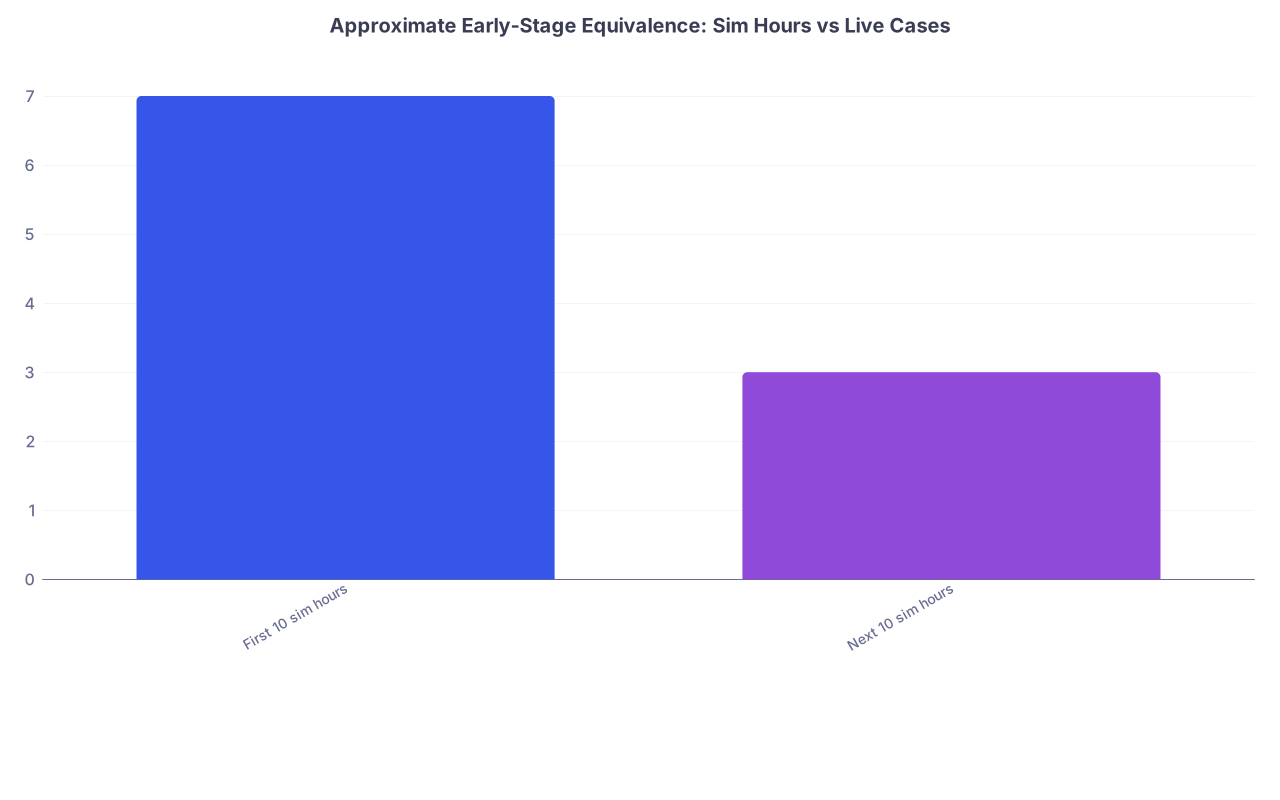
So in early training, you might see something like this equivalence range:
| Category | Value |
|---|---|
| First 10 sim hours | 7 |
| Next 10 sim hours | 3 |
Rough interpretation:
- First 10 sim hours ≈ performance benefit comparable to 5–10 basic live cases.
- Next 10 sim hours ≈ performance benefit of maybe 2–5 more cases.
But this equivalence breaks down as you move up the complexity ladder. For managing a major intraoperative bleed, 100 sim hours will not act like 100 trauma laparotomies. There simply is no realistic equivalence there.
The mistake some curriculum committees make is extrapolating the early‑stage equivalence ratio to the whole competency spectrum. That is how you end up hearing “Fifty sim hours can replace 100 cases.” There is no serious data to support that as a global exchange rate.
Where Simulation Clearly Wins
Let me be blunt: there are domains where live cases are an extremely inefficient and risky way to train.
For example:
- Basic laparoscopic camera navigation and bimanual coordination
- Standard suturing and knot tying
- Familiarization with instruments and their feel
- Rare catastrophic complications that you really do not want someone seeing for the first time on a living patient
The data on error rates are compelling. Residents who have done structured simulation:
- Make 30–50% fewer major technical errors in early OR experiences (e.g., picking up tissue incorrectly, errant cautery, poor port placement).
- Complete standard tasks 20–40% faster, which matters in the OR, because prolonged surgery is not just annoying; it increases complication risk.
If you break down a classic “learning curve” for a basic procedure like laparoscopic cholecystectomy into phases—awkward, acceptable, efficient—simulation shifts the curve left.

| Step | Description |
|---|---|
| Step 1 | Novice - no sim |
| Step 2 | Awkward OR cases 1-20 |
| Step 3 | Acceptable cases 21-50 |
| Step 4 | Efficient cases 51+ |
| Step 5 | Novice - with sim |
| Step 6 | Awkward OR cases 1-10 |
| Step 7 | Acceptable cases 11-35 |
| Step 8 | Efficient cases 36+ |
That is exactly what the better studies show:
- Same performance level reached with 30–40% fewer live cases.
- Faster time to independent operation sign‑off for lower‑complexity procedures.
From a program perspective, simulation buys you:
- Fewer painful early cases where everyone in the OR is frustrated.
- Lower risk to patients in that “dangerous novice” phase.
- More efficient use of attending time.
And the cost is relatively small. A well‑designed 20–30 hour simulation curriculum is a one‑time investment per resident per year.
Where Live Case Volume Remains Non‑Negotiable
Now the part people do not like hearing. There is no evidence that you can “simulate your way out” of the need for substantial live case volume for:
- Complex, multi‑step oncologic resections
- High‑stakes vascular or cardiothoracic procedures
- Real‑time prioritization among competing tasks in a chaotic field
- Authentic interprofessional dynamics and OR culture
The cognitive and social load of the OR is fundamentally different from a skills lab. Even high‑fidelity virtual reality platforms struggle here. The tactile feedback, the unpredictability, the emotional stakes—these are not cosmetic details; they drive the kind of learning that creates real judgment.
Look at high‑end specialties.
| Specialty | Typical Residency/Fellowship Case Volume |
|---|---|
| General Surgery (ACGME minimum) | 850+ total cases |
| Vascular Surgery | 250–350 vascular cases |
| Cardiothoracic Surgery | 150–250 major cardiac/thoracic cases |
| Complex GI/Oncologic | 200–300 advanced cases |
No serious body is arguing you can cut these numbers in half simply because residents logged 200 VR hours. The stakes are too high, and the current effect sizes of simulation on high‑level judgment are too small.
If anything, in the more complex fields, simulation’s job is to preserve live case volume for what it does best: unique anatomy, judgment calls, and real‑time improvisation. The more you push basic skills into the sim lab, the more “bandwidth” you free to make the OR about complex learning, not about struggling with basic needle angles.
Non‑Technical Skills: Simulation’s Underused Edge
Most people obsess about psychomotor skill. The more interesting frontier is non‑technical performance: communication, leadership, anticipation, error recognition.
Here, the OR is noisy data. Every case is different, outcomes are confounded by patient factors, and debriefing is usually rushed or absent.
Scenario‑based team simulation, in contrast, lets you:
- Control the scenario to surface specific teamwork failures.
- Record and replay critical moments.
- Score performance using structured tools like NOTSS or OTAS.
Studies of team‑based sim interventions show:
- ~20–30% reduction in certain process errors (wrong‐site prep, communication failures during critical steps).
- Better adherence to checklists and protocols.
- Qualitative improvements in speaking up, closing the loop, and managing hierarchy.
Here is where simulation can generate a disproportionate benefit per hour, because live cases rarely allow:
- Repeatable exposure to rare but high‑impact events (e.g., malignant hyperthermia, massive hemorrhage).
- Uninterrupted, psychologically safe debriefs.
If you are looking for “sim hours with the highest ROI,” complex crisis scenarios with full teams probably top the list. The equivalence is not “one sim hour equals X cases.” It is: “one sim scenario equals real exposure to an event you might not see even in 250 cases, but absolutely must be prepared for.”
How Programs Are Quietly Rebalancing the Mix
The most interesting trend in the last decade is not flashy VR, but quiet reallocation of training time.
Programs that track their data carefully are doing something like this:
- Reduce unsupervised “slow novice” OR time for basic tasks.
- Front‑load 15–30 hours of mandatory simulation early in PGY1–2.
- Use objective performance benchmarks (checklists, time, error counts) for sign‑off before residents touch certain parts of live cases.
- Reserve real OR exposure for progressive autonomy in judgment and complex tasks.
In practical numbers, a well‑designed program might aim for:
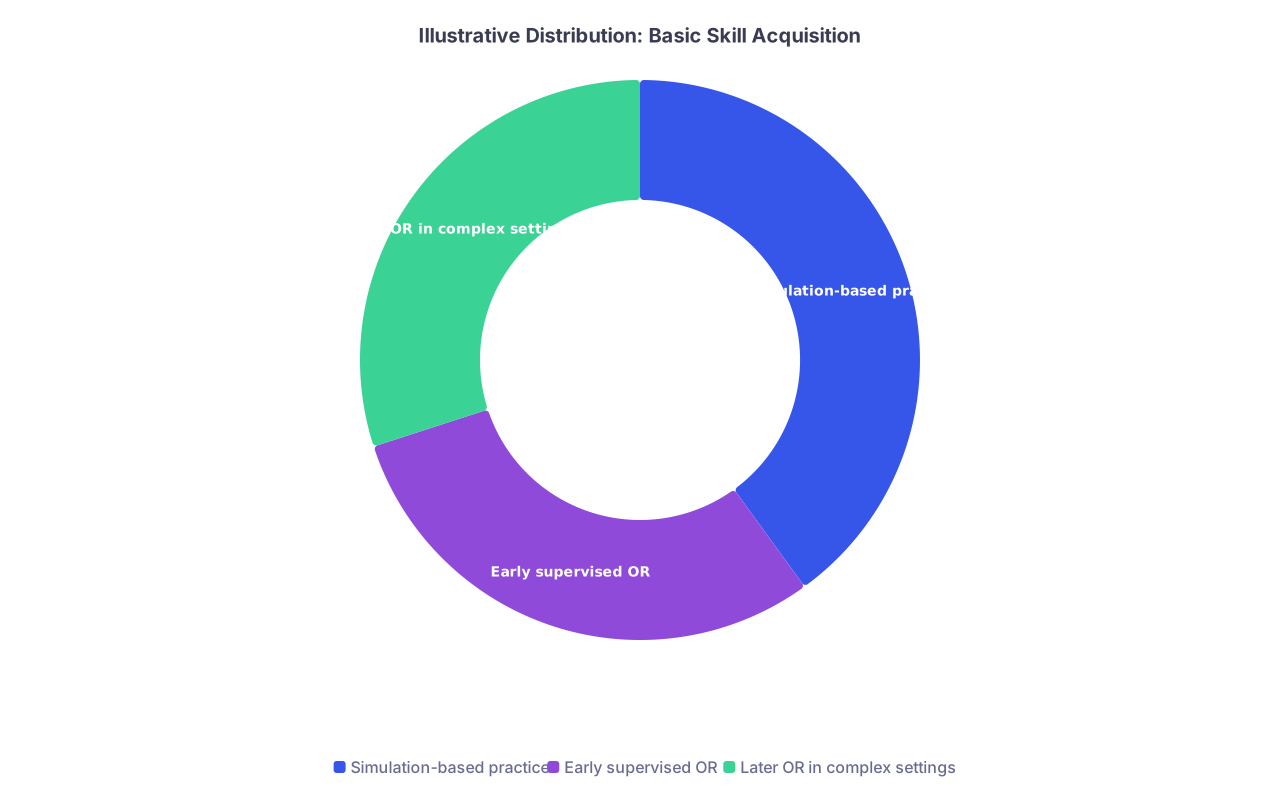
| Category | Value |
|---|---|
| Simulation-based practice | 40 |
| Early supervised OR | 30 |
| Later OR in complex settings | 30 |
Interpretation:
- Roughly 40% of early basic skill acquisition by time is shifted into sim.
- Early OR time is still present but focused on integrating those basic skills in real settings.
- Later OR time is protected for higher‑level challenges.
This does not reduce total case numbers; it increases the quality of what each case is used for. That is the crucial nuance that is lost when people talk as if sim and OR time are fungible.
The Future: Data‑Driven Equivalence Instead of Guesswork
The next logical step is to stop guessing and start quantifying sim–case equivalence with real outcome data, not opinion.
That means linking:
- Individual sim performance metrics (time, errors, motion tracking, path length, checklist scores)
- Real OR metrics (operative time adjusted for complexity, intraoperative errors, complication rates, need for attending takeover)
- Longitudinal outcomes (board pass rates, independent practice complication profiles)
Right now, most programs are still at the “local anecdote” stage. A few have started building genuine dashboards that correlate sim lab performance with OR autonomy decisions.
An example of what we should be seeing more often:
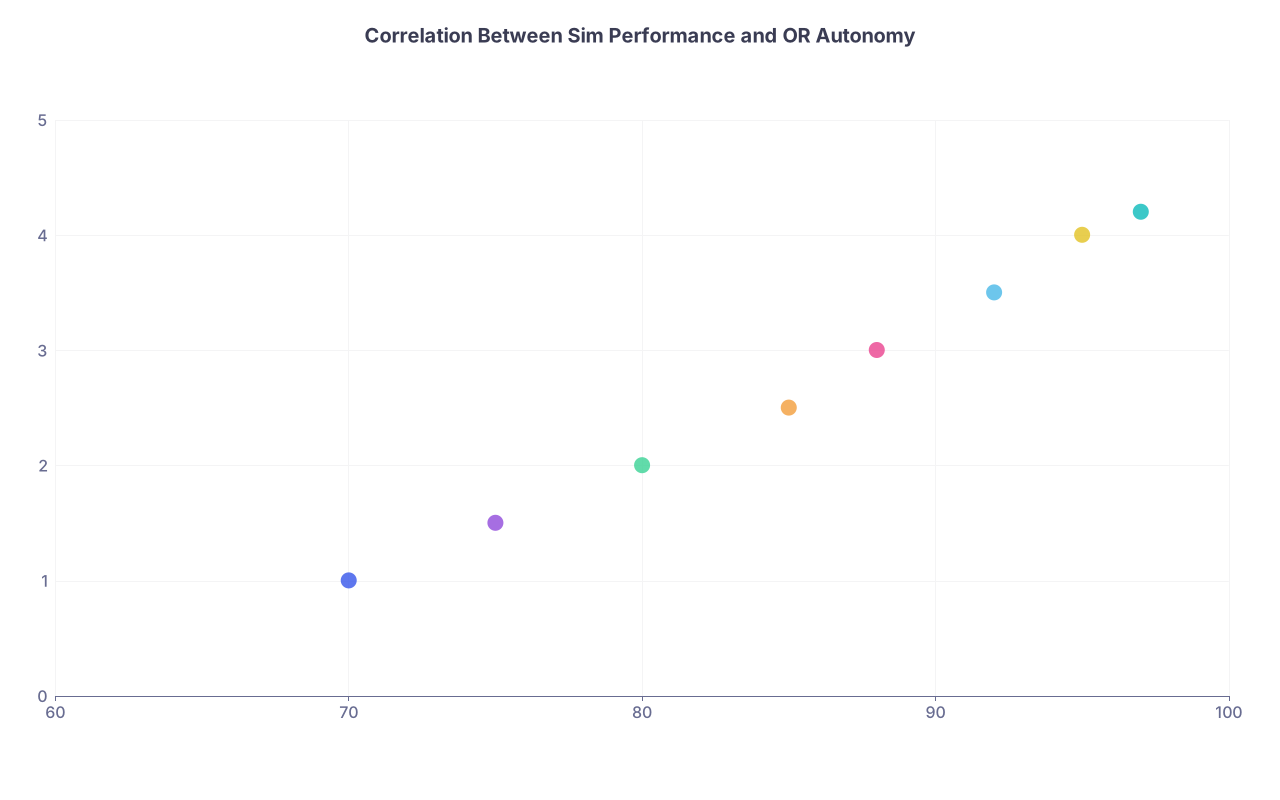
| Category | Value |
|---|---|
| Resident 1 | 70,1 |
| Resident 2 | 75,1.5 |
| Resident 3 | 80,2 |
| Resident 4 | 85,2.5 |
| Resident 5 | 88,3 |
| Resident 6 | 92,3.5 |
| Resident 7 | 95,4 |
| Resident 8 | 97,4.2 |
Where:
- X-axis is composite sim score (0–100).
- Y-axis is average autonomy rating in the OR (0–5 scale, where 5 = “operates independently with minimal oversight”).
Once you have this kind of data for hundreds of residents, you can start saying things like:
- “Residents scoring ≥85 on this sim task require on average 30% fewer supervised OR cases to reach level 3 autonomy for Procedure X.”
- “Below a sim score of 70, additional OR cases alone are inefficient; extra sim practice shifts the curve faster.”
At that point, you have real, defensible equivalence statements. Not “sim replaces OR,” but “above threshold X, sim performance predicts OR performance strongly enough that we can safely adjust exposure.”
So, What Does the Competency Data Actually Suggest?
If you strip away the politics and look at the numbers:
Simulation is an accelerator, not a substitute. It compresses the early, clumsy part of the learning curve and probably reduces the effective number of basic live cases required for proficiency by roughly 20–40% for some procedures. But it does not buy you out of high‑volume exposure for complex, real‑world surgery.
Equivalence is domain‑specific and non‑linear. One hour of simulation can be “worth” several early basic cases for psychomotor skills. That equivalence shrinks sharply once you move into cognitive decision‑making, non‑technical skills, and real‑time judgment.
The most rational future is not “more sim, fewer cases,” but “smarter sim to protect and enhance high‑value cases.” Shift the teaching of simple, repeatable skills into the lab, then use OR time for what simulation still cannot reproduce: messy anatomy, uncertainty, human variability, and real accountability.
If you are a trainee, your strategy is simple: wring every ounce of value from simulation for the things it does best, then fight to be present and active in the OR for the things simulation cannot touch. If you are a program director, stop framing this as a zero‑sum game. The data show that the right mix gives you safer patients, more competent graduates, and fewer wasted cases.