
The belief that “more cases equals better outcomes” in surgery is only half true—and the half people ignore is where patients get hurt.
The core question: volume, outcomes, and where the curve flattens
Strip away the rhetoric. The data shows three blunt facts:
- Surgeons and hospitals with very low case volumes have consistently worse complication and mortality rates.
- As volume increases, outcomes improve—up to a point.
- Beyond that point, additional volume yields diminishing returns, and sometimes risk creeps back up because of system strain.
The nuance is in the curve, not the slogan.
When you look at the hard numbers, there is no serious debate that volume correlates with outcomes in many procedures. The argument is about thresholds, slopes, and exceptions. Not whether the volume–outcome relationship exists, but how aggressively systems should use it to centralize care, credential surgeons, and steer patients.
Let’s walk through what the numbers actually say.
What the data shows: high-level patterns
Most of the foundational evidence comes from large administrative and registry datasets: Medicare claims, state discharge databases, NSQIP, STS, NSQIP-P, etc. You will see the same pattern repeated across them.
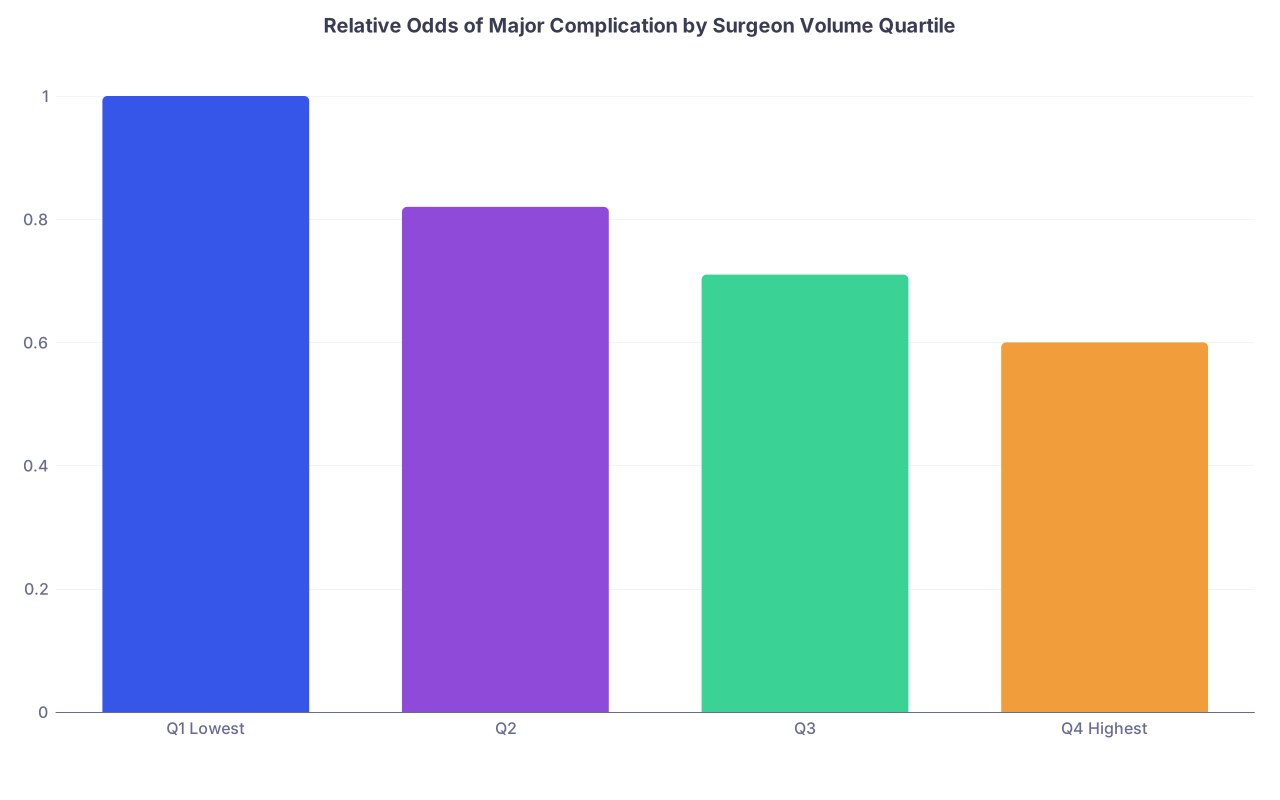
| Category | Value |
|---|---|
| Q1 Lowest | 1 |
| Q2 | 0.82 |
| Q3 | 0.71 |
| Q4 Highest | 0.6 |
Interpretation: in a typical high-risk procedure, a patient operated on by a top-quartile volume surgeon might have around 40% lower odds of a major complication than with a bottom-quartile surgeon, after risk adjustment. Exact percentages vary by procedure, but that directionality is consistent.
The volume–outcome effect is strongest in:
- High-risk, complex surgeries: esophagectomy, pancreaticoduodenectomy, complex aortic surgery, lung resections, radical cystectomy.
- Cancer surgeries with significant lymphadenectomy or reconstruction.
- Procedures with steep learning curves: bariatric surgery, laparoscopic and robotic oncologic resections.
By contrast, for straightforward, lower-risk procedures (simple cholecystectomy, basic hernia repair), the volume–outcome gradient exists but is weaker, and can nearly vanish once basic competency is reached.
To ground this, let’s look at concrete numbers rather than abstractions.
Examples from specific procedures
Pancreaticoduodenectomy (Whipple)
Everyone quotes Whipple data because the numbers are brutal.
In older but still instructive Medicare datasets, in-hospital mortality for pancreaticoduodenectomy varied roughly like this:
- Very low-volume hospitals (1–2 Whipples/year): mortality 15–20%+
- Moderate-volume hospitals (5–10/year): mortality around 8–10%
- High-volume centers (≥20/year): mortality often under 5%, some under 2–3%
Those gaps are not rounding errors. That is a 3–4× relative risk spread between the extremes.
You see similar trends for major complications, length of stay, and readmission. Each additional 5–10 cases per surgeon per year, at the lower end of the volume spectrum, is associated with meaningful percentage drops in complications.
Esophagectomy
Esophagectomy shows one of the clearest volume gradients.
Older multi-state analyses found:
- Low-volume hospitals: mortality around 15–20%
- High-volume hospitals: often 5–8%
With intermediate tiers in between. Again, a 2–3× relative difference.
Over time, absolute mortality has decreased everywhere thanks to better perioperative care, but the relative advantage of high-volume centers persists. The “gap” shrinks slightly as low-volume centers adopt better protocols, but it does not disappear.
Total joint arthroplasty (TKA/THA)
Here the pattern is more subtle.
National joint registries and NSQIP-type analyses suggest:
- Surgeons doing fewer than 12–25 primary TKAs per year have higher revision, reoperation, and complication rates.
- Past about 50–75 primary joints per year, the benefit curve flattens; more cases do not dramatically reduce complication risk.
Exact thresholds vary by study, but you can think in ballparks:
- Very low volume (<10–12/year): clearly worse.
- Low-moderate (20–40/year): decent but still slightly higher complications.
- Moderate-high (50–100+/year): marginal improvement beyond this range.
We can summarize a simplified cross-procedure picture in a table.
| Procedure Type | Very Low Volume Outcome | High Volume Outcome | Relative Risk Difference |
|---|---|---|---|
| Pancreaticoduodenectomy | 15–20% mortality | 2–5% mortality | ~3–4× |
| Esophagectomy | 15–20% mortality | 5–8% mortality | ~2–3× |
| Major lung resection | Higher pneumonia/LOS | Lower complications | ~30–40% reduction |
| Primary TKA/THA | Higher revisions/comp | Lower revisions | ~20–30% reduction |
| Bariatric surgery (RYGB/SG) | Higher leaks/bleeding | Lower leaks | ~30–50% reduction |
These are ranges, not precise current values, but the directional pattern is stable across decades.
Surgeon volume vs hospital volume: not the same thing
One of the lazier mistakes I see in both public discussion and occasionally in hospital marketing is to conflate surgeon volume with hospital volume. They are correlated but not identical—and the relative importance depends on the procedure and the system around the surgeon.
The evidence splits roughly like this:
- For technical, high-skill, steep learning curve procedures, individual surgeon volume has a strong independent effect.
- For complex, multi-step perioperative pathways (ICU heavy, complex anesthesia, specialized nursing), hospital volume exerts a powerful effect independent of the surgeon.
A fairly typical pattern in multivariable models:
- Moving from low- to high-volume surgeon might reduce odds of major complications by, say, 20–40%.
- Moving from low- to high-volume hospital might yield a similar 20–40% reduction.
- Having both high-volume surgeon and high-volume hospital is multiplicative, not redundant. Risk can be cut essentially in half compared with the worst combination.
For some procedures, hospital volume dominates. Example: complex aortic surgery with high risk of massive transfusion, prolonged ICU stays, mechanical circulatory support. Even a relatively high-volume surgeon operating in a low-volume hospital can be constrained by inexperienced ICU teams, poor protocols, and resource gaps.
Yet at the same time, high hospital volume with a low-volume individual surgeon is not reassuring. You see this in teaching hospitals where a new attending is ramping up; their early cases ride on the back of strong institutional support, but individual learning curve effects are still visible in the data.
The most honest reading of the literature: do not treat surgeon and hospital volume as interchangeable proxies. Measure both.
Learning curves, thresholds, and when “more” stops helping
The relationship between volume and outcomes is not linear. It is more like an S-curve or a steep descent that flattens.
At the low end:
- Going from 0 to 10–20 lifetime cases in a complex procedure usually yields big improvements.
- Early on, every 5–10 additional cases can significantly reduce errors, operative time, and complications.
At the moderate range:
- The curves start to flatten. Going from 50 to 100 cases still helps, but the marginal gain is smaller.
- Most high-volume surgeons plateau in technical proficiency somewhere here; further gains come more from systems and team consistency than from the surgeon’s own hands.
At the extreme high end:
- You can see a slight U-shaped risk effect in some datasets: outcomes get worse again as the system is stretched. Think of call burden, burnout, overloaded OR schedules, and case mix creeping into higher and higher risk territory.
- This effect is smaller than the low-volume penalty but it exists.
There is also a concept of “minimum annual volume” to maintain proficiency. The cutoff is procedure-specific. For example:
- Some analyses of elective abdominal aortic aneurysm repair suggested that surgeons doing fewer than about 10–15 repairs per year had worse outcomes.
- In bariatric surgery, common thresholds cited are 50+ bariatric cases per year per surgeon and 125+ per year per center to maintain accreditation-level outcomes (e.g., MBSAQIP context).
- For high-risk pancreatic resections, hospitals doing fewer than 5–10 per year are consistently associated with much worse mortality and morbidity.
No single magic number exists, but the general shape is: extremely low volume is consistently dangerous; moderate volume is acceptable; high volume is best until you hit system capacity limits.
What is signal, and what is confounding?
Any honest analysis has to deal with the elephant: correlation versus causation.
Do high-volume centers have better outcomes because they do more cases, or because they are richer, better staffed, more urban, and more selective in whom they operate on?
Some patients are “filtered”:
- Complex, comorbid individuals are more likely to be referred to tertiary centers.
- But paradoxically, some high-volume tertiary centers also push into sicker, riskier cases precisely because they can.
Risk adjustment in the literature typically includes:
- Age, comorbidities (Charlson, Elixhauser), functional status.
- Tumor stage, sometimes.
- Emergent vs elective status.
- Socioeconomic factors in more sophisticated models.
Even after aggressive risk adjustment, the volume–outcome effect generally persists. It attenuates but does not vanish. That is the key point.
Residual confounding is real. Selection bias is real. But you would need absurd levels of unmeasured bias to erase a 2–4× relative mortality difference between extremes. The more modest 10–20% relative differences at mid-level volumes could be more heavily influenced by confounders, but the basic shape of the curve—especially at the low end—is robust.
Mechanisms: why does higher volume help?
The mechanisms are not mysterious. They are the same reasons a high-volume airline route generally runs smoother than a once-a-week backwater hop.
You see:
- Shorter operative times. Fewer anesthesia-related complications, less blood loss.
- Tighter adherence to standardized pathways: ERAS protocols, VTE prophylaxis, glycemic control.
- Better anticipation and management of complications: experienced ICU nurses recognizing early sepsis, anesthesiologists who have seen dozens of similar cases, interventional radiologists on speed dial.
- More complete lymphadenectomy, better margin status in oncologic surgery, simply because the surgeon is not reinventing steps each time.
I have watched teams in high-volume centers run a Whipple like a choreographed routine. Instruments appear before the surgeon asks. Anesthesia knows exactly when the hemodynamics will shift. Then you go to a low-volume community setting where everyone is a little slower, more tentative, and small delays accumulate into prolonged operative time and complications.
Volume is not magic; it is a proxy for repetition, muscle memory, and stable systems.
The hidden problem: overgeneralizing the rule
Now the harsh part. People take “higher volume is better” and weaponize it indiscriminately.
Three common mistakes:
Assuming volume matters equally for all procedures
It does not. The relative benefit for laparoscopic appendectomy is not the same as for esophagectomy. Pushing centralized care for low-risk procedures can generate access issues and travel burdens with marginal safety gains.Ignoring distribution and equity
Volume-based regionalization tends to favor urban academic centers. In some regions, that means rural patients face several hours of travel for complex surgery. The mortality drop from moving to a high-volume site has to be balanced against delays in care, logistical barriers, and postoperative follow-up challenges.Using crude thresholds as blunt policy tools
Hospital “must perform at least 15 of X procedure per year” sounds appealing. In practice, thresholds get gamed, cases are reclassified, and borderline centers hover just above cutoffs without real performance improvement. Outcomes are what matter, not checkbox volumes.
The right way to use volume is as a strong, early filter. It signals risk. It is not the only variable you should care about.
Future directions: beyond raw case counts
The phase you specified—“Miscellaneous and Future of Medicine”—is where things actually get interesting.
We are already moving toward more sophisticated metrics:
- Risk-adjusted complication and mortality rates at surgeon and hospital level.
- Composite scores that integrate volume, outcomes, readmissions, and patient-reported outcomes.
- Procedure-specific learning curve modeling that uses cumulative sum (CUSUM) methods to detect when a surgeon has reached acceptable performance, not just arbitrary numbers.
Expect this to accelerate as registries get richer and EHR data becomes more structured.
We can also do better matching of patients to surgeons/centers:
- For a very low-risk patient undergoing a routine procedure, the marginal benefit of traveling to a high-volume tertiary center is small. Local is often fine.
- For a frail 78-year-old with a pancreatic head adenocarcinoma, sending them to a low-volume hospital for a Whipple bordered on negligent even 15 years ago. Now, with risk models in hand, you can quantify that difference.
Machine learning on massive surgical datasets will not magically erase the volume–outcome relationship; it will refine it, personalize it, and in some cases identify low-volume surgeons or centers performing unexpectedly well and high-volume ones underperforming their peers.
One more likely trend: credentialing based on performance, not just volume. For example:
- “Your last 50 cases of X procedure have a risk-adjusted mortality above the 95th percentile of national benchmarks; your privileges for this procedure will be reviewed.”
- or “You have acceptable outcomes but are below expected volume; we require either supervised proctorship or simulation work before renewal.”
Volume as the gatekeeper, outcomes as the arbitrator.
How to use this as a patient, surgeon, or administrator
From a data perspective, some principles are clear:
- For high-risk, complex surgeries, surgeon and hospital volume matter a lot. You want both high-volume if you can get it.
- For intermediate-risk procedures, avoid the extreme low-volume tail. You do not want to be one of three cases per year.
- For low-risk, routine operations, volume still matters, but basic credentialing and outcomes monitoring can cover most of the safety gap.
And from the systems side:
- Regionalizing truly complex, rare surgeries is defensible. Esophagectomy, Whipple, complex aortic work, and certain sarcoma resections arguably have no business in ultra-low-volume centers.
- Volume targets without transparent, risk-adjusted outcome reporting are half measures. A 30-case/year surgeon with mediocre outcomes is not automatically safer than a 15-case/year surgeon with excellent metrics.
- Training programs must confront the math. If a resident only sees 2–3 complex cases of a given type in an entire residency, and then graduates into a setting where they will be the only one doing them, the data suggests trouble.
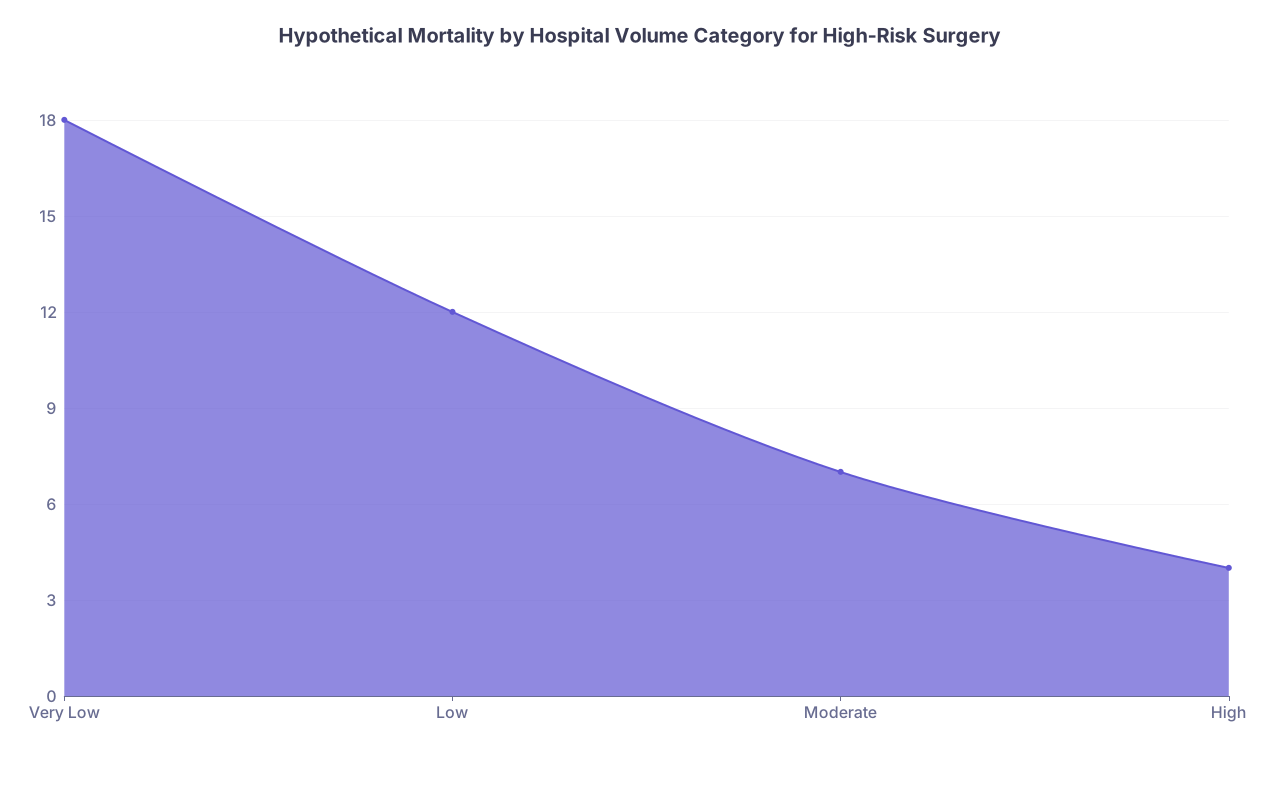
| Category | Value |
|---|---|
| Very Low | 18 |
| Low | 12 |
| Moderate | 7 |
| High | 4 |
Even if the exact numbers vary, the shape of that area chart is the story: steep drop from very low to moderate volume, then tapering.
To tie process and timelines together, imagine the future referral flow for a high-risk procedure:

| Step | Description |
|---|---|
| Step 1 | Primary Clinician |
| Step 2 | Manage Locally |
| Step 3 | Refer to High Volume Center |
| Step 4 | High Risk Procedure |
| Step 5 | Local Volume Adequate |
| Step 6 | Local Outcomes Acceptable |
This is where the field is going: not “high volume always” but “volume plus outcomes plus patient context.”
The bottom line
Strip away the noise and three points remain:
- For many complex surgeries, higher surgeon and hospital volume strongly predicts fewer complications and lower mortality, especially when escaping the very low-volume tail.
- The benefit of volume is not linear and not universal. It is procedure-specific, flattens with experience, and can be undercut by poor systems or overextension at the extreme high end.
- The future is not worshipping raw case counts but combining volume with risk-adjusted outcomes to direct the right patients to the right surgeons in the right hospitals—using data, not slogans, to decide who should cut.