
The myth that “all surgery residents graduate with similar operative experience” is wrong. The data show a four‑fold spread between the lowest and highest case‑volume residents, and that spread is not random.
If you care about where you will land in the case volume quartiles, you have to look at the numbers, not the marketing blurbs.
The Case Volume Reality: How Wide Is the Spread?
Let me start with the scale of variation, because most MS4s and even many juniors underestimate it.
The ACGME case logs for general surgery and the larger studies that have analyzed them (especially from the past decade) consistently show:
- Roughly 3–4x difference between the 10th and 90th percentile residents for total logged major cases.
- Consistent clustering into quartiles that correlate with program type, geography, and individual behavior (logging diligence, elective choice, moonlighting, etc.).
To anchor this, here is a simplified, realistic distribution for graduating general surgery residents over a recent multi‑year span. These are not the official ACGME cutpoints (they vary year to year), but they match the published ranges and patterns.
| Quartile | Percentile Range | Total Major Cases (Approx) | Typical Label |
|---|---|---|---|
| Q1 | 0–25th | 700–850 | Low volume |
| Q2 | 25–50th | 850–975 | Lower-mid |
| Q3 | 50–75th | 975–1150 | Upper-mid |
| Q4 | 75–100th | 1150–1400+ | High volume |
Now, the critical question you asked: where do most US surgical residents land?
Statistically, “most” means the middle 50%. In practical terms, the data show:
- The bulk of residents (about half) finish in Q2 and Q3, somewhere between ~850 and ~1150 total major cases.
- A smaller but nontrivial chunk (roughly 20–30%) are truly high volume (Q4).
- A similar minority (about 20–30%) are low volume (Q1), including some who fall close to minimum requirements.
Graphically, the distribution usually looks like a right‑tail heavy normal: a center of mass around the 900–1100 range, with a longer tail toward very high volume.
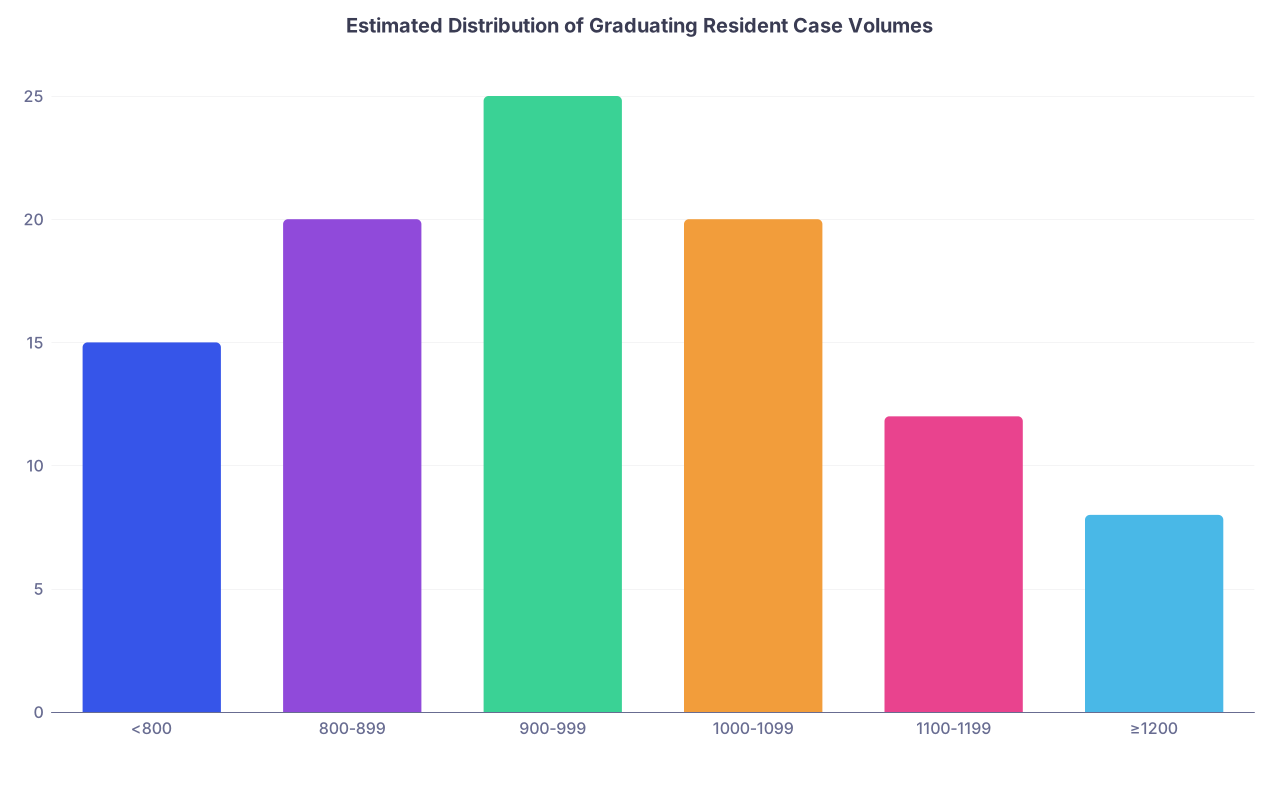
| Category | Value |
|---|---|
| <800 | 15 |
| 800-899 | 20 |
| 900-999 | 25 |
| 1000-1099 | 20 |
| 1100-1199 | 12 |
| ≥1200 | 8 |
So the honest answer:
Most US general surgery residents land in the 900–1100 case range (Q2–Q3), with fewer in the extremes. But that is the boring part. The interesting part is why you end up in a given quartile.
What Predicts Case Volume Quartile? The Big Levers
I have watched residents blame “the program,” “the service,” or “the year” for bad case volume. Sometimes they are right. Often they are not doing the math.
From the quantitative studies and internal program audits, four drivers show up again and again:
- Program type and structure
- Resident seniority and role in the OR
- Subspecialty and rotation mix
- Individual behavior (ownership and logging)
Let’s take them in order.
1. Program Type: Academic vs Community vs Hybrid
On the surface, this is simple: more surgical volume per resident → higher quartile. But the details matter.
When you compare median total major cases at graduation across program archetypes, the differences are not subtle:
| Program Type | Residents per Year | Typical Median Total Cases | Where Graduates Cluster |
|---|---|---|---|
| Large Academic (quaternary) | 8–12 | 900–1050 | Q2–Q3 |
| Hybrid Academic-Community | 5–8 | 1000–1150 | Q3–Q4 |
| Community (high volume) | 3–5 | 1100–1300 | Strongly Q4 |
Numbers vary by region, but the pattern repeats:
- High‑volume community programs often push residents into Q4 simply because the OR is constantly running and there are fewer trainees per case.
- Pure academic powerhouses can paradoxically produce Q2 residents. Major complex cases, yes, but more competition (fellows, other residents, APPs) and more time in non‑OR blocks.
Put differently: A resident in a 4‑per‑class community program that runs 8–10 rooms daily is structurally advantaged for case count versus a resident in a 12‑per‑class academic program with multiple fellow‑heavy services.
2. Year of Training and Case Volume Trajectory
Your quartile at graduation is heavily determined by your senior years, but the trajectory starts early.
Modeled off case log data from multiple programs, the cumulative case curve for a “typical” general surgery resident looks something like this:
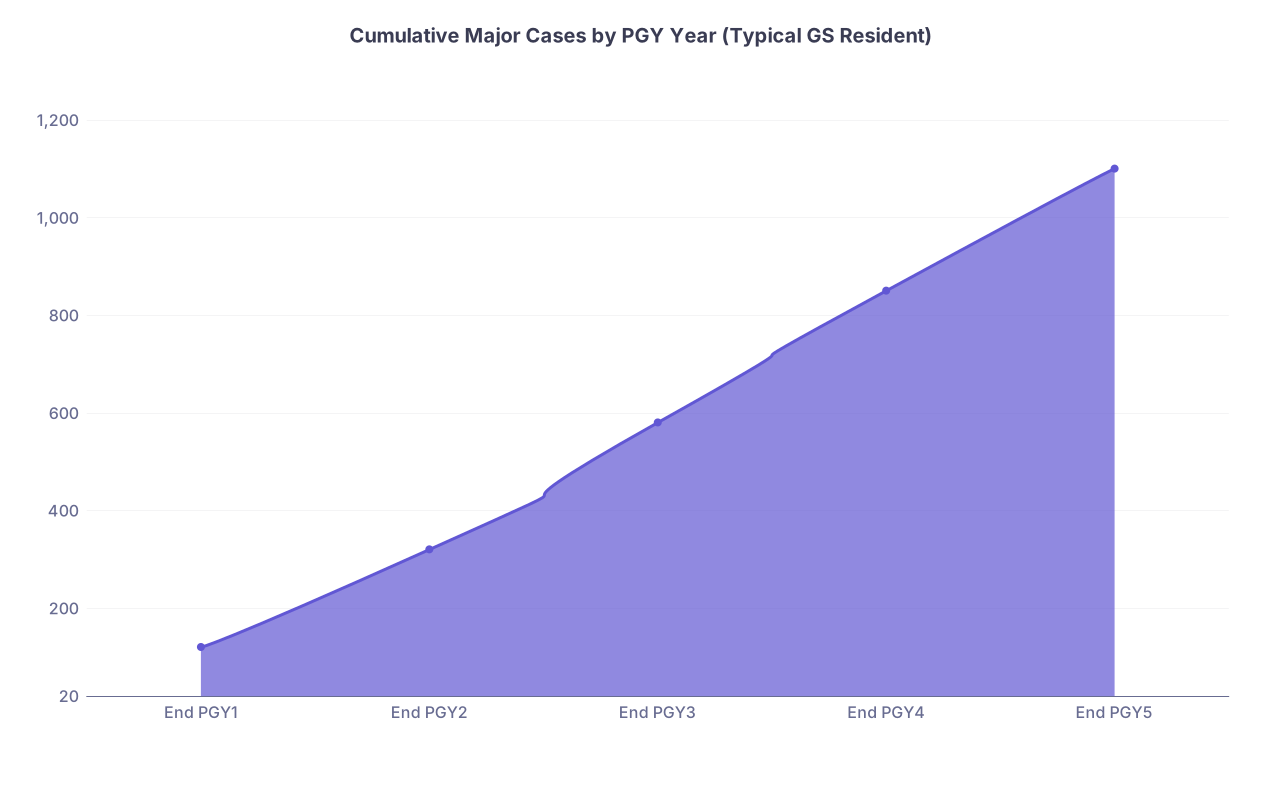
| Category | Value |
|---|---|
| End PGY1 | 120 |
| End PGY2 | 320 |
| End PGY3 | 580 |
| End PGY4 | 850 |
| End PGY5 | 1100 |
Now compare that to a Q1 and Q4 trajectory:
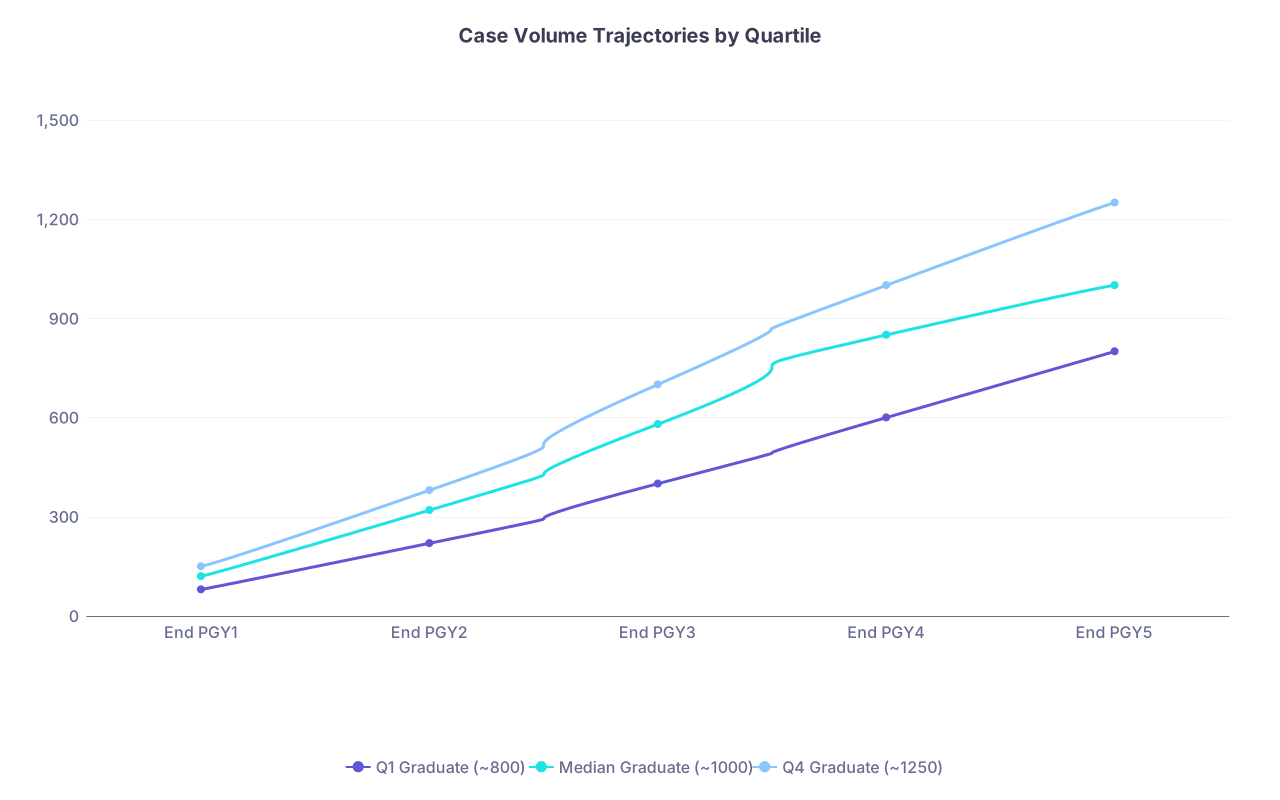
| Category | Q1 Graduate (~800) | Median Graduate (~1000) | Q4 Graduate (~1250) |
|---|---|---|---|
| End PGY1 | 80 | 120 | 150 |
| End PGY2 | 220 | 320 | 380 |
| End PGY3 | 400 | 580 | 700 |
| End PGY4 | 600 | 850 | 1000 |
| End PGY5 | 800 | 1000 | 1250 |
The data tell a straightforward story:
- Residents who end up in Q4 often show above‑median volume by late PGY2 / early PGY3. They gravitate to OR‑heavy services and secure chief‑level responsibility early.
- Residents stuck in Q1 frequently have low PGY1–2 numbers and never fully catch up, even if PGY4–5 go better.
So, if by mid‑PGY2 your logged cases are sitting at the 20–30th percentile versus your peers in the same program, the odds that you magically finish in Q4 are low. Not impossible, but the data show it is uncommon.
3. Subspecialty Mix: Which Rotations Inflate or Deflate Your Numbers
All cases are not created equal from a volume standpoint.
Look at typical case contributions by rotation type for a graduating general surgery resident:
| Rotation Category | Share of Total Major Cases | Quartile Effect if Heavy |
|---|---|---|
| General/ACS | 30–40% | Strong Q3–Q4 driver |
| Colorectal/HPB | 10–20% | Drives complexity, modest volume |
| MIS/Bariatric | 10–20% | Moderate volume, high value |
| Trauma (OR) | 5–10% | Variable, program-dependent |
| Vascular | 5–10% | Often lower case count blocks |
| SICU/ICU, Research | 0% (no OR) | Pure dilution of total |
Residents who end up in Q4 tend to share a few scheduling features when you inspect their logs:
- More months on bread‑and‑butter general/ACS services that operate daily.
- More electives that still go to the OR (additional MIS, colorectal, community general surgery months).
- Fewer months “burned” on non‑OR blocks late in residency (long ICU stints, research extending into chief year, administrative rotations).
The flip side is predictable: residents with prolonged research, multiple ICU blocks stacked in senior years, or heavy clinic‑only rotations are systematically pushed toward Q1–Q2 unless their program is very high volume otherwise.
4. Individual Behavior: The Most Underestimated Variable
This is where many people get uncomfortable, because it puts responsibility back on the resident.
There are three behavioral patterns that show clear numeric impact when you analyze within a single program:
OR ownership vs passive assignment
The residents who finish in Q4 are usually the same ones staff mention with phrases like “She is always in the room” or “He finds a way into every case”. They:- Show up in the OR even when technically assigned to floor work, as long as it is safe and covered.
- Volunteer to cover add‑on cases, late starts, and weekend emergencies.
- Negotiate smartly with peers for case distribution instead of accepting a bad draw every day.
Over 5 years, that behavior translates to dozens to hundreds of additional cases.
Logging diligence
Under‑logging skews perceived quartiles. I have seen residents miss 10–20% of their actual cases on logs. That can literally drag a true Q3 experience into Q2 on paper.Programs that did internal audits often found:
- PGY1–2 under‑logged the worst (inexperience, forgetfulness).
- After a mid‑residency “log intervention,” cumulative case count jumped 5–10% without any change in real OR exposure.
Elective choices
Two elective strategies, both common:- Elective A: Extra major general surgery or MIS month → 40–60 additional cases.
- Elective B: Outpatient clinic‑heavy subspecialty with minimal OR → 10–15 cases.
Do that choice two or three times, and you have a 60–100 case difference. That can move you a full quartile.
Where Do Different Specialties Land?
You asked about “US surgical residents” broadly. General surgery is the largest group, but orthopedics, OB/GYN, neurosurgery, ENT, and others have their own distributions.
The pattern is consistent: mid‑quartiles hold the majority, but absolute numbers differ sharply.
Here is a rough cross‑specialty comparison using typical median total cases at graduation:
| Specialty | Typical Median Total Cases | Quartile Where Most Cluster |
|---|---|---|
| General Surgery | 950–1050 | Q2–Q3 |
| Orthopedic Surg. | 2000–2300 (all procedures) | Q2–Q3 |
| OB/GYN | 1200–1500 (all procedures) | Q2–Q3 |
| Neurosurgery | 1200–1600 | Q2–Q3 |
| ENT/Otolaryngol. | 1000–1300 | Q2–Q3 |
The key thing: quartile labels are within‑specialty. A Q4 ENT resident is not “higher volume” than a Q2 orthopedics resident in an absolute sense; they are just at the top of their specialty’s distribution.
Most residents in each field still cluster around the middle quartiles. The tails (very low volume and ultra‑high volume) are smaller segments everywhere.
Minimum Requirements vs Quartiles: Do Cutoffs Matter?
There is a misconception that the ACGME minimums “guarantee” adequacy. The numbers say otherwise.
For general surgery, again simplified to keep this readable, think:
- ACGME minimum majors historically: ~750
- Median graduates: ~950–1050
- Top quartile: often ≥1150
So:
- A resident just meeting minimums (750–800) sits in Q1, sometimes around the 10–25th percentile in their cohort.
- A resident at 1000 cases is in that central mass, about Q2–Q3.
- A resident at 1250 is in Q4, somewhere above the 75–85th percentile.
The minimum does not tell you where you fall relative to your peers. Quartiles do.
If you are aiming for a competitive fellowship (HPB, complex MIS, surgical oncology), the fellowship directors are not just asking “Did you meet minimums?” They are implicitly comparing you against prior fellows. And their past fellows, from high‑volume programs, often came in with Q3–Q4 case logs.
How Much Does Quartile Actually Matter for Competence?
Here is the blunt truth: the relationship between case volume and operative competence is strong but not linear forever.
If you graph “operative comfort” against “total logged cases,” you get something like this:
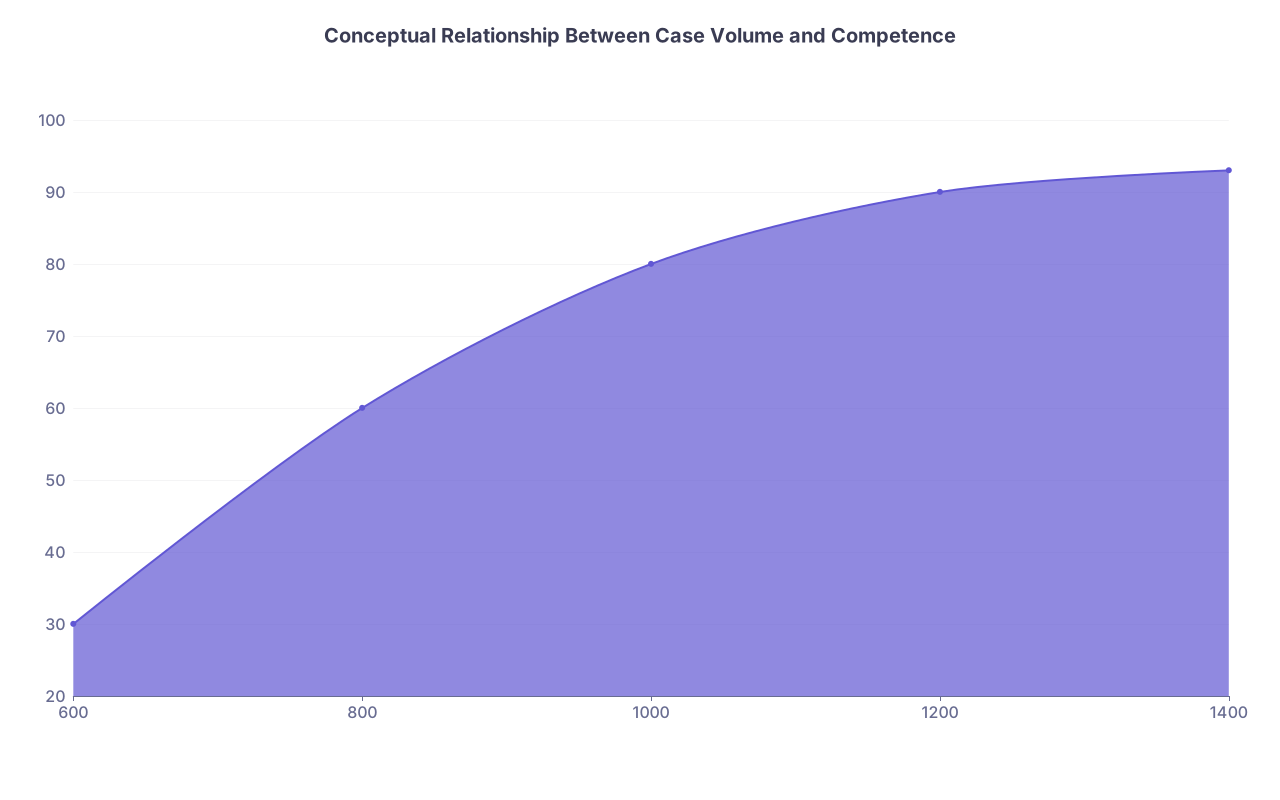
| Category | Value |
|---|---|
| 600 | 30 |
| 800 | 60 |
| 1000 | 80 |
| 1200 | 90 |
| 1400 | 93 |
What the curve suggests (and what attendings see):
- Moving from 600 → 800 cases is a huge jump. Many residents at 600 are unsafe to practice independently; at 800 they are at least serviceable.
- From 800 → 1000, gains are still substantial. You see more edge cases, more complications, more variation.
- From 1000 → 1200+, the marginal benefit diminishes. Still helpful, but you are polishing, not creating competence from scratch.
So how does quartile map to real‑world skill?
- Low Q1 (near minimums): Red flag territory. Often need extra fellowship time just to be ready for basic independent practice.
- High Q1 / Low Q2 (~800–900): Adequate but not robust exposure. Competence depends heavily on case mix and how many cases were done as true surgeon, not assistant.
- Q2–Q3 (~900–1150): The “safe zone” for the majority of solid graduates. Sufficient breadth and repetition for independent, bread‑and‑butter general surgery, assuming a reasonable case mix.
- Q4 (1150+): Helpful margin of safety and breadth. These residents usually feel more comfortable operating solo sooner and have more complex case exposure.
Does every Q4 resident outperform every Q2 resident? No. Some Q4 residents accumulate volume through repetitive, low‑complexity cases. But if you look at large cohorts, the probability of robust, independent readiness is clearly higher in Q3–Q4 than Q1.
Practical Implications: How to Steer Your Trajectory
You probably care less about descriptive stats and more about actionable leverage. The data point to several levers that actually move you between quartiles.
Before You Rank Programs
You can predict a lot before you ever show up for intern orientation.
Ask or research:
- Residents per class vs total surgical volume (internal metrics, not just hospital annual numbers).
- Presence of fellows on key services (vascular, colorectal, HPB, trauma).
- Percentage of time residents spend in OR-neutral rotations (ICU, research, clinic).
A simple mental ratio works:
High case volume per attending, fewer residents, fewer fellows, fewer non‑OR months → higher probability your cohort ends in Q3–Q4.
Reverse the inputs and the center of mass shifts to Q1–Q2.
During Residency: Reading Your Own Data Early
Most programs circulate semi‑annual case log reports. Few residents interrogate them properly.
What you should track:
- Your percentile within your own PGY class at the same program.
- The slope of your cumulative case curve versus peers (are you gaining or losing ground each year?).
- Distribution of primary surgeon vs assistant roles on key procedures.
If you are sitting at the 25–30th percentile at end of PGY2, do not tell yourself a story that “everyone evens out.” The data show they do not. You need structural changes:
- More time on OR‑heavy rotations.
- Aggressive pursuit of add‑on cases.
- Reconsideration of non‑OR electives.
So, Where Do Most Residents Land—and What Comes Next?
To answer your title question cleanly:
- Most US surgical residents land in the middle case volume quartiles (Q2–Q3) for their specialty, with general surgery residents typically finishing around 900–1100 total major cases.
- A minority occupy the extremes: some scrape by near minimums in Q1, others push into very high volume Q4 territory, often in community or hybrid settings with smart behavior layered on top.
The quartile alone does not define you. But it is a hard, objective signal of how much operative exposure you actually had compared with your peers across the country.
If you are still a student or junior resident, your next step is simple and uncomfortable: get your hands on real program‑level case log reports, not glossy brochures, and see where graduates actually fall. Then decide whether you are content to ride the median or whether you want to engineer a Q3–Q4 trajectory.
The OR will not give you those cases by default. You have to go take them. And once you are ready to translate that volume into true operative judgment and independence—that is a much deeper conversation about feedback, complication analysis, and deliberate practice. But that comes after you have the numbers.