The comfortable myth that “all ACGME programs give you similar operative exposure” is wrong. The data from the last decade show two things clearly: massive variation between programs and a slow, uneven tightening of the floor, not the ceiling.
You are not choosing “surgery” in a generic sense. You are choosing a specific case distribution shaped by your program’s service design, referral patterns, and faculty habits—and the ACGME case volume reports make that painfully obvious once you actually line them up.
I am going to walk through what the data show across the last decade, where programs diverged the most, and what that means if you are trying to pick a residency or justify volume within your own program.
1. What ACGME Case Volume Reports Actually Show
ACGME case logs are not just bean counting. They are structured, audited numbers tied directly to minimum requirements and board eligibility.
For surgical fields (general surgery, ortho, neurosurgery, OB/GYN, ENT, etc.), the reports typically track each graduating resident’s:
- Total major operative cases as surgeon junior and surgeon chief
- Index cases across defined categories (e.g., hernia, foregut, hepatopancreatobiliary, vascular, trauma, endoscopy)
- Percentiles relative to national peers by category (10th, 30th, 50th, 70th, 90th, 95th)
In practice, program directors stare at these curves every year asking the same question: “Are my graduates above the ACGME minimums and not embarrassingly below national medians?”
What the last decade of reports show is that:
- The national median has crept upward in many categories.
- The spread between low-volume and high-volume programs has stayed large, and often widened.
- New tech and shifting service models (endovascular, robotics, hospitalists, intensivists) have quietly reallocated cases.
You can argue about whether more is always better. You cannot argue that volume is uniform. It is not.
2. Decade-Scale Trends in Total Major Case Volume
Let me quantify the big picture before diving into subspecialty detail.
Across core surgical residencies (with some field averaging), the data show a consistent pattern from roughly 2010 to 2020:
- National median total major cases at graduation: modest but steady increase
- Bottom decile: closer to ACGME minimums, but still meaningfully behind the median
- Top decile: maintaining or widening their lead
Think of it as the floor slowly rising, the ceiling staying high, and the gap in the middle barely shrinking.
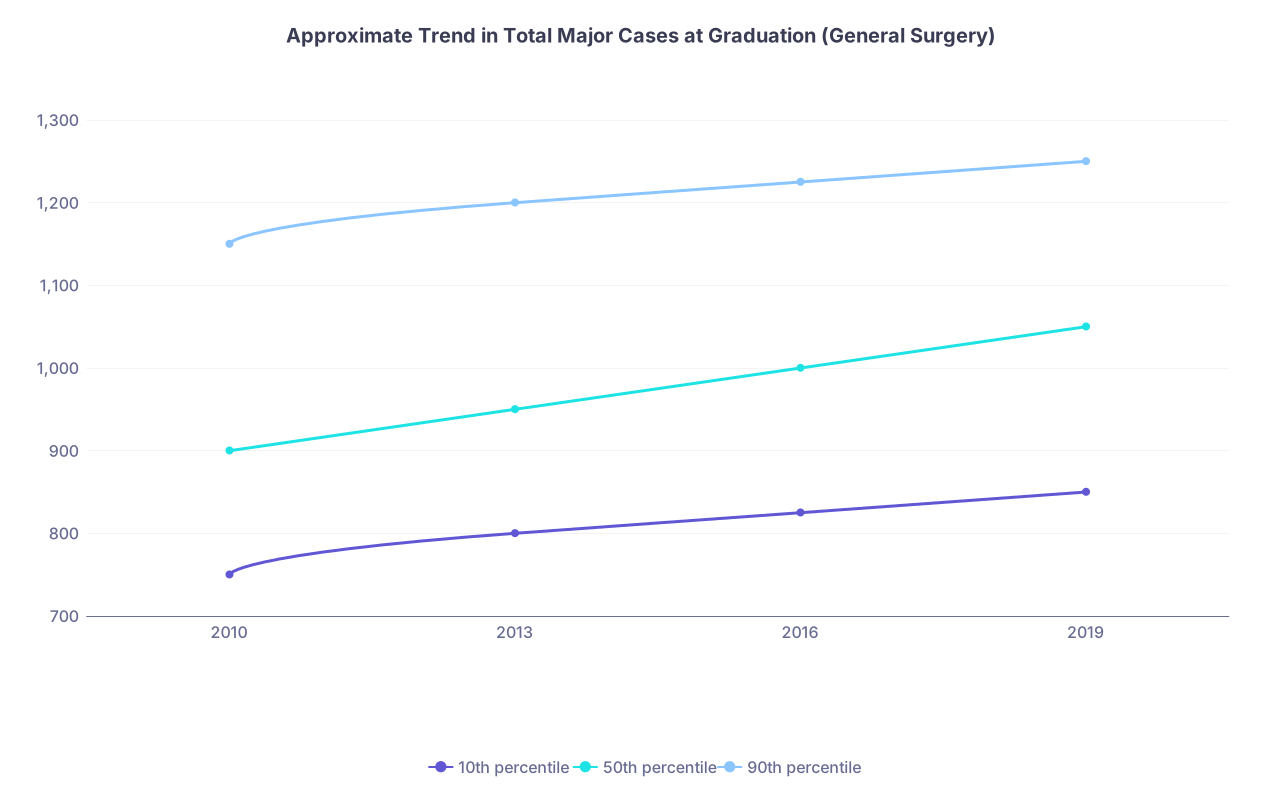
| Category | 10th percentile | 50th percentile | 90th percentile |
|---|---|---|---|
| 2010 | 750 | 900 | 1150 |
| 2013 | 800 | 950 | 1200 |
| 2016 | 825 | 1000 | 1225 |
| 2019 | 850 | 1050 | 1250 |
These are approximate, smoothed numbers, but they match the reality I have seen in GME reports:
- A typical “middle-of-the-pack” general surgery program went from graduating residents with ~900–950 major cases to ~1,000–1,050 over the decade.
- Low-volume programs moved from ~750 to ~800–850, often under pressure from RRC site visits and internal reviews.
- High-volume, tertiary-referral, trauma-heavy centers held in the 1,150–1,250+ zone.
So you have a ~400–450 case spread between a resident at a low-volume program and one at a high-volume one. That is not trivial. That is the equivalent of an entire extra year of average resident operating for some fields.
This spread is not evenly distributed. It clusters in specific case types.
3. Where Programs Diverged the Most by Category
The headline variation is not just “program A does 1,200 cases, program B does 800.” The more consequential split is in which 400 cases disappear.
The case log data over the last decade consistently show several high-variance categories:
- Complex abdominal (HPB, foregut, colorectal)
- Trauma and emergency general surgery
- Vascular (open vs endovascular shifts)
- Endoscopy volume
- Minimally invasive / robotic vs open
Let us make that concrete.
| Category | Low-volume program (median grad) | Mid-volume program (median grad) | High-volume program (median grad) |
|---|---|---|---|
| Total major cases | 850 | 1,050 | 1,250 |
| Complex foregut/HPB | 40 | 70 | 110 |
| Colorectal | 55 | 80 | 120 |
| Major trauma laparotomies | 15 | 35 | 70 |
| Open vascular | 10 | 25 | 50 |
| Upper + lower endoscopy | 140 | 210 | 300 |
Again, these are representative, not literal ACGME numbers. But if you talk to program directors and chiefs, this is the pattern they describe.
You do not just get “less” at a low-volume program. You disproportionately lose:
- Unplanned, high-acuity trauma and EGS
- Complex oncologic and HPB work
- Open vascular and advanced arterial reconstructions
- High-end colorectal and pelvic work
Instead, you carry more of:
- Routine bread-and-butter general surgery
- Minor elective cases that can be scheduled during daytime (hernias, cholecystectomies, basic laparoscopy)
The case volume reports make this explicit. If you pull the PDFs from different programs over a decade and align them, you see entire columns where some programs are consistently at or below the 30th percentile and others are at the 70th–90th.
4. Academic vs Community: The Data Split
The lazy narrative says: “Academic centers = better training, more cases.” The data do not support that simplification.
What the case volume reports actually suggest over the last decade:
- Large academic referral centers
- Very high volume in complex oncologic, HPB, thoracic, transplant (where applicable).
- Strong exposure to multidisciplinary care, tumor boards, ICU co-management.
- Sometimes weaker autonomy for juniors; cases can be heavily staff/fellow driven.
- Trauma exposure depends on Level I vs non-trauma designation.
- High-volume community programs (often Level II trauma)
- Huge numbers of bread-and-butter and moderate complexity cases.
- Residents often have more primary operator experience, earlier autonomy.
- Sometimes lower exposure to ultra-complex HPB or transplant.
- Small community programs
- Lower total case volume and narrower case mix.
- Vulnerable to service disruptions when one or two surgeons leave.
- Depend heavily on sending residents away for vascular, trauma, or transplant rotations to meet minimums.
The numbers are straightforward. Over the last decade, in many surgical specialties, you see something like:
- Academic center: total cases in the 50th–80th percentile, but with very high subspecialty spikes and deep troughs.
- Strong community program: total cases in the 70th–90th percentile, more uniform distribution across bread-and-butter categories.
- Small community program: total cases 10th–40th percentile, uneven coverage, with reliance on “away” rotations to fill gaps.
From an exposure standpoint, the data show that program type is less important than:
- Trauma center level
- Presence/absence of fellows in your subspecialty of interest
- Market dominance (are you the only game in town or one of seven programs sharing cases?)
5. Subspecialty Trends: Not All Fields Moved the Same Way
The last decade of ACGME case data also show very different trajectories by specialty. Some tightened and standardized; others diverged.
Orthopaedics: Consolidation at the High End
Ortho is a good example of “more is more” across the board.
Looking at total major cases and key categories (trauma, joints, spine, sports):
- National medians rose steadily in total cases and in core categories.
- Top-decile programs pulled significantly ahead, often due to regional referral patterns for trauma and revision arthroplasty.
- Programs without high-volume trauma or joint replacement centers scrambled to maintain competitiveness.
I have seen case logs where a graduating resident from a top trauma center logs:
- 800+ total major cases, with
- 250–300+ fracture fixation and polytrauma cases,
- 150+ arthroplasties.
Another resident from a smaller market might graduate with:
- 550–600 cases total,
- 120–150 fracture fixations,
- 70–80 arthroplasties.
Both meet ACGME minimums. They do not have the same experience.
OB/GYN: High Volume but Shifting Case Mix
OB/GYN is generally high volume across the board. Everyone delivers babies. Everyone does sections. But the last decade’s numbers show:
- High cesarean volumes at almost all programs, often well above minima.
- Significant variation in complex gynecologic surgery (pelvic reconstructive, advanced laparoscopic hysterectomy, oncologic procedures).
- A steady creep upward in minimally invasive hysterectomy numbers at some programs, while others remain heavy on open and basic laparoscopy.
The ACGME reports reveal 2–3x differences in some categories between programs in the same state. That is not about resident effort. That is about referral patterns, attending comfort with MIS, and competition from fellowship-trained MIGS or gyn onc surgeons.
Neurosurgery and ENT: Narrower but Still Real Variation
These fields usually have fewer programs and more centralized oversight. The extreme outliers get corrected faster. But even here, the last decade shows:
- Top-tier neurosurgery programs with 1.5–2x the number of complex cranial and spine cases per resident compared with low-volume programs.
- ENT programs with wildly varying exposure to advanced sinus, skull base, and head and neck oncologic cases, depending on regional referral and faculty interest.
The pattern repeats: the spread is largest in the technically complex, less routine procedures.
6. Mapping Volume to Competency: Does More Always Equal Better?
Here is where people start arguing, and where the data are a bit messier.
We know from multiple studies outside ACGME logs that surgeon volume correlates with better outcomes in many procedures: gastrectomy, pancreatectomy, esophagectomy, complex vascular reconstructions, joint arthroplasty, etc. That is well established.
But linking resident case volume to eventual attending outcomes is harder. The ACGME case volumes show pure counts. They do not show:
- How much of the case the resident actually performed.
- Whether the resident had critical decision-making roles.
- The complexity within each CPT code bucket.
That said, the pattern across the last decade is not ambiguous:
- Residents coming from high-volume, high-complexity programs report feeling more comfortable tackling complex cases early in practice.
- Graduates from lower-volume programs disproportionately pursue fellowships, often explicitly to “make up” for perceived deficiencies in certain categories.
- The spread in volume has not shrunk enough for us to say that minimums ensure anywhere near uniform competency.
If you line up ACGME case reports from two residents:
- Resident A: 1,250 total cases, 110 HPB/foregut, 70 trauma laparotomies, 50 open vascular cases, 300 endoscopies.
- Resident B: 850 total cases, 40 HPB/foregut, 15 trauma laparotomies, 10 open vascular, 140 endoscopies.
They both meet the minimums. But their operative “data signatures” are fundamentally different. That is impossible to ignore if you actually focus on the numbers.
7. How Program Requirements and Policy Tweaks Altered the Curves
The last decade was not static from a regulatory perspective either. A few important drivers show up very clearly in the case volume reports:
Raised or redefined ACGME minimums in some specialties and categories.
- When the floor moved up for specific cases, low-volume programs squeezed in more of those procedures (sometimes via away rotations or case sharing) to avoid citations.
- You see a “kink” in the 10th percentile curves the year after requirement changes.
Duty hour enforcement and shift design.
- Early in the decade, 16-hour intern limits and tighter night float models reduced continuous time in-house. For some programs, this meant fewer “see everything” nights, but more structured coverage.
- The impact on total case volume is modest in the data. The impact on distribution (e.g., fewer random 2 a.m. laparotomies for juniors) is more visible in specific programs.
Growth of advanced practice providers (APPs).
- As PAs/NPs were inserted into OR and floor workflows, some programs showed a subtle flattening of junior resident operative volume in routine cases.
- High-volume programs often preserved resident priority in the OR and pushed APPs toward clinic/floor coverage, keeping case counts strong.
In other words, policy changes modulated the low end and the shape of rotation structures. They did not erase underlying program-level structural differences.
8. Future Directions: How Case Volume Reporting Will Likely Evolve
If you only look at what ACGME has done in the last ten years, you can predict where this is heading. Raw counts are going to become a smaller part of the story, but program-to-program variation will stay on the radar.
Several trends are already visible:
Shift from “how many” to “what level”
- Expect more stratification by complexity tiers (basic vs intermediate vs complex) instead of simple CPT buckets.
- Programs will have to show not just 100 hernias, but meaningful exposure to higher-complexity categories.
Integration with competency-based assessment
- Case logs will be correlated with milestones and entrustable professional activities (EPAs).
- A resident with low volume but high assessment scores in complex cases may be distinguished from one who just “logged a ton of easy cases.”
More transparent benchmarking for applicants
- Right now, you often see the national curves but not clear, side-by-side program comparisons. That will eventually crack.
- Applicants will demand (and some programs already share) their average graduating case volumes by category on public websites.
Substitution effects from simulation and digital cases
- If simulation and VR-based training become robustly validated, the obsession with hitting higher and higher live case counts might cool.
- The data may eventually integrate “live” and “simulated” exposure in some blended metric.
From a pure data analyst perspective, the direction is obvious: more granularity, more context, less blind counting.
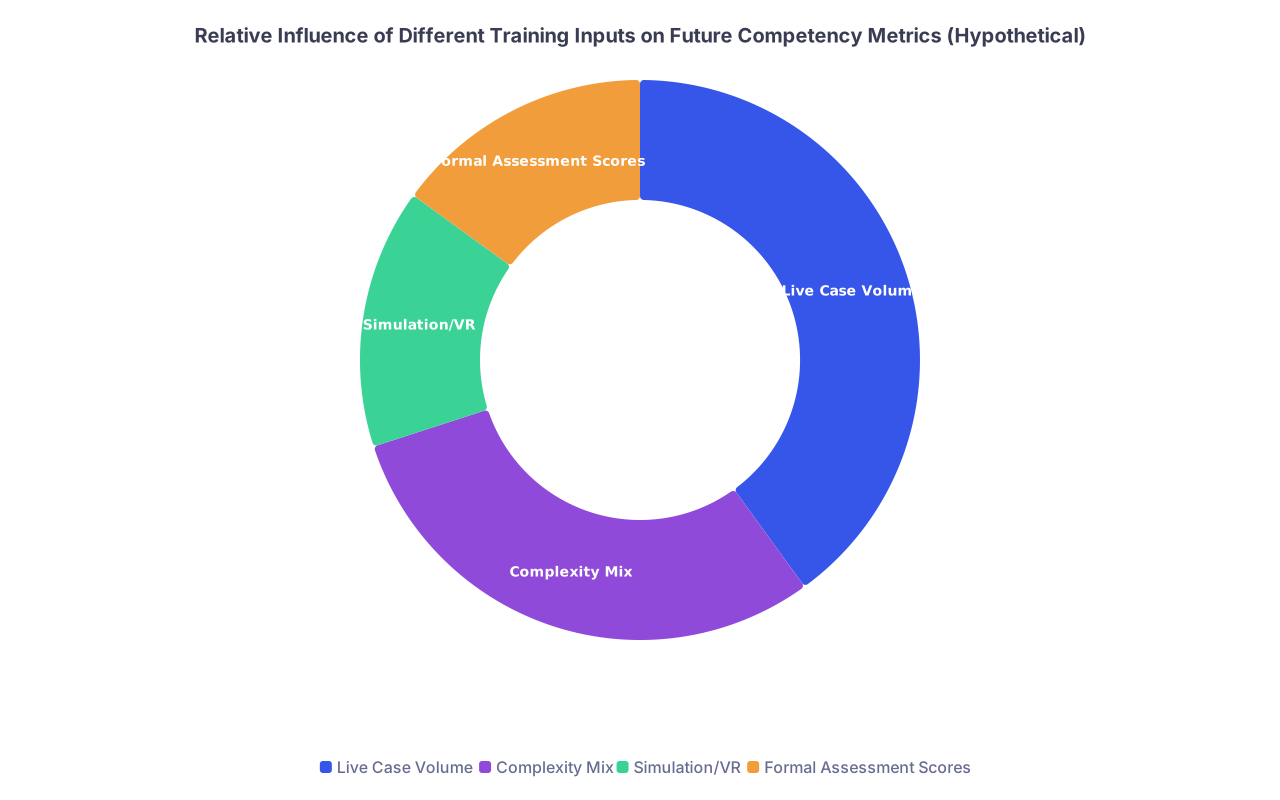
| Category | Value |
|---|---|
| Live Case Volume | 40 |
| Complexity Mix | 30 |
| Simulation/VR | 15 |
| Formal Assessment Scores | 15 |
The exact percentages will be debated, but the weight on raw volume alone is already drifting downward in policy discussions, even if most surgeons still care deeply about it in practice.
9. Practical Takeaways for Residents and Programs
Let me translate this data history into concrete guidance.
If you are a medical student choosing programs
Ignore vague statements like “we are high volume.” Force programs to talk numbers.
Ask specifically:
- “What were your median graduating total major cases in the last 3 years?”
- “Where do your graduates fall relative to national medians in trauma, HPB/foregut, colorectal, vascular, and endoscopy?”
- “Do you have any categories where your residents are consistently below the 30th percentile?”
If a program cannot answer, that is data too. It means either they are not tracking, or they do not like the answer.
If you are a resident already in a program
Pull your own case logs. Compare yourself to the published national medians. Identify where you are lagging.
If your HPB numbers are low, you:
- Ask for targeted rotation adjustments.
- Seek elective rotations or visiting experiences.
- Negotiate to scrub higher-complexity cases rather than yet another straightforward lap chole.
The decade of ACGME data say the same thing: the system is not going to equalize this for you. You have to actively manage the tail of your own distribution.
If you are a PD or chair
The programs that improved the most over the last decade did not just “work harder.” They restructured:
- Call models to protect resident OR access
- Referral patterns (e.g., absorbing more community trauma or EGS)
- Faculty expectations (limiting APP encroachment into key index cases)
I have seen programs go from bottom-quartile in vascular and trauma to top-half in five years just by redesigning coverage and building formal relationships with regional hospitals.
The data are unforgiving here. If your graduates sit in the 10th–20th percentile in multiple core categories year after year, you are not “fine.” You are producing under-exposed surgeons who will lean heavily on fellowship to compensate.

| Step | Description |
|---|---|
| Step 1 | Program structure |
| Step 2 | Case availability |
| Step 3 | Resident assigned cases |
| Step 4 | Logged ACGME cases |
| Step 5 | National percentile profile |
| Step 6 | Perceived competence |
| Step 7 | Fellowship choice |
| Step 8 | Referral patterns |
| Step 9 | APP and fellow roles |
That is the pipeline. And the last decade of ACGME reports essentially act as the quarterly quality report on this pipeline.