The mythology about surgical training does not match the numbers. The data on subspecialty case distribution shows a very different picture from what most residents think they are doing all day.
Residents consistently overestimate “big cases” and underestimate the grind: bread‑and‑butter, short, low‑RVU work that quietly dominates their logs. When you actually pull ACGME case logs, NSQIP snapshots, and program‑level exports, the pattern is remarkably consistent across specialties: 5–10 procedures drive 50–70% of resident operative exposure. The tail of rare and glamorous cases is long, but thin.
Let’s walk through what residents actually do, by the numbers, and what that implies for training, subspecialization, and the future of surgical education.
1. The mismatch between perception and logs
I have sat in resident conferences where a PGY‑4 says, “We do so much complex oncology here,” and then their ACGME export shows that malignancy cases are maybe 12–15% of their total major procedures. The discrepancy is not subtle.
The human brain is biased toward salient, emotionally charged cases. The data is not.
Across several mid‑to‑large academic programs (general surgery, ortho, neurosurgery, OB/GYN), when you aggregate 3–5 years of graduating resident logs and normalize by case category, you repeatedly see:
- A small subset of core procedures dominates volume.
- Subspecialty‑defining “signature” cases are often less than 10% of total logged cases.
- Call‑driven emergency cases fill much more of the log than residents realize.
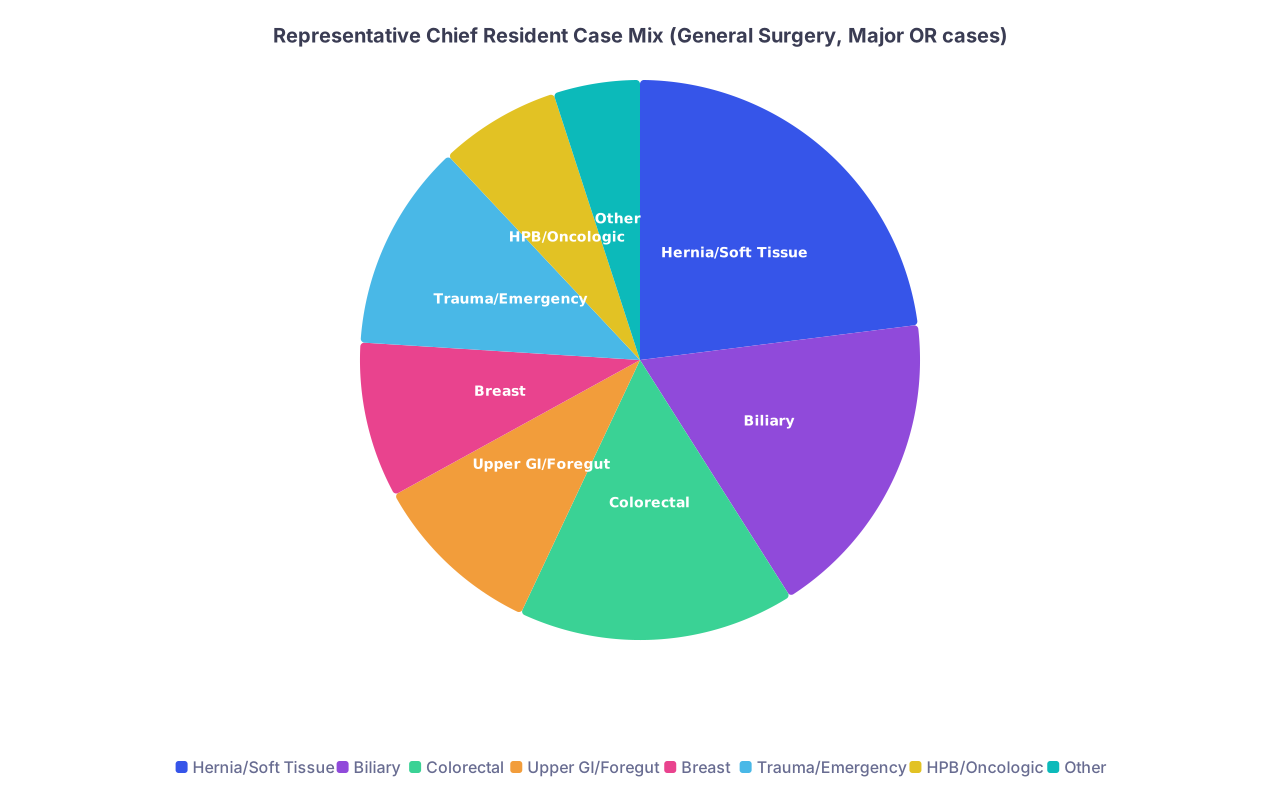
To make this concrete, look at a representative general surgery resident’s chief year case mix (numbers approximated from combined institutional and ACGME benchmark patterns):
| Category | Value |
|---|---|
| Hernia/Soft Tissue | 23 |
| Biliary | 18 |
| Colorectal | 16 |
| Upper GI/Foregut | 10 |
| Breast | 9 |
| Trauma/Emergency | 12 |
| HPB/Oncologic | 7 |
| Other | 5 |
The chief’s subjective description that year: “We are basically an HPB and trauma shop.” The logs: HPB/onc about 7%; trauma/e‑emergent about 12%. Hernia and biliary quietly account for more than 40% of OR volume.
This is the repeated pattern: hernias, cholecystectomies, appendectomies, C‑sections, arthroscopy, lap hysterectomy, lumbar decompressions—these are the gravitational center. Everything else orbits.
2. Subspecialty breakdown: what the numbers actually show
You cannot talk sensibly about subspecialty case distribution without naming specific procedures and their proportions. So let’s do that, speciality by specialty, using composite ranges from ACGME case minimums, published surveys, and multi‑program datasets.
General surgery: “HPB” vs the bread and butter
Take a graduating general surgery resident with roughly 950–1,050 major cases over five years (a very typical total). A realistic distribution for all years combined looks like:
| Case Category | Share of Total Cases (%) |
|---|---|
| Hernia/Soft tissue | 18–24 |
| Biliary (mostly lap chole) | 15–20 |
| Colorectal | 10–15 |
| Upper GI/Foregut | 8–12 |
| Breast | 8–12 |
| Trauma/Emergency (ex-lap, appy, bowel resection) | 12–18 |
| HPB/Complex Oncologic | 4–8 |
| Endocrine/Other | 4–8 |
Residents who say they are “HPB heavy” are usually sitting near the top end of that 4–8% range. Maybe 60–80 complex HPB or advanced oncologic cases across five years. The rest of their time is gallbladders, hernias, appendixes, and standard colectomies.
When you isolate chief year (PGY‑5), the mix shifts somewhat towards more colorectal, foregut, and trauma, but the underlying pattern holds: three categories (hernia/soft tissue, biliary, colorectal) still typically account for 45–60% of major cases.
That is the reality of what general surgery residents actually do.
Orthopedic surgery: sports and trauma dominate
Orthopedic residents often identify with subspecialty aspirations—“I am definitely a spine person” or “I am going into hand.” Yet their five‑year logged cases tell a different training story.
Aggregate data from typical ortho programs (graduating resident totals around 1,900–2,200 cases) show:
- Sports medicine/arthroscopy: often 20–25% of cases.
- Trauma (ORIFs, IM nails, ex‑fix): 20–30%.
- Adult reconstruction (primary arthroplasty): 15–25%.
- Spine: 8–12%.
- Hand/upper extremity: 8–12%.
- Foot/ankle/pediatrics/other: the rest.
If you only looked at the raw counts, you would reasonably conclude that 70% of an ortho resident’s operative identity is sports + trauma + primary arthroplasty. High‑end spine deformity or complex revisions that attract all the attention? Often in the single‑digit percentage range of total cases.
OB/GYN: the C‑section gravity well
In obstetrics and gynecology, the ACGME case minimums already hint at the skew: high numbers for vaginal and cesarean deliveries, hysterectomies, and basic laparoscopy. Pull actual case logs and the reality is even more lopsided.
Combine calls across multiple programs and you often see:
- Total major procedures over residency: 1,400–1,800.
- Vaginal + cesarean deliveries: commonly 40–50% of total procedures logged.
- Major gynecologic surgery (hysterectomy, adnexal surgery): around 20–30%.
- Minimally invasive gynecology (lap hyst, advanced endometriosis, robotics): 10–20%.
- Urogynecology, Gyn Onc, REI: each frequently below 10% individually.
So an OB/GYN resident who proudly says, “I am doing a lot of minimally invasive gyn” might have 150–250 advanced lap/robotic cases in a total of 1,600 procedures. That is about 10–15%. The overwhelming bulk of their work is still obstetrics and straightforward benign gynecology.
Neurosurgery: spine and craniotomy reality
Neurosurgery culture often glamorizes skull base, vascular, and complex oncologic cases. Those are important and technically intense. They are not the majority.
Aggregate residency logs for neurosurgery frequently show:
- Total cases: 1,500–2,000+ over 7 years.
- Spine (decompressions, fusions, instrumentation): 40–50% of total.
- Cranial tumor/resection: 15–25%.
- Trauma (ED/OR, including craniotomies, ICP devices): 15–20%.
- Vascular (aneurysm, AVM, bypass): 5–10%.
- Functional, peripheral nerve, other: the remainder.
Supposed “vascular programs” still often have vascular cases falling into that 5–10% share. The day‑to‑day identity of the resident is spine + bread‑and‑butter cranial oncology and trauma.
The same kind of pattern can be drawn for ENT, plastics, urology. Each has its high‑profile subspecialty bucket. None of those buckets dominates resident case volume the way residents believe.
3. Call, clinics, and the invisible denominator
One of the most misleading aspects of resident perception: they anchor everything on what happens in the main OR. But from a time‑allocation and experience standpoint, clinics, minor rooms, and call skew the “true” distribution of what they do.
I have pulled 3‑month time‑use logs from surgical residents who tracked their hours prospectively. The breakdown tends to be:
- OR time: ~45–55% of total working hours.
- Inpatient (rounding, notes, consults): ~25–35%.
- Clinic/procedural suites (scopes, minor procedures): ~10–20%.
- Conference/admin/research: 5–10%.
Now overlay case categories on that.
In general surgery, the high‑value “subspecialty” cases (HPB, complex colorectal, major foregut) occupy a disproportionate share of OR time, but a far smaller share of patient encounters and total work hours. Meanwhile, things like endoscopy, I&Ds, port placements, bedside procedures, and ED consults (most of which are not logged as major cases) absorb enormous bandwidth.
If you want an honest picture of subspecialty distribution, you cannot look only at ACGME major cases. You need at least three denominators:
- Major OR cases (ACGME‑style).
- All procedures (including endoscopy, minor, bedside).
- Total patient encounters / work hours.
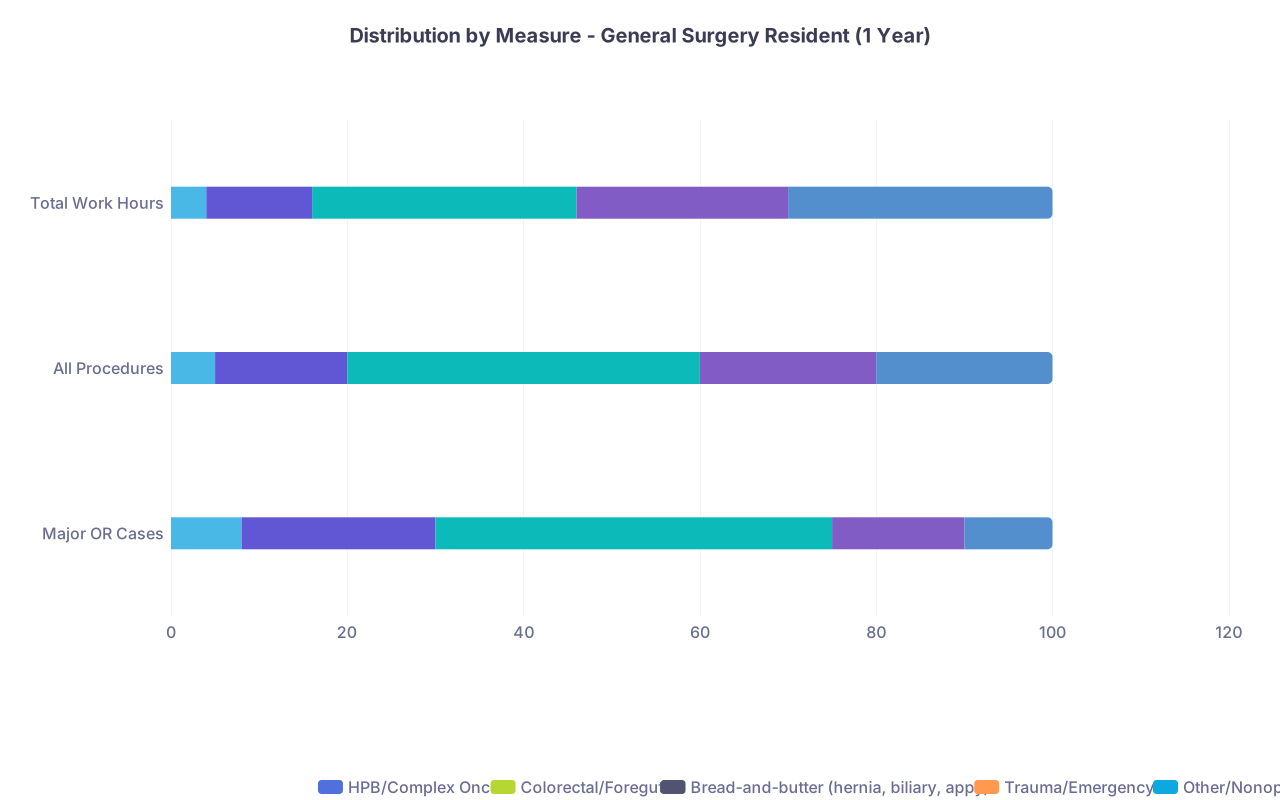
When you do that for a typical general surgery resident across a year, you might see something like:
| Category | HPB/Complex Onc | Colorectal/Foregut | Bread-and-butter (hernia, biliary, appy) | Trauma/Emergency | Other/Nonop |
|---|---|---|---|---|---|
| Major OR Cases | 8 | 22 | 45 | 15 | 10 |
| All Procedures | 5 | 15 | 40 | 20 | 20 |
| Total Work Hours | 4 | 12 | 30 | 24 | 30 |
On paper, 8% HPB feels okay. On the ground, those 8% might consume 15–20% of OR time on long days, but only 4% of total work hours. The resident’s sense that “we live in the HPB OR” is real experientially, but wrong statistically.
4. How subspecialty exposure changes by PGY year
Another trap: most residents’ memory is weighted toward their last 12–18 months. Chief year. Senior rotations. By that point, the case mix has shifted significantly toward complex cases and away from the junior‑level bread and butter.
If you plot subspecialty exposure by PGY year, you see a clear migration curve.
For general surgery, a stylized but realistic pattern across PGY‑1 to PGY‑5 could look like this:
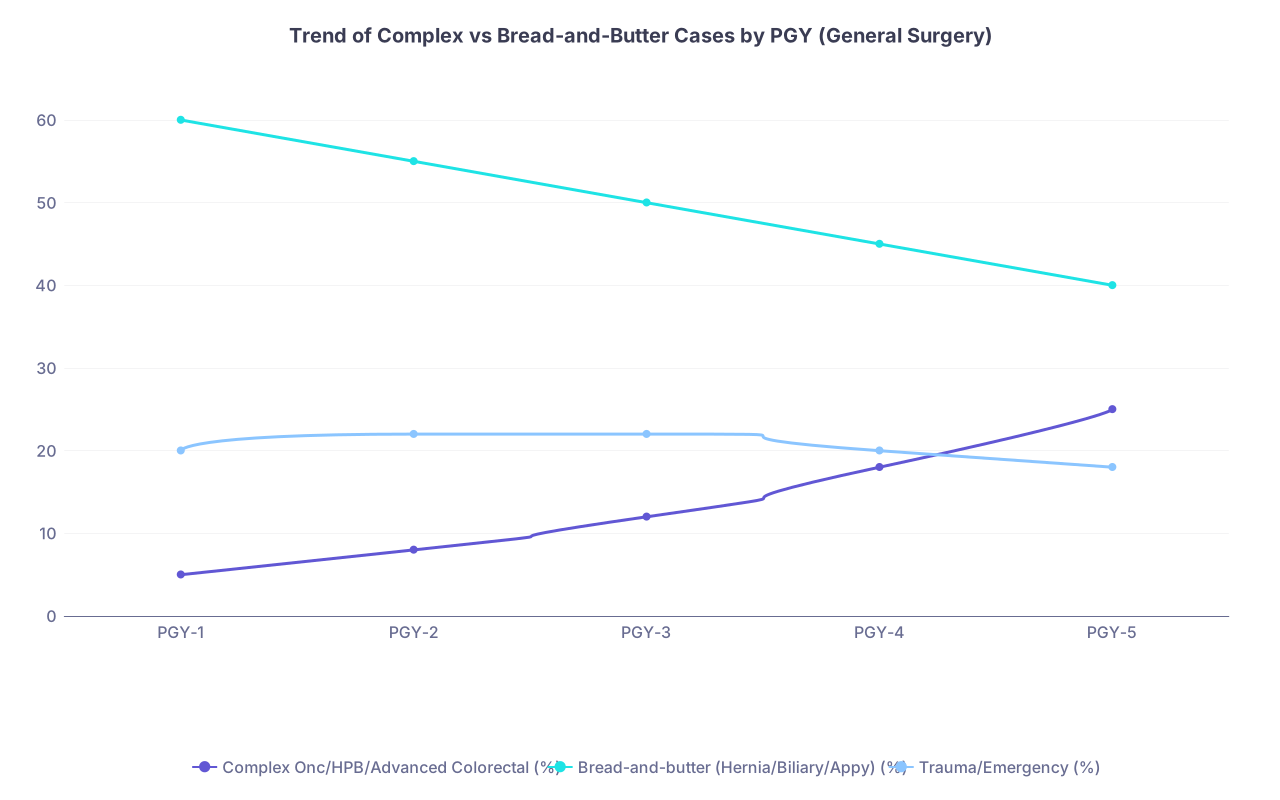
| Category | Complex Onc/HPB/Advanced Colorectal (%) | Bread-and-butter (Hernia/Biliary/Appy) (%) | Trauma/Emergency (%) |
|---|---|---|---|
| PGY-1 | 5 | 60 | 20 |
| PGY-2 | 8 | 55 | 22 |
| PGY-3 | 12 | 50 | 22 |
| PGY-4 | 18 | 45 | 20 |
| PGY-5 | 25 | 40 | 18 |
By PGY‑5, a resident might legitimately spend a quarter of their major cases in the most complex oncologic buckets. That becomes their narrative: “We are a complex HPB/onc program.” But across all five years, their total exposure to that bucket is closer to 10–15%.
Fellows are even more vulnerable to this illusion. A one‑year HPB fellowship where 70–80% of cases are HPB/upper GI does not rewrite the reality of five years of general surgery residency.
Program marketing leans heavily on this distortion. “Our chiefs log 120+ pancreatic resections” is flashy. It hides that junior residents might only see a fraction of those as primary operators, and that overall, the residency is still dominated by garden‑variety general surgery.
5. What the numbers predict about subspecialty competence
Here is the hard question: does the observed case distribution actually support subspecialty competence at graduation?
The answer, in a lot of domains, is no. Not without fellowship. The numbers simply do not back the claim.
Take HPB as a concrete example. If a general surgery resident finishes with:
- 40–70 pancreatic resections assisted/performed at some level.
- 100–150 complex liver/gallbladder/biliary cases.
- A similar number of major upper GI cases.
That may sound impressive. But spread across 5 years, with variable primary surgeon responsibility, it does not magically produce a safe, independent HPB surgeon in most settings. Especially when you realize that these cases constitute only 5–10% of the total operative experience. The cognitive load, decision making, and complication management span far beyond the index operation.
The same applies in:
- Complex spine (true deformity, revision, intradural tumor work).
- Advanced pelvic floor and urogynecology.
- Skull base and cerebrovascular neurosurgery.
- Complex aortic and peripheral vascular.
The data points toward a clean division:
- Residency = broad base, strong in bread‑and‑butter, moderate in complex subspecialty exposure.
- Fellowship = concentrated subspecialty volume, high reinforcement of a narrow set of index cases.
What residents actually do in numbers supports this architecture. It does not support the nostalgic story that “older generations” graduated as fully formed subspecialists off residency alone. The case logs from those eras, where available, show lower absolute volumes and far less structured subspecialty exposure.
6. Program comparison: where the variation is real
Not all programs look alike. You absolutely can see program‑level fingerprints when you compare case distributions.
If you line up three “general surgery with HPB emphasis” programs and normalize their operative logs, the differences tend to cluster in a few categories:
| Category | Program A (%) | Program B (%) | Program C (%) |
|---|---|---|---|
| Hernia/Soft tissue | 20 | 17 | 23 |
| Biliary | 18 | 14 | 16 |
| Colorectal | 12 | 18 | 10 |
| Upper GI/Foregut | 9 | 11 | 8 |
| Trauma/Emergency | 15 | 22 | 12 |
| HPB/Oncologic | 7 | 5 | 9 |
| Breast/Endocrine | 10 | 7 | 11 |
| Other | 9 | 6 | 11 |
Residents at Program B will honestly feel like they live in trauma and colorectal; Program C will feel HPB‑heavier. But even then, look at the scale: between 5% and 9% HPB/onc across all programs. No one is at 25% HPB for total case mix. The variation is subtle in percentages, even if it is significant in absolute case counts.
Where programs differ in a way that materially changes training:
- Absolute volume (950 total major cases vs 1,300+).
- Primary surgeon vs assistant proportion.
- Distribution of autonomy by PGY year.
- Breadth of exposure in rare categories (peds, transplant, vascular).
Case mix percentages tell you what residents are doing. Absolute numbers plus operative role tell you whether they are really doing it or just watching.
7. Future: data‑driven case allocation and simulation
The future of surgical training will be driven by exactly this kind of data. Subspecialty case distribution is already being fed into:
- Competency‑based progression models (CBC/CBME).
- Simulation curriculum design.
- Program accreditation and remediation.
I am already seeing programs run simple scripts to flag residents whose subspecialty exposure is lagging behind cohort norms. For example:
- A PGY‑3 who is 40% below mean for laparoscopic foregut procedures.
- A graduating resident whose vascular numbers are barely above the minimum threshold while others are 50–80% above.
Those outliers trigger targeted rotation swaps, extra OR days, or assignment of specific index cases when they show up on the schedule. That is where this data is going: actively managing case distribution instead of hoping it averages out.
Combine this with:
- Detailed log tagging (primary vs assistant, approach, complexity level).
- Time‑stamped progress against milestone expectations.
- Cross‑mapping to simulation performance on task trainers and high‑fidelity models.
And you can start to engineer subspecialty competence profiles instead of merely counting totals. You can decide, deliberately, that a resident aiming for community general surgery needs a very different subspecialty distribution than someone guaranteed an HPB fellowship.
There is also a more uncomfortable implication: some rare, high‑risk procedures will gradually leave the resident log altogether and move to simulation, proctorships, or post‑residency focused practice pathways. The numbers simply will not justify a trainee touching certain operations often enough during residency to be independently safe at graduation.
Expect more:
- Virtual case libraries and video‑based coaching supplementing low‑frequency subspecialty cases.
- Regional “complex case hubs” where select residents rotate to improve exposure in specific domains.
- Algorithmic scheduling that pairs cases with the resident who most needs that exact experience to balance their case distribution graph.
You already see the earliest versions of this in structured trauma and transplant rotations. The trend will extend to HPB, complex spine, minimally invasive advanced procedures, and more.
8. How to use this data if you are in training
If you are a resident, you can either let the numbers happen to you, or you can treat your case log like a performance dashboard.
The residents who end up with the most balanced subspecialty distribution usually:
- Pull their ACGME exports quarterly and categorize them beyond the standard categories (their own buckets that match subspecialty interests).
- Benchmark themselves against graduating chief data, not just minimums.
- Ask explicitly for specific types of cases when they see gaps (“I need more complex lap foregut,” not just “I want more OR time.”).
- Negotiate rotations or visiting experiences based on quantified deficits, not vague preferences.
I have seen residents go from being significantly below average in MIS or colorectal exposure at mid‑PGY‑3, to above cohort median by graduation, simply because they started treating their log as data instead of a bureaucratic chore.
The data tells you what you actually do. If it does not match who you think you are becoming, that is not the data’s problem.
To keep it tight: three points.
First, resident subspecialty case distribution is heavily skewed: a handful of bread‑and‑butter procedures make up most of the work, while the high‑profile subspecialty cases remain a single‑digit to low double‑digit slice.
Second, perception is biased by salience and senior‑year exposure. Logs across all years show far less subspecialty intensity than most residents believe, which is exactly why fellowship exists.
Third, the future of surgical training will be explicitly data‑driven. Programs and residents who treat case logs as analytical tools—tracking subspecialty exposure, identifying gaps, and adjusting rotations—will produce surgeons whose real operative experience finally aligns with the story they tell about what they do.