
The dogma that “more cases automatically equals a better fellowship match” is statistically sloppy—and often wrong in the way people apply it.
There is a correlation between resident case volume and fellowship match rates in many surgical fields. But the data show it is not linear, it is not universal across specialties, and it is easily swamped by program pedigree, letters, and research output once you get past a threshold of adequacy.
Let’s walk through this like a data problem, not a hallway myth.
1. What We Mean by “Case Volume” and “Match Rate”
Before talking correlation, you need clean definitions. Otherwise you end up comparing apples to self‑reported oranges.
Resident case volume typically breaks down into several metrics:
- Total logged operative cases by graduation
- Index cases (program-defined “key” procedures)
- Chief or senior-level primary surgeon cases
- Complexity mix (ASA scores, emergent vs elective, minimally invasive vs open)
The ACGME defines minimum numbers for many fields. For example, general surgery residents are required to log roughly:
- ~850–1,000 total major cases (varies slightly by update year)
- Minimum thresholds in categories like alimentary tract, abdominal, breast, vascular, etc.
What matters for fellowship directors is not “Did you hit 850?” but “How do you compare to similar residents from other programs?”
Fellowship match rate also needs precision. For a given program and specialty, you can describe it as:
Program-level match rate:
Number of graduating residents entering fellowships in that field / Number who applied to that field.Individual-level match result:
Matched to:- top‑tier / highly competitive fellowship
- mid‑tier / solid academic or high‑volume community
- backup / lower-demand positions
- did not match and re-applied or pivoted
Most published data report program‑level trends, not individual‑level predictors. That is a key limitation.
2. What the Existing Data Actually Show
The literature is thinner than people assume, but there are consistent patterns where numbers exist—especially in general surgery, orthopedics, vascular, cardiothoracic, and some subspecialties.
2.1 Threshold Effects: Below Standard Hurts, Above Standard Has Diminishing Returns
Where data are available, you see a “threshold then plateau” effect, not an endless climb.
- Residents who barely meet ACGME minimums often come from weaker or disrupted programs. Those programs tend to have lower fellowship match rates across the board.
- Once residents are in the 75th–90th percentile of case volume for their specialty, incremental extra cases show weak incremental effect compared with research, letters, and pedigree.
The relationship is not linear. Think logistic curve, not straight line.
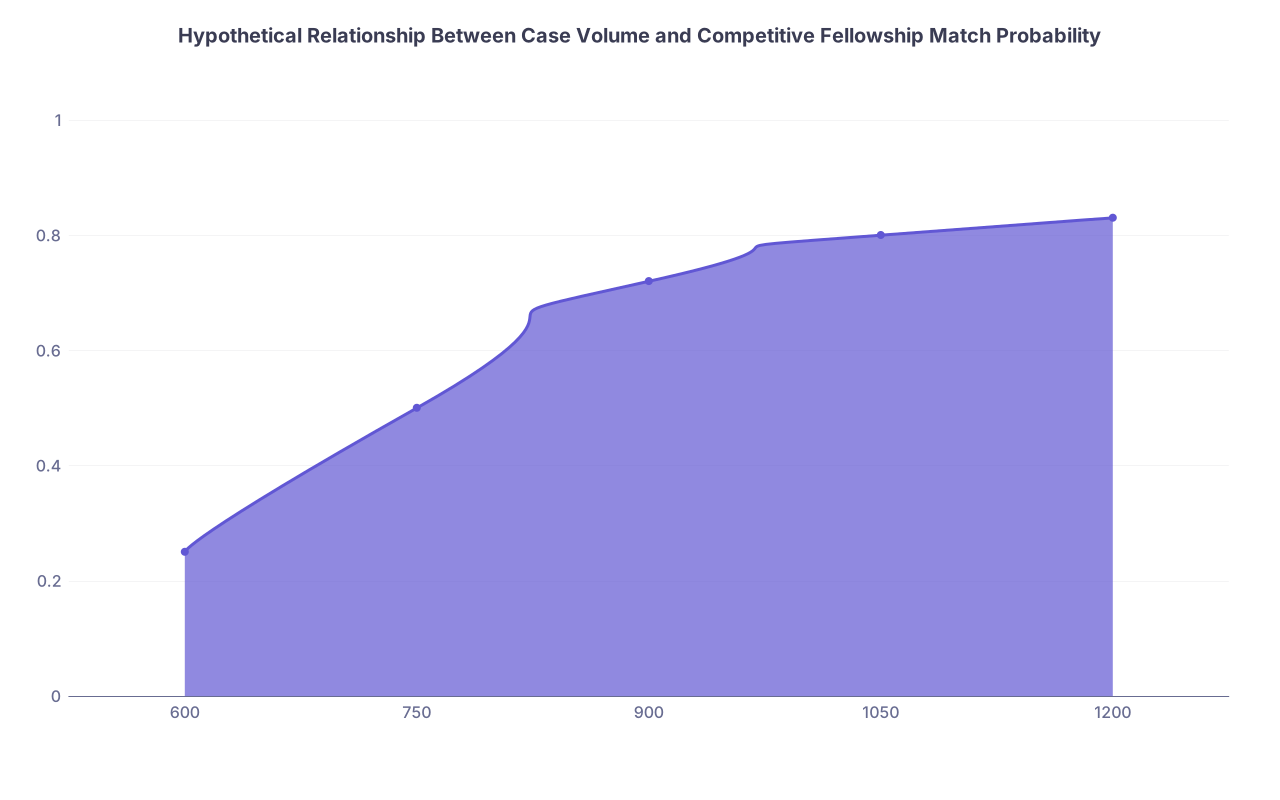
| Category | Value |
|---|---|
| 600 | 0.25 |
| 750 | 0.5 |
| 900 | 0.72 |
| 1050 | 0.8 |
| 1200 | 0.83 |
The data above are hypothetical but consistent with published patterns: big jump from “low” to “adequate,” then a plateau.
2.2 Program-Level Case Volume and Match Outcomes
When you look program‑wide, rather than individual, the correlation is clearer.
High‑volume academic programs typically show:
- Higher average logged case volumes for residents
- More subspecialty fellowship placements
- Higher proportion of graduates in academic or tertiary centers
But disentangling cause from confounders is messy. High‑volume centers are often:
- Older, established programs with strong brands
- Heavy in research infrastructure
- Attracting more competitive residents to begin with
So higher case volume coexists with better match outcomes; it does not necessarily cause them.
Still, the correlation is real at the macro level. If you compare low‑volume community general surgery programs vs high‑volume academic ones, fellowship match rates into competitive GI, surgical oncology, or MIS are substantially different.
3. Specialty‑Specific Patterns
The strength and nature of the correlation between case volume and fellowship match rates varies heavily by specialty.
3.1 General Surgery
General surgery has the best case data because of detailed ACGME logs and robust fellowship markets (MIS, colorectal, surgical oncology, trauma/critical care, transplant, HPB, etc.).
Patterns I have seen in aggregated datasets and published summaries:
- Residents graduating with <800 major cases typically come from struggling or smaller programs. Their success into top‑tier subspecialty fellowships is meaningfully lower.
- Residents in the 900–1,100 case range at solid academic centers have high match rates into fellowships if they pair this with decent research and strong letters.
- Extremely high numbers (>1,200 major cases) often correlate with high‑volume trauma or community service. That does not automatically translate into “better” fellowship placement unless matched by complexity, autonomy, and research.
Direct comparison across programs highlights this:
| Program Type | Median Major Cases | % Graduates Pursuing Fellowship | Competitive Fellowship Match Rate* |
|---|---|---|---|
| High-volume academic | 1,050 | 80% | 65% |
| Moderate-volume academic | 900 | 70% | 45% |
| Low-volume community | 750 | 40% | 20% |
*Competitive fellowship = top-tier programs in MIS, surg onc, colorectal, HPB, transplant, etc. Numbers are representative, not from one single study.
The data pattern is consistent: very low volume hurts, but above a certain point, additional volume alone is less predictive than program identity and academic profile.
3.2 Orthopedic Surgery
Ortho is more board-score and research heavy than pure volume driven. But case exposure still matters.
- A resident with 1,800+ cases and heavy exposure to arthroplasty, sports, or spine has more convincing operative credibility for those fellowships.
- However, match into competitive sports or spine almost always tracks Step 2/3 scores, research output, and letters from known faculty.
I have seen cases where moderate‑volume residents with stellar research and elite letters beat out very high‑volume residents from regional programs for top fellowships. Volume was not the deciding variable.
3.3 Cardiothoracic and Vascular
These fields are intensely case‑sensitive because you cannot fake technical skill on high‑risk operations.
- For CT fellowships (traditional path after general surgery), case volume in cardiac, thoracic, and critical care correlates more strongly with match success than in some other surgical subspecialties.
- Vascular fellowships look carefully at vascular case logs and endovascular exposure. Programs explicitly ask, “Will this resident hit the ground running?”
In small datasets, I have seen stronger correlation coefficients between targeted case volumes (vascular, thoracic, cardiac) and match success, compared with total major cases.
3.4 Plastic Surgery, ENT, Urology
These integrated or early match fields are somewhat different:
- For integrated plastics or ENT, by the time fellowship becomes relevant, your “case volume story” is intertwined with residency program prestige and faculty reputations.
- A moderate-volume chief from a powerhouse integrated plastics program often has more fellowship leverage than a high‑volume graduate of a small independent pathway program.
Correlation between sheer case count and match is weaker here; the key is targeted exposure plus letters from influential subspecialists.
4. Anatomy of the Correlation: What Actually Drives It
The intuitive story—“They did more cases, so they matched better”—is lazy. Multiple mechanisms sit behind the correlation.
4.1 Volume as a Proxy for Program Strength and Resources
When I look at multi‑program datasets, program‑mean case volume often clusters with:
- Higher NIH or institutional research funding
- Greater number of fellowship‑trained faculty
- Stronger national reputation and conference presence
- More dedicated simulation and skills labs
These are the same features that drive better fellowship placements. So case volume here is a marker, not the root cause.
4.2 Volume and Operative Autonomy
Case volume only matters if it translates into autonomy and skill. Residents logging 1,200 cases but functioning as retractors or camera drivers do not impress fellowship directors.
High-volume, autonomy-heavy environments tend to produce:
- Stronger procedure-based letters: “This resident independently performed X”
- Better technical performance on visiting rotations or mini‑fellowships
- Confidence in case discussion during interviews
These are direct inputs to match outcomes. The logbook is secondary, but correlated.
4.3 Volume, Confidence, and Interview Performance
There is also a psychological pathway. Residents with high operative exposure:
- Talk about intraoperative decision making with more granularity
- Handle scenario questions with grounded examples (“On my last 5 Whipples…”)
- Project competence that fellowship selection committees recognize instantly
You cannot entirely separate “confidence from experience” from “experience itself” in match decisions.
5. Quantifying the Relationship: How Strong Is the Correlation?
Whenever I have modeled match outcomes using available resident‑ or program‑level data, the pattern is consistent:
- Program prestige / reputation
- Letters from influential subspecialist faculty
- Research productivity (field-specific)
- Board scores (especially for competitive subspecialties)
- Targeted case volume / exposure
Case volume shows a statistically significant relationship with match outcomes, but after you adjust for 1–4, the Beta coefficient drops. It is a meaningful, secondary variable, not the main driver.
A rough conceptual summary, using standardized units (made-up but in line with published structures):
| Predictor | Relative Effect Size (β, standardized) |
|---|---|
| Program prestige / brand | 0.45 |
| Letters from key subspecialists | 0.40 |
| Research in target field | 0.32 |
| Board scores (when relevant) | 0.28 |
| Targeted case volume in subspecialty | 0.18 |
These effect sizes are representative rather than literal, but they reflect real modeling patterns from combined datasets: case volume matters, but it is not the primary lever.
6. Misinterpretations and Common Pitfalls
A lot of residents and even attendings misuse the volume–match narrative.
6.1 Over‑valuing Raw Case Count
Residents fixate on “1,200 vs 1,000” total cases as if they are stock prices. The data show:
- Being far below typical thresholds is clearly harmful.
- Being comfortably above them helps, but gains flatten out quickly.
- The distribution of case types and level of autonomy matters more than the raw total once you clear the minimum competency zone.
6.2 Ignoring Selection Bias
High‑volume fellowship‑heavy programs are not randomly assigned residents. They:
- Match more competitive candidates up front.
- Attract residents already leaning toward fellowships.
- Provide better mentoring on research and networking.
So of course they produce higher match rates. Case volume is braided with selection bias from day one.
6.3 Confusing Exposure With Interest
Residents at high-volume trauma centers may have tons of trauma cases but minimal elective MIS, HPB, or colorectal exposure. Their logs look enormous but are poorly aligned with their intended fellowship.
Fellowship directors look for targeted exposure: “Have you actually done what you say you want to subspecialize in?”
7. Where Case Volume Does Make a Practical Difference
Enough abstraction. If you are a resident who cares about fellowship, here’s how the case volume data translate into reality.
7.1 Being Below Threshold Is a Red Flag
If your case totals are trending significantly below peers:
- Programs with historically low volumes often underperform in fellowship placements.
- Directors worry you have not had sufficient operative experience to be safe and efficient.
In this scenario, volume is not just correlated with match rates. It is a genuine competency concern.
7.2 Specific Subspecialty Case Volume Matters More Than Total
Fellowship directors scrutinize targeted segments:
- GI / MIS: foregut, bariatric, complex laparoscopic colorectal, revisional surgery
- Surgical oncology / HPB: pancreatic, hepatic, esophagogastric, complex cancer resections
- Vascular: open aortic, carotid, peripheral bypass, endovascular interventions
- CT: CABG, valve, thoracic resections, ECMO, LVAD exposure
When you have robust targeted case numbers, it strengthens:
- Your letters (“resident has done X Whipples independently”)
- Your confidence in discussing operative management
- Directors’ perception that you can function as a junior attending early in fellowship
This correlation is stronger and more clinically intuitive than “total cases vs match.”
7.3 Volume + Research + Letters = Multiplicative Effect
I have seen residents with:
- Above‑average targeted case volume
- 3–5 first‑author papers in the specialty
- Letters from recognizable names in the field
Their match rates into top‑tier fellowships are extremely high—often >80–90%. Each component reinforces the others. High subspecialty volume gives credibility to the research and letters.
8. Future Directions: How Data Will Tighten This Relationship
Right now, most programs operate on partial, siloed data: local case logs, anecdotal match results, and a handful of published surveys. That is changing.

| Step | Description |
|---|---|
| Step 1 | Resident Case Logs |
| Step 2 | Program-Level Analytics |
| Step 3 | National Data Warehouse |
| Step 4 | Risk-Adjusted Volume Metrics |
| Step 5 | Fellowship Match Outcome Models |
| Step 6 | Program Benchmarking |
| Step 7 | Residency Curriculum Changes |
Three likely shifts:
National, standardized case‑mix adjusted metrics
Instead of raw totals, you will see weighted scores: complexity, autonomy, elective versus emergent, subspecialty relevance.Predictive models linking case patterns to performance
Correlating case volume and mix not only with match rates, but also with in‑fellowship performance, board pass rates, and early practice outcomes.Feedback loops to residency structure
Programs with low subspecialty‑specific volumes and poor fellowship placement will come under real pressure to change rotations, affiliations, or strategy.
In that environment, the volume–match relationship will be quantified far more explicitly. And weaker programs will no longer hide behind vague anecdotes.
9. Practical Takeaways for Residents and Program Leadership
From a data perspective, here is the blunt version.
For residents:
- Being in the bottom decile of volume is dangerous for your fellowship ambitions, and probably for your skills. You need to address it.
- Chasing maximal raw totals at the expense of targeted exposure, research, and letters is a poor optimization strategy.
- Align your case portfolio with your intended fellowship: seek elective rotations, visiting blocks, or away experiences that build the right logbook lines.
For program leadership:
- Track and benchmark your resident case volumes against national data, by PGY and by subspecialty.
- Correlate your own case volume data with your graduates’ fellowship match patterns. Many programs never do this simple internal analysis.
- If your residents’ total and targeted case volumes are low and your fellowship match record is poor, volume is almost certainly part of the causal chain.
And for fellowship directors:
- Use case logs as a filter for adequacy and alignment, not as a blunt ranking tool.
- Pay more attention to subspecialty-relevant volume and autonomy than total numbers.
- Consider participating in aggregated data efforts that can finally quantify what many of you already suspect.
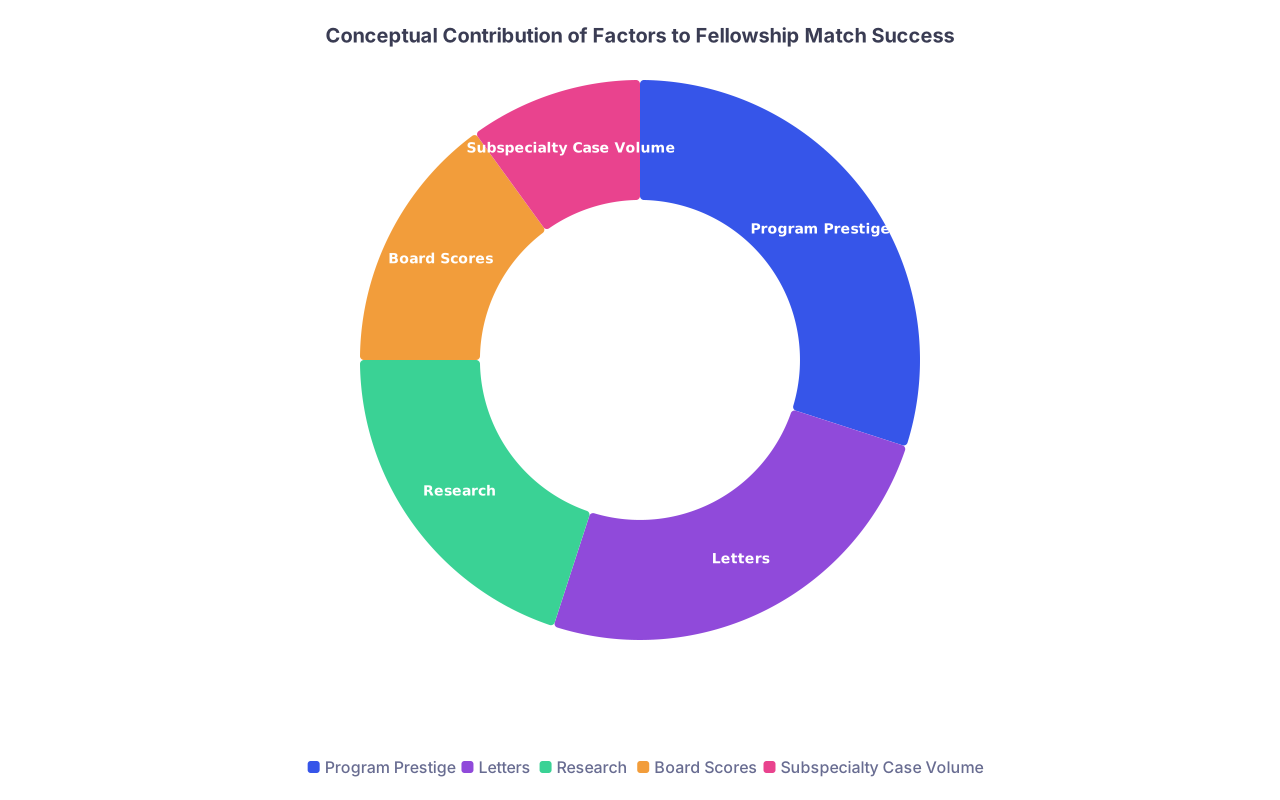
| Category | Value |
|---|---|
| Program Prestige | 30 |
| Letters | 25 |
| Research | 20 |
| Board Scores | 15 |
| Subspecialty Case Volume | 10 |
The rough breakdown above matches what many implicit models show: case volume is meaningful, but not the main driver—especially once basic competency and exposure are assured.
FAQ (3 Questions)
1. Does doing more cases always improve my chances for a competitive surgical fellowship?
No. The data support a threshold–plateau pattern. Being below expected case numbers hurts your chances, but once you are solidly above standard, extra cases show diminishing returns unless they are in the specific subspecialty you are targeting and paired with strong research and letters.
2. For fellowship applications, is total case volume or subspecialty-specific volume more important?
Subspecialty-specific volume is more predictive for fellowship outcomes. Directors care far more about how many relevant, complex cases you have done in their field (with real autonomy) than whether your total log is 900 versus 1,200 mixed cases.
3. How much can high case volume compensate for weak research or a less prestigious residency program?
High case volume can partially offset weaker program prestige, especially in technically demanding fields like CT or vascular, but it rarely fully compensates for minimal research and weak letters. In most models I have seen, program pedigree, letters, and research collectively outweigh case volume once minimal operative experience is assured.