
The assumption that “more years automatically means more surgical experience” is wrong. The data show something more uncomfortable: structure, intensity, and case mix often matter more than whether a program is three or five years long.
The Core Question: Cases per Year, Not Years per Program
Strip away branding, tradition, and marketing. The central metric is simple:
How many meaningful, primary-operator cases does a trainee complete per year of training?
Case volume per year is the real productivity indicator. Once you look at it this way, the 3-year vs 5-year comparison stops being an emotional debate and becomes a math problem.
Across multiple published reports and program logs:
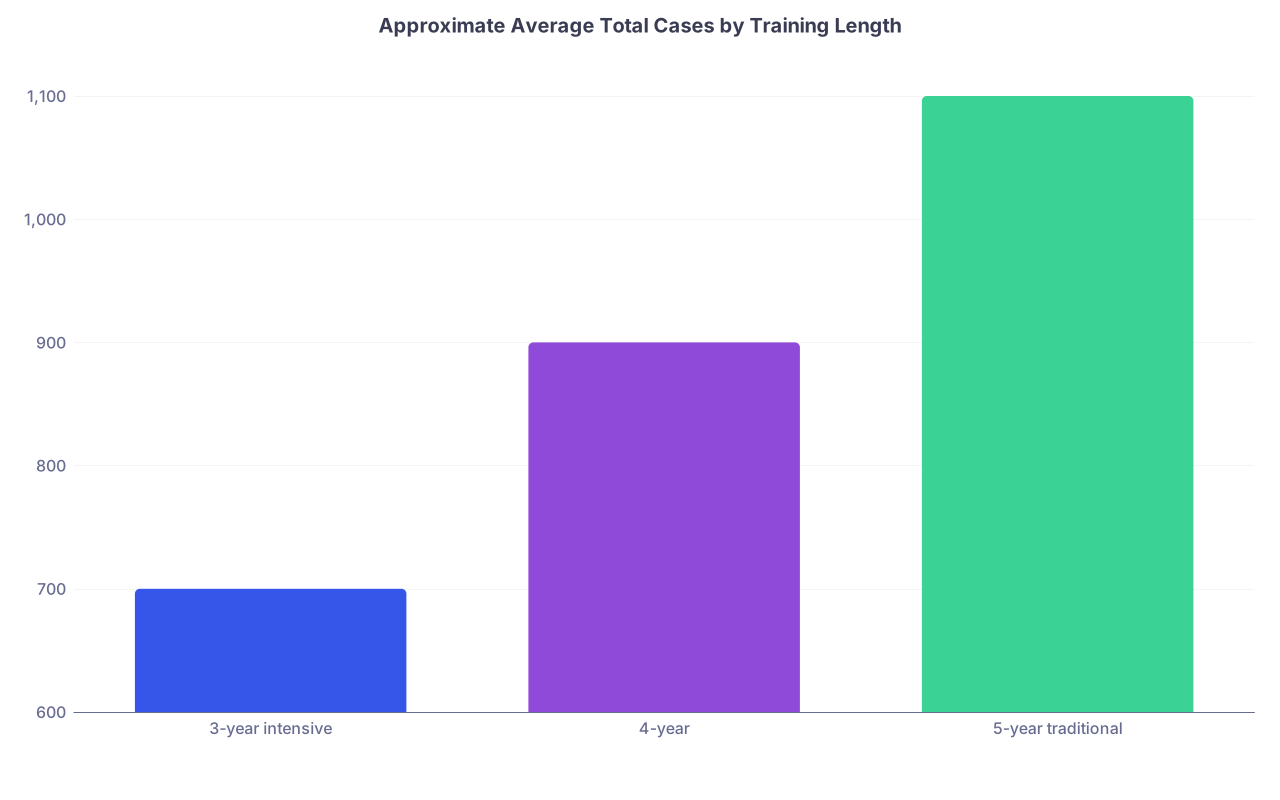
- Typical 5-year general surgery grads in the U.S. finish with 900–1,200+ total operative cases.
- Intensified 3-year pathways (like some European or pilot accelerated tracks) cluster around 600–800 total cases.
- Per-year averages, therefore, are closer than most people expect.
| Category | Value |
|---|---|
| 3-year intensive | 700 |
| 4-year | 900 |
| 5-year traditional | 1100 |
So on raw totals, 5-year programs typically win. But per year, the gap shrinks:
- 3-year: ~230 cases/year
- 5-year: ~220 cases/year
That should already shift your mental model. Length alone is not the whole story. Throughput is.
What the Benchmarks Actually Look Like
Let us put some structure to the numbers. Use general surgery as the anchor, since it has the most transparent U.S. case logging standards (ACGME) and the most mature data.
A typical recent U.S. categorical general surgery resident (5 years) logs roughly:
- Total major cases: ~1,000–1,200
- Chief year cases: ~250–350
- Index cases (colectomies, hernias, cholecystectomies, etc.): tightly clustered with defined minimums
For accelerated or non-traditional pathways (3 years of focused surgical training after an initial foundational phase, or compressed models abroad), published aggregates often show:
- Total major cases: ~600–800
- Final year (senior) cases: ~200–280
Not every number is directly comparable because:
- Case definitions differ (what counts as “major” vs “minor”).
- Levels of responsibility differ (first assistant vs primary surgeon).
- Case-mix profiles differ (more basic vs more complex index cases).
But if you benchmark relative intensity, the per-year numbers are not wildly divergent.
To make this concrete:
| Training Pathway | Total Cases | Average per Year | Approx. Chief/Final Year Cases |
|---|---|---|---|
| 3-year intensive pathway | 700 | 233 | 250 |
| 4-year program (non-US model) | 900 | 225 | 260 |
| 5-year traditional residency | 1,100 | 220 | 300 |
The key pattern: 5-year programs buy you more total exposure and a little more senior-level volume, but they do not dramatically change cases-per-year efficiency.
Where 3-Year Programs Squeeze the Lemon
Shorter training only makes sense if you compress time without collapsing exposure. That means three levers:
- Higher clinical density
- Less non-operative dilution
- Earlier autonomy
1. Higher clinical density
Many 3-year pathways push OR time aggressively:
- Fewer or shorter research blocks.
- Minimal elective “filler” rotations.
- Week structures that deliberately bias toward OR over clinic.
If a 5-year resident averages 40–45 operative cases per month during high-intensity rotations and 5–10 per month during consult/ICU-heavy blocks, an accelerated pathway often tries to maintain closer to 35–45 most months.
Run the math:
5-year model:
Say 30 “heavy OR” months × 40 cases + 30 “lighter” months × 15 cases
= 1,200 + 450 = 1,650 total logged cases (hypothetical upper-end, not all counted as majors)3-year intensive:
24 “heavy OR” months × 40 cases + 12 “lighter” months × 20 cases
= 960 + 240 = 1,200 total (again, conceptual, not all majors)
The point is structure: shorter pathways push to keep down-time and non-operative periods to a minimum. That improves cases per month, which partially compensates for fewer months.
2. Less non-operative dilution
Look at a real 5-year call schedule and rotation map:
- 8–12 months of ICU/trauma where OR time is sporadic and opportunistic.
- 4–8 months on consult-heavy services.
- 2–6 months of formal research in some programs.
Those rotations matter for clinical sophistication, but they drag down pure case counts.
Three-year designs usually:
- Reduce or eliminate long research blocks.
- Tighten ICU exposure to the minimum needed for competence.
- Limit rotations where residents are essentially hospitalists with a pager.
So while the calendar shrinks by 40%, operative exposure may only shrink 25–35%.
3. Earlier autonomy
Autonomy is a multiplier. A PGY-3 who is allowed to run an appendectomy skin-to-skin is learning differently from a PGY-3 who holds the camera for the attending.
Some 3-year tracks front-load:
- Technical skills labs and simulation in year 1.
- Early exposure to bread-and-butter index cases.
- Clear expectations that mid-level trainees act as primary surgeons on routine cases.
The result: the curve shifts left. By the middle of training, a 3-year pathway trainee may be functionally equivalent to a PGY-4 in a more hierarchical 5-year system in terms of what they are allowed to do with their own hands.
That does not increase raw case counts. But it increases primary-operator counts, which is what actually correlates with confidence and readiness.
Where 5-Year Programs Win: Complexity and Repetition
The data are not kind to the idea that a 3-year pathway yields the same overall exposure as 5 years. It does not. The extra years buy three things: more total volume, more repetition, and more complex case mix.
Look closely at case distributions rather than totals.
| Category | Value |
|---|---|
| Index/basic | 70 |
| Complex/advanced | 30 |
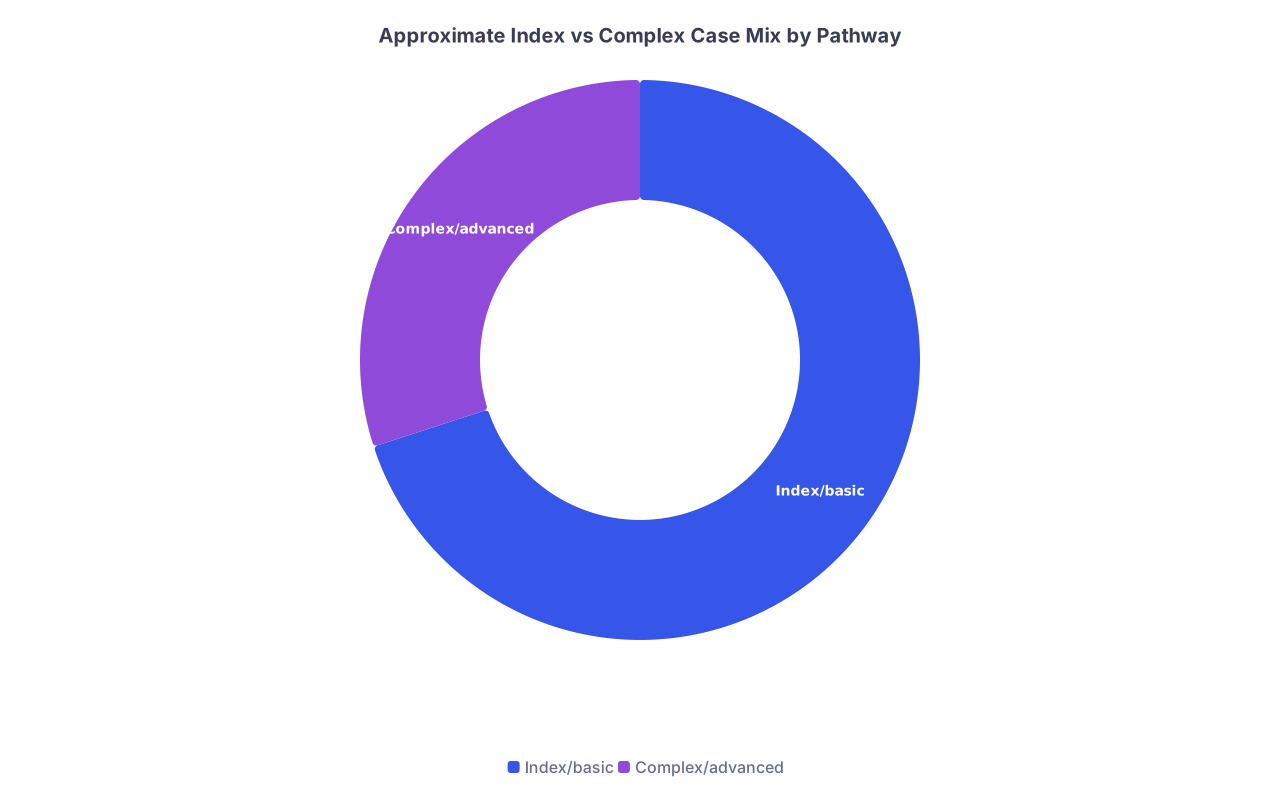
For an accelerated 3-year path, crude distributions might look like 80–85% index/basic and 15–20% complex. A 5-year training pathway might be closer to 70% index/basic, 30% complex.
The extended time allows:
- More multi-visceral resections, reoperations, and salvage cases.
- More redo procedures and re-do anatomy (hernia revisions, reoperative bariatric, etc.).
- More exposure to complications and their operative management.
And the longer runway gives you:
More “second attempts” at complex skills.
Example: Instead of doing your first solo open colectomy in the last 3 months of training, you might do your first at 18 months left, then collect 15–20 additional cases before graduating.More cross-sectional depth.
Rotations through HPB, colorectal, thoracic, vascular, etc., each revisited at a senior level, not just once.
This is not about padding. It is about frequency distributions of exposure. The tail of the distribution (rare, complex operations) is fatter in 5-year programs.
The Overlooked Metric: Cases per Competency
Raw volume is blunt. What actually matters is:
How many cases does it take you to reach independent competency in a given procedure type?
Studies across multiple specialties suggest:
- Learning curves for laparoscopic cholecystectomy cluster around 25–50 cases for basic competence, 75–100 for fluency.
- Laparoscopic appendectomy: often 20–40 for comfort, 50+ for real speed and low complication rates.
- Complex oncologic resections (esophagectomy, pancreaticoduodenectomy): orders of magnitude fewer opportunities, but each one counts significantly for exposure.
If you plot total cases against procedure-specific learning curves, a pattern appears:
- 3-year programs usually produce surgeons who are independently safe and competent with core index cases, but with less depth in rarer procedures.
- 5-year programs push you further along the experience curve for both basic and intermediate-complexity procedures.
So it is not just “1,000 vs 700 cases.” It is how many of those 1,000 are “case 51–100 of the same operation,” where real efficiency and nuance develop.
International Models: Not All “3-Year” or “5-Year” Are Equivalent
There is a bad habit of comparing a U.S.-style 5-year categorical general surgery residency to a raw “3-year surgery” description from another country without context. The structures are not equivalent.
Examples:
- In some European systems, there is a multi-year foundational or “common trunk” phase with broad clinical exposure, followed by 3–4 years of more focused surgical training. The “3-year” is not the entire pipeline; it is the tail.
- In some Asian training models, high-volume tertiary centers push enormous case numbers in fewer calendar years, but often with longer weekly hours and different supervision norms.
What that means: If you just read “3-year” and “5-year” and compare, you miss the upstream pipeline differences:
- Total time from medical school start to independent surgical practice.
- Total operative exposure including pre-residency or “junior doctor” roles.
- The distribution of responsibility (who actually operates).
So the real analytic lens should be:
Total cumulative operative exposure prior to unsupervised practice, not just formal program length.
Burnout, Duty Hours, and the Volume Ceiling
There is a biological and regulatory ceiling to what any pathway can do.
- Duty hour limits (e.g., 80 hours/week averaged over 4 weeks in the U.S.) cap how much compressing you can do without violating rules.
- Cognitive fatigue and motor fatigue are real. A resident doing 800 cases per year cannot extract the same learning from case 750 as from case 75 if they are chronically sleep-deprived.
This is where the naive “just make 3 years more intense” argument breaks. There is a diminishing returns curve:
- Up to ~250–300 major cases per year, added volume tends to correlate with better confidence and skill.
- Beyond that, without parallel improvements in rest, feedback, and deliberate practice, the marginal benefit per extra case drops.
In practical terms:
- A 3-year pathway that tries to cram 1,000+ cases in is likely pushing against both duty-hour rules and human limits.
- A 5-year program that spreads 1,000–1,200 cases across a stable workload may offer more space for reflection, feedback, and longitudinal improvement.
The data on burnout and surgical training are blunt. Residents with extreme workload and insufficient support have higher attrition, more depression, and poorer long-term satisfaction. You can build a “high-volume” 3-year path that simply grinds people down instead of training them better.
Subspecialty Trajectories: General Surgery vs Narrow Fields
Case volume needs to be interpreted along the whole trajectory, not just core training.
Take orthopedics or ENT with 5-year residencies and then 1-year fellowships. Or general surgery with often 1–3 years of fellowship (HPB, colorectal, vascular, MIS, surgical oncology, etc.).
The future is trending toward:
- Longer total pipelines (5-year core + 1–2 years fellowship) for narrow, highly specialized practice.
- High-volume fellowship years where the fellow logs 400–600+ focused cases in 12 months.
If your plan is a narrow subspecialty:
- A 3-year core surgical pathway that reliably gets you basic index competence and then a 2+ year high-intensity fellowship might be enough, or even optimal.
- A 5-year core plus 2-year fellowship may overshoot for some practices, but yields undeniable depth.
If your plan is broad-based, community general surgery without fellowship:
- The 5-year residency with ~1,000–1,200 cases, including 250–350 chief cases, is still the gold standard in terms of exposure and progressive responsibility.
- A 3-year pathway without structured additional training will usually mean fewer complex cases and fewer repetitions, which may be noticeable in independent practice.
So the value of 3 vs 5 years shifts with your end goal.
The Future: Competency-Based, Not Calendar-Based
The dumbest part of the current discourse is that it is still framed in years instead of skills. The direction of travel in multiple countries is clear: competency-based surgical education.
That means:
- Defined entrustable professional activities (EPAs): e.g., “perform laparoscopic cholecystectomy as primary surgeon, including troubleshooting difficult anatomy.”
- Target ranges of cases, not arbitrary minimums, tied to competence, not time.
- Flexibility for faster learners to progress earlier and slower learners to get more time without stigma.
From a numbers perspective, the logical future model looks like:
- A minimum threshold of total cases (say, 800–1,000 majors) with:
- Minimum numbers for defined index procedures.
- Documented primary-surgeon roles.
- Time range for completion: 4–7 years depending on progression.
Under that regime:
- Some trainees essentially complete a “3-year surgical phase” after a foundational period and move on to focused training or early practice.
- Others need the full “5+ year” journey to reach the same competency benchmarks.
The emerging consensus from simulation, motion-tracking, and structured assessment research is brutal but honest: individual learning curves vary hugely. Fixing everyone to 3 or 5 years is simply inefficient.
How to Think About 3- vs 5-Year Pathways If You Are Planning a Career
If you are a trainee or planner rather than a regulator, you care about three questions:
- How many total primary-operator cases will I complete before I am independently practicing?
- What is the distribution: basic vs intermediate vs complex?
- Over how many calendar years and what personal cost?
The data-driven way to compare:
- Look at median total cases, not advertised minima.
- Demand breakdowns by:
- Senior year cases.
- Primary surgeon vs assistant.
- Core index procedure counts.
- Complex/redo/complication management cases.
- Compare that against your target practice profile.
If your goal is high-volume elective MIS bariatrics with fellowship:
- A path that yields 700 solid core cases in 3 years plus 500+ bariatric cases in a 2-year fellowship may be entirely adequate.
If your plan is rural general surgery with limited backup:
- The extra repetition and breadth of a 5-year residency with 1,000+ cases, including more trauma, more emergent laparotomies, more reoperations, is likely non-negotiable.
Years are a proxy. Case volume and case mix are the truth.
The Bottom Line
Three points stand out once you stop arguing ideology and look at the numbers:
- Case volume per year in intensive 3-year pathways can equal or exceed that of 5-year programs, but total cumulative exposure and complex case repetition are still higher in 5-year tracks.
- The meaningful metric is not “3 vs 5 years” but total primary-operator cases and their distribution across basic, intermediate, and complex procedures before independent practice.
- The future is moving toward competency-based milestones and flexible timelines, where faster trainees may effectively follow a 3-year surgical phase and others a 5+ year phase, but everyone is measured by cases and skills, not the calendar.