
The brutal truth: your visa status can get you ranked lower. But not in the way your 3 a.m. brain is imagining.
Let me be very clear: programs absolutely care about visa status. Some will rank you lower. Some won’t rank you at all. Some genuinely don’t care. The hard part is figuring out which is which before you waste your sanity (and money) on them.
And meanwhile you’re sitting there thinking:
“I’m good enough to be here… but will a stupid line on my passport sink my entire application?”
Let’s unpack how much this actually matters, instead of just catastrophizing in the dark.
1. Do Programs Really Rank Visa Needing Applicants Lower?
Yes. Some do. Systematically.
I’ve heard the exact phrases:
- “Great applicant, but we’re trying to cut down on visas.”
- “If we can get a similar US citizen, we’ll go with them.”
- “We only have budget for two visas this year.”
So yeah, you’re not imagining it. But you’re also not doomed. Because “visa = ranked lower” isn’t universal. It’s program-specific and often budget- or admin-driven, not personal.
Here’s the ugly but honest breakdown:
Some programs:
“We don’t sponsor visas.” → You’re filtered out before they even read your PS.Some programs:
“We sponsor J-1 only.” → H‑1B people get sunk. US citizen vs visa? US citizen often wins if similar.Some programs:
“We strongly support IMGs and sponsor multiple visas yearly.” → They honestly don’t care as long as you’re strong.
Your brain is probably doing the all-or-nothing thing:
“If any program ranks me lower because of visa, everyone will. So I’ll never match.”
That’s not how this works. You don’t need 100 programs to rank you high. You need:
- Enough programs that:
- Actually sponsor your visa type
- Are IMG-friendly
- Don’t see visa as an automatic downgrade
- Like your specific profile
You’re not trying to win a popularity contest. You’re trying to win enough people.
2. What Visa Status Signals To Programs (That They’ll Never Say Out Loud)
Programs don’t just see “visa” and think “paperwork.” They see risk, cost, delay, and sometimes politics. Even if they like you.
Here’s what’s running through their heads:
Extra admin work:
GME office, HR, legal, ECFMG, DS‑2019, I‑129… it’s more emails and more chance something gets screwed up.Cost:
Some institutions pay legal fees and filing fees. Some don’t. If it comes out of their budget, they feel it.Timing risk:
What if USCIS delays? What if you’re not cleared by July 1? That’s a huge headache for them.Retention worries:
Some places think: “We’ll invest in them and then they’ll leave the country or switch visas.”
None of this is your fault. But it’s there.
So yes—if they’re deciding between you and a nearly identical US citizen or green card holder, some programs will pick the easier option. Of course they will.
But you can’t control that. What you can control is where you apply and how many programs you stack that actually sponsor and like IMGs.
3. How Much Does Visa Status Actually Matter Compared To Everything Else?
This is where your brain usually lies to you.
Your anxious side:
“Visa is everything. My Step scores, LORs, research, none of it matters if they see ‘needs visa.’”
Reality:
Visa is one factor sitting on top of everything else.
Think of it as a layered filter:
- General cutoffs: Step scores, attempts, YOG, clinical experience
- IMG filter: US-IMG vs non‑US‑IMG, school, red flags
- Visa feasibility:
- Do they even sponsor?
- Does your visa type match what they offer?
- Preference:
- Are you strong enough that it’s worth the paperwork?
Where people get burned is this: they have weak–average applications and then blame visa status for everything.
Harsh opinion:
If your Step 2 is 216 and you graduated 8 years ago with no recent USCE, your biggest problem isn’t your visa. It’s your entire competitiveness profile.
On the flip side:
- If you’ve got solid scores
- Decent or strong US clinical experience
- No massive red flags
- Clearly IMG-friendly targets
Then visa is more of a “slight drag” at some places, neutral at others, and a non-issue at the ones that actually like IMGs.
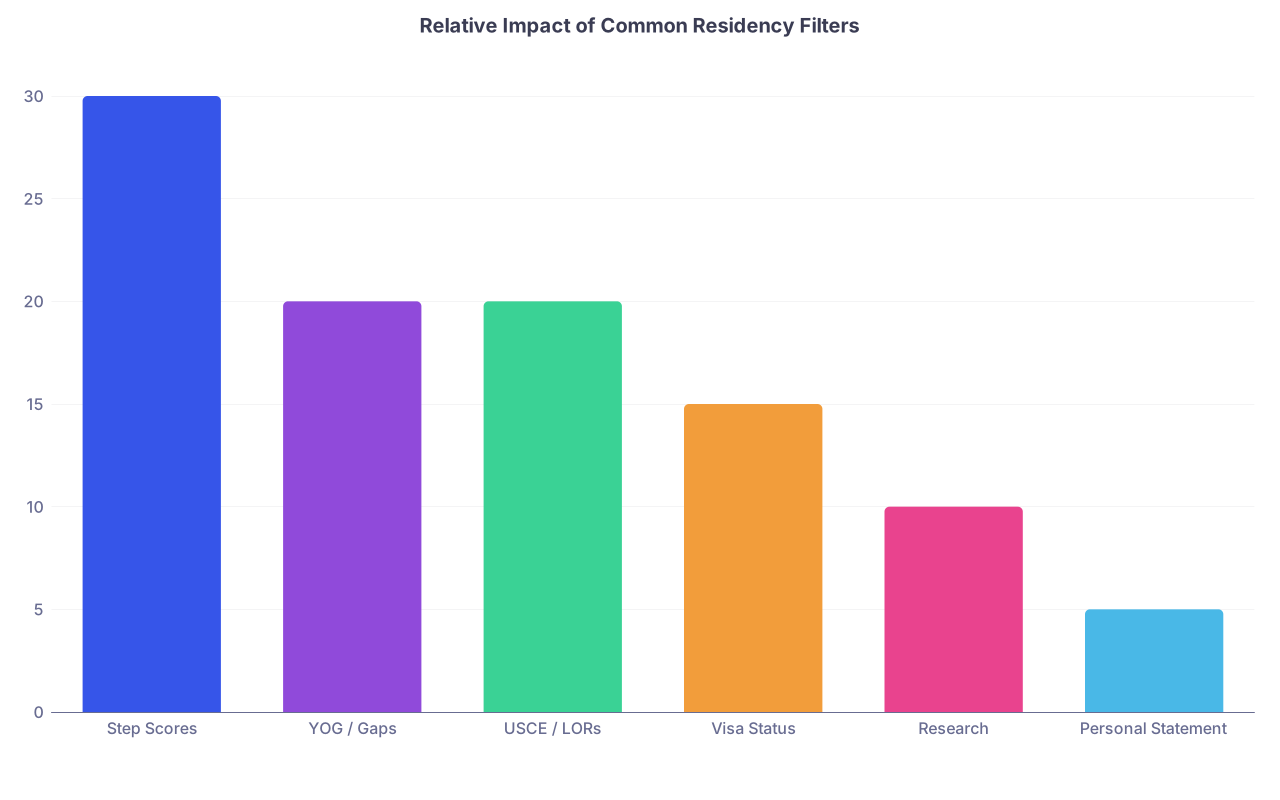
| Category | Value |
|---|---|
| Step Scores | 30 |
| YOG / Gaps | 20 |
| USCE / LORs | 20 |
| Visa Status | 15 |
| Research | 10 |
| Personal Statement | 5 |
This is rough, but look at that: visa isn’t at 90%. It’s not nothing, but it’s not the entire story.
4. J‑1 vs H‑1B vs Green Card: Does One Get You Ranked Higher?
Short answer: yes, type matters. Programs often quietly prioritize:
Green card / US citizen
J‑1
H‑1B (or the reverse, depending on the institution’s politics and cost rules)
Here’s the reality, stripped of BS:
Green card / US citizen
Easiest sell. No sponsorship. No headaches. You’re “clean” administratively.J‑1
Most common for IMGs. Many community and university hospitals are set up for this. ECFMG handles a lot.
Downside from your side: home country requirement later.
From their side: they’re used to it. Often neutral.H‑1B
More expensive, more legal work, more institutional variation. Some programs love it, some hate it, some won’t touch it.
You can’t usually do prelim-only on H‑1B.
They might rank you lower if they think H‑1B = expensive + complicated.
So yes: a J‑1-friendly program might rank a strong J‑1 needing IMG higher than an H‑1B needing IMG with similar stats, just because of cost and hassle.
But again, the key is matching your status to their pattern.
| Program Type | J‑1 Stance | H‑1B Stance |
|---|---|---|
| Big university hospital | Common, routine | Selective / limited |
| Community teaching | Often supportive | Mixed, few spots |
| Small community | Sometimes limited | Rare / often no |
| Top competitive academic | Will do J‑1 | Very selective / few |
| Safety / IMG-heavy | Usually flexible | Varies, ask directly |
Not perfect, but you get the point: you can’t treat all programs the same.
5. Will I Get Interviewed But Then Ranked Lower Because Of My Visa?
This is the nightmare scenario, right?
“I spent money, flew there, they smiled in my face, and then quietly dropped me on the rank list because I need a visa.”
Can that happen? 100% yes. I’ve seen it.
But let’s be precise:
Programs that know they don’t want to sponsor typically:
- Filter you out before interview
- Or mark your file as “backup if we don’t fill with non-visa applicants”
So you still might get ranked. Just lower. Like “we like them, but only if we have to go this far down our list.”
What this looks like in practice:
- You thought you crushed an interview
- You feel they loved you
- You ranked them high
- They didn’t rank you high enough to match
And your brain screams: “It’s the visa.”
Maybe. Or maybe:
- They had a huge internal candidate pile
- They prioritized US grads
- Their chair wanted more research‑heavy residents
- You were ranked mid, and the list just didn’t go down that far
Here’s the part you don’t want to hear but need to hear:
You will never truly know why any one program didn’t rank you high enough. Ever. They’re not going to email you a post-game analysis.
So you can spend the whole year rewriting that story in your head (“It’s all my visa”), or you can accept: visa can hurt at some places, but the solution is more appropriate programs, not infinite self-blame.
6. How To Minimize The “Visa Penalty” In Real Life
This is where you get some control back.
1. Ruthlessly filter programs by visa policy
Don’t just glance at FREIDA and pray. Do this:
- Check: “Sponsorship of J‑1 / H‑1B”
- Go to the program website – sometimes they’re clearer there
- Email the coordinator with a very short, specific question:
“Hello [Name], I’m an IMG requiring [J‑1/H‑1B]. Does your program sponsor this visa type for incoming residents this cycle?”
If they waffle or say “case by case,” mentally treat that as: “Might rank you lower or not at all if they have enough easier options.”
Focus more on:
- Programs openly saying “We sponsor J‑1 for IMGs”
- Programs with many current residents on visas
2. Stalk their current residents (in a normal, non-creepy way)
Go to the program website and actually look:
- How many IMGs?
- How many obviously from your region?
- How many list “visa: J‑1 / H‑1B” in their bios or are clearly non-US-grads?
If they have 8/12 residents clearly IMGs on J‑1, guess what? Your visa is not a big problem there.
If they have one IMG from 7 years ago and everyone else is US MD, your visa might not be the only thing working against you.

3. Align your expectations by specialty competitiveness
Let’s be blunt:
- FM / IM / Peds / Psych (community-heavy): visa is a hurdle, but survivable with strong applications and broad lists.
- EM, Ortho, Derm, ENT, plastics: you’re already in an ultra-hard game; visa is another layer of difficulty.
If you’re IMG + visa + non-research heavy + trying to match Dermatology? That’s not “hard.” That’s basically lottery odds.
7. Your Brain’s Favorite Self-Torture: “If I Were a Citizen, I’d Definitely Match”
This one hurts. Because… sometimes it’s true. Sometimes if you were a US citizen with your exact same stats and experiences, your odds would be higher.
But here’s what’s also true:
- We’re not changing your passport by September.
- Plenty of IMGs with visas match every single year.
- Blaming 100% of the outcome on one factor you can’t change is just emotional self-harm.
Your job is not to become “hypothetical citizen you.” Your job is to become:
- The strongest version of “you with this visa status”
- The most strategic in targeting programs that actually take people like you
- The one who applies to enough realistic options that one program says: “Yes, we’ll take the paperwork hit. They’re worth it.”

| Step | Description |
|---|---|
| Step 1 | You Need a Visa |
| Step 2 | Do Not Apply |
| Step 3 | Apply if J-1 OK |
| Step 4 | Confirm Requirements |
| Step 5 | Prioritize on Rank List |
| Step 6 | Lower Priority, Apply Only if Extra Slots |
| Step 7 | Check Program Visa Policy |
| Step 8 | IMG Friendly Residents? |
8. Quick Reality Check: Where Visa Matters Most vs Least
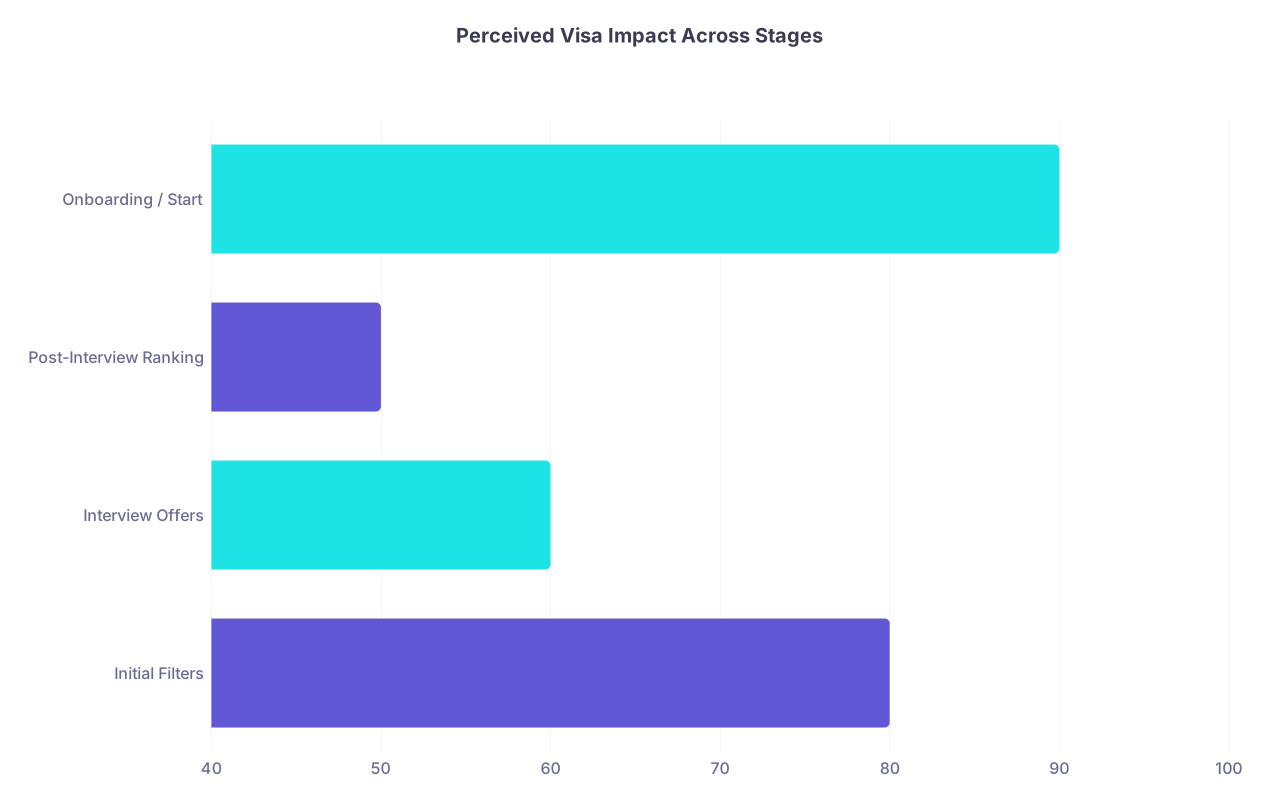
| Category | Value |
|---|---|
| Initial Filters | 80 |
| Interview Offers | 60 |
| Post-Interview Ranking | 50 |
| Onboarding / Start | 90 |
Translated to normal language:
- Initial filters: If they don’t sponsor → dead. If they’re picky → maybe dead.
- Interview offers: Some will say “we have limited visa spots,” so fewer invites.
- Ranking: Less harsh than you think, but still can push you slightly down vs non-visa candidates.
- Onboarding: Once you match, visa suddenly becomes the absolute priority for them because they need you there by July 1.
9. A Very Short, Very Honest Checklist
You’re likely over-fixating on visa if:
- You applied to < 80 programs in IM as a non‑US‑IMG with mid-range stats
- You applied heavily to university programs with very few IMGs
- You didn’t verify visa sponsorship and just assumed
- Your PS, LORs, and USCE are “fine” but not actually strong
You’re correct to worry about visa if:
- You’re H‑1B only and most of your list is J‑1 only
- You’re targeting competitive specialties with minimal IMG footprint
- You didn’t check if the institution still sponsors at all post‑COVID / post-policy changes

But worrying without adjusting strategy is just… suffering for no benefit.
FAQ (Exactly 4 Questions)
1. Can a program like me, interview me, and still rank me low just because of my visa?
Yes. They can, and some do. Sometimes they only have budget or institutional approval for 1–2 visa spots and prioritize their top couple of visa-needing applicants. You might still be on the list, just not high enough to match. You won’t ever get a neat explanation; you’ll just see “No Match” and your brain will fill in “visa” as the reason. The truth is usually more mixed: visa + limited spots + overall competitiveness vs others.
2. Is J‑1 actually better than H‑1B for getting ranked?
“Better” depends on the program. Many hospitals are set up to easily handle J‑1 through ECFMG and are comfortable with it, so they see it as routine. H‑1B often means higher cost and more legal complexity. So at some programs, a J‑1 applicant and an H‑1B applicant with similar profiles will tilt toward J‑1. At other places that proudly support H‑1B and long-term retention, H‑1B might even be a plus. You have to look at what they’ve historically done, not just what they say.
3. Will changing or getting a green card during med school or research years dramatically improve my chances?
Yes, in a very practical way. Once you’re no longer a visa-needing applicant, you instantly remove a major administrative barrier. You’ll get filtered out less, you’ll be more attractive to programs that don’t want to deal with sponsorship, and you’ll probably see more interviews for the same stats. But relying on “maybe I’ll have a green card by then” is dangerous; build your application assuming you’ll still need a visa, and if the green card comes through, that’s a bonus.
4. What’s one concrete way to tell if my visa is actually my main issue?
Look at programs where people like you do match: same specialty, similar scores, similar YOG, also needing visas. If a bunch of them are matching at programs you didn’t even apply to—or that clearly sponsor visas and have many IMGs—then your problem isn’t “visa” alone; it’s your program list or overall strength. If you only applied to a small number of programs with weak IMG presence and vague visa policies, then yeah, your visa plus poor targeting likely sank you. The pattern across many programs is more honest than your feelings about one rejection.

Here’s what you can do today:
Open your program list and make a three-column sheet: “Sponsors my visa clearly,” “Unclear / case by case,” “No sponsorship.” Move everything into the correct column. Then commit to dropping or downgrading the “unclear” ones and adding more from the “clearly sponsors + IMG-heavy” group. That one boring spreadsheet session will help your chances more than another week of late-night spiraling.


