

H‑1B does not mean you are “safe.” It means your countdown clock just changed.
I’m going to be blunt: IMGs in residency repeat the same bad immigration myths to each other like they’re handing down sacred wisdom. Most of it is wrong, outdated, or dangerously incomplete. Especially around H‑1B, “dual intent,” and green cards.
Let’s tear it apart.
Myth #1: “If I can get H‑1B for residency, I’m basically set for a green card.”
No. You’re not “set.” You’re on a different kind of treadmill.
Here’s the sales pitch I hear attendings and older residents give:
“Try for H‑1B. It’s dual intent. Then you can get a green card later. Much better than J‑1.”
That statement mixes one truth with three half‑truths and one big lie.
What the law actually says
H‑1B does allow dual intent. That means:
- You can hold H‑1B status and still apply for a green card without “violating” your nonimmigrant intent.
- You can go to visa stamping with a pending I‑140 and not automatically get destroyed for immigrant intent.
That’s all dual intent means. It does not mean:
- The hospital is required to sponsor you for a green card.
- You’ll magically be eligible for a green card just because you’re a resident.
- You’ll avoid all queues, caps, and backlogs.
For most IMGs, the real bottleneck isn’t whether you’re on H‑1B vs J‑1. It’s:
- Are you from a high‑demand country (India, China in particular)?
- Is your employer willing to sponsor PERM/I‑140 for you?
- How early they start the process relative to your H‑1B timeline.
I’ve seen IMGs on H‑1B hit the end of their sixth year with no PERM filed and no I‑140 approved. You know what happens then? They scramble for:
- A “cap‑exempt” H‑1B at a university / nonprofit.
- A J‑1 waiver job (if they had a prior J‑1, which complicates everything).
- Another training program and a new H‑1B (if they qualify and IF cap‑exempt).
None of that is automatic. Your green card odds depend far more on the employer + your strategy + your country of birth than on the bare fact that your residency was H‑1B.
So no, H‑1B for residency is not a ticket. It’s just a different set of trade‑offs.
Myth #2: “H‑1B is always better than J‑1 for IMGs.”
I’ve heard this phrase in resident lounges almost word‑for‑word:
“Never take J‑1 if you can get H‑1B.”
Wrong. Sometimes H‑1B is clearly worse.
Let’s be clinical and compare the two in the context of residency and early career as an IMG.
| Factor | H‑1B | J‑1 |
|---|---|---|
| Dual intent | Yes | No |
| Subject to 2‑year home requirement | No | Often yes (waiver needed) |
| Max duration (without extensions) | 6 years total | Typically length of training |
| Moonlighting | Sometimes allowed | Often more restricted |
| Common in community programs | Increasingly | Very common |
Now the reality that people ignore:
- If you’re from India or China, an H‑1B with zero green card planning just puts you on a six‑year fuse with no easy way to stay long‑term.
- If you’re J‑1 and you secure a solid waiver job in a decent location, you can often start PERM/green card much earlier and more aggressively than many H‑1B residents whose academic hospitals refuse to sponsor them.
I’ve watched this exact scenario play out:
- IMG A (India) goes H‑1B for internal medicine residency at a large academic center. Program proudly says, “We don’t sponsor green cards for residents or fellows.” They graduate, start a hospitalist job on H‑1B year 5, employer is slow, PERM gets delayed, audit hits. They’re burning months. By the time I‑140 is approved, they’re at year 6 with no approved I‑140 for extended H‑1B time. Result: forced out, or emergency move to a cap‑exempt academic job.
- IMG B (also India) does J‑1 internal medicine. Gets a waiver job in a slightly rural but not‑awful town. Employer files PERM in year 1 of the waiver job. I‑140 approved in year 2, now they have a stable nonimmigrant path (H‑1B tied to approved I‑140) while stuck in the EB‑2 backlog—but with more time flexibility.
Who is “better off”? It’s not the one who reflexively avoided J‑1.
People turn “avoid J‑1” into a religion. That’s lazy thinking. The actual calculus is:
- What are your chances of a good J‑1 waiver job in your specialty?
- Is your target residency/fellowship employer willing to do PERM/I‑140 for you if you’re on H‑1B?
- What’s your country of birth and expected EB category (EB‑2 vs EB‑3)?
If you don’t ask those questions, “H‑1B is always better” is just a comforting slogan.
Myth #3: “Once I’m on H‑1B, I can stay as long as I keep switching jobs.”
No, you cannot run from the six‑year clock forever by job‑hopping.
Here’s how H‑1B time actually works in practice:
- You get (typically) up to 6 years in H‑1B status, total, across all employers and periods in the U.S.
- Any time physically spent outside the U.S. can sometimes be “recaptured,” but that’s limited and requires documentation.
- Once you hit the 6‑year mark, you’re done—unless you have certain green card milestones reached (PERM or I‑140 timing).
There are extensions available:
- 1‑year extensions beyond year 6 if a labor certification (PERM) or I‑140 has been pending for at least 365 days.
- 3‑year extensions if you have an approved I‑140 and your priority date is not current.
If you do not have these in place, your sixth year is a wall, not a suggestion.
Residents often misunderstand one more thing: cap‑exempt vs cap‑subject H‑1B.
- Many teaching hospitals and universities are cap‑exempt. That means they can give you H‑1B without going through the lottery.
- But if you later move to a purely private group in the community that is cap‑subject, you may need to win the H‑1B lottery to transfer there—unless you stay within the cap‑exempt umbrella or use other strategies.
For some IMGs, this becomes a trap: they do residency and fellowship at a cap‑exempt academic center, then discover that moving to a private practice job requires a lottery that they may not win. Add a near‑expiring 6‑year limit and now they’re painted into a corner.
So the idea that “I’ll just hop from job to job on H‑1B indefinitely” is fantasy. The law is considerably harsher than the stories you hear in the call room.
Myth #4: “Fellowship on H‑1B is straightforward if I did residency on H‑1B.”
Sometimes true. Often not.
I’ve watched interns on H‑1B confidently say:
“I’m set. I’ll do residency, then fellowship, then attendingship, all on H‑1B.”
Then fellowship season hits and reality smacks them.
The complications:
Clock usage
If you’re in a 3‑year residency + 3‑year fellowship on H‑1B, that’s your entire 6‑year H‑1B lifespan. That leaves no H‑1B time for your attending job unless you have I‑140‑based extensions or you reset your clock by leaving the U.S. for a full year and reapplying (with lottery or cap‑exempt strategy).Programs that won’t sponsor H‑1B
Some fellowships—especially smaller ones or under certain specialties—simply refuse to handle H‑1B petitions. They’ll take J‑1 only. If you boxed yourself into H‑1B and burned your F‑1/J‑1 bridge permanently, you may have fewer fellowship options.Cap‑exempt vs cap‑subject transition
Same issue as above. Residency at a university hospital = cap‑exempt. Fellowship at a small private hospital = cap‑subject. That can trigger lottery needs at exactly the wrong moment.
So no, “residency H‑1B → fellowship H‑1B → attending H‑1B” is not some guaranteed three‑step path. You need to map the six‑year window against:
- The actual length of your training pipeline
- Whether your intended fellowship even entertains H‑1B
- Whether you’ll have I‑140 milestones early enough to justify extensions
If you never sit down and pencil this out on paper, you’re gambling with your entire future on vibes.
Myth #5: “Green card sponsorship will just happen once I’m an attending.”
The most dangerous assumption I see:
“I’ll worry about the green card later. Once I’m an attending, hospitals fight over us.”
Hospitals fight over bodies to cover shifts. That doesn’t mean they all want to pay legal fees, PERM ads, and commit to multi‑year immigration sponsorship.
I’ve seen job offers that look terrific on the surface—salary, lifestyle, schedule—and then quietly state: “No immigration sponsorship offered.” Or worse, HR verbally says, “We’ll look into it,” then drags their feet until you’re already in year 4‑5 of H‑1B and running out of oxygen.
A lot of hospital systems have:
- Centralized HR with strict policies: e.g., “We do not sponsor green cards for hospitalists.”
- Prior bad experiences with PERM audits and now treat it as radioactivity.
- A strong preference for hiring citizens/green card holders because it’s administratively simpler long‑term.
If you’re on H‑1B, your first attending contract might be your only realistic shot to get PERM started early enough. Waste those first 2‑3 years on an employer who “isn’t sure yet,” and suddenly your six‑year clock is bleeding out.
What you actually need before signing:
- In‑writing confirmation that they will sponsor PERM and I‑140
- A rough timeline (year 1 vs year 3 makes a huge difference)
- Clarification on who pays legal/filing fees (signals how serious they are)
H‑1B isn’t “permanent safety.” It just gives you the option to pursue permanence—if your employer and timing cooperate.
Myth #6: “I’ll handle immigration stuff after I match. One step at a time.”
That “one step at a time” mentality is exactly how residents end up in immigration emergencies during PGY‑3.
You do not need to become an immigration lawyer. But you do need to understand the high‑level structure of your own risk.
Here’s the cold reality in data form:
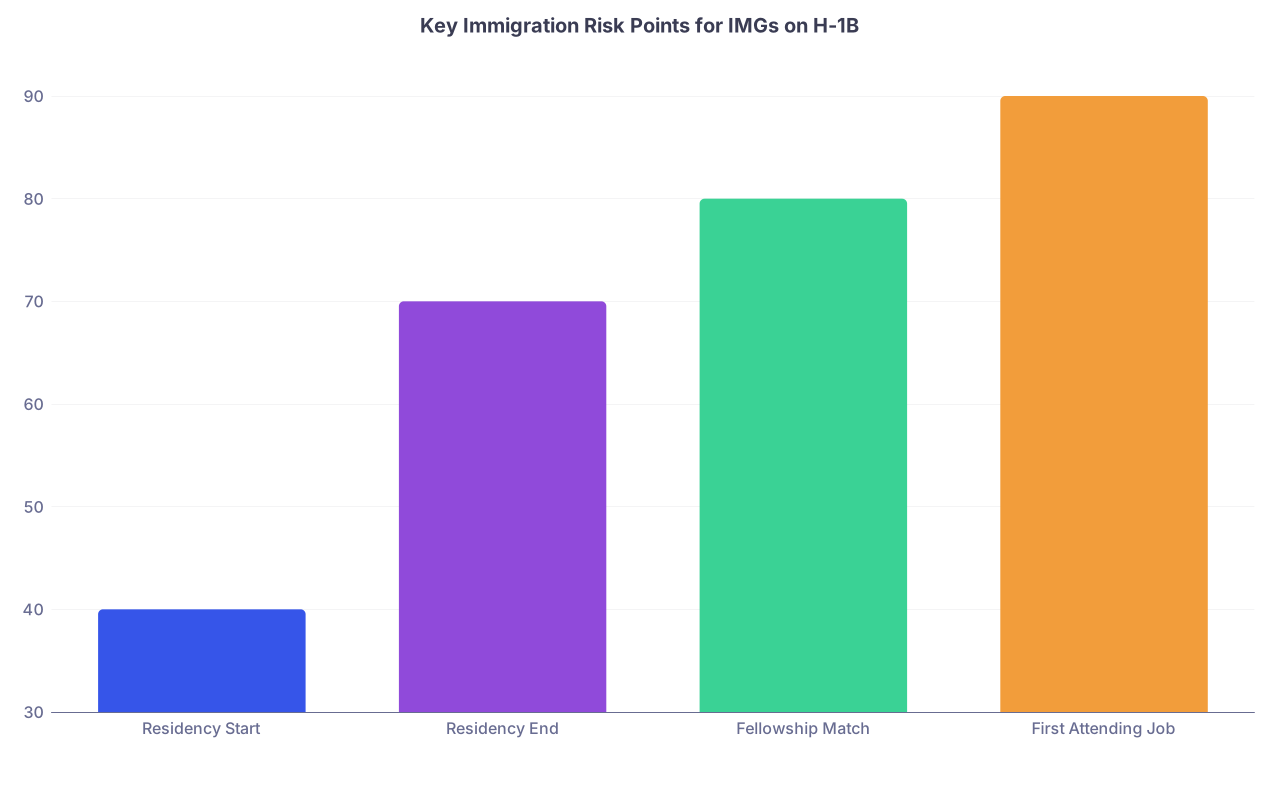
| Category | Value |
|---|---|
| Residency Start | 40 |
| Residency End | 70 |
| Fellowship Match | 80 |
| First Attending Job | 90 |
(Think of those numbers as relative risk, not percentages. The later you go without a green card strategy, the worse it gets.)
The critical planning windows:
- During residency interviews: Ask blunt questions about visa types they sponsor, historical patterns for IMGs, whether they ever do green card sponsorship for later faculty.
- Early in residency: If on H‑1B, do a rough count: how many years will your training path require? What does that leave in the 6‑year bucket?
- Before fellowship applications: Know which programs have historically sponsored H‑1B vs J‑1. Don’t assume. Ask current fellows.
- Before signing any attending contract: Treat “Do you sponsor green cards? When?” as a core part of your negotiation, not a side detail.
Here’s another pattern I’ve watched more than once: The IMG who learns the word “PERM” for the first time in PGY‑4. On H‑1B year 5.
Do not be that person.
Myth #7: “Everybody else seems to figure it out. I’ll be fine.”
Survivorship bias is brutal here.
You mostly see and hear from the people who landed on their feet:
- The cardiology fellow who got H‑1B, then EB‑2, and now talks about “how it all works out.”
- The senior resident who got a J‑1 waiver job in a nice mid‑sized city and is now waiting quietly in the EB backlog.
You don’t hear as much from:
- The resident who had to leave the U.S. after year 6 of H‑1B because their employer never filed PERM and they didn’t realize the timing mattered.
- The fellow who couldn’t start a dream job because the practice was cap‑subject and they lost the H‑1B lottery.
- The IMG who took terrible, exploitative J‑1 waiver work conditions because they had no other option left.
Those people rarely come back to noon conference to give a cheerful “immigration talk.” They’re just…gone.
So yes, many IMGs do “figure it out.” but often:
- By planning early
- By making unglamorous choices (rural locations, less prestigious jobs)
- By being ruthless about which offers are actually viable long‑term
Your goal is not to rely on being lucky. Your goal is to be boringly prepared.
What You Should Actually Do With All This
Let me condense the contrarian angle into something actionable.
First, stop worshipping H‑1B as if it’s a green card. It isn’t. It’s a temporary, employer‑dependent status with a strict time cap that you can only beat through early green card steps.
Second, stop demonizing J‑1 as if it’s career death. For some IMGs, especially those willing to do a J‑1 waiver in a decent underserved area, it can be a very direct bridge to a green card—more direct than H‑1B residency with a non‑sponsoring academic center.
Third, treat your immigration path as a strategy problem, not a vibes problem. For your specialty, your country of birth, and your long‑term goals, map:
- Training length vs H‑1B six‑year limit
- J‑1 waiver job landscape in your field
- Employer types that reliably sponsor PERM/I‑140
And then choose residency, fellowship, and first job options that fit that map, not just what sounds “prestigious” on day one.
Key Takeaways
- H‑1B is not permanent safety; it’s a temporary status with a six‑year fuse that only green card steps can extend.
- “H‑1B is always better than J‑1” is lazy advice; depending on your country, specialty, and waiver prospects, J‑1 + strong waiver job can actually be safer long‑term.
- If you’re not asking concrete visa and green card questions at every major step—residency, fellowship, first job—you’re not planning, you’re gambling.


