

The data shows a blunt reality: most IMGs on J‑1 waivers are underpaid relative to both H‑1B peers and US graduates, especially in rural and safety‑net settings, and they stay underpaid for longer.
If you understand why that happens and what the usual numbers look like, you stop “hoping for a fair offer” and start treating the visa as a hard constraint in a negotiation model. Which is exactly what you should be doing.
Below I am going to walk through what I actually see in contracts, surveys, and market data: salary ranges, bonuses, loan‑repayment patterns, and how J‑1 waiver vs H‑1B status systematically pushes those numbers up or down.
1. The basic economic setup: why visa type moves your salary
You are not negotiating in a vacuum. You are negotiating in a constrained labor market.
Three constraints dominate for IMGs finishing residency:
- Geography restriction (for J‑1 waiver).
- Sponsorship and immigration risk (for both, but different).
- Time pressure at graduation.
Put simply:
J‑1 waiver IMGs usually:
- Must work in a designated underserved area (HPSA/MUA or VA/DoD exception).
- Have a tight timeline to secure a contract to start on time.
- Face fewer alternative employers in a given region.
H‑1B IMGs usually:
- Do not have the 3‑year underserved‑area requirement.
- Have somewhat more geographic and institutional flexibility (especially if transferring H‑1B within cap‑exempt → cap‑exempt or into cap‑exempt roles).
- Can sometimes leverage competing offers more effectively.
Employers understand this. They respond in the most predictable way: they discount salaries and reduce flexibility when the physician has fewer exit options. You see this clearly if you line up the actual numbers.
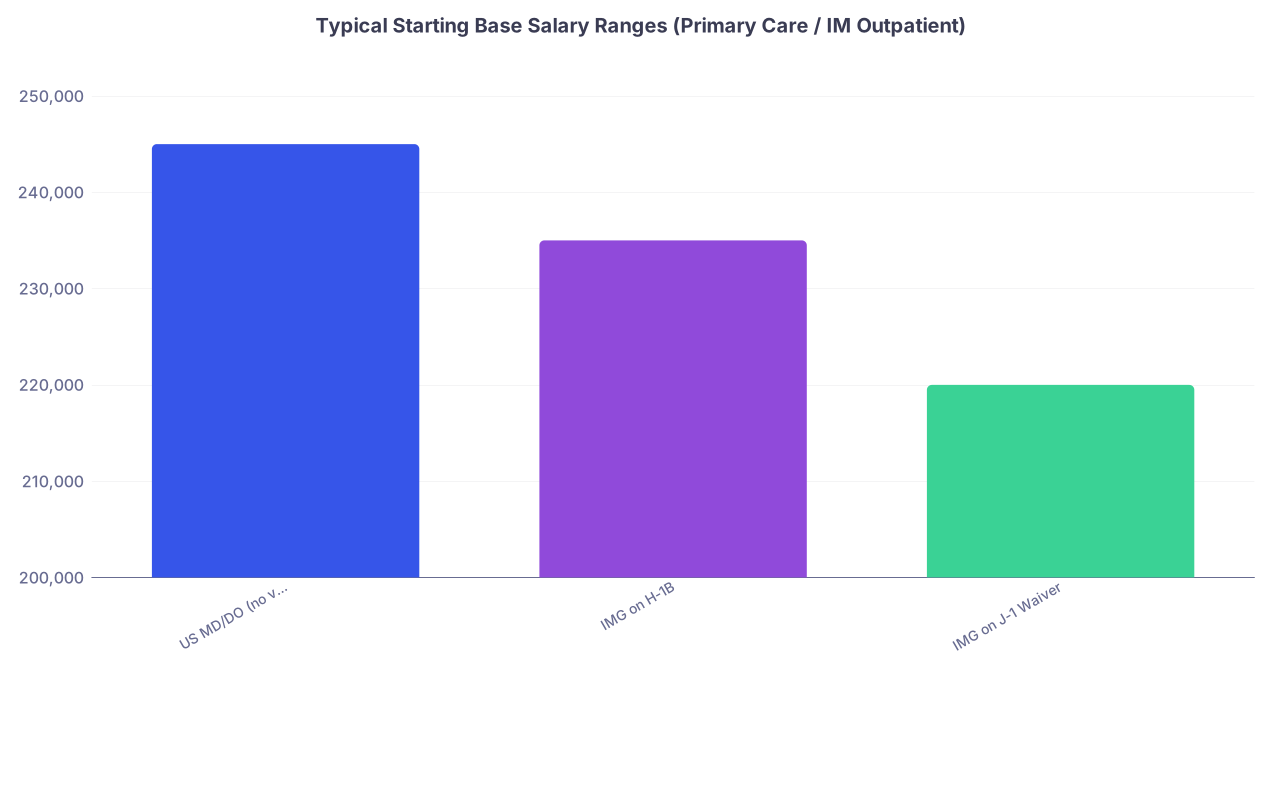
| Category | Value |
|---|---|
| US MD/DO (no visa) | 245000 |
| IMG on H-1B | 235000 |
| IMG on J-1 Waiver | 220000 |
This is illustrative, but it tracks well with MGMA/AMGA medians and real contracts I have seen in the last 3–4 years:
- US MD/DO, no visa: roughly $230k–260k base in many non‑coastal markets for outpatient internal medicine.
- IMG on H‑1B: often $220k–245k in the same markets.
- IMG on J‑1 waiver: more often $200k–235k, even when RVU expectations are identical or higher.
That 10–15% haircut on J‑1 waiver roles is not an illusion. It is a structural effect of leverage, location, and program design.
2. J‑1 waiver attending salaries: patterns and traps
Typical salary structure
Most J‑1 waiver internal medicine roles (hospitalist + outpatient primary care) fit into one of three frameworks:
- Fixed base + modest RVU bonus
- Lower base + higher RVU upside
- Salary guarantee for 1–2 years → then pure production
Some median‑type numbers I keep seeing (non‑academic, non‑coastal, IM hospitalist / outpatient):
- IM hospitalist, J‑1 waiver:
- Base: $240k–280k (7 on / 7 off; 15–18 shifts/month range).
- RVU bonus: modest, often $15–$35 per wRVU above threshold, with high thresholds.
- Outpatient internal medicine, J‑1 waiver:
- Base: $200k–235k.
- RVU bonus or quality bonus adding $10k–30k if targets met.
Compare that to peers without waiver constraints in similar rural markets:
- Hospitalist, non‑visa: $260k–310k base is common.
- Outpatient IM, non‑visa: $225k–260k base, with better bonus structures.
The waiver often knocks $15k–30k off the base and may lock you in for 3 years with fairly weak annual raises (2–3% “cost of living” if you are lucky).
The 3‑year lock‑in and its cost
The J‑1 waiver requirement is 3 years of full‑time service. Employers weaponize that in contracts:
- 3‑year initial term, heavy restrictive covenants.
- Repayment or “liquidated damages” of $60k–150k if you exit early (sometimes framed as forgiveness of relocation/sign‑on over time).
Now run the numbers on a very common real‑world comparison:
- J‑1 waiver job: $220k base × 3 years = $660k total base.
- Comparable non‑waiver / more competitive offer: $240k base × 3 years = $720k.
Difference: $60k over 3 years.
If your J‑1 waiver job is actually underpaying by $20k–30k per year (which I see a lot), you are losing $60k–90k relative to fair market.
That loss directly affects your ability to service loans and save. And because you are contract‑locked, you cannot fix it quickly.
Where J‑1 waiver salaries look better on paper
There is one nuance. Waiver jobs sometimes post higher nominal numbers than urban H‑1B jobs, but the comparison is misleading.
Example I have seen multiple times:
- Rural J‑1 waiver hospitalist:
- $280k base, 7 on / 7 off, lots of nights/nocturnist coverage.
- Urban academic H‑1B hospitalist:
- $215k–230k base, 18–20 shifts per month, heavy teaching, lower RVUs.
Headline: the J‑1 job “pays more”.
Reality: hours, intensity, and call structure are quite different, and the academic job may open much bigger doors (fellowship, research, brand).
So the salary headline can hide opportunity cost. But strictly on cash in vs. hours, the J‑1 waiver roles still cluster lower than non‑visa jobs in the same market.
3. H‑1B attending salaries: more flexibility, smaller penalty
H‑1B physicians still carry immigration risk, but employers do not get the legally mandated 3‑year service benefit of a waiver. That changes the entire bargaining game.
Patterns I see in internal medicine:
- Outpatient IM on H‑1B:
- Base: $220k–250k in many community settings.
- Better access to urban/suburban practices with more balanced compensation.
- Hospitalist on H‑1B:
- Base: $250k–300k depending on shifts and region.
- Some teaching hospitals will be lower pay, but still not “waiver‑discounted.”
The H‑1B discount, relative to US graduates, tends to be smaller and last for fewer years.

A typical pattern:
Year 1–2 post‑residency:
- US grad: 100% of local “market” rate.
- IMG on H‑1B: ~95–98% of that rate.
- IMG on J‑1 waiver: ~85–90% of that rate (especially in primary care).
Year 3–5:
- H‑1B IMG can often switch jobs within the same metro, negotiate higher comp, or move into more lucrative subspecialties / settings.
- J‑1 waiver IMG often completing service in an area with very limited alternative employers, then starting immigration transition (waiver → H‑1B → green card), which limits another 1–2 years of mobility.
H‑1B portability and its salary effect
Portability rules allow H‑1B transfers to new employers, particularly among cap‑exempt institutions (universities, teaching hospitals, some non‑profits). That portability is not magic, but it creates real counteroffer leverage.
I have watched this negotiation many times:
- IMG on H‑1B with 2 years at a community hospital:
- Base $240k, shift load increasing, minimal bonus.
- Competing offer in same state:
- Base $265k + better CME + more predictable schedule.
Physician goes back to current employer with the offer. A 10–15% raise or retention bonus suddenly appears.
This dynamic almost never works the same way during a J‑1 waiver term because:
- You may not find another waiver‑eligible employer in the same region.
- The employer knows you cannot easily “walk away” without restarting the visa/waiver process, which is not trivial.
4. Loan‑repayment: where J‑1 waivers quietly win
Now to the part many IMGs underestimate: loan‑repayment and forgiveness.
J‑1 waiver jobs, by design, concentrate in Health Professional Shortage Areas (HPSAs), rural networks, FQHCs, and safety‑net systems. Those settings disproportionately qualify for federal and state loan‑repayment programs.
H‑1B jobs cluster more broadly:
- Urban private groups.
- Suburban health systems.
- Academic centers (sometimes with internal loan‑repayment, often smaller).
The result: even if J‑1 salaries are lower, the loan‑repayment tailwind can materially narrow or even reverse the financial gap over a 3–5 year span.
Let’s quantify.
Common loan‑repayment programs J‑1 waiver IMGs can access
Patterns I see for internal medicine J‑1 waiver roles:
- National Health Service Corps (NHSC) Loan Repayment:
- Up to $50k for 2 years full‑time at high‑need sites; renewable in chunks.
- State loan‑repayment programs:
- Commonly $25k–$50k per year for 2–4 years in qualifying HPSAs.
- Employer‑based repayment:
- $10k–$30k per year, separate from sign‑on bonus.
Now compare a realistic 3‑year snapshot.
| Scenario | Salary (3 yrs) | Loan Repayment (3 yrs) | Total Cash/Benefit Impact |
|---|---|---|---|
| J-1 Waiver in HPSA with state + NHSC | $660,000 | $90,000–$130,000 | $750,000–$790,000 |
| J-1 Waiver in rural hospital only | $660,000 | $30,000–$60,000 | $690,000–$720,000 |
| H-1B in community hospital (no HPSA) | $705,000 | $0–$20,000 | $705,000–$725,000 |
Numbers are stylized but consistent with real offers:
- J‑1 waiver salary: $220k/year.
- H‑1B salary: $235k/year.
- Loan repayment: $10k–$40k/year for qualifying J‑1 roles vs. usually $0–$10k/year on H‑1B in non‑shortage settings.
You can see the pattern. A strong loan‑repayment package can more than offset a $10k–15k salary penalty.
Public Service Loan Forgiveness (PSLF) angle
Another often‑ignored factor: PSLF.
If you have U.S. federal Direct Loans and work full‑time at a qualifying non‑profit or government employer, PSLF can wipe out massive balances after 120 qualifying payments.
Most J‑1 waiver settings that are:
- FQHCs,
- County or state hospitals,
- Large non‑profit health systems,
…will count toward PSLF.
Many H‑1B jobs in private practice or for‑profit systems do not.
If you owe $300k+ in loans at ~6–7% interest and can qualify for PSLF after 10 years, the long‑run financial gain dwarfs a $10k/year salary difference.
The catch: both J‑1 waiver and H‑1B physicians can qualify for PSLF. The difference is probability of ending up at qualifying employers:
- J‑1 waiver: more likely to be forced into PSLF‑eligible safety‑net roles.
- H‑1B: more likely to choose between PSLF‑eligible academics vs higher‑pay private jobs.
This is where the data becomes less binary and more about your personal strategy.
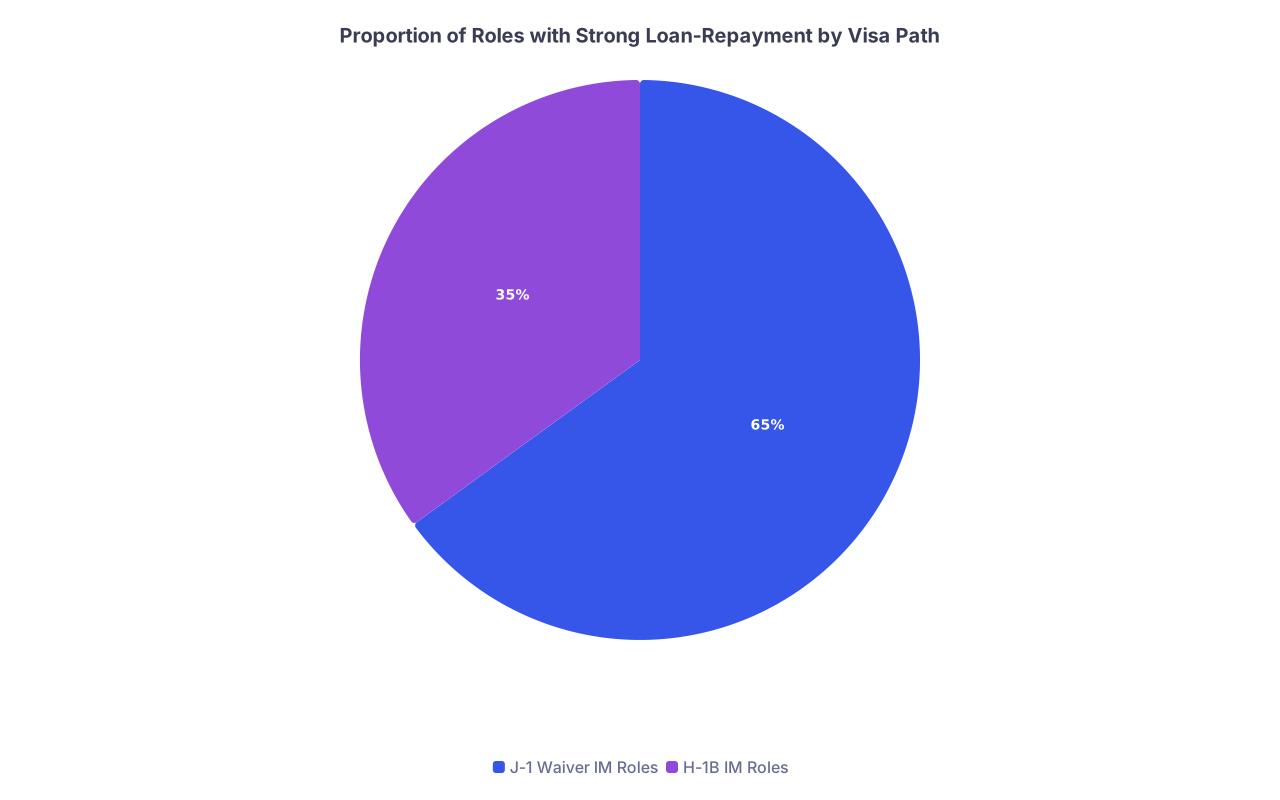
| Category | Value |
|---|---|
| J-1 Waiver IM Roles | 65 |
| H-1B IM Roles | 35 |
Rough but realistic: around 60–70% of J‑1 waiver IM roles I see on job boards and lists highlight loan‑repayment or PSLF eligibility. For H‑1B roles, it is closer to one‑third.
5. Putting it together: net take‑home vs visa path
You do not care about one number. You care about net disposable income and debt trajectory.
Let’s model two internal medicine graduates over the first 5 attending years:
- Both owe $250k in federal loans at 6.5%.
- Both file taxes as single.
- Both live in a moderate cost‑of‑living state.
Scenario A: J‑1 waiver, strong loan‑repayment
- Salary:
- Years 1–3: $220k base J‑1 waiver job, HPSA, some bonuses → assume $230k total average.
- Years 4–5: Moves to H‑1B role at $260k base, mild RVU bonus → $270k total average.
- Loan‑repayment:
- Years 1–3: $30k/year from a combination of state + employer programs.
- PSLF‑eligible employer all 5 years.
Rough 5‑year totals:
- Gross salary: 3 × 230k + 2 × 270k = $1,230,000.
- Loan‑repayment subsidies: 3 × 30k = $90,000.
- Aggressive IDR + PSLF strategy: may pay ~ $100k–$140k out of pocket before potential forgiveness window.
Scenario B: H‑1B, higher salary, minimal loan‑repayment
- Salary:
- Years 1–3: $240k base + bonus → $255k average.
- Years 4–5: switches to $280k base + bonus → $295k average.
- Loan‑repayment:
- Small employer incentive Years 1–2: $10k/year.
- Works at non‑PSLF eligible private systems entire time.
5‑year totals:
- Gross salary: 3 × 255k + 2 × 295k = $1,355,000.
- Loan‑repayment subsidies: 2 × 10k = $20,000.
- No PSLF; typical aggressive standard/extended payoff: might pay $220k–260k total over that time horizon.
Now compare:
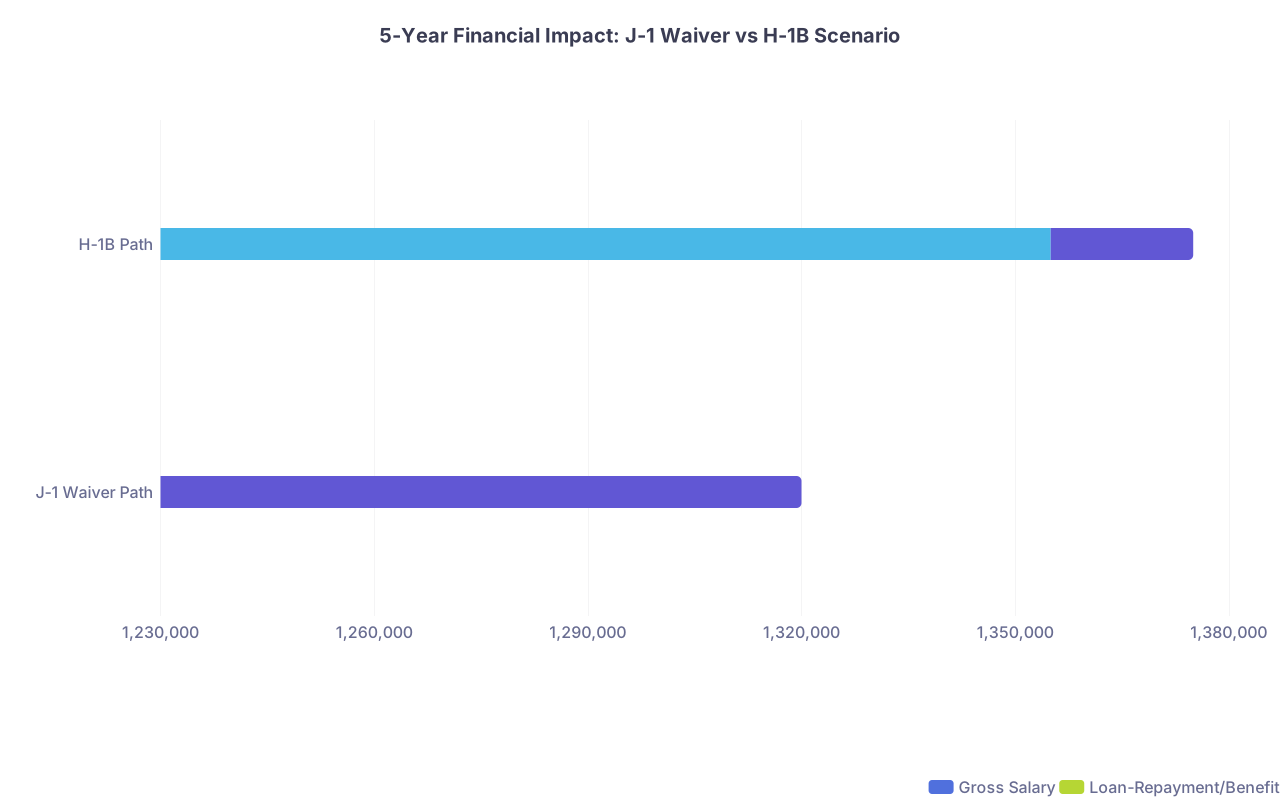
| Category | Gross Salary | Loan-Repayment/Benefits |
|---|---|---|
| J-1 Waiver Path | 1230000 | 90000 |
| H-1B Path | 1355000 | 20000 |
At 5 years, the H‑1B path has earned roughly $135k more in salary. But the J‑1 path has $70k more in direct loan support and, if PSLF is properly set up, may be heading toward substantial forgiveness after 10 years. That future loan relief can easily be worth hundreds of thousands.
So which is “better”? Pure cash salary says H‑1B. Student‑loan‑adjusted net worth can lean toward the J‑1 waiver path if you exploit every government and employer program available.
6. Practical signals to watch in real offers
Let me strip this down to what matters when you have two PDFs in your inbox and 7 days to sign.
When comparing a J‑1 waiver offer vs an H‑1B offer, quantify these:
Base salary and structure
- Is the salary a fixed 3‑year guarantee or does it reset?
- Are raises automatic or discretionary?
- Is RVU/bonus real, with attainable thresholds, or decorative?
Loan‑repayment components
- Federal/state programs explicitly mentioned?
- Employer‑based repayment: how much per year, for how long, and what are the clawbacks if you leave?
- PSLF‑eligible employer or not?
-
- J‑1 waiver: 3‑year service + early‑termination penalties.
- H‑1B: what non‑compete radius, what notice period, any repayment of immigration costs or bonuses?
Immigration trajectory
- Does employer sponsor green card promptly (PERM/I‑140)?
- Any written commitment to file within first year?
- For J‑1s: is the employer experienced with waiver processes and subsequent H‑1B/green card steps?
Total 3–5 year financial path
- Sum salary + likely bonuses + loan‑repayment.
- Subtract your realistic loan payments and living costs.
- Ask: which path leaves me with higher net worth and optionality after 3–5 years?
To make this concrete, here is how two internal medicine offers might compare numerically.
| Feature | J-1 Waiver Offer (Rural HPSA) | H-1B Offer (Suburban Community) |
|---|---|---|
| Base Salary Year 1 | $220,000 | $240,000 |
| Expected Total Year 1 | $230,000 (bonus) | $255,000 (bonus) |
| Loan-Repayment / Year | $25,000 (state + employer) | $5,000 (employer only) |
| Contract Term | 3 years | 2 years |
| PSLF Eligible | Yes | No |
| Non-Compete Radius | 50 miles | 20 miles |
| B --> | J-1 | C[J-1 Waiver Jobs Only] |
| B --> | H-1B | D[Broader Job Options] |
| E --> | Yes | F[Consider J-1 despite lower salary] |
| E --> | No | G[Push for higher J-1 comp] |
| H --> | Yes | I[Prefer PSLF-eligible H-1B roles] |
| H --> | No | J[Maximize salary/future mobility] |
7. Common myths that the data does not support
A few patterns I see residents repeat that simply do not hold up:
“All J‑1 waiver jobs pay a lot because they are desperate.”
No. Some pay more nominally, but adjusted for RVUs, call, and leverage, a significant fraction pay less than equivalent non‑waiver roles.“H‑1B always means low salary because of sponsorship burden.”
Also wrong. Sponsorship cost is tiny relative to your annual revenue as a physician. Many systems hardly discount at all for H‑1B, especially once you have US training and board certification.“Loan‑repayment is just marketing; it does not move the needle.”
Completely false when you owe $200k–400k. Well‑structured NHSC + state + employer repayment can shift $60k–150k over a few years. That is not marketing. That is the difference between still drowning in debt and seeing daylight.“PSLF will not be around in 10 years, so ignore it.”
Policy risk exists, but betting your entire financial life on PSLF disappearing while you work at a county hospital is not rational. The historical data so far: PSLF had implementation issues, but the federal government has doubled down with temporary waivers and fixes rather than scrapping it.
8. How to approach your own decision like an analyst
If you want to do this rigorously, build a simple spreadsheet with:
- Rows: Years 1–10.
- Columns:
- Base salary.
- Expected bonus.
- Loan‑repayment benefits.
- Estimated taxes.
- Loan payments (standard vs IDR).
- Net savings / net worth.
Run it twice:
- Scenario 1: J‑1 waiver → then H‑1B → PSLF if applicable.
- Scenario 2: H‑1B from start, with realistic job changes.
I have done this with residents in real time. Outcomes vary, but a few patterns repeat:
- If you have low debt (<$100k) and no strong interest in academics/safety‑net medicine, higher‑salary H‑1B jobs often win financially.
- If you have very high debt ($250k+) and can lock in strong loan‑repayment + PSLF‑eligible roles, some J‑1 waiver paths come out ahead despite lower salaries.
- The real killer for J‑1 is accepting a low‑paying waiver job without meaningful loan‑repayment or PSLF. That is the worst of both worlds: lower income, high lock‑in, minimal debt relief.

9. Key takeaways
J‑1 waiver IMGs usually start with lower base salaries and less mobility than H‑1B peers, but they have better access to rich loan‑repayment and PSLF‑eligible roles that can partially or fully offset the salary gap.
H‑1B IMGs tend to earn more and regain bargaining power earlier, but often see weaker structured loan‑repayment, shifting the onus of debt payoff entirely onto salary and personal discipline.
The financially smart choice is not “J‑1 good” or “H‑1B good.” It is: maximize total 3–10 year net worth by combining salary, loan‑repayment, and immigration trajectory, instead of fixating on any single year‑one base salary number.


