
The faculty member who bases your career path on your family plans is wrong—and you need a concrete response plan, not just outrage.
This is where “women in medicine” stops being an abstract value statement and becomes a Tuesday afternoon in a cramped office with someone twice your academic power telling you surgery is “hard with kids.”
Let’s walk through what to do when that happens. Not philosophically. Tactically.
1. Name What’s Actually Happening
First, let’s get blunt: when a faculty member suggests your specialty, hours, or trajectory based on:
- your desire (or non-desire) to have kids
- your relationship status
- your age and “biological clock”
- your perceived “family responsibilities”
…that’s not “mentorship.” It’s bias. Often gendered. Often illegal if it crosses into decision-making about opportunities.
Common phrases you might hear:
- “Women with kids really struggle in ortho. Have you thought about pediatrics?”
- “You’re engaged—are you sure you want to be an interventionalist?”
- “Programs worry about women going on maternity leave early in residency.”
- “With your family situation, I’d be cautious about choosing anything too demanding.”
- “If you want kids soon, maybe aim for something more controllable.”
I’ve heard all of those, verbatim, said to actual residents and students.
You don’t need to argue about whether they “meant well.” Impact > intent. The impact is:
- You’re being funneled based on gendered assumptions.
- Your autonomy is being quietly undermined.
- You’re being told your reproductive plans are the organizing principle of your career.
So the goal is not to win a philosophical debate. The goal is to:
- Protect your options.
- Send a boundary signal.
- Decide if and how to escalate.
2. Decide Your Priority in This Moment
Before you answer, you need to know what you’re optimizing for. In the actual room, you usually can’t have everything.
Your priorities might be:
- Preserve this relationship because you need a letter
- Shut this down because you’re done tolerating it
- Extract any useful info and discard the bias
- Create a paper trail for a pattern you’re starting to see
Different situations, different moves.
Use this quick internal triage:

| Step | Description |
|---|---|
| Step 1 | Faculty comments on family plans |
| Step 2 | Maintain working relationship |
| Step 3 | Can you safely push back? |
| Step 4 | Polite boundary, redirect topic |
| Step 5 | Directly challenge assumption |
| Step 6 | Short answer, document later |
| Step 7 | Do you need their support for eval or letter? |
You do not have to be brave every time. You do have to be strategic.
3. Scripts You Can Actually Use—In The Room
Let’s get concrete. Here’s how to respond in different scenarios.
Scenario A: You Need Their Letter / Evaluation
You’re a third-year student. Clerkship director. You need honors. They say:
“If you want a family in the next few years, I’d avoid anything as intense as general surgery.”
You can’t burn this bridge, but you also don’t have to silently swallow it.
Try something like:
- Validate the surface (career thinking), reject the premise (family as primary filter), and redirect.
“Planning a sustainable career is definitely important to me, but I’d like to focus on fit with the work itself. Based on my performance so far, how do you see me fitting into general surgery as a field?”
or:
“I’m thinking about long-term career satisfaction more than specific life milestones. When you look at my skills and interests, which surgical paths do you think I could be competitive for?”
You’re doing three things:
- You’re not giving them ammunition about family timing.
- You’re re-centering the conversation on your abilities and interest.
- You’re quietly signaling: I’m here to talk about my career, not my uterus.
If they push:
“Well, I just know a lot of women who struggle once kids come along.”
You can keep it short:
“I appreciate your concern. I’m comfortable making my own decisions around family planning. I’d really value your feedback on my performance and competitiveness.”
Then stop. Silence is your friend. Make them either change topics or double down (which becomes useful later if this turns into a pattern you document).
Scenario B: You Don’t Need Them, And You’re Done Being Polite
You’re a resident. Not counting on this person for a letter. They say:
“Interventional is hard for a mom. Have you considered general cards instead?”
You can be more direct:
“I want to be clear—I’m choosing my specialty based on my interest and skill set, not on assumptions about parenting. I’d rather focus on training and career fit than on stereotypes about who can do what with kids.”
or, if you want to call it by name:
“When career advice is based on gendered assumptions about family, it can be discouraging. I’d appreciate keeping the focus on my abilities and goals.”
You’re identifying the bias without starting a screaming match. That alone makes many people back off.
Scenario C: They Ask Directly About Your Family Plans in a Gatekeeping Context
Example: fellowship PD in an “informal” meeting:
“So, any plans to start a family during fellowship?”
That’s a red flag. For residency and fellowship recruitment, this can cross into prohibited territory.
You can choose a non-answer that flips it:
“I’m fully committed to completing the fellowship and meeting its demands. I’m very intentional about planning my personal life around my training, not the other way around.”
If they push again:
“I prefer to keep my personal plans private. I can assure you I’m committed to fulfilling the obligations of the program.”
You’re allowed boundaries. You don’t owe them your reproductive timetable.
4. Keep the Useful Parts, Discard the Bias
Sometimes under the garbage is a valid point. For example:
- “This specialty has a lot of overnight call.”
- “Part-time options are rare in this field.”
- “Procedural specialties can have unpredictable schedules.”
Those facts matter—for everyone, not just women with hypothetical babies.
When you hear a biased framing, mentally translate it:
Biased version:
“Women with kids don’t do well in ortho.”
Reality-based translation:
“This field has long, physically demanding hours, and many people—of any gender—find that challenging with caregiving responsibilities.”
You can then ask neutral, data-focused questions:
- “What’s the typical weekly schedule like?”
- “How many faculty here work less than full-time?”
- “What kinds of schedule adaptations have you seen trainees use successfully?”
- “What’s the culture like around parental leave for all residents?”
This moves the conversation from “are you planning to procreate” to objective workload and culture—which is actually useful.
5. Document, Document, Document
If your antenna goes up—especially if this is not the first comment from this person—start a record. Not because you’re definitely filing a complaint, but because you want the option.
Immediately after the conversation, email yourself or a trusted account:
- Date, time, location
- Who was present
- Exact phrases as close as you can recall
- Your response
- How it made you feel / any perceived impact on opportunities
Example of a contemporaneous note:
1/12, 3 PM, Dr. K office. During “career advising,” he said: “If you’re planning to have kids in the next few years, I’d steer clear of EM and surgery; programs don’t like losing women to maternity leave.” I redirected to my interest in surgery. Felt pressured to discuss family plans. Concern: bias in future evaluations.
You’re building a pattern, not a gotcha moment.
If it escalates later (e.g., your evaluation mysteriously tanks after you assert boundaries), this record becomes critical.
6. Decide Whether To Escalate—And How
You have several escalation routes. None are perfect. Pick based on risk, your energy, and severity.
| Option | Best For |
|---|---|
| Informal ally check-in | Sanity check, pattern spotting |
| Trusted faculty mentor | Strategy, protection |
| Clerkship/Program dir | Pattern, impact on training |
| GME/Title IX/HR | Serious or repeated behavior |
Step 1: Sanity Check with Peers or Near-Peers
Talk to senior residents, other women in the department, or alumni.
Good question to ask:
- “Have you ever gotten career ‘advice’ here that felt tied to gender or family?”
- “Have you heard similar comments from Dr. X?”
If three people independently say, “Oh yeah, that’s his thing,” then you’re probably not imagining it.
Step 2: Bring It to a Trusted Mentor
Pick someone with:
- Some power
- A reputation for actually caring about trainees
- No obvious conflict of interest with the offender
Script:
“I’d like your advice about something that happened in a career advising meeting. I got feedback that seemed tied to assumptions about my family plans rather than my abilities. I’ve written down what was said. I’m trying to figure out if this is something to let go, address directly, or bring forward more formally.”
Then you shut up and let them talk. A good mentor will help you:
- Gauge how serious this is in your institution’s culture
- Predict fallout of different options
- Sometimes intervene behind the scenes
Step 3: Formal Routes (When It’s Repeated or Harmful)
If:
- You’re being steered away from opportunities
- You feel pressured to disclose pregnancy plans
- Evaluations explicitly reference family inappropriately
- The same person does this to multiple trainees
…you’re now in territory where GME, Title IX, or HR may be appropriate.
You can often start with a “hypothetical” consult:
“I want to discuss a concerning pattern I’ve observed in faculty advising regarding gender and family assumptions. I’m not sure yet if I want to file a formal complaint, but I’d like to understand my options.”
Ask about:
- Confidentiality limits
- Potential retaliation protections
- What documentation they’d want
No, this shouldn’t be on you. But this is the game board we’re playing on.
7. Boundaries Around Your Personal Life
You are allowed to treat your reproductive life as private health information. Because it is.
You do not have to answer:
- “When are you planning to have kids?”
- “Are you trying right now?”
- “Do you think you’ll freeze your eggs?”
- “Does your partner want to stay home?”
Both faculty and “nice” colleagues will ask intrusive questions, sometimes framed as helpful.
Standard boundary phrases you can reuse:
- “I prefer to keep my personal life separate from evaluations and career decisions.”
- “That’s something I’m keeping private, but I’m fully committed to this training.”
- “I’m not comfortable discussing that in this context.”
If they act offended, that’s their problem. Not yours.
8. If You’re Caught Off Guard and Say Nothing
You will have the conversation where you freeze, nod, and leave, then spend the rest of the day furious in the stairwell.
That doesn’t mean you lost.
You can still:
- Document it.
- Debrief with someone you trust.
- Decide if you want a “do-over” via email or later conversation.
Example of a follow-up email:
“Dr. Smith, thanks for meeting with me about career options yesterday. I’ve been thinking more about our discussion. I want to emphasize that I’m selecting a specialty based on my interests and strengths rather than assumptions about my personal life or family plans. Going forward, I’d really value feedback focused on my clinical performance and fit for different fields.”
This:
- Creates written evidence
- Clarifies your boundary
- Forces them to see their words in a new light
You’re allowed to respond late. It still counts.
9. Protecting Your Long-Term Career Freedom
Let’s zoom out. The point of pushing back on this isn’t only about that one attending’s bias. It’s about not letting other people’s limited imagination shrink your life.
A few principles to keep in your back pocket:
- Every specialty has parents in it. Every single one.
- “You can’t be X and have kids” really means “I’ve only seen one rigid model of how to do this field.”
- You get to change your mind—about both family and specialty.
- The system will always be happy to default you into “flexible” and “less prestigious” roles if you don’t actively claim space.
If you decide you want to pick a “lifestyle” specialty because it genuinely fits you—great. But do it because you love the work, not because some guy in an office projected his anxieties onto your ovaries.
Seek out counterexamples deliberately:
- Women surgeons with kids
- Women cardiologists with non-traditional schedules
- Single women in “family-friendly” fields who are still overworked
Get their unfiltered stories. Ask what they’d do differently. Build your own data set, not just what the loudest faculty member thinks.
10. Quick Mental Checklist in the Moment
When someone brings up family in a career conversation, run this mini-script in your head:
- Do I want to engage or deflect?
- Do I need something from this person (eval, letter, rotation)?
- Can I redirect back to skills, interests, and objective demands of the field?
- Do I need to write this down afterwards?
If all else fails, you can always say:
“I appreciate your perspective. I’ll take that under consideration,”
then go talk to someone whose worldview wasn’t fossilized in 1995.
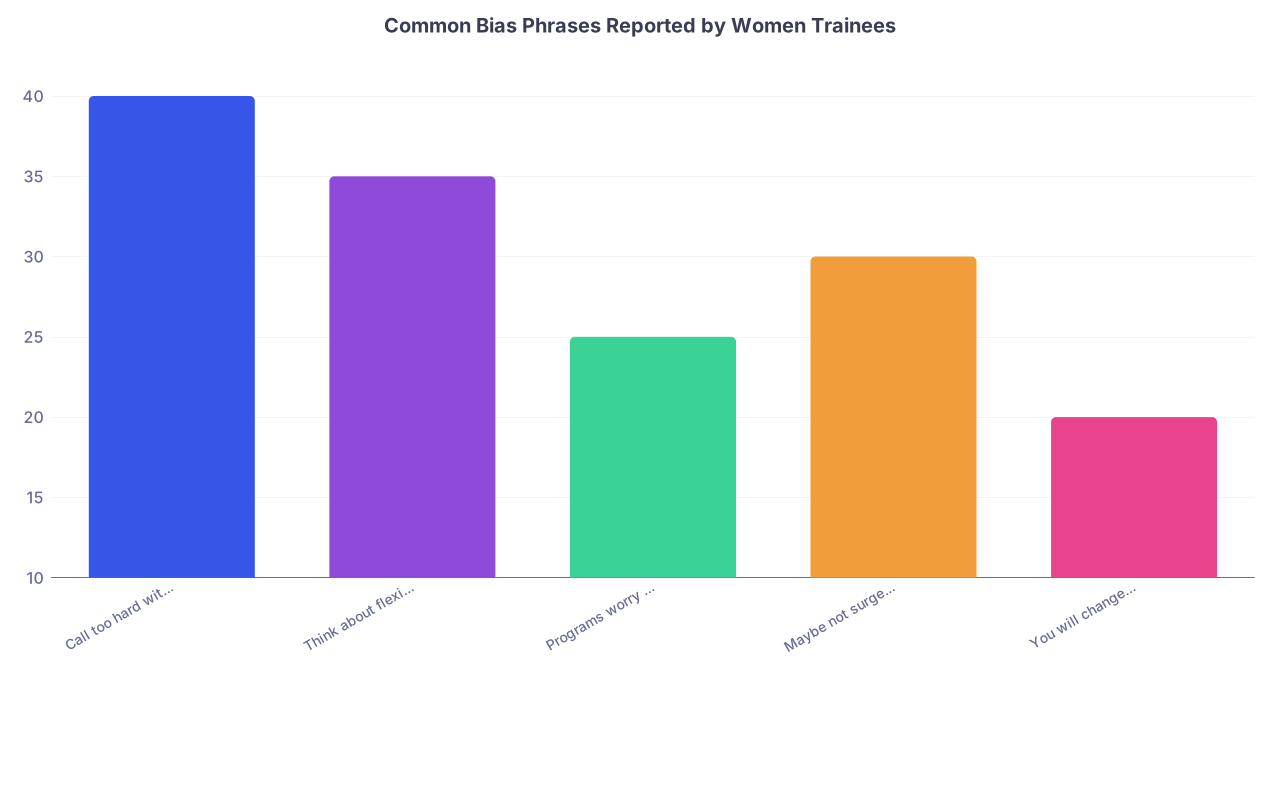
| Category | Value |
|---|---|
| Call too hard with kids | 40 |
| Think about flexible field | 35 |
| Programs worry about leave | 25 |
| Maybe not surgery for women | 30 |
| You will change mind after kids | 20 |
11. Building Your Own Advisory Circle
You cannot rely on random faculty assigned to “advise” you. Build a small, intentional circle:
- 1–2 women in your field of interest
- 1 person who is child-free and happy about it
- 1 person in a “hard” specialty who has a family
- 1 person outside your department who understands institutional politics
These are the people you reality-check with:
- “My advisor said X—does that sound like good advice or bias?”
- “What questions should I ask about lifestyle that don’t trigger assumptions?”
- “How did you think about kids and training, if you did?”
Think of it as your personal IRB for life decisions.

12. Ethical Grounding: You’re Not the Problem
There’s an ethical layer underneath all of this. Medicine talks a big game about diversity and inclusion. But your experience in that office reveals the gap between slogans and reality.
Here’s the ethical bottom line:
- It is not “good mentorship” to assume a woman’s primary identity is future mother.
- It is not “honest advice” to universalize a few burned-out colleagues’ choices.
- It is not “caring” to pre-limit someone’s ambitions to protect them from a system we could instead be working to change.
You are not asking for special treatment when you insist on being evaluated on your merits. You’re asking for baseline fairness.
And yes, that’s exhausting. You’re doing your actual job and then this meta-job of managing other people’s biases. You’re allowed to be tired of it.
So pick your battles. But remember: every time you calmly refuse to accept “you can’t because of kids” as the starting point, you make it fractionally easier for the woman behind you.
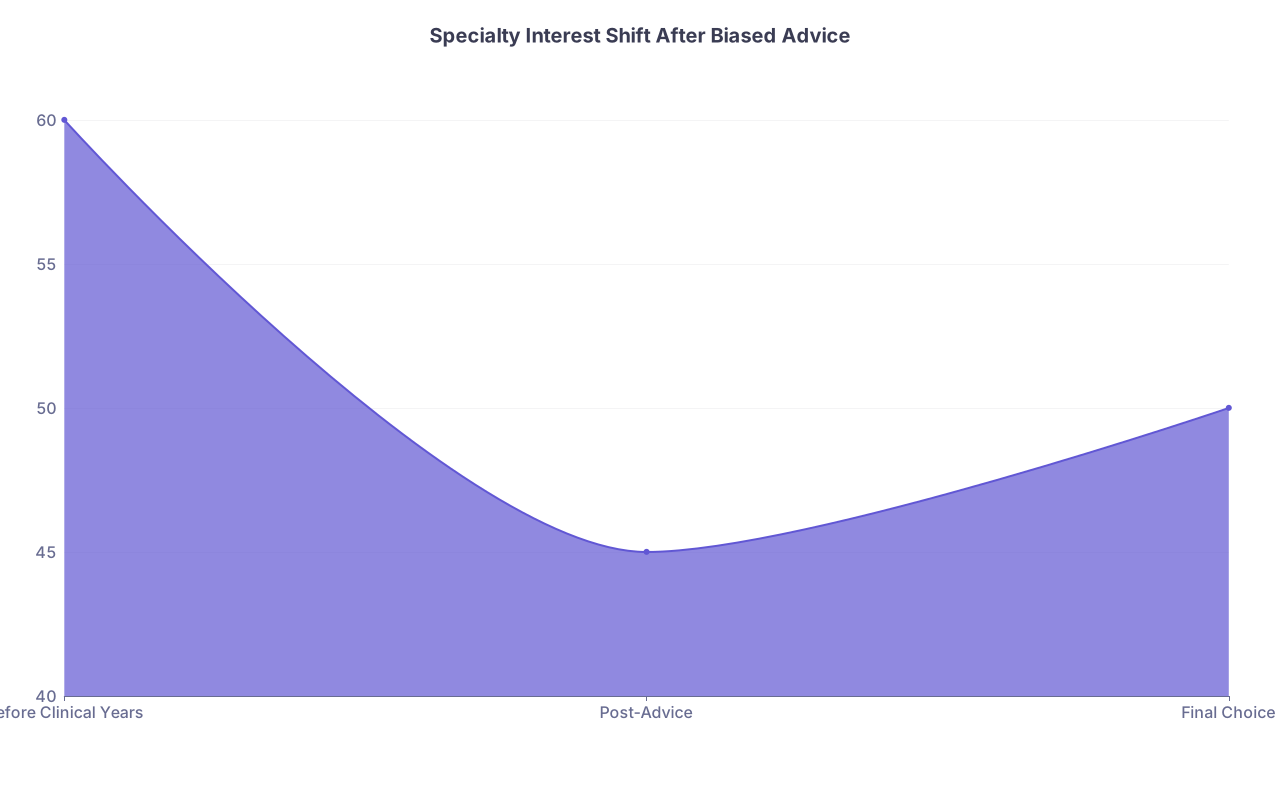
| Category | Value |
|---|---|
| Before Clinical Years | 60 |
| Post-Advice | 45 |
| Final Choice | 50 |

FAQ (Exactly 4 Questions)
1. Is it ever appropriate for faculty to talk about family when advising on career choices?
Yes, but only if you invite it. There’s a difference between you saying, “I know I want to be the primary parent, how does that work in your field?” and them assuming that about you. The ethical version is: they describe objective demands of the field, share a range of paths people have taken, and let you decide how your personal life fits. The unethical version is: they pre-filter options for you because of your gender or assumed family role.
2. Should I disclose that I’m pregnant or trying to conceive when applying to residency or fellowship?
From a fairness perspective, you shouldn’t have to hide it. From a practical perspective, disclosure still carries risk in many places. My blunt advice: you are under no obligation to share that information during applications or interviews, and there is rarely a strategic upside. If you do disclose, do it to people you already trust, not gatekeepers who hold your acceptance in their hands.
3. How do I handle it when the biased advice comes from a woman faculty member?
Same way. Internalized bias is still bias. “I did X, and it was hard with kids, so you shouldn’t do X” is about their life, not yours. You can say, “I appreciate you sharing your experience. I’d love to hear about colleagues who made different choices too, so I can see a range of models.” If they still universalize their path, mentally tag it as one data point, not a rule.
4. What if I genuinely want a more “lifestyle-friendly” specialty—am I letting women down?
No. The problem isn’t that some women pick more flexible fields. The problem is when they feel pushed there by bias or lack of support. If you’ve looked at your values, your interests, and your actual day-to-day happiness and you land on dermatology or peds or path—own it. That’s a strong choice. Just be honest with yourself that it’s your decision, not something you accepted because authority figures told you the doors to other fields were closed.
You’re going to keep running into this—on rounds, in “mentoring” sessions, in interviews disguised as coffee chats. The comments won’t disappear overnight. But your ability to respond skillfully can grow fast.
You’ve now got scripts, escalation paths, and a way to separate useful information from sexist noise. Use them. Refine them. Share them with the MS2 who’s about to walk into the same office after you.
And as you get more senior, you’ll have your own advisees sitting across from you, waiting to see what kind of physician you’re going to be. That’s when you’ll rewrite the script entirely. But that’s the next phase of this story.