
What if that one time you finally stood up for yourself is the exact thing that quietly destroys your entire career?
Because that’s the fear, right?
Not the abstract “ethics” stuff. The very specific, sick-to-your-stomach thought: I reported harassment. Now every whisper network in academic medicine is going to label me “difficult,” and no top program will touch me.
Let’s talk about that. Honestly. No sugarcoating. But also not the doom spiral your brain keeps looping on at 2 a.m.
The Fear You’re Not Saying Out Loud
You probably aren’t worried about whether reporting was “right.” You know it was. Or at least… you know what happened wasn’t.
You’re worried about the fallout.
You’re thinking:
- “Are PDs going to see some vague ‘professionalism’ comment and assume I’m the problem?”
- “Do programs secretly blacklist people who file complaints?”
- “Will my Dean’s letter quietly poison my application?”
- “Did I just trade safety and integrity for a worse match or no match at all?”
And if you’re a woman in medicine, especially in a male-dominated specialty, the fear turns up to maximum: What if I’m now “that girl”? The one who complained. The one they warn each other about.
I’ve watched students go through this. I’ve seen the emails, heard the offhand comments in hallways. Some people are supportive. Some are… not. Academia can be petty as hell.
So let me be very clear on one core thing:
Yes, you can still match competitively after reporting harassment.
But. The path might be messier, and you can’t be naive about that.
What Programs Actually Care About (Versus What You’re Imagining)
Programs don’t sit around with a list labeled “whistleblowers to avoid.” They do, however, care about risk. Anything that looks like instability, drama, or lack of professionalism makes them pause. Sometimes unfairly.
The problem is: harassment reporting lives in a gray area in their minds. They’ve seen:
- True, serious reports that exposed predators.
- Weaponized complaints used in power struggles.
- Quiet retaliation that never makes it to paper, but everyone “just knows.”
So programs get jumpy.
To understand how this hits you, you have to know where it can show up in your application.
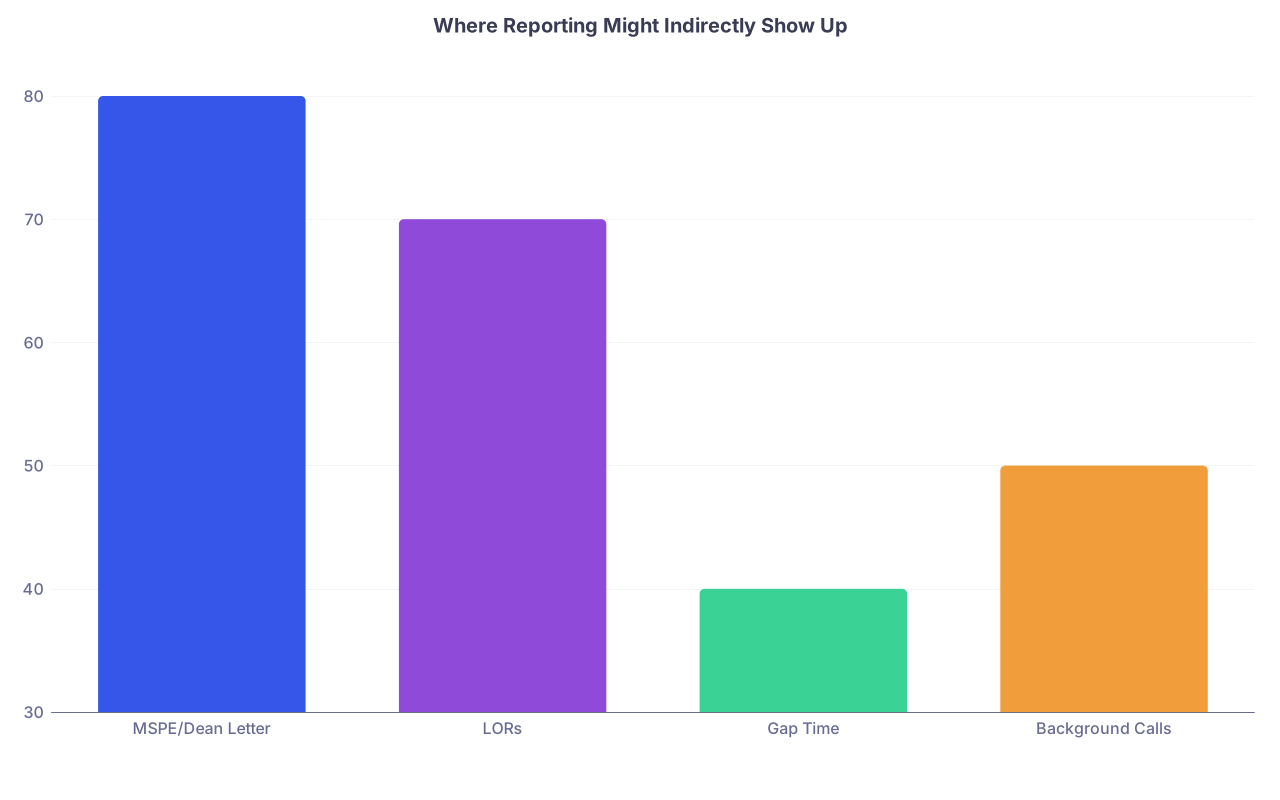
| Category | Value |
|---|---|
| MSPE/Dean Letter | 80 |
| LORs | 70 |
| Gap Time | 40 |
| Background Calls | 50 |
Those numbers aren’t real data; they’re just a rough way of saying: the biggest risks are narrative, not checkboxes.
MSPE / Dean’s Letter
Most schools won’t explicitly say, “She reported harassment.” That would be a lawsuit waiting to happen.
But they might:
- Soften or omit praise from certain rotations.
- Use vague phrases like “required additional support,” “navigated complex interpersonal issues,” or “had conflict during clinical training.”
- Flag “professionalism” issues if the institution decided to protect the harasser, not you.
Some schools are great. They protect you. Others? I’ve seen them bury students.
Letters of Recommendation
This is where things really get dicey.
If the person you reported was a big name or tightly connected, there’s a risk that:
- Their friends quietly tank you with lukewarm letters.
- Attendings who “don’t want to get involved” withhold strong support.
- People subtly frame you as “sensitive,” “needs a lot of support,” or “better in structured environments.”
Or the opposite happens: one attending sees what you went through, is furious on your behalf, and writes you the strongest letter of your cycle.
Both scenarios are real. I’ve seen both.
Backchannel Communication
This part no one likes to admit: program directors talk. Informally.
“Hey, this applicant rotated with you—anything I should know?”
“Oh, yeah, there was some drama. Be careful.”
Or: “She had a rough situation with a faculty there, and she handled it really well.”
No official record. No way to “prove” anything. Just humans gossiping at conferences and in group chats.
So yes, there’s risk. But also, there’s opportunity for people to vouch for you.
The Ethics vs Reality Collision
You did something medicine says it values: you reported harassment, upheld a safe learning environment, refused to normalize abuse.
And yet you’re scared that the system will punish you for it.
You’re not crazy for thinking that. Medicine loves “professionalism” until it costs them a powerful attending or threatens grant money. Then suddenly, you’re “disruptive.”
Here’s where I land on it:
- Ethically: You did the right thing. Full stop.
- Politically: The system is not always kind to people who do the right thing.
- Strategically: You need to be smart about how you move from here.
Doing the right thing doesn’t guarantee the system will reward you. It does mean you need to protect yourself while that system catches up—if it ever does.
Can You Still Match Competitively? Yes. But Here’s What Matters.
Matching “competitively” means different things: Derm at MGH versus solid IM at a good academic program. Your baseline stats matter: scores, grades, research. No way around that.
But let me assume you were already reasonably competitive for your specialty. Then ask: does this one event define your entire application?
Usually: no. Unless the school or faculty go out of their way to weaponize it against you. That happens, but it’s not automatic.
| Situation | Relative Match Risk |
|---|---|
| Harasser was a resident, quickly removed | Low |
| Harasser was a minor faculty, leadership supported you | Low–Moderate |
| Harasser was big-name chair, you’re in same specialty | Moderate–High |
| You withdrew from rotation / took LOA tied to incident | Moderate–High |
| Documented “professionalism concern” linked to it | High |
Notice something: it’s not the report itself. It’s how your institution and specialty ecosystem reacted around it.
You can still match competitively if:
- You have at least a few people in your corner who will go to bat for you in letters and phone calls.
- Your MSPE isn’t a disaster zone of passive-aggressive wording.
- You can explain any weirdness (LOA, grade shifts, rotation changes) calmly and coherently in interviews without sounding like chaos follows you.
What kills applications isn’t “I reported harassment.” It’s when the overall narrative becomes: “Wherever she goes, there’s drama.”
So your job is to make sure your file reads like: “High-performing applicant who had one really bad situation and handled it with maturity.”
How To Talk About It Without Torching Your Application
You don’t need to open every interview with, “So I reported harassment…”
In fact, don’t.
But you do need a controlled, practiced way to talk about it if it comes up—because it might, especially if there’s an LOA, transfer, unusual evaluation, or you changed specialties.
Think of it like this: three parts, no details.
Context without trauma-dump
“During my clinical years, I faced an inappropriate situation with a supervising physician that created a hostile learning environment.”Action you took
“I used the formal reporting channels available to me and worked with student affairs to address it.”What you learned / how you grew
“It was a difficult experience, but it reinforced how important psychological safety is for learners and patients. I also learned to set boundaries, document concerns appropriately, and seek support early.”
Short. Steady. No names. No emotional spiral in the middle of an interview.
If they push for details—which most decent interviewers won’t—you can hold the line:
“I’m not comfortable going into specifics about individuals, but I’m happy to talk about how it shaped my commitment to safe, respectful training environments.”
If something in your file clearly demands explanation (like a professionalism blurb), you can say:
“There was a conflict that arose after I reported behavior I felt was inappropriate. Looking back, I might handle parts of it differently in terms of communication, but I stand by raising the concern. Since then, I’ve worked closely with mentors and have had strong, positive clinical evaluations.”
This signals: I’m not a grenade. I’m self-aware. I won’t let you get sued, but I’m also not a doormat.
Protecting Yourself Quietly (Without Going Full Conspiracy Mode)
I know the instinct: “If I just work hard enough, it’ll all be fine.” That’s naïve. Hard work matters, but strategy is survival.
A few things you can control:
1. Who Writes Your Letters
Do not—under any circumstances—rely on anyone adjacent to the problem for a key letter. Even if they “seem fine now.” Even if they apologized once.
Pick attendings who:
- Saw you work after the incident.
- Are known to be decent humans.
- Have some academic or institutional weight.
You want at least one person who, if a PD calls and asks, “Is there anything I should be worried about?” will unambiguously say: “No. She’s solid. If anything, she handled a tough situation better than most would.”
2. Who Knows the Full Story
Find one or two people in positions of real influence—clerkship director, program director at home, trusted dean—who know what happened and believe you.
Not five. Not everyone. You’re not starting a political campaign.
You’re protecting yourself for when the backchannel calls happen.
“Yeah, I know about that situation. Her version is accurate. She was put in a bad position and did the right thing.” That sentence can save a whole season.
3. Your Specialty and Program List
If the harasser is a big name in your target specialty, be realistic: there may be a few programs where it’s not worth applying. Their best friend is the PD? They run the fellowship you’d need? That’s not paranoia. That’s pattern recognition.
But that doesn’t mean your whole field is poisoned. Academic medicine is insular, but it’s not monolithic.
Target programs known for actually giving a damn about wellness, DEI, and psychological safety. Not just the ones with the shiniest names.
This Won’t Define Your Whole Career (Even Though It Feels Like It Will)
Right now it feels enormous. Consuming. Like your entire future hangs on this one truth: I reported harassment.
Fast forward five or ten years. You’re a senior resident, maybe faculty. When you look back, this moment won’t be your “career-ender.” It’ll be:
- A story you tell a mentee who’s scared, the way you are right now.
- The reason you never brush off the student who says, “Can I talk to you about something that happened on my rotation?”
- The quiet engine behind why you’re fiercely protective of your team.
You might not match at your ego-dream program. That’s possible. But you can still build a meaningful, respected, impactful career in medicine. The field is bigger than a handful of programs and the fragile egos who run them.
For now, your job isn’t to erase what happened. It’s to make sure this part of your story is integrated—not hidden, not center stage—into who you are as a physician.
You weren’t wrong for wanting safety. You weren’t wrong for refusing to be silent. And you’re not doomed because you chose to be honest in a system that still, too often, rewards silence.

| Step | Description |
|---|---|
| Step 1 | Harassment Incident |
| Step 2 | Report Through Channels |
| Step 3 | Institution Response |
| Step 4 | Strong Mentors |
| Step 5 | Seek External Allies |
| Step 6 | Thoughtful LORs |
| Step 7 | Strategic Program List |
| Step 8 | Interviews |
| Step 9 | Controlled Narrative |
| Step 10 | Match Outcome |

FAQ (Exactly 6 Questions)
1. Should I disclose that I reported harassment in my personal statement?
Usually, no. Your personal statement is prime real estate. If the incident truly reshaped your view of medicine and you can discuss it without centering trauma, maybe a brief mention fits. But if you’re using it to preemptively defend yourself, that often backfires. Save it for conversations where it directly explains something (LOA, rotation changes) rather than making it your headline.
2. What if my MSPE hints at “professionalism concerns” related to this?
You need to know exactly what’s in your MSPE. If there’s vague language, sit down with student affairs and ask what can be clarified or contextualized. Then build a calm, consistent explanation you can use in interviews: “This comment reflects a complex situation that arose after I reported behavior I believed was inappropriate. Since then, my evaluations have been consistently strong.” Do not sound defensive. Do not unload every detail. Steady, succinct, and forward-focused.
3. Can I ask my letter writers to address the situation?
Yes—but carefully. You can say something like: “You’re aware of the situation that happened on X rotation. If you feel comfortable, it would help me if you could speak to how I handled it and to my overall professionalism and clinical performance.” The key is picking writers you already trust to be unambiguously on your side. Do not use letters to relitigate the incident. Use them to demonstrate that people who know the full story still strongly support you.
4. Is switching specialties after harassment going to look suspicious?
It might raise questions. That doesn’t make it fatal. Programs switch specialties all the time for legitimate reasons. If the specialty change is clearly tied to fleeing a toxic environment, frame it as: “That experience made me reflect on what kind of culture I want to train in. As I explored other fields, I found that [new specialty] aligned best with my interests and long-term goals.” They don’t need the full story, but they do need to see intentionality, not pure escape.
5. What if I think my school is retaliating against me subtly?
You’re not crazy to consider that. Document everything: emails, meetings, evaluations, sudden changes. Seek an ombudsperson, Title IX, or an external advisor (like a trusted faculty at another institution or national organization for women in medicine). Sometimes just knowing someone outside your school sees what’s happening gives you leverage. In extreme cases, legal counsel is reasonable—not dramatic. But move carefully; your priority is protecting your future, not winning a moral war on your own.
6. How do I handle the shame and constant anxiety about all of this?
That’s the part no one in the Dean’s office really talks about. You’re carrying fear, anger, and self-doubt on top of an already brutal application process. Therapy helps. Peer support helps. Talking to women a few years ahead of you who’ve survived similar situations helps a lot. Remind yourself: the system didn’t protect you perfectly, but that doesn’t mean you were wrong to expect better. Your anxiety is a response to a real risk, but it’s not a reliable predictor of your outcome. Years from now, you’ll remember this as a sharp, painful chapter—but not the final one.
Years from now, you won’t measure your career by the worst person you trained under or the ugliest email in your file. You’ll measure it by the kind of physician you became anyway.