
The ugliest thing about that “I want a real doctor” comment is this: it’s usually not about your training. It’s about your gender, your age, your race, your accent—or all of the above.
You’re not overreacting. And you’re not powerless.
This is one of those moments in medicine that tests who you are, not just what you know. Let’s walk through exactly what to do in the room, what to do after, and how to protect both your patient and yourself without selling your self-respect for “customer satisfaction.”
1. First: Decode What Is Actually Happening
Before you respond, you need to understand the pattern you’re in. Because this is not random.
I’ve seen women physicians get hit with some version of this line in a few predictable flavors:
The “You look too young / are you old enough?” variation
Translation: “You don’t look like my mental image of a doctor.”The “I want the man / the older doctor / the white doctor” variation
Translation: “My bias is showing and I’m not even trying to hide it.”The “I want the attending, not the resident/NP/PA/student” variation
Translation: “I genuinely don’t understand roles, or I’m scared and want the ‘top’ person.”
You treat those three differently, even if the words sound similar. So your first internal step:
Ask yourself, quickly:
Is this ignorance, fear, or bias?
- Ignorance can be educated.
- Fear can be reassured.
- Bias can be contained—but rarely fixed in a 10‑minute encounter.
You do not need to get this perfect. But having that filter in your head keeps you from spiraling, and it guides your next move.
2. What To Say In The Room: Scripts That Actually Work
Let me give you real language, because in the moment your brain will want to go offline.
Scenario A: They question your legitimacy (“Are you a real doctor?”)
Assume some mix of ignorance and fear first.
You can use a calm, matter‑of‑fact script:
“Actually, yes. I’m a doctor. I completed medical school and I’m the physician taking care of you today. My name is Dr. [Last Name].”
If they push:
Patient: “Well, I want to see a real doctor. The main doctor.”
You: “Dr. [Attending] and I work together. I’ll be your primary doctor at the bedside, and I discuss your care directly with them. That’s how our team works here.”
If they’re still angling for someone else:
You: “I hear that you’d like someone else. I’ll let you know how care works on this team and then you can tell me what your main concern is.”
You’re doing three things here:
- Stating your role clearly.
- Naming the structure (team-based care).
- Redirecting to the underlying concern.
Do not apologize for existing. Do not apologize for being the doctor they got.
Scenario B: They specifically want a man / older / white doctor
This is the one that burns.
Example: “I want a real doctor. A male doctor.” Or, “I don’t want her. I want an American doctor.” You know the ones.
Here’s the rule: you do not have to swallow overt discrimination in silence. But you do have to stay professional and protect the patient’s safety.
A possible script:
“I hear that you’re asking for a different doctor based on my gender. We do not assign doctors on that basis. I’m fully qualified to take care of you today. If there is something specific you’re worried about, I’m happy to address that.”
If they double down:
Patient: “I don’t care. I don’t want a woman doctor.”
You: “I understand that’s your preference. Right now, I’m the physician available to treat you safely. If you’d like to discuss changing doctors, that can be arranged through [charge nurse/clinic manager/patient relations], but I cannot leave you without care while that’s sorted out. Would you like me to start your evaluation now, or would you prefer to wait to speak with the charge nurse?”
Notice the structure:
- You name what’s happening.
- You state the boundary (“we don’t assign by gender/race”).
- You keep the focus on safe care, not personal validation.
- You redirect the “switch” process away from you (nursing/administration).
You are not customer service. You are a physician.
Scenario C: They just want “the top person” (attending, not trainee)
This one is common in academic centers and not always malicious.
They say: “I want the real doctor. The main doctor. Not the student.”
Split it by your actual role.
If you’re a student:
“I’m a medical student working with Dr. [Attending]. I won’t be making independent decisions about your care. I’ll gather information, then I present it to Dr. [Attending], and we see you together or separately. Many patients find they get more time and explanation this way, but if you’d prefer to speak only with the attending, I can let them know.”
If you’re a resident/fellow:
“I’m Dr. [Last Name], the resident physician on your team. I work directly with Dr. [Attending], who supervises your care. I’ll be the doctor seeing you most often and updating you. If there’s something you want to discuss specifically with Dr. [Attending], I can let them know.”
Here, if you sense no bias, I’d usually accommodate a reasonable request:
“Sure, I’ll let Dr. [Attending] know you’d like to speak with them directly. In the meantime, I’d like to get started with your history and exam so we don’t delay your care.”
You can protect your role without making every misunderstanding a battle over sexism.

3. When It’s Flat-Out Sexist Or Racist: Boundaries and Escalation
You’re a woman in medicine. You will get comments that are not salvageable with “education.”
“I don’t want a woman touching me.”
“I want a doctor who speaks better English.”
“You’re too pretty to be a real doctor.”
Or the old favorite: “Sweetheart, send in the real doctor.”
Here’s how I handle the truly gross ones.
Step 1: Name and reframe.
“That comment is inappropriate. I’m your physician, not ‘sweetheart.’ My job is to treat you safely. If you’d like to continue, we can focus on your medical care.”
You’ve just:
- Marked the line.
- Refused the role they’re trying to stuff you into.
- Redirected back to medicine.
Step 2: Give one chance to reset.
If they back off (often they will—embarrassment is a powerful teacher), proceed. Brief, businesslike. No extra emotional labor.
If they persist or escalate:
Step 3: Use your team and your institution.
“I’m not comfortable being spoken to that way. I’m going to step out and ask the charge nurse to come talk with you about how we can proceed safely.”
And then you actually leave. You page your senior, attending, or charge nurse. You document the behavior in the chart in factual language:
“Patient stated preference for ‘real doctor, not female doctor.’ Informed patient I am the assigned physician and fully qualified. Patient continued to make gender-based comments. Escalated to charge nurse and attending for further management.”
Documentation is not tattling. It’s protection—for you, and sometimes for the next woman who walks into that room.
4. How To Involve Your Attending Without Feeling Undermined
Here’s the fear: you call your attending, they swoop in, the patient relaxes, and you’re left looking like the junior imposter. Or worse, your attending appeases the bias and quietly reassigns the patient.
So you set expectations early—up the chain, not just down.
Before you’re in crisis, have this conversation with at least one attending you trust:
“Sometimes patients ask for a ‘real doctor’ or specifically for a male doctor instead of me. When that happens, I’d like to manage it in a way that doesn’t reward bias and doesn’t undercut my role. Can we agree on how we’ll handle it when it comes up?”
Most decent attendings will say yes and give you their playbook. If they do not—note that. That’s information about who you can rely on.
In the moment, your page or call might sound like:
“Hi, this is [Your Name] on [Service]. I have a patient in room 12 asking for a ‘real doctor’ and explicitly for a male physician instead of me. I clarified my role, offered to proceed with care, and they’re still refusing. For safety and professionalism I’ve stepped out. Can you come discuss next steps, and can we present a united front about my role?”
Attending walks in, ideally, and says something like:
“Dr. [Your Last Name] is the physician caring for you. I supervise the team. She is fully capable of managing your care. If you choose not to work with her, we’ll need to discuss how to handle your care safely, but we do not change physicians based on gender.”
You’d be surprised how often a firm boundary from a senior physician shuts this down quickly.
If your attending instead capitulates—“Okay, we’ll assign you someone else”—you’ve learned something painful about your environment. That’s not on you. But now you know this is not the attending who will fight for your authority, and that matters for your future choices.
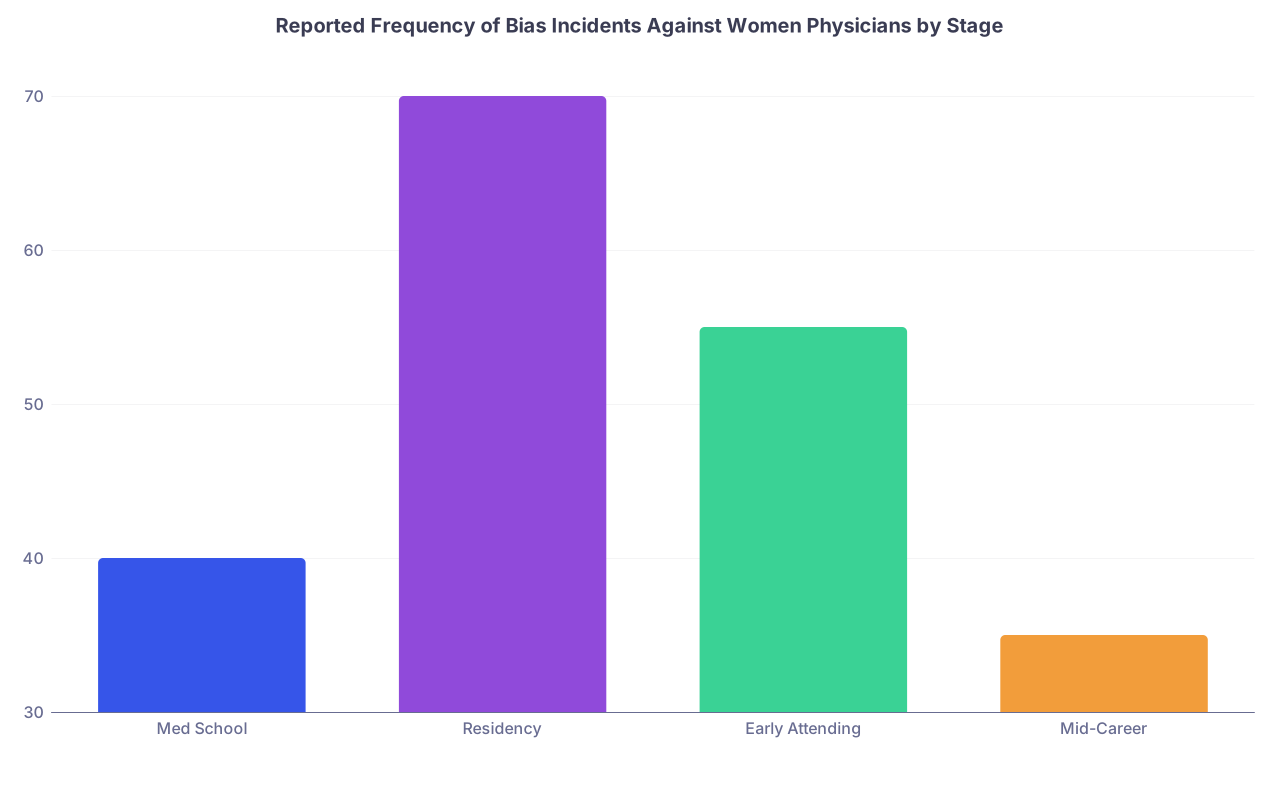
| Category | Value |
|---|---|
| Med School | 40 |
| Residency | 70 |
| Early Attending | 55 |
| Mid-Career | 35 |
5. Protecting Yourself Emotionally After the Encounter
The room might only take 5 minutes. The emotional hangover can last all day.
Here’s what you do after you walk out.
Name it to someone safe.
The worst thing is thinking you’re the only one. You’re not. Tell a co‑resident, a co‑fellow, that one nurse who always has your back:
“Patient just asked for a ‘real doctor’ instead of me. I know it’s bias, but it still stung.”
Saying it out loud takes away some of its power.Don’t automatically “be understanding” to your own detriment.
Yes, patients are scared. Yes, people regress under stress. None of that obligates you to absorb unlimited disrespect.Decide what this will mean for you.
This is where people go off the rails. They let one bigoted or ignorant comment become internal evidence: “I’m not convincing as a doctor.”
No. The event means: “There is bias in the world and I ran into it today.” That’s it. Don’t turn their prejudice into your narrative.Consider a brief written note or reflection, especially if it’s happening a lot.
Not for touchy‑feely reasons (though that can help) but to track patterns. Helpful later if you’re advocating for institutional changes or your own boundaries.
6. Ethical Tensions: Autonomy vs. Non‑Discrimination
You’re not just dealing with feelings; there are ethical questions underneath all this.
Patients do have rights:
- Right to accept or refuse care
- Right to choose a clinician in non-urgent situations (switching PCPs for personality fit, for example)
Patients do not have:
- A right to discriminate based on protected characteristics and have the system comply
- A right to immediate, perfectly customized care in every context, especially in emergencies
So where’s the line?
Here’s how I break it down in practice:
Emergency, unstable, or time-sensitive situation
You treat the patient. Full stop. You state your role and provide the safest care possible. If they’re yelling for someone else while you’re running an ACLS code, that’s just noise.Non-emergent hospital care
You try to address concerns, then escalate to charge nurse/attending. If a reassignment can happen without punishing you or rewarding clearly discriminatory demands, sometimes it’s the least-worst option for their ongoing care. But the institution, not you personally, should own that decision.Outpatient continuity care
If a patient says “I prefer a female clinician for intimate exams” or “I would feel more comfortable with someone who speaks my first language,” that’s not automatically discrimination. There is nuance. You can triage those requests more generously, especially when they’re rooted in trauma, culture, or communication needs rather than hierarchy and bias.
The key: you’re allowed to think about your own moral distress too. If a patient is openly sexist or racist, you are not ethically bound to keep seeing them forever just to preserve continuity. You can ask for transfer. That is not a failure; that’s self-preservation.
| Situation | Primary Goal | Best Initial Response Style |
|---|---|---|
| “Are you a real doctor?” (confused) | Educate, reassure | Clarify role, explain team |
| “I want the male/older doctor” | Set boundary, protect self | Name bias, offer safe care |
| “I want the attending, not resident/student” | Preserve team structure | Explain hierarchy, involve attending if needed |
| Overt slurs or repeated disrespect | Safety, professionalism | Stop, step out, escalate |
7. Long Game: How To Prepare Yourself And Your Environment
You can’t control patients. You can influence your system.
A few things that actually help:
- Rehearse 2–3 stock phrases out loud
Not in your head. Out loud. In your car, in the shower, walking your dog.
“I’m Dr. [Last Name], your physician today.”
“That comment is inappropriate. I’m here to treat you safely.”
“We don’t assign doctors based on gender. I’m fully qualified to care for you.”
If the words are already in your mouth, they’ll come out under stress.
Find allies who will back you up in the room
Nurses and techs see everything. Many of them hate this behavior as much as you do.
A quiet, “Did you hear what they said?” after the encounter can turn into, “Next time, page me and I’ll help reinforce your role.”Push for institutional scripts and policies
If this is happening to several of you (it is), raise it at resident meetings, faculty meetings, DEI committees. Ask for standard language staff can use when patients make discriminatory requests. Ask what your hospital’s policy is. If the answer is “we don’t have one,” that’s the opening.Remember who you are trying to impress
Hint: it’s not the patient who calls you “sweetheart doctor.”
It’s the nurse who sees you stay calm and firm.
The co‑resident who hears your script and thinks, “I’m using that next time.”
The medical student watching to see what “being a woman in medicine” looks like in real life.
You are allowed to be the person who changes the tone of how these moments are handled. You do not have to wait for permission.

| Step | Description |
|---|---|
| Step 1 | Patient asks for real doctor |
| Step 2 | Clarify role and team |
| Step 3 | Name bias and set boundary |
| Step 4 | Proceed with care |
| Step 5 | Step out and involve charge or attending |
| Step 6 | Institution decides reassignment |
| Step 7 | Document, provide essential care only |
| Step 8 | Is it role confusion or bias |
| Step 9 | Patient accepts? |
| Step 10 | Safe to reassign? |
FAQ (Exactly 4 Questions)
1. What if calling my attending feels like “losing” or proving the patient right?
You’re not losing. You’re using your resources. The issue is not that you needed backup; the issue is why. A patient refusing care based on your gender is not evidence that you’re inadequate; it’s evidence that bias exists. Good attendings know this. Involving them shows judgment, not weakness.
2. Should I ever just quietly switch patients to avoid drama?
Sometimes, yes—but only if you’re making that call for your own sanity and safety, not to reward discriminatory demands. If a patient is truly toxic and you feel yourself getting rattled to the point it might affect care, stepping back is responsible. Just document clearly and ask your leadership to acknowledge why the switch happened so it doesn’t get framed as “she couldn’t handle a difficult patient.”
3. How do I tell the difference between a trauma-based preference and discrimination?
Listen to how they ask. “Because of my past, I’d feel safer with a woman for pelvic exams” is not the same as “Women are too emotional to be real doctors.” Cultural, religious, or trauma-informed requests usually come with some context and often humility. You can honor those when feasible. Open contempt or stereotypes about women or minorities as clinicians—that’s discrimination.
4. What if my own team makes “real doctor” jokes or undercuts me in front of patients?
That’s a red flag. If a colleague says, “Here’s the real doctor,” when they walk in, you shut that down privately: “When you say that, it undermines me and reinforces what patients already assume about women doctors. I need you not to do that again.” If they keep doing it, escalate to your chief or program director. Internal sabotage is worse than one rude patient, and you’re not required to tolerate it in silence.
Key points: You can respond to “I want a real doctor” with clarity, not apology. You are allowed—professionally and ethically—to name bias and protect yourself. And over time, your calm, firm responses do not just help you; they make it easier for every woman who walks into that room after you.