
You’re three months out from application season. You’ve worked your ass off, impressed attendings, and now you’re stuck on something that should be simple: asking for letters of recommendation.
Except you’re a woman in medicine, which means you’re carrying extra baggage:
- You do not want to sound “demanding.”
- You do not want to be dismissed as “too self-promotional.”
- You’re also painfully aware that vague, “kind” letters can quietly sabotage you.
Let’s cut through the noise. Here’s how to ask for strong, specific letters as a woman in medicine—without apologizing, without shrinking, and without pretending bias does not exist.
1. First Principle: You Are Not Asking a Favor
You’re not begging for a nice gesture. You are requesting a professional evaluation that is literally part of an attending’s job.
The mental shift matters. Women are socialized to soften every ask:
- “If it’s not too much trouble…”
- “I completely understand if you’re too busy…”
- “I was just wondering if maybe…”
That language signals low confidence and low expectations. And—this is the brutal part—busy faculty will sometimes respond accordingly.
Here’s the standard you want in your head:
- You earned this by working with them.
- Programs expect you to have strong letters.
- Faculty write letters all the time; this is normal.
So your internal script stops being: “Can you please do this huge favor?”
And becomes: “You’ve seen my work. I’d like your professional support in the form of a strong letter.”
We’ll talk exact wording in a minute.
2. Who You Should (and Should Not) Ask
Not every attending who “liked you” should write your letter. You’re aiming for three things:
- They know your work well.
- They are willing to use strong, specific language.
- Their role and specialty match your goals.
If you’re a woman, add a fourth: they are unlikely to undermine you with subtle bias.
Red flags I’ve seen play out in real letters:
- “She is very nice, kind, and a pleasure to work with” …and almost nothing about clinical ability.
- “She works hard despite some personal insecurities.” (Why is that even in there?)
- “I think she will do well with support and careful supervision.” (That’s a torpedo.)
If you sense they:
- Over-comment on your “personality” and not your skills
- Make gendered remarks about you being “sweet” or “quiet”
- Have never seen you make decisions, lead, present, or handle sick patients
…do not ask them for a core letter. If you must (small specialty, required rotation), you control the damage with structure and talking points.
A quick comparison:
| Situation | Better Choice | Risky Choice |
|---|---|---|
| You impressed both | Attending who supervised you daily | Big-name chief who barely saw you |
| You did research | PI who knows your work in detail | Co-author who met you twice |
| You’re going into IM | Ward attending who saw your admits | Outpatient preceptor you saw 3 half-days |
| Mixed gender options | Faculty who comments on your leadership | Faculty who only calls you "nice" |
Bottom line: pick people who have seen you think, decide, and manage—not just smile and help.
3. The Actual Ask: Exact Phrases That Work
You have two main formats: in-person and email. In-person is better if possible, but email is perfectly acceptable, especially for follow-up.
What you’re really asking
You are not asking: “Will you write me a letter of recommendation?”
You are asking: “Would you be comfortable writing me a strong, detailed letter of recommendation for [X]?”
That one word—strong—saves you from lukewarm letters. It also gives them a graceful way to decline if they can’t endorse you strongly.
In-person script
You catch your attending after rounds or schedule a brief meeting.
Here’s a straightforward, non-apologetic script:
“Dr. Smith, I’m applying to internal medicine this cycle, and I was hoping to ask you something. I really valued working with you on wards, especially on patients like Mr. Jones where we talked through the differential. Would you feel comfortable writing me a strong letter of recommendation for my residency applications?”
If they hesitate, or say something vague: “I’d be happy to write a letter, but…” or “I don’t know you that well…”
You want to hear that now, not after they upload a weak letter. You respond:
“I really appreciate your honesty. I want my letters to come from people who can speak in detail about my clinical work and potential, so it might make sense for me to ask someone else who worked more closely with me.”
Then you smile, you walk away, and you just avoided a landmine.
Email script
Subject: Letter of Recommendation Request – [Your Name]
Body:
“Dear Dr. Smith,
I hope you’re doing well. I’m applying to [residency/fellowship/position] in [cycle/year], and I wanted to ask if you would feel comfortable writing a strong letter of recommendation on my behalf.
I worked with you on the [service/rotation] in [month/year], and I especially appreciated your feedback on my [presentations/clinical reasoning/procedural skills]. I’m aiming for [brief goal: e.g., ‘academic internal medicine with a focus on medical education’], and I believe your perspective on my clinical performance would be very valuable to programs.
If you’re able to write a strong letter, I’d be happy to send my CV, personal statement draft, and a brief summary of my work on your service to make this as easy as possible.
Thank you for considering this,
[Name]
[Med school / PGY level]”
That’s it. Clear, professional, no apologies.
4. Give Them Ammunition: What to Send So They Write the Right Letter
Here’s where women often get burned: they assume “I did good work, so the letter will show it.”
Wrong. Busy attendings default to generic letters unless you hand them concrete examples.
You are not “being extra” by doing this. You are making their job easier and your letter stronger.
Send this package (usually as one PDF or clearly labeled attachments):
- CV
- Personal statement draft (even if it’s not perfect)
- One-page “Letter Writer Guide” with:
- What you’re applying for and why
- 4–6 bullet points of your strengths, tied to specific moments they saw
- Any key experiences they supervised: tough cases, presentations, QI, teaching
You can frame it like this in your email:
“To make things easier, I’ve attached my CV, a draft of my personal statement, and a brief summary of my work with you, including a few examples that highlight my clinical reasoning, teamwork, and communication. I know programs value specific examples, and I thought this might help jog your memory.”
Notice what I slipped in there: “clinical reasoning, teamwork, and communication.”
Those are growth words. Programs lean on them.
As a woman, you should push even harder for language that emphasizes:
- Leadership
- Independence
- Decision-making
- Resilience under pressure
Because the data is clear: women’s letters skew more “communal” (kind, caring, helpful), men’s letters more “agentic” (brilliant, leader, decisive). You have to actively correct for that.
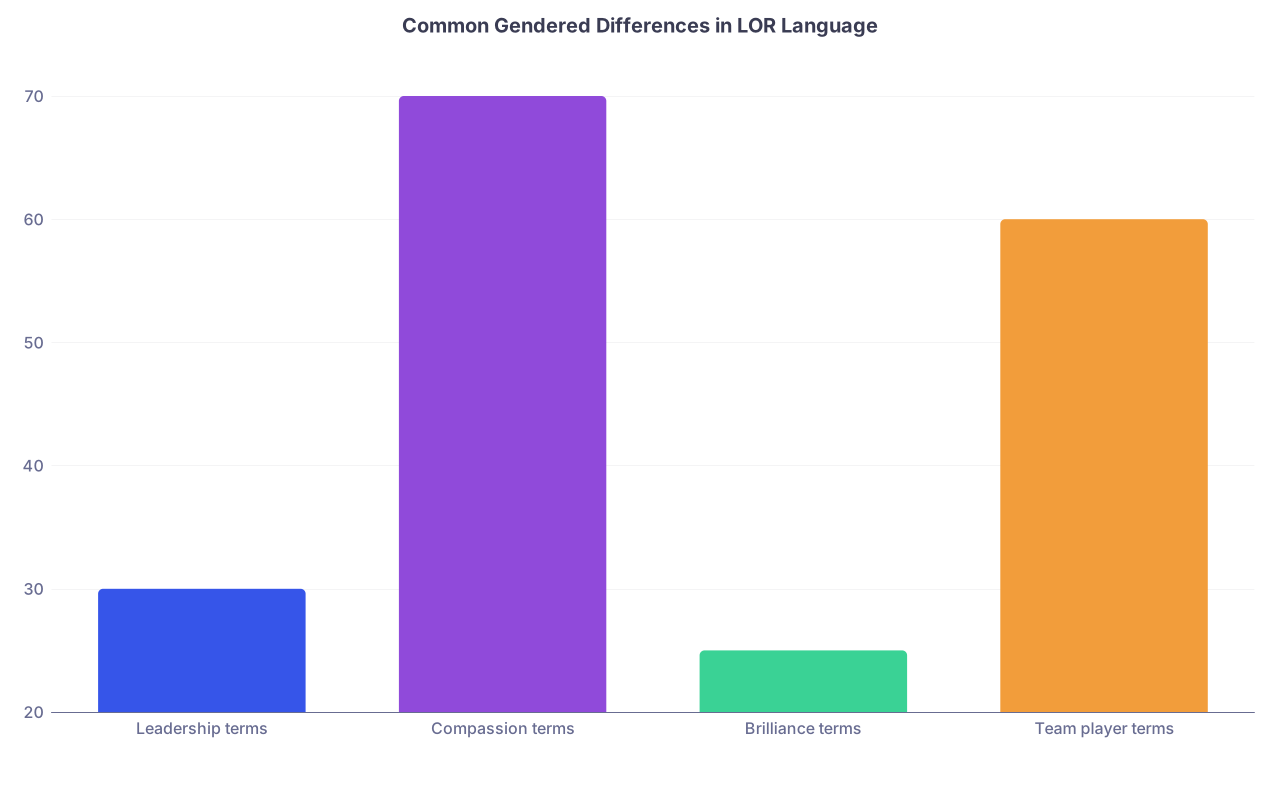
| Category | Value |
|---|---|
| Leadership terms | 30 |
| Compassion terms | 70 |
| Brilliance terms | 25 |
| Team player terms | 60 |
(Interpretation: letters for women skew toward compassion and team-player language; you want to pull more of that “leadership” and “brilliance” language into your letters.)
So in your bullet points, say things like:
- “Led pre-rounding and presentations for 8–10 complex patients daily.”
- “Independently managed cross-cover issues with appropriate escalation.”
- “Presented a structured, evidence-based plan for [specific case].”
Do not just say: “Worked hard, was always on time, and got along with team.” That’s baseline.
5. Timing, Reminders, and Following Up Without Apologizing
You’re busy; they’re busier. You still have to manage this process like a project manager.
When to ask
For residency/fellowship:
- Ideal: 6–8 weeks before the deadline.
- Minimum: 4 weeks (earlier if they’re known to be slow).
Ask while you’re still fresh in their mind:
- Last week of the rotation.
- Or within 1–2 months after if you must delay.
How to track this without losing your mind
Make a simple tracker:
| Writer | Type | Date Asked | Confirmed? | Uploaded? |
|---|---|---|---|---|
| Dr. Smith | IM Attending | 6/10 | Yes | Pending |
| Dr. Lee | Research PI | 6/12 | Yes | Uploaded |
| Dr. Patel | Subspecialty | 6/15 | Awaiting reply | Pending |
If someone has not confirmed in 7–10 days, you follow up. Briefly.
“Dear Dr. Smith,
Just checking in to see if you’d be able to write a strong letter of recommendation for my [X] application. I know your schedule is very busy, so if it’s not feasible, I completely understand and can ask someone else.
Best, [Name]”
Notice again: you give them a clean exit if needed.
Reminders before deadlines
About 2 weeks before the deadline:
“Dear Dr. Smith,
Thank you again for agreeing to write a letter on my behalf for [X]. This is a quick reminder that the submission deadline is [date]. The link from [ERAS/portal] should have come directly to your email, but I’d be happy to resend it if needed.
Best, [Name]”
You don’t apologize for reminding them. This is standard.
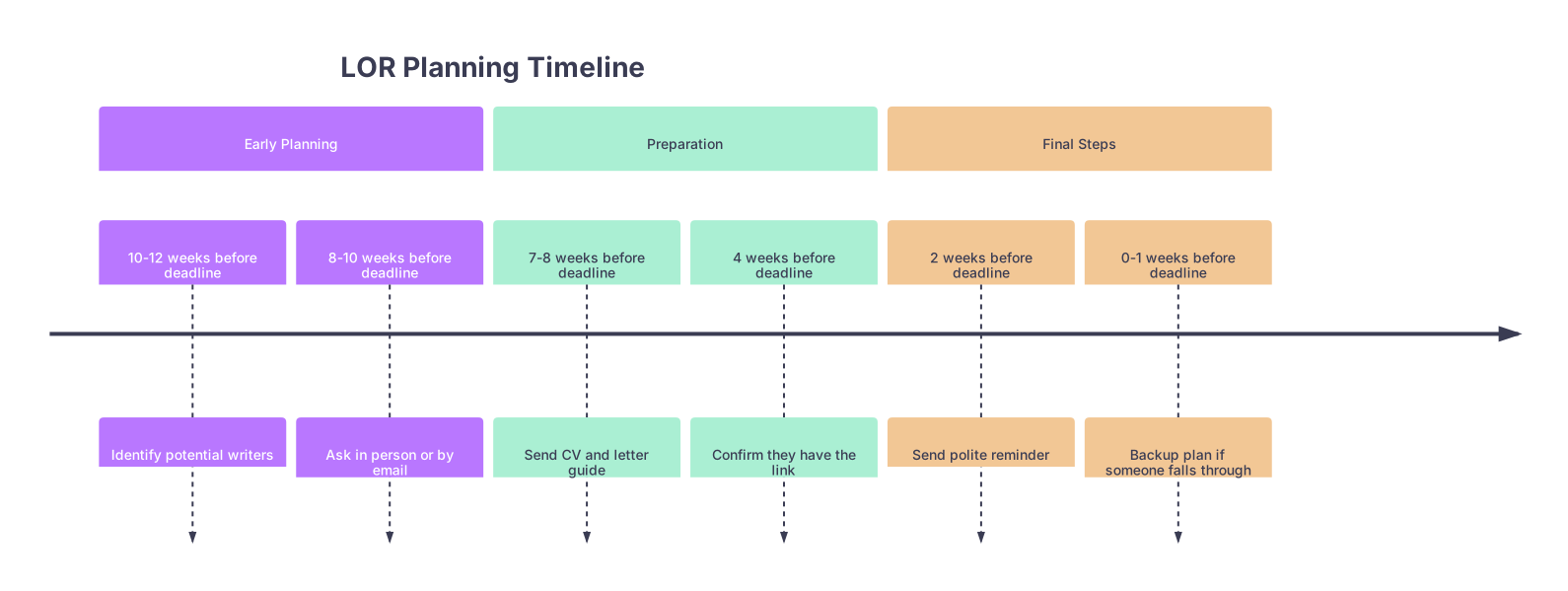
| Period | Event |
|---|---|
| Early Planning - 10-12 weeks before deadline | Identify potential writers |
| Early Planning - 8-10 weeks before deadline | Ask in person or by email |
| Preparation - 7-8 weeks before deadline | Send CV and letter guide |
| Preparation - 4 weeks before deadline | Confirm they have the link |
| Final Steps - 2 weeks before deadline | Send polite reminder |
| Final Steps - 0-1 weeks before deadline | Backup plan if someone falls through |
6. Handling Gender Bias Without Being Naive About It
You cannot control everything a writer puts in your letter. But you’re not powerless either.
Here’s what you can control:
Who you choose
If you have a choice between:- An attending who consistently comments on your “demeanor”
vs. - An attending who challenges you on your reasoning and respects you as a thinker
Choose the second. Every time.
- An attending who consistently comments on your “demeanor”
How you frame yourself in your materials
Your CV and personal statement should mirror the strengths you want them to echo: analytical, resilient, independent, collaborative but not submissive.What you explicitly highlight in your “letter guide”
Write bullets that push them toward specifics about:- How you handled uncertainty
- How you responded to feedback
- How you led when the team was overwhelmed
Your ask: “strong” and “detailed”
Those words make people think twice before sending a vague “she is very nice” letter.

One more uncomfortable truth: if you suspect a letter was weak or biased after the fact (because programs keep ghosting you despite a strong app), you adjust next time. You do not reuse that writer. You do not protect their feelings at the expense of your career.
7. Ethical Boundaries: What’s Okay vs. Not Okay
You might be asked to:
- Draft your own letter
- Provide “bullet points” that basically become the letter
- Or a faculty might say, “Just write something up and I’ll sign it.”
This is where ethics comes in.
What’s acceptable:
- Providing a detailed outline of your work, strengths, and specific examples.
- Sharing language from evaluations you’ve already received.
- Suggesting themes (“clinical reasoning, leadership on the team, and communication with patients”).
What crosses the line:
- Writing a full letter in their voice and having them sign it.
- Exaggerating or inventing accomplishments.
If someone asks you to write the whole thing, you can respond:
“I’m happy to send a detailed summary of my work and accomplishments, and some bullet points of things you might mention. I’d be more comfortable if the actual letter is in your words, since it’s your evaluation.”
If they push back hard or refuse to write anything themselves, that’s another red flag. They’re lazy, and lazy letter writers rarely do you any favors.

8. Quick Decision Framework: Should I Ask This Person?
Use this mental flow when you’re debating whether to ask someone:

| Step | Description |
|---|---|
| Step 1 | Did they see your clinical work directly? |
| Step 2 | Do not ask |
| Step 3 | Did they give you clear positive feedback? |
| Step 4 | Probably skip unless required |
| Step 5 | Do they respect you as a thinker or leader? |
| Step 6 | High risk of vague or biased letter |
| Step 7 | Ask for strong letter |
If at step E you find yourself saying, “They like me, but mostly talk about how nice/polite I am,” that’s a problem. You need people who talk about your mind, not just your manners.
FAQ: Women and Letters of Recommendation
Should I prefer women faculty as letter writers?
Not automatically. Choose the people who know your work best and respect you as a clinician, regardless of gender. That said, women and allies who are aware of bias sometimes write more intentionally strong, specific letters for women trainees. If it’s a close call, that can be a good tiebreaker.What if an attending I need a letter from is known to write short, weak letters?
Then you go heavy on structure. Ask them early, send an excellent CV, a strong personal statement, and a very detailed bullet-point summary of what you did on their service. You can also say directly: “Programs really value specific examples, especially around clinical reasoning and leadership. I’ve highlighted a few below that might be helpful.”Is it pushy to ask, ‘Would you be comfortable writing a strong letter?’
No. It’s standard. Most PDs and advisors recommend that exact wording. Anyone who gets offended by that is either not used to being held to a standard or wasn’t going to write you a good letter anyway.How many letters should I aim for, and how many should be ‘very strong’?
For residency, you usually need 3–4 letters. At least 2 should be from people who supervised you closely on core rotations in your target specialty and can write very strong letters. The others can be from research, sub-specialty, or longitudinal mentors—still strong, but maybe less central.Should I read my own letters if given the option?
For ERAS, you’re expected to waive your right to see the letters—programs trust them more that way. If a faculty member shares what they wrote informally, fine. But do not pressure them to show you, and do not try to edit your own evaluation. That’s where ethics starts getting shaky.What if no one knows me well enough to write a detailed letter?
Then you have a bigger problem: you’re not being seen enough. You fix this going forward by speaking up more on rounds, taking ownership of patients, asking for feedback, and seeking out longitudinal mentors. For this cycle, choose the people who know you best, then send them the most detailed “letter guide” you can. You cannot fake history, but you can help them remember more than they would on their own.
Key takeaways:
- You’re not asking for a favor; you’re requesting a professional evaluation you’ve earned. Ask for a “strong, detailed” letter, not just “a letter.”
- Choose writers who know your work, respect your mind, and will use specific, performance-focused language—not just “she’s nice.”
- Make it easy for them to write the right letter: send your CV, personal statement, and a targeted summary of your strengths and concrete examples, especially emphasizing leadership, clinical reasoning, and independence.