
The biggest myth about “women‑friendly” programs is that you can spot them from the brochure. You cannot.
You know a program is truly supportive of women residents when the lived reality matches the marketing. That means specific policies, real numbers, and how women talk about their day‑to‑day lives there. Not just a smiling photo on the website and a DEI slide on interview day.
Here’s how to actually assess it.
1. Start With the Hard Data, Not the Vibe
If a program cannot show you basic numbers about women in their ranks, they are not serious about supporting women. Full stop.
Here are the minimum datapoints you should try to get:
| Metric | What To Look For |
|---|---|
| % women residents | At least close to national averages for that specialty |
| % women faculty | Not just a token few, especially at mid/senior levels |
| Leadership roles | Any women PDs, APDs, chiefs, committee chairs |
| Attrition | How many women have left in last 5–10 years |
| Parental leave usage | How many women (and men) have taken it |
If they dodge or “don’t track that,” that’s already information. Serious programs know these numbers because they care about them and discuss them internally.
A quick pattern I’ve seen repeatedly:
- Programs with 70–80% men in a female‑heavy specialty (like pediatrics or OB/GYN) often have culture problems.
- Programs with women in visible leadership (PD, APD, chiefs) usually have at least some infrastructure for support, even if imperfect.
- Abrupt “we don’t really have attrition” with zero numbers? Suspicious.
You cannot always get exact stats, but you can ask directly:
- “What proportion of your current residents are women?”
- “Do you have women in leadership roles in the residency or department?”
- “Have any residents left the program in the last few years? For what reasons?”
Watch how they answer more than what they answer. Defensive, vague, or minimizing responses are a red flag.
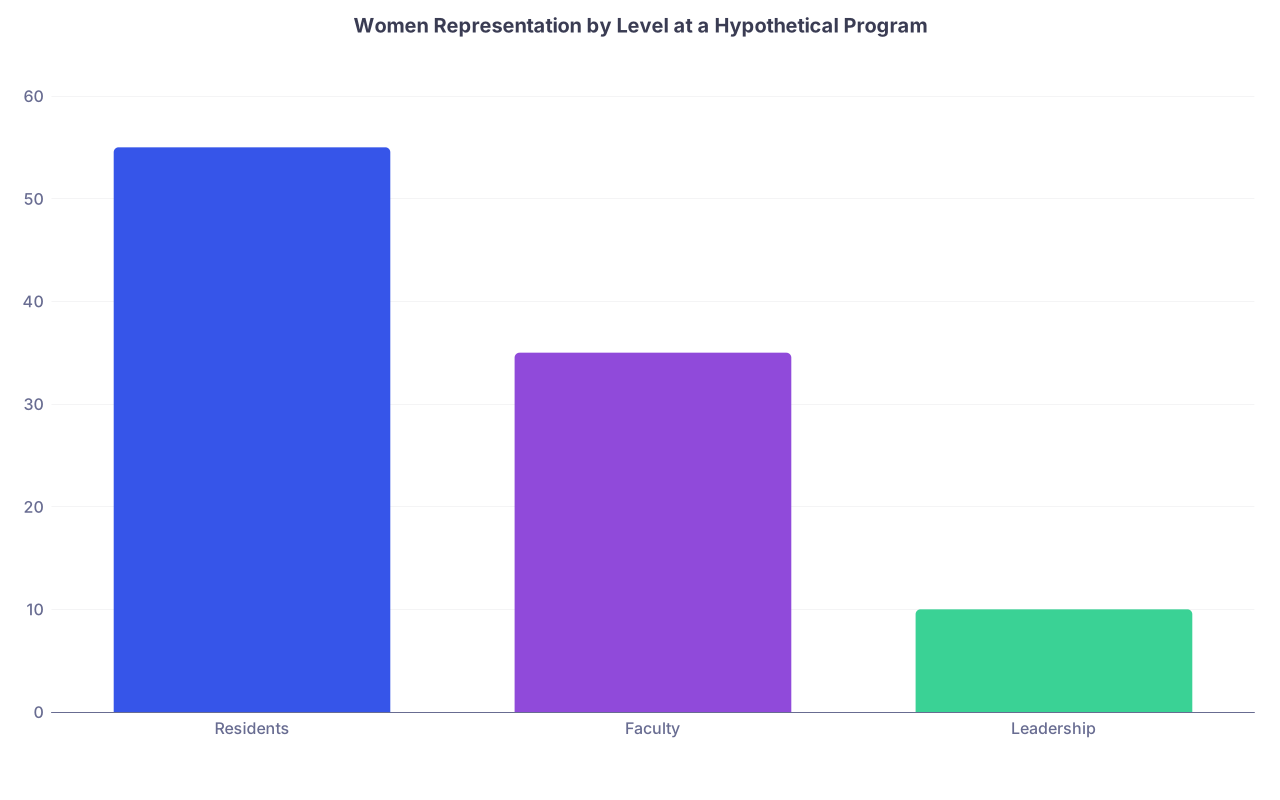
| Category | Value |
|---|---|
| Residents | 55 |
| Faculty | 35 |
| Leadership | 10 |
If you see something like the chart above—decent numbers of women residents but almost no women in leadership—that tells you the pipeline stalls out. Support may be limited to “we accept women,” not “we help women advance.”
2. Scrutinize the Policies That Actually Matter
Most programs will say they “support work–life balance” and “value diversity.” Fine. That’s background noise.
You want concrete, written policies in at least these areas:
Parental Leave and Pregnancy
Ask these questions as directly as you can:
- “What is your standard paid maternity leave for residents?”
- “Do pregnant residents usually have to extend training?”
- “Do you require residents to use vacation time for parental leave?”
- “How are call schedules adjusted during pregnancy and on return?”
Supportive programs:
- Have clear written leave policies (not just “we work it out individually”).
- Do NOT require you to cobble together FMLA + sick + vacation just to get a few weeks.
- Have examples of women who had children during residency and successfully graduated on time or with a clear, non‑punitive extension.
Non‑supportive programs:
- Say “It depends” with no framework.
- Talk immediately about “service coverage” and “fairness” without mentioning your health or the baby.
- Rely on informal “we’ll see what we can do” deals with PD discretion. That’s code for inconsistent and potentially biased decisions.
Lactation and Postpartum Support
Ask:
- “Where do residents pump during shifts?”
- “Are there protected times or is it just ‘if you can find a moment’?”
- “Who covers pages while a resident is pumping?”
Supportive programs have:
- Actual lactation rooms (plural), not “there’s a bathroom if you need it.”
- An expected workflow: attending and team know you’ll step out, someone covers the pager, and you’re not punished for it.
- At least one recent example of a resident who pumped and was supported.
If the answer is “We had someone use an empty office I think,” that’s not infrastructure. That’s improvisation.
Harassment, Discrimination, and Reporting
Here’s where programs either step up or quietly fail you.
Ask:
- “If a resident experiences sexist comments or harassment, what is the process to report and address it?”
- “Is there an ombudsperson or someone outside the direct chain of command?”
- “Have you ever had to remove a faculty member or attending from teaching due to behavior concerns?”
You’re not asking for gossip; you’re testing whether problems are taken seriously.
Supportive:
- Clear procedure. Multiple reporting routes. Explicit anti‑retaliation stance.
- Examples (even anonymized) of actual action taken.
- Residents say, “We had an issue, and leadership handled it fast and in our favor.”
Non‑supportive:
- “We’ve never really had that issue here.”
- Everything routed only through the PD with no alternative.
- Shrugging, joking, or minimizing.
3. Pay Close Attention to How Women Talk When Leadership Is Not in the Room
Informal conversations with current women residents are the single most valuable data source you have.
On interview day, use any unstructured time—resident lunch, pre‑interview social, hallway walks—to ask targeted questions like:
- “Do you feel comfortable speaking up around attendings?”
- “Have you seen residents punished for pregnancy, illness, or mental health?”
- “If you could go back, would you choose this program again?”
- “Are there any attendings you warn each other about?”
Their tone matters more than perfectly diplomatic phrasing.
Patterns I look for in supportive places:
- Women laugh about the usual residency chaos but do not have that “dead behind the eyes” vibe when they mention leadership.
- They talk about actual mentors by name: “Dr. X really went to bat for me when I had to adjust my schedule.”
- They admit to problems (every program has some) and follow it with “and this is how it was fixed.”
Patterns in problematic places:
- Residents give you obviously rehearsed, uniform answers that sound like PR.
- Someone says, “Honestly, we just try to keep our heads down.”
- There are “known bad people” that everyone is aware of but “nothing ever really changes.”
If possible, try to talk to:
- At least one junior woman (PGY1–2).
- One senior woman (PGY3+).
- Ideally, someone who has had a kid, serious illness, or needed accommodation.
They’ve stress‑tested the system.
4. Decode the Culture During Interview Day and Away Rotations
You can pick up more than you think just by watching how people behave in real time.
Red Flags in How People Interact
Look for:
- Attendings interrupting women residents repeatedly in case discussions while letting men talk.
- Women residents consistently doing more “scut” or emotional labor—organizing group stuff, handling family conversations, taking the notes.
- Jokes that land badly: “Oh, we used to be all women, now it’s balanced again” or “Surgery is not very mommy‑friendly, haha.”
You’re not being “too sensitive” for noticing patterns. That’s exactly what you should be doing.
Watch the Chiefs and PD
Who does most of the talking for the program?
If the PD or chief residents:
- Explicitly talk about supporting women, parents, and underrepresented trainees without being prompted.
- Acknowledge hard topics (burnout, pregnancy, harassment) and describe concrete actions, not just values.
That’s a good sign.
If leadership leans on vague clichés—“We’re like a family,” “We treat everyone the same”—without specifics, be cautious. “Same” treatment sounds fair but often ignores the very real differences in how women are treated in medicine.
Use Rotations as Recon
If you rotate there as a student, this is gold.
You should quietly track:
- Do women residents look empowered or constantly anxious around certain attendings?
- Are women called by “doctor” as consistently as men, or do you hear first names and diminutives?
- Who gets procedures, conference presentations, and stretch opportunities?
If you’re always watching a male junior get picked over a competent woman senior, that’s not random.

| Step | Description |
|---|---|
| Step 1 | Identify programs |
| Step 2 | Review website and data |
| Step 3 | Ask policy questions |
| Step 4 | Talk with women residents |
| Step 5 | Observe culture on visit or rotation |
| Step 6 | Rank higher |
| Step 7 | Drop or rank lower |
| Step 8 | Signals align? |
5. Look for True Structural Support, Not Just Good Intentions
Good intentions do not protect you when an attending retaliates, when you get pregnant, or when you burn out. Systems do.
Here are structural signs a program is actually built to support women:
- Formal mentorship program that pairs residents with faculty, and includes women mentors.
- Regular, protected check‑ins with leadership where you can raise concerns without immediate blowback.
- Wellness or equity committees with real resident input and visible outcomes (schedule changes, policy updates).
- Clear guardrails around duty hours and post‑call responsibilities that are actually enforced.
Programs that just say “We’re always here if you need us” but have no structure? Lovely sentiment. Not safety.
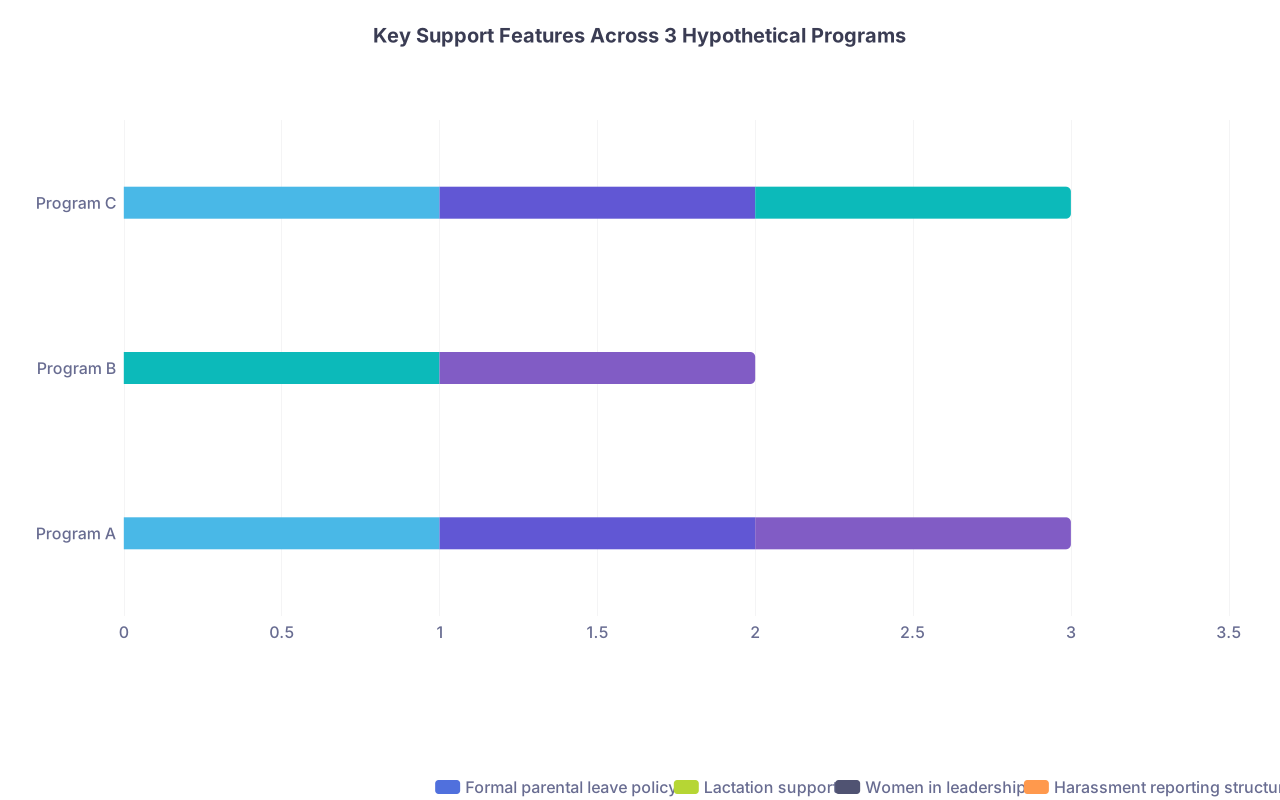
| Category | Formal parental leave policy | Lactation support | Women in leadership | Harassment reporting structure |
|---|---|---|---|---|
| Program A | 1 | 1 | 0 | 1 |
| Program B | 0 | 0 | 1 | 1 |
| Program C | 1 | 1 | 1 | 0 |
You will not find perfection. But you should see at least a few of these pieces in place, not zero.
6. Questions You Should Actually Ask (Verbatim)
Here’s a short list you can more or less read off during interviews or emails. Adjust for your style:
To PD/faculty:
- “How has the program supported residents during pregnancy or when they have children during training?”
- “What does parental leave realistically look like here for residents?”
- “Can you tell me about your process for handling mistreatment or harassment reports from residents?”
- “Are there formal mentorship opportunities, especially for women and underrepresented residents?”
To current residents (ideally women):
- “Do you feel safe speaking up if something feels sexist or unfair?”
- “Have you seen anyone face consequences for reporting a problem?”
- “Are there any unspoken expectations for women in this program?”
- “How often do you see women residents matched to good fellowships or hired as faculty?”
You’re not asking for perfection. You’re looking for honesty plus action.

7. How to Weigh All This When Ranking Programs
Here’s the dirty secret: there will be trade‑offs.
You might find:
- A brand‑name program with weak support for women.
- A less famous but genuinely humane program with strong policies and culture.
You have to decide what matters more for your life and values.
My advice:
- If you already know you want kids in residency, bump supportive policies up near the top of your priority list.
- If you’re not sure about kids, prioritize culture and how women residents describe their daily lives. That still affects you.
- If a program gives you even moderate “this feels off” signals about how they treat women, trust that feeling. Residency is too long and too hard to gamble on a toxic culture.
You’re not just picking a training site. You’re picking the environment that will shape your confidence, your identity as a physician, and frankly, your sanity.
8. Quick Reality Check: What “Supportive” Actually Looks Like
Let me make this concrete.
Supportive program example:
- Woman PGY2 develops complications late in pregnancy. PD proactively rearranges rotations, moves call, works with GME to secure paid leave that meets ABMS minimums.
- She returns part‑time for a short period, pumps in a designated lactation room 3 times per shift, teammates cover her pager as a norm, not a favor.
- When an attending makes a sexist remark in conference, a chief addresses it immediately, and the PD follows up privately and formally documents it.
Unsupportive program example:
- Pregnant resident is told, “We’ll need to see how your classmates feel about covering you,” and pressured to “not leave us short.”
- She is told to use vacation and sick time to cobble together barely any leave, is warned about “falling behind” her class.
- After reporting repeated sexist comments from a senior faculty, she is told to “avoid him” and then mysteriously gets weak evaluations from that department.
Both will say they “value diversity and support women.” Only one actually does.

FAQ: Supportive Programs for Women Residents
1. Should I directly tell programs I care about pregnancy/parental leave during interviews?
Yes, if it matters to you. Programs that punish you for asking basic questions about health and family are not places you want to spend 3–7 years. Phrase it neutrally: “I’m interested in learning more about how your program supports residents who have children during training.”
2. What if a program looks weak on women’s issues but is top‑tier academically?
Then you have a real decision. Ask yourself whether the brand name is worth daily microaggressions, poor structural support, or outright discrimination. For many residents, a slightly “less prestigious” program with a healthy culture produces a better career and a much better life.
3. How can I spot subtle sexism during a short interview day?
Listen for who gets interrupted, who gets credit, and who does the emotional labor. Watch how attendings address women versus men (“doctor” vs first name). Note jokes and who laughs nervously. Any pattern that consistently minimizes women is a red flag, even if nobody says anything overtly hostile.
4. Are women‑only social events or groups always a good sign?
They can be, but not always. A women’s group with a budget, regular meetings, and actual influence is great. A single “women in medicine” lunch once a year with no follow‑through can be more symbolic than substantive. Ask what’s come out of that group: policy changes, mentoring networks, schedule reforms?
5. What if current women residents seem split—some love it, some hate it?
That’s actually normal. Focus on the patterns: are the negative stories about the same few people or systemic issues? Are the positive stories tied to specific mentors or to the entire culture? When in doubt, weigh the experiences of those who’ve gone through stressors you might also face—pregnancy, illness, reporting mistreatment—more heavily than generic “I like it here” comments.
Key points to remember: do not judge a program by its brochure; judge it by policies, numbers, and how women talk when leadership is not listening. And when you see consistent red flags around pregnancy, reporting, and culture, believe them—and rank accordingly.