
What’s the Safest Path to Report Harassment as a Trainee?
What do you actually do the moment your attending crosses the line—but also controls your evaluation, your schedule, and possibly your career?
Let me be very clear: there is no perfectly “safe” path. You’re operating in an environment with power imbalances, egos, and sometimes institutions that protect themselves first. But there is a safer, smarter, more strategic path than just venting to a friend or firing off an angry email at midnight.
Here’s the answer you’re looking for: how to protect yourself, preserve your career, and still act ethically.
Step 1: Before You Report – Protect Yourself and Build a Record
Do not start with a formal report. Start with documentation and safety.
1. Get out of immediate danger
If you feel physically unsafe or harassed in the moment, your first job is not to be polite.
You can say:
- “I’m not comfortable with that. I need to step out.”
- “I’m going to excuse myself and check on my patient.”
- “We’ll need to keep this professional.”
Then you leave. Bathroom, workroom, nurse’s station. Anywhere with other humans and witnesses.
If you are in immediate physical danger: call security or 911. That’s not overreacting.
2. Start a contemporaneous record—today
You need a written, time-stamped log. Not a vague memory six months from now. A log.
Use:
- A private, backed-up document (e.g., a note app you control, or a personal email to yourself)
- Not a work device that your institution owns and can access
- Not a shared Google doc with your friends
Every single time something happens, record:
- Date and time
- Location
- Who was present (names + roles: “Dr. X – attending, Sarah – PGY3, anesthesia tech”)
- Exactly what was said or done (direct quotes as much as you can remember)
- How you responded
- Any immediate consequences (“later that day he told me my evaluation would ‘depend on how chill I was.’”)
Do not sanitize the language. If they said “You’d go further if you dressed more feminine,” write that. If they touched you, describe how and where.
This record is your backbone. Without this, institutions can pretend it was “a misunderstanding.”
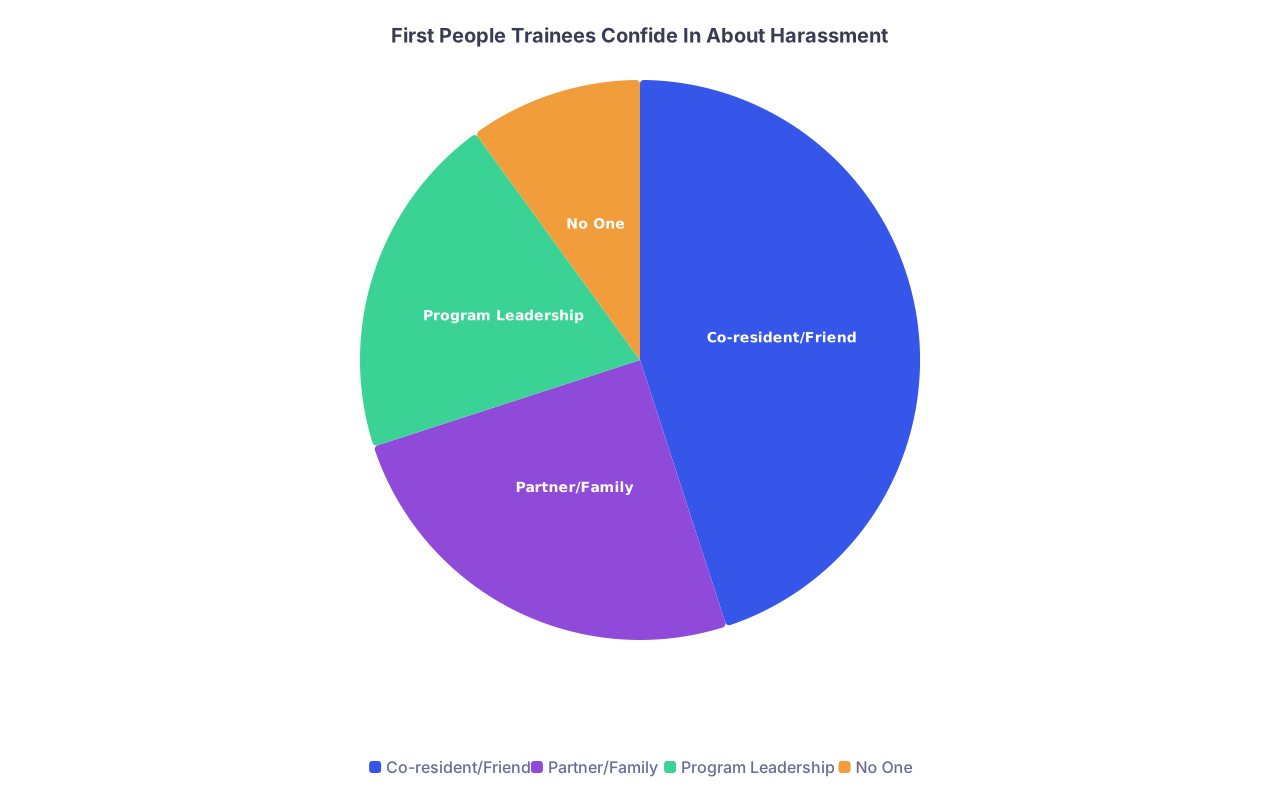
| Category | Value |
|---|---|
| Co-resident/Friend | 45 |
| Partner/Family | 25 |
| Program Leadership | 20 |
| No One | 10 |
3. Quietly check your institution’s policies
Go to your school or hospital website and search:
- “Harassment policy”
- “Code of conduct”
- “Title IX”
- “Anti-retaliation”
Download or screenshot the relevant sections. Especially:
- Definitions of harassment and discrimination
- Reporting options (anonymous, informal, formal)
- Anti-retaliation language
Why bother? Because when people later tell you “This is just how it is here” or “He’s like that with everyone,” you’ll know exactly how that conflicts with the written policy.
Step 2: Choose Your First Conversation Carefully
Your first disclosure outside your close friends matters.
The safest first “official-adjacent” conversations are with people who:
- Don’t control your evaluation directly
- Understand the system
- Have some duty to support you
Think: confidential resources and trusted senior allies.
1. Confidential resources (use these early)
Most U.S. medical schools and hospitals have at least some of the following:
- Title IX office (for sex- or gender-based harassment)
- Ombudsperson / Ombuds office
- Employee or Student Assistance Program (EAP/SAP) counselor
- Wellness office with confidential counseling
These people usually:
- Can explain your options
- May track patterns (e.g., “you’re the third person to mention Dr. X”)
- Often are not mandatory reporters to your program director (verify this directly)
Ask them explicitly:
- “Is this conversation confidential?”
- “Are you a mandatory reporter?”
- “What are my options that do not immediately expose my identity to my program?”
You want clarity before you dump details.
2. A trusted mentor who does not rate you
If you have:
- A mentor in another department
- A dean of students known to protect learners
- A faculty member you trust who’s senior enough not to be scared of one attending
That person can help you navigate politics: “If you go to the PD directly, here’s how they’re likely to react. Here’s a safer route.”
What you do not do as step one: storm into your program director’s office without a plan. PDs vary wildly—some are fantastic, some are openly protective of high-billing faculty.
Step 3: Map Your Options – Informal vs Formal Reporting
You basically have five main paths. You can mix them, but understand what each does.
| Path | Confidential? | Triggers Formal Investigation? |
|---|---|---|
| Ombuds / Confidential Office | Usually high | Usually no |
| Title IX Office | Limited | Often yes or documented option |
| Program Leadership (PD/Chair) | Low | Maybe, depends on them |
| HR / Institutional Hotline | Low to medium | Usually yes |
| Anonymous Report System | Medium (identity) | Sometimes, if enough detail |
1. Ombuds / confidential office
Best for: getting oriented, pressure-testing your interpretation, building a strategy.
They help you:
- Reality-check: “Yes, what you described clearly meets the harassment definition.”
- Understand risk: “That attending sits on the promotions committee, so here’s what to anticipate.”
- Decide sequence: who to talk to, in what order.
2. Title IX / Equity office
Use this when:
- The behavior is gender-based, sexual, or discriminatory.
- You want the institution to take this seriously beyond your department.
- You’re okay that this may move quickly into formal territory.
You can often ask:
- “I’m not ready for a formal complaint yet. Can I do an informational consult?”
- “What happens to my name? To the accused? To my rotation if I report?”
If they can’t answer simply, that’s a red flag—but it’s still useful to know.
3. Program director / clerkship director / department chair
This is trickier.
Go this route when:
- The harassment is affecting your evaluation, schedule, or clinical environment.
- You need a rotation change or to avoid that attending.
- You have at least one documented incident and some support (e.g., a mentor who knows).
When you talk to them:
- Bring your written log (you don’t necessarily hand it over; you use it to stay precise).
- Use clear, direct language: “What I’m describing is harassment as defined by the policy.”
- State what you need: “I need to be removed from direct supervision by Dr. X without academic penalty.”
If their first move is “We don’t want to ruin his career,” mentally document that. You now know who they’re protecting.
4. HR / compliance hotlines / ethics hotline
These are usually not built for trainees, but you can use them. They’re more often used by employees.
Good for:
- Documenting that the institution was notified
- Creating a paper trail outside your department
- Cases involving staff, not faculty (e.g., an abusive senior nurse, tech, or administrator)
You may not get much feedback. But the record exists.
5. Anonymous systems
Suggestion boxes, online portals, QR codes in the bathroom that say “Report mistreatment here.”
They are… hit or miss.
Use them when:
- You’re not safe disclosing your identity yet.
- You want to flag a pattern: “Dr. X makes sexualized comments to multiple female residents on rounds.”
Don’t expect miracles from anonymous reports alone. They rarely change a powerful attending’s behavior by themselves, but they do matter when multiple people report the same name.
Step 4: Minimize Retaliation Risk (While Knowing It’s Still Possible)
Yes, retaliation happens. Quietly, subtly: fewer opportunities, harsher evaluations, “not a team player.”
You can’t eliminate the risk. You can reduce it and prepare for it.
1. Know the anti-retaliation policy—but don’t worship it
Your institution likely has one. Good. Screenshot it.
Then be realistic: bad actors ignore policies all the time. The value of the policy is leverage later, not magic protection now.
2. Build a wider support network
You need people who can vouch for:
- Your clinical performance
- Your professionalism
- Your work ethic
So if one attending suddenly labels you “difficult” after you report, there’s counterweight.
Deliberately:
- Ask to work with other attendings
- Volunteer for visible, neutral tasks (e.g., QI projects, teaching sessions)
- Keep your emails professional and documented
3. Keep your documentation going—especially after you report
After you report, start a new section in your log titled “Post-report events.”
Track:
- Any changes in schedule, duties, or evaluations that don’t make sense
- Comments like “People who make trouble here don’t last long”
- Grades or Milestones that drop without explanation
If retaliation happens, your log becomes gold.
Step 5: What to Actually Say (And How to Say It)
You don’t need the perfect script. You just need to be:
- Specific
- Professional
- Direct enough to be undeniable
Here are concrete templates you can adapt.
1. To a confidential resource / ombuds
“I’m a [MS3/PGY2/etc.] and I need confidential guidance about harassment from a supervisor. I’m not sure yet whether I want to file a formal complaint, but I need to understand my options and my safety.”
2. To a trusted mentor
“I need to talk with you about something serious that’s happening on my rotation. There have been repeated comments and behaviors from an attending that I believe meet the definition of harassment. I’m concerned about my evaluation and my safety if I report. Can you help me think through the safest path?”
3. To program leadership
“In the [medicine ICU] rotation, Dr. [Name] has repeatedly [describe behavior: e.g., made sexual comments about my appearance, commented on my body, and implied my evaluation depends on how I respond]. I’ve documented specific dates and statements that I can share.
This behavior violates the institution’s harassment policy and has affected my ability to learn and feel safe. I’m asking for two things:
- That I be removed from direct supervision by Dr. [Name] without academic penalty, and
- That this be addressed through the appropriate institutional channels so other trainees are not subjected to the same behavior.”
Short. Direct. Hard to spin as “she was just uncomfortable with feedback.”
Step 6: Decide How Far You Want to Take It
You’re allowed to prioritize survival. You’re also allowed to push hard for accountability. Both are ethical decisions in a broken system.
Here’s a simple decision frame:

| Step | Description |
|---|---|
| Step 1 | Harassment Occurs |
| Step 2 | Document Details |
| Step 3 | Seek urgent help - security, trusted colleague |
| Step 4 | Consult confidential resource |
| Step 5 | Formal report - Title IX or leadership |
| Step 6 | Monitor, build record, adjust exposure |
| Step 7 | Escalate to higher level, external bodies |
| Step 8 | Maintain documentation, support others |
| Step 9 | Immediate Safety Concern? |
| Step 10 | Want institutional action now? |
| Step 11 | Retaliation or no action? |
You can:
- Stop after consulting confidentially and quietly altering your exposure to that person.
- File a formal complaint and push it all the way through.
- Join others if there is already a pattern case building.
None of those choices makes you weak or complicit. It makes you human in a system with real power dynamics.
Special Situations
If the harasser is a resident or fellow
- You still document.
- You can go to: chief residents, PD, GME office, or HR.
- There is less institutional protection around trainees than around a senior, high-RVU attending. That can make it slightly easier to address, if leadership has any backbone.
If it’s “only” microaggressions (constant, low-grade gender bias)
Harassment doesn’t need to be physical or explicit to be harmful.
Examples:
- “Women don’t usually like trauma nights; it’s too much.”
- “You’re probably going to have kids soon; are you sure you want a surgical career?”
- Only calling on men for procedures, ignoring women.
You can:
- Log patterns.
- Address individual comments in the moment when it’s safe: “I’m committed to my surgical training; please don’t make assumptions about my plans.”
- Use climate channels: anonymous surveys, diversity offices, faculty leads for equity.
Patterned bias can absolutely be reportable, especially if it affects evaluations, assignments, or opportunities.
When the System Fails You
Sometimes you do everything “right” and the institution still:
- Minimizes it
- Protects the harasser
- Labels you the problem
You are not crazy. You’re seeing the gap between policies on paper and power in practice.
If that happens, consider:
- Talking to your national specialty organization’s trainee or women-in-medicine group
- Quietly consulting an employment attorney who understands academic medicine
- Planning an exit: different rotation sites, altered schedule, transferring programs or institutions if necessary
That’s not failure. That’s self-preservation.
The Move You Can Make Today
Open a private, secure note on your phone or laptop. Title it: “Professional Climate Log.”
Write down the last incident that made your stomach drop, even if you’re not sure it “counts.” Date. Time. Who. What was said. How you felt. That’s it.
If nothing else ever happens, you lost five minutes.
If something does, you will have the one thing institutions can’t spin away easily: a clear, contemporaneous record.
FAQ (Exactly 7 Questions)
1. What if I am not sure it “counts” as harassment?
If you’re asking the question, it’s already significant. Harassment is not limited to assault or explicit propositions. Repeated comments about your body, your gender, your “future kids,” or “how women perform in this specialty” can absolutely qualify. Talk to a confidential resource or ombuds and describe specific behaviors. Let them map it against policy. You do not need to legally classify it before you seek help.
2. Should I confront the harasser directly before reporting?
You’re not required to. Some policies suggest telling the person their behavior is unwelcome, but that’s not always safe. If the power difference is huge (attending, PD, chair) or the behavior is severe, skipping a direct confrontation is completely reasonable. If you do speak up, keep it simple: “That comment was inappropriate and unprofessional. Please don’t say that again.” Then log what happened.
3. Can I record conversations secretly to protect myself?
Depends on your jurisdiction and your hospital policy. Some places allow one-party consent recording; others require all parties to consent. Violating that can backfire legally and professionally. Before you record anything, quietly look up your state’s recording laws and be aware many hospitals explicitly forbid recordings in clinical areas. Your written contemporaneous log, plus any emails or messages, is usually safer and still powerful.
4. What if my evaluation is threatened or actually lowered after I report?
Treat that as potential retaliation. Save copies of all prior evaluations, comments, and any emails praising your work before you report. If your evaluation suddenly tanks with no clear, documented performance issue, you have a factual discrepancy to point to. Raise this with someone higher up (GME office, dean’s office, Title IX, or HR) and reference the anti-retaliation policy: “My evaluations were consistently [X] before I reported, and dropped to [Y] immediately after, without new concerns being documented.”
5. Is it safer to wait until after the rotation or graduation to report?
Safer for your immediate life? Sometimes, yes. More effective for stopping ongoing harm? Usually not. There’s a tradeoff. If you wait until you’ve moved on, your personal risk drops, but the institution has an easier time saying, “We can’t investigate; it’s too old, no direct impact now.” You can also do a hybrid: confidentially log and consult now, and decide on a formal report at a tactically better time (e.g., after grades are finalized).
6. Can I report if I only heard about harassment secondhand (not directed at me)?
Yes. You can report observed behavior or information you received, especially if it shows a pattern: “Multiple co-residents have told me that Dr. X has made sexual comments to them on nights.” Say what you actually know: don’t embellish or put words in others’ mouths. Many institutions need bystander reports to see that one “star faculty member” is a repeat offender.
7. What if the harasser is extremely powerful and “untouchable”?
Then you adjust your strategy. Expect that going through only departmental channels will be useless or risky. Go higher and more lateral: Title IX, GME office, institutional compliance, national specialty bodies, or legal counsel if needed. Document every step and protect your own trajectory first—letters, mentors, alternative rotation sites. That person may not be stopped this year. But your documentation, added to others’, is often how seemingly “untouchable” people finally fall.