
Last winter, a third‑year internal medicine resident walked into my office, shut the door, and burst into tears before she even sat down. Positive pregnancy test. Due in the middle of her ICU block. “I know what I should say ethically,” she told me, “but I also know what attendings say behind closed doors.”
You’re not paranoid. There is a politics to pregnancy announcements in residency, and most of it never gets written in policies or ACGME documents. It gets whispered in workrooms, decided over rank lists, and enforced through culture, not contracts.
Let me walk you through what really happens.
The Unspoken Reality: What People Actually Say Off the Record
Here’s the part you never hear on recruitment day.
Behind closed doors, when a woman resident announces she’s pregnant, most programs cycle through the same five reactions. Not always out loud. But they’re there.
Schedule panic.
Chief residents immediately open the scheduling software. Who’s going to cover? Are we already short on nights? Who’s on the same rotation block? I’ve watched chiefs calculate FTE coverage before they’ve even said “Congratulations.”Fairness resentment.
Other residents start silently counting: “I did all six weeks of nights pregnant,” “She’s getting out of the worst ICU month,” “I don’t have kids; why do I keep covering for people who choose to?” They may still throw you a baby shower. And complain about you at 2 a.m. in the call room.Professionalism judgment.
This one is ugly but real. Some attendings will quietly question your “commitment” if your pregnancy hits a bad stretch of the schedule. They won’t say it in an evaluation. But they’ll say it to each other: “Terrible timing. We needed her this year.”Legal awareness.
Program directors instantly remember: pregnancy is protected, retaliation is illegal, ACGME is watching. So publicly they’re careful — they talk about “support,” “duty hour compliance,” “institutional policy.” Privately they might vent to other PDs at national meetings.Reputation calculus.
Programs care how they look to applicants and faculty. A place known to punish pregnant residents loses talent fast. So there’s a quiet PR motive to “handle this well,” even if some people are seething underneath.
You live at the center of all that—trying to protect your baby, your career, your evaluations, and your co-resident relationships at the same time.
That tension is the real politics.
Timing: Why You’re Obsessing Over When to Tell
Every pregnant resident asks the same question: “When do I tell them?” They’re not asking about medicine. They’re asking about politics and power.
Here’s how programs actually react at different points in the pregnancy.
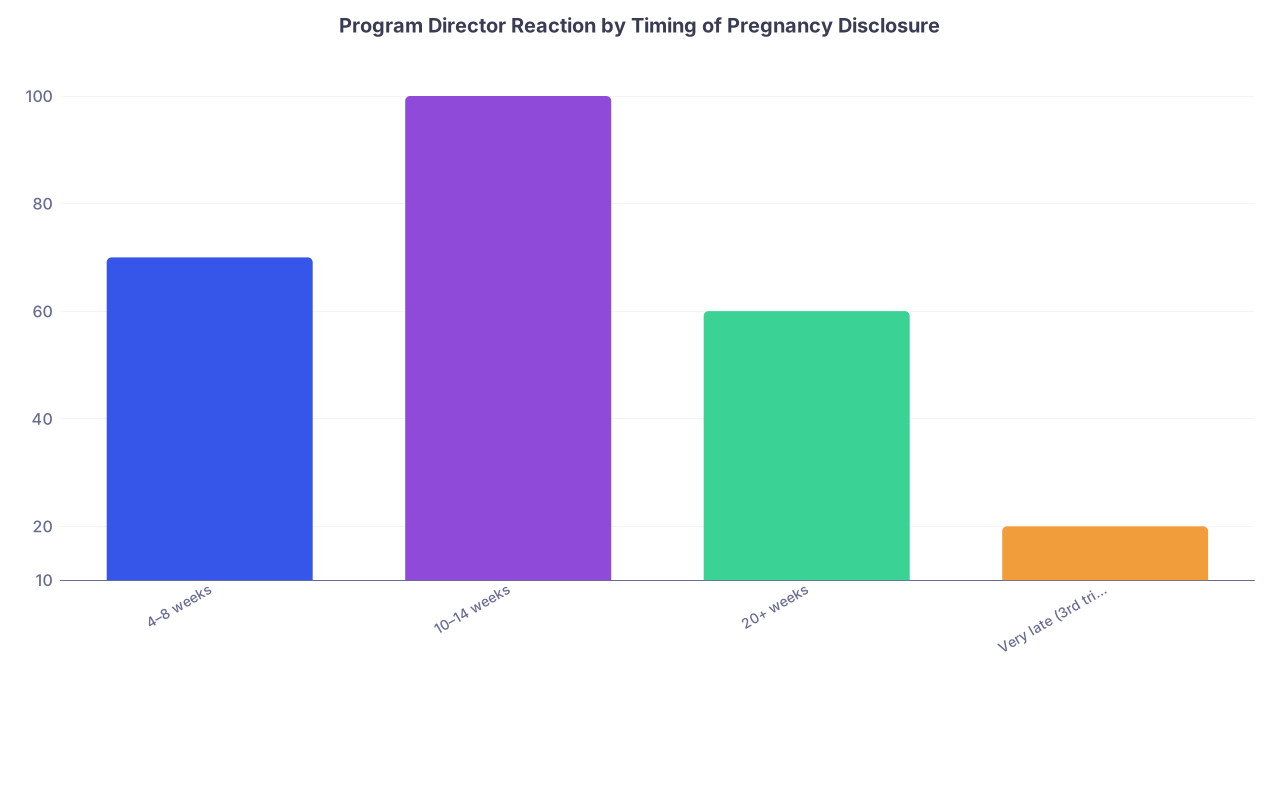
| Category | Value |
|---|---|
| 4–8 weeks | 70 |
| 10–14 weeks | 100 |
| 20+ weeks | 60 |
| Very late (3rd trimester) | 20 |
Interpretation (this is how most PDs feel, even if they won't say it):
- 4–8 weeks: “Early, may change, but good they’re transparent.”
- 10–14 weeks: “Best case. We can plan. Feels respectful.”
- 20+ weeks: “Now we’re scrambling. Why so late?”
- Very late: “They hid it. This damaged trust.”
The dirty secret: they want time more than honesty
Culturally, medicine loves to pretend that “family comes first,” but operationally what programs want is planning time. That’s the real currency.
Too early and you’re emotionally exposed if there’s a miscarriage. Too late and people feel blindsided and disrespected, even if you were just protecting yourself.
The sweet spot politically: around the end of first trimester or when you’re starting to show or need accommodations — whichever comes sooner.
But the calculus changes by rotation.
- On an easy elective, people shrug: “We’ll figure it out.”
- On ICU or nights, the exact same announcement feels like a betrayal to some colleagues.
Is that fair? No. Is it real? Absolutely.
The Back Room Conversation: What Chiefs and PDs Actually Do
Let me tell you what happens in the chief office after you leave.
Someone closes the door. The whiteboard or Google Sheet goes up. And they start a three-layer balancing act:
Coverage grid:
Who has already done multiple cover shifts this year? Who is on a research block? Who’s on visa restrictions and can’t easily moonlight? Chiefs are trying to avoid overburdening the same people again, even if it looks like they’re punishing the “single and childless.”Politics grid:
Who will scream the loudest if we move them? Who’s already burned out and threatening to go on leave? Who’s on the PD’s radar as “fragile”? Chiefs are playing survival too. They will spread the pain in ways that keep the least likely-to-explode residents covering more.Reputation grid:
Will this look reasonable if the DIO, ACGME, or GME office reads our emails? Could this be interpreted as retaliatory? That’s when they suddenly remember to say “We want to support her” and document the discussions.
You’re not there. You don’t see the tradeoffs. You just feel the mood change.
Here’s the part no one says to your face: your pregnancy becomes a scheduling problem first, a human event second, in the system’s eyes. Individual people may be thrilled for you. The machine is not.
Residents’ Reactions: The Quiet Social Fallout
The political risk isn’t just from faculty. It’s from your co-residents — because they control your day-to-day life.
Common patterns I’ve watched play out over and over:
Support in public, resentment in private.
Instagram stories of the baby shower. Group chat rants about extra call. Both are real. Both coexist.Different rules for “stars” vs “problem residents.”
If you’re already loved, hard-working, and seen as a team player, your pregnancy will be framed as “She gives so much, of course we’ll support her.”
If you’ve been late, disorganized, or conflict-prone, people quietly say, “Of course this would happen with her.” Same baby. Totally different narrative.Other women can be harsh.
The worst comments I’ve heard about pregnant residents often came from other women:
“I held my urine for 12 hours; she needs 3 bathroom breaks.”
“I planned my kids for fellowship, why couldn’t she?”
This is internalized culture, not logic. But you’ll feel it.Fathers vs pregnant residents.
Male residents announcing a new baby get “Congrats, man!” and maybe a couple days off. It’s emotionally celebrated, logistically minor.
Pregnant residents are seen as logistically major from day one. That double standard stays mostly unspoken, but you’ll see it clearly if you’re paying attention.
You can’t control all of this. But you can control how you position yourself before and after the announcement.
Ethics vs Survival: What You “Owe” the Program (and Yourself)
Let’s be blunt: the ethical narrative in residency is that you should “do what’s best for patients and the team” and “be transparent.” The lived narrative is that if you don’t protect yourself, no one else will.
So you’re stuck between:
- Your pregnancy and medical needs
- Your ethical commitment to your patients
- The expectations (often unreasonable) of your colleagues
- The legal framework around discrimination
The actual ethical line
These are the things you are not ethically obligated to do, despite what the culture suggests:
- You are not obligated to tell anyone before you are ready simply to make scheduling easier.
- You are not obligated to “make it up” by taking more nights post‑partum to compensate.
- You are not obligated to limit your family planning to program needs. You’re not equipment they lease.
However, if you know your pregnancy will overlap with a high-intensity, hard-to-cover rotation and you deliberately withhold that information well into the second or even third trimester purely to avoid hard conversations, you will break trust with colleagues. Ethically and politically.
A good rule:
Protect your early pregnancy. But once it’s reasonably stable and you know it affects scheduling, treat disclosure as part of professional responsibility — not as a favor you’re doing them.
Strategic Disclosure: How to Actually Do the Conversation
Let’s get practical. There’s a way to do this that minimizes fallout.
Step 1: Know your protections and policies
Before you tell anyone, quietly read:
- Your institution’s parental leave policy
- Your residency handbook
- ACGME requirements for your specialty (board eligibility time, minimum weeks, etc.)
Do not walk into a PD meeting blind. You don’t need to argue, but you should know what you’re entitled to so you can recognize when someone tries to “reinterpret” things.

| Step | Description |
|---|---|
| Step 1 | Positive test |
| Step 2 | Review policies |
| Step 3 | Estimate due date vs rotations |
| Step 4 | Decide target disclosure window |
| Step 5 | Talk to trusted mentor |
| Step 6 | Schedule PD meeting |
| Step 7 | Discuss coverage and leave |
| Step 8 | Announce to peers |
Step 2: Decide your message before you walk in
Do not go into the PD’s office and say, “So I’m pregnant… I don’t know, what do you think we should do?” That’s how you end up with a plan written for the program, not for you.
You want something closer to:
- “My due date is in late October. I’ve looked at my schedule — that overlaps with my MICU block. I’d like to discuss options for moving that earlier in the year and planning my leave in a way that keeps me board eligible and meets program requirements.”
Notice the subtext:
You’re proactive, you’ve thought about coverage, and you’re framing this as a shared logistical challenge, not a confession.
Step 3: Control the first audience
Tell the program director or associate PD before you tell the entire cohort. Don’t let rumors do the work.
Then, tell your chief residents early enough that they can schedule strategically instead of in a panic. If they feel blindsided, you will pay for that later in small, annoying ways.
Only after that should you tell the rest of the residency. Ideally, not at sign-out or in a chaotic moment. Choose a neutral time. Keep it brief. Don’t apologize.
“I wanted you all to hear it from me — I’m pregnant, due in October. We’re already working on schedule planning with the chiefs. I know this affects the team, and I’ll do my best to help make things as smooth as possible while staying within what my OB recommends.”
Notice what you’re not doing: you’re not promising superhuman coverage, you’re not groveling, you’re not opening the floor for debate.
How Programs Quietly Judge You (Even When They Say They Don’t)
Here’s the uncomfortable part. The fact that you’re pregnant is protected. How you handle the pregnancy is where they start forming opinions.
Things that tend to be viewed positively:
- You gave them time to plan.
- You came with a proposed structure for leave that accounted for board rules.
- You communicated clearly with co-residents about how coverage would work (without volunteering to martyr yourself).
- You respected medical limits but didn’t weaponize pregnancy to escape any unappealing task.
Things that fuel resentment and negative narrative:
- You disclosed very late when it was obvious you knew earlier.
- You appeared to use pregnancy as a shield in conflicts completely unrelated to medical needs.
- You routinely disappeared from the unit for extended personal breaks, leaving colleagues drowning.
- You made snide comments about others “not understanding” or “not caring about families” whenever there was a disagreement.
And yes — men get away with some of this more than women. That’s not your fault. But you should know the game being played.
Specialty and Program Culture: Why OB Gyn May Not Be Safer Than Surgery
People assume OB Gyn must be the most supportive place for pregnant residents. I’ve seen the opposite.
Here’s the rough reality by culture type:
| Program Type | Typical Reaction to Pregnant Resident |
|---|---|
| Malignant surgical | Open resentment, minimal flexibility |
| High-power academic IM | Polite on surface, pressure underneath |
| OB Gyn | Mixed: clinical insight but judgment |
| Community-focused FM | Generally most accommodating |
| Pediatrics | Warm culturally, but coverage-stressed |
And another way to see the pattern:
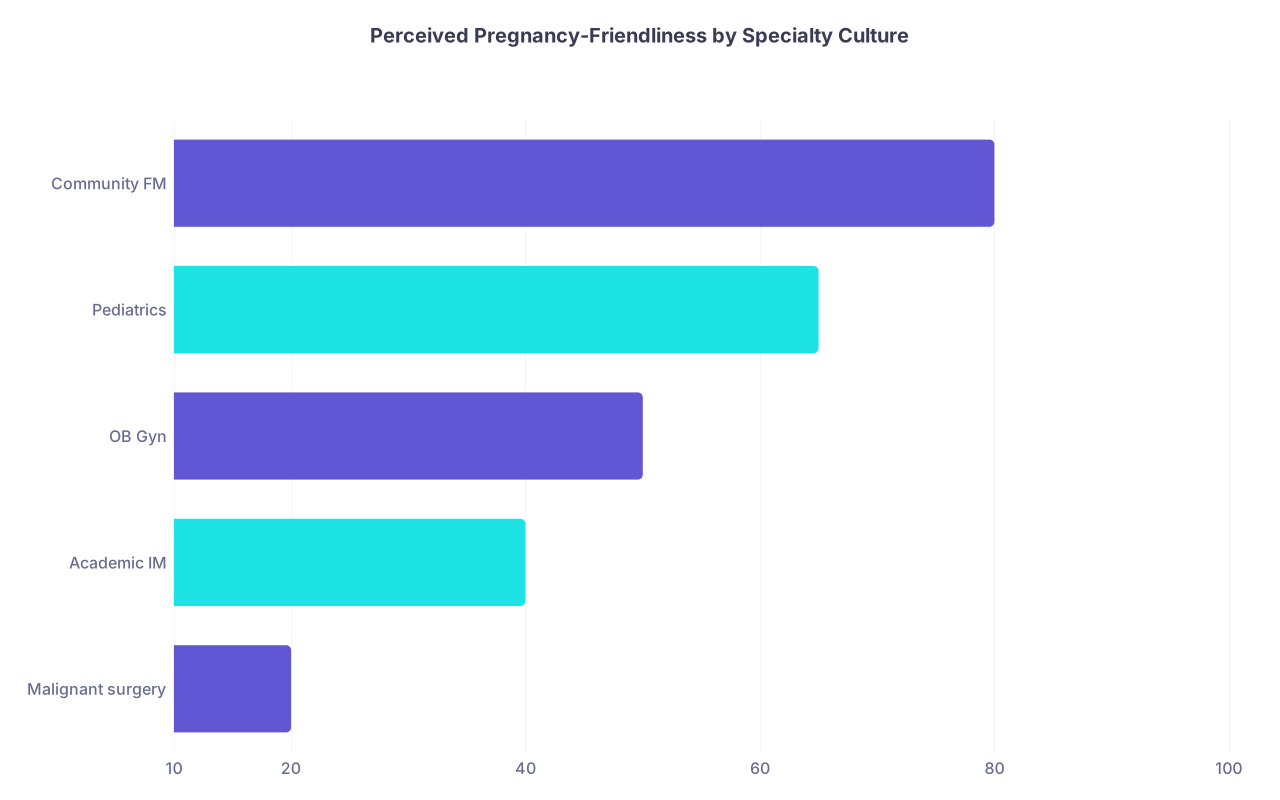
| Category | Value |
|---|---|
| Malignant surgery | 20 |
| Academic IM | 40 |
| OB Gyn | 50 |
| Pediatrics | 65 |
| Community FM | 80 |
This is not perfect data; it’s years of watching programs from the inside. But it’s not far off.
The cruel irony: some of the most woman-dense specialties (OB, peds) are also some of the most stretched-thin (night float, heavy call, understaffing). Wanting to support you and actually having the system bandwidth to do so are not the same thing.
So no, you did not “choose wrong” if you get pregnant during a tough residency. The system was not built for human reproduction at all.
Protecting Your Evaluations and Career Trajectory
One of your quiet fears — which you might not even say out loud — is, “Are my evaluations and fellowship chances going to tank because of this?”
Here’s how the politics usually plays out.
On paper vs in person
On paper, no one will ever write, “She was pregnant and therefore…” That’s lawsuit bait.
Instead you’ll see:
- “Reliability was occasionally an issue.”
- “Needed help maintaining workload.”
- “Struggled with continuity during critical months.”
The timing of those comments tells the story. That’s why you should keep a personal log of:
- Rotations during pregnancy
- Any pregnancy-related medical restrictions
- Coverage arrangements that were agreed upon
If a pattern of subtly negative evaluations emerges specifically during this period, you’ll at least have contemporaneous notes. You might never need them. But it changes how confidently you can challenge something if needed.
Fellowship and job politics
Fellowship directors and hiring attendings absolutely ask your PD informally, “How was she to work with?” They won’t mention your baby. But if your PD or faculty felt deeply aggrieved by coverage issues, that’ll leak in the form of vague lack of enthusiasm.
This is why the relationship with your PD matters. If they see you as:
- Thoughtful
- Reasonable
- Trying to balance an impossible situation
They’ll often defend you more strongly than you realize. I’ve watched PDs say, “She went through pregnancy and leave here, but she remained one of our strongest residents and handled a lot of nonsense graciously. I’d take her back in a heartbeat.”
You want that person talking about you. Not the bitter co-resident you left holding the pager during your 28-week vomiting spell.
Your Body Is Not a System Failure
Let me zoom out for a moment.
Medicine has built an entire training structure on the assumption that doctors are:
- Young
- Healthy
- Disembodied from normal human life events
Pregnancy, chronic illness, disability, caregiving — all of that is treated as an “interruption” to the “proper” uninterrupted training pipeline. That’s not your failure. That’s a design flaw.
So when you feel guilty for “breaking the schedule” or “burdening others,” remember: you are not the problem. The system that pretends human beings can run a 3–7 year gauntlet of 60–80 hour weeks with no major life events — that’s the problem.
Your job is not to fix that entire system during your pregnancy. Your job is to survive it with your integrity, health, and career intact.
A Few Very Practical Tactics That Quietly Help
Let me give you specific moves that tend to reduce political blowback:
Bank goodwill early.
Before you announce, if possible, be visibly solid: show up on time, help out, be reliable. People are more generous to those they already respect.Preempt the whispering with clarity.
“My OB has recommended I avoid night shifts after X weeks. I’m working with the chiefs to adjust. Until then, I’m doing full duties.” Simple, factual, not defensive.Offer realistic, not heroic, flexibility.
“I know moving my ICU block will inconvenience others; I’m willing to take a tougher elective later to help balance.” That shows you see the team’s viewpoint without sacrificing your medical needs.Have one ally in the chief group or leadership.
A senior resident, APD, or faculty who knows you well and can say, “She’s trying to be fair,” when others complain. That person is worth their weight in gold.Document when things feel off.
If someone explicitly ties your pregnancy to negative consequences (“Well, you chose to get pregnant during residency”), write it down with date, time, and witnesses. Do not start with legal threats, but don’t gaslight yourself either.
FAQ: The Messy Questions You’re Really Asking
1. Is there such a thing as “good timing” for pregnancy in residency?
From the system’s perspective, the “ideal” is: non-ICU rotation, not during peak admit season, away from boards, and in a year with extra residents. From your perspective, the ideal is: when your body and life are ready.
Those two almost never align. If you keep waiting for the system’s perfect timing, many of you will age out of your own fertility window. So yes, look at your schedule and avoid absolute worst-case scenarios if you can. But don’t sacrifice your life to optimize a call grid that will change three times anyway.
2. Will my program secretly hate me if I get pregnant twice during residency?
Some people will. Some won’t. Two pregnancies in a three‑ or four‑year program absolutely stress the schedule; pretending otherwise is fantasy. But I’ve seen programs handle two pregnancies by the same resident and still rank her at the very top because she was excellent, fair, and communicative.
The key is how each pregnancy is handled logistically and relationally. If you approach it with the same transparency and thoughtfulness both times, reasonable people respect that. The unreasonable ones were never going to be on your side anyway.
3. What if I have complications and need more time off than the policy allows?
This is where you cross from “routine politics” into “hard advocacy.” Extended leave can affect board eligibility and graduation timing. Many residents end up needing to add a few months of training; that’s not a failure, that’s reality.
You want:
A) Maternal–fetal medicine or OB documentation,
B) A PD willing to help you structure an extension that preserves your future opportunities, and
C) Clear written agreements about what your return will look like.
There are limits to what a program can flex. But there’s often more room than they initially admit, especially if GME or HR becomes involved.
4. Should I tell fellowship programs about my pregnancy or kids during interviews?
You’re not obligated to disclose. At all. But if your parental leave or extended training affects your graduation date, you do need to be accurate about when you’ll be available. Many women choose a middle path: they don’t hide it, they don’t lead with it, and if it comes up, they frame it as, “I navigated pregnancy/parenthood during residency and still maintained strong performance. It taught me a lot about prioritization and resilience.”
If a program penalizes you for that, you just identified a bad fit early. That’s information.
5. What if my co-residents are clearly resentful — do I confront it?
You don’t need a dramatic confrontation. But you also don’t have to swallow everything. A calm, private conversation can help:
“I get that my leave and schedule changes have affected you. I’m not expecting you to be thrilled about extra work. I am asking that if you have concerns, you bring them to me or the chiefs instead of sniping in the workroom. I’m doing my best within medical limits, and I’d rather we talk directly.”
Some will soften. Some won’t. Your goal isn’t universal approval. It’s a livable working environment until you’re out.
You’re training in a system that still hasn’t figured out how to treat physicians as humans with bodies and families. Pregnancy exposes that flaw faster than almost anything.
But you’re not powerless in this. You can time your disclosure strategically, script your conversations, build allies, and insist—quietly but firmly—that your body is not a scheduling error.
The politics will always be there. Your job is not to fix them all. Your job is to get yourself, your baby, and your career through this season intact. And once you’ve done that, you’ll be the attending or program leader who remembers exactly how it felt and quietly changes the rules for the next resident who walks into your office, closes the door, and says, “I’m pregnant.”
That next chapter—how to reshape the culture once you survive it—that’s coming later. For now, focus on playing this round of the game like someone who knows exactly what’s really happening behind the scenes.