
The “mommy track” in medicine is not inevitable. It is a story we keep telling women so often that it starts to look like fate instead of what it actually is: a set of structural choices disguised as personal failure.
Let me be blunt. The idea that women who have children are naturally destined for slower careers, fewer promotions, and less academic output is lazy thinking. It sounds explanatory, but it collapses the second you actually look at the data and compare systems, policies, and cultures.
The truth is more uncomfortable: it’s not motherhood that derails careers in medicine. It’s how medicine is set up around unpaid care work, outdated gender expectations, and institutional cowardice about redesigning jobs.
Let’s dissect the myth properly.
The Story We Keep Telling: What “Mommy Track” Really Means
In hallways and resident lounges, “mommy track” gets thrown around with an eye-roll and a shrug:
- “She went part-time. Basically on the mommy track now.”
- “He’s department chair; she’s the mommy track primary care doc.”
- “Once you have kids in residency, you’re done for anything competitive.”
No one writes “mommy track” in policy documents. But it shows up in:
- How colleagues react when a junior woman asks about maternity leave
- Who’s quietly removed from leadership consideration after a baby
- Which faculty get labeled “serious” vs “less committed”
What people mean by mommy track in medicine usually includes:
- Slower promotion or never making full professor
- Fewer leadership roles (chief, chair, dean, medical director)
- Less research output; more “service” or clinical grunt work
- Being seen as less reliable, less available, less ambitious
Notice what’s missing: actual evidence that parenthood, by itself, biologically or psychologically reduces competence, ambition, or ability.
There is none.
What the Data Actually Shows: The Motherhood Penalty Is Designed, Not Inevitable
Let’s get specific.
Studies in the US and Europe repeatedly show:
- Women physicians are more likely than male physicians to reduce work hours after having children.
- Female academic physicians with children publish less and are promoted more slowly than male peers.
- Male physicians who become fathers typically do not experience a similar career hit. In some data, they actually get a wage premium.
So the myth goes: “Kids → less time → fewer achievements → mommy track. Nature, not bias.”
Except that explanation falls apart when you look closer.
1. The gender gap is not just about hours worked
Even after adjusting for:
- Specialty
- Part-time vs full-time status
- Years in practice
…women physicians still:
- Earn less
- Hold fewer leadership positions
- Are promoted more slowly
And the penalties are particularly steep for mothers, not just women generally.
If this were “purely about hours,” the gap would disappear or shrink dramatically after controlling for workload. It does not.
2. Where there are better policies, the gap shrinks
Compare:
- Departments with formal, transparent parental leave, tenure-clock extensions, and flexible scheduling
- Versus “case-by-case, talk to your chair” departments
In the first group, the career penalties for women with children are smaller or delayed. In the second, they’re brutal and front-loaded.
That means the “mommy track” effect is environmentally sensitive. Translation: it is not fixed law. Change the environment, and outcomes change.
3. The bias is symmetric in exactly the way you’d expect
Sociology and labor economics data outside medicine show:
- Mothers face a “motherhood penalty”: perceived as less committed, less competent
- Fathers often enjoy a “fatherhood bonus”: seen as more stable, more deserving of higher pay
Medicine doesn’t exist in a vacuum. The same patterns appear in academic medicine evaluations, reference letters, and leadership selection.
So no, the “mommy track” is not just a cold neutral consequence of less time. It’s a gendered penalty layered on top of any workload differences.
The Hidden Script: How Institutions Quietly Build the Track
You don’t need a policy labeled “mommy track” to produce one. You just need a system optimized for a 1950s household model: full-time doctor with a full-time spouse at home.
Here’s how that shows up in medicine.
1. “Ideal worker” norms that are frankly irrational
The unspoken rules in many specialties:
- Be always reachable
- Say yes to last-minute schedule changes
- Take on extra call “as a team player”
- Stay late for meetings scheduled at 5:30 pm
Now imagine two people:
- Dr. A: Father of two, partner handles most childcare, has backup nanny
- Dr. B: Mother of two, partner works full-time, no extended family nearby
Both are equally capable. The system is built for Dr. A.
Dr. B is labeled “less committed” not because she cares less, but because the job is defined in a way that assumes she has someone else to absorb all non-work responsibilities.
That’s not destiny. That’s design.
2. “Case-by-case” flexibility – which is code for “bias-rich”
On paper, some places brag: “We are flexible and family-friendly.”
In practice, flexibility means:
- You ask your (often male) chair for a special accommodation
- You’re told “we’ll see what we can do”
- Whether you get it depends on personal goodwill and your “reputation”
Guess who historically gets more leeway? The golden-boy future chair, not the junior woman who “just went on maternity leave” and is “already asking for more.”
That’s not neutral. That’s discretionary power.

3. Metrics that reward face time, not outcomes
Academic medicine loves counting:
- Hours
- Committees
- Late meetings attended
- Number of evenings at “optional” events that are not really optional
Less attention is paid to:
- Clinical quality
- Patient outcomes
- Actual leadership effectiveness
- The efficiency of your teaching or research
So the person who leaves at 4:30 to pick up from daycare but runs a hyper-efficient clinic and writes grants at home after bedtime? Very often undervalued relative to the always-present-but-mediocre colleague.
Again: this is a choice. This is what institutions choose to reward.
The Biggest Myth: That Women Are “Choosing” the Mommy Track
You will hear this a lot:
“She chose family over career.”
“She didn’t want leadership.”
“She decided to go part-time.”
Half true. Which is the dangerous kind of lie.
What’s actually happening, over and over, looks more like this:
- A woman physician asks about having a baby during residency and gets told, “If you’re serious about a competitive fellowship, I’d wait.”
- She watches a colleague get subtly sidelined after coming back from parental leave.
- She realizes promotion criteria assume someone else is doing all her house/childcare work.
- When she raises issues, she’s told to “be realistic” and “this is just how medicine is.”
So yes, she “chooses” differently — under constraint, under threat, and with fewer viable paths. That’s not a free choice. That’s a forced trade.
Stop pretending those are the same thing.
Not Every Woman, Not Every Specialty: Outliers Matter
Here’s where the myth really cracks: look at the women who do reach the top.
Chairs, deans, program directors, division chiefs — many of them are mothers. Some had kids in residency. Some in med school. Some in their 40s after tenure.
What they have in common usually isn’t superhuman stamina. It’s a combination of:
- Unusual support (partner with flexible job, extended family, paid help)
- Unusual mentors who protected them instead of penalizing them
- Unusual institutions that bent a little instead of breaking them
Their existence proves something important: motherhood does not biologically preclude high achievement. It precludes high achievement in systems that refuse to adapt.
When you see:
- One institution where mothers never get promoted
- Another where mothers visibly dominate leadership in pediatrics or OB/GYN or even surgery
You’re not looking at “nature.” You’re looking at culture and policy.
The Fatherhood Plot Twist: This Isn’t Just a “Women’s Issue”
Let’s puncture another quiet myth: that only women care about this.
Ask male residents and attendings under 40 if they’d like:
- The ability to pick up their kids regularly
- Paternity leave without a wink and a joke
- To attend a school performance without groveling for coverage
You’ll hear the same frustration — just less publicly expressed.
This matters, because the “mommy track” myth is really the old “ideal worker” myth in drag:
- Real doctors don’t have constraints
- Real doctors have someone else handling home life
- Real doctors are available 24/7, physically and mentally
Many younger men do not live in that world anymore. Two-career households are the norm, not the exception. When medicine punishes caregiving, it’s not just punishing mothers. It’s punishing any physician who refuses to sacrifice family completely.
So yes, the label lands on women. But the underlying structure hurts everyone.
What Actually Works: Systems That Break the Track
If the mommy track were inevitable, we’d see the same patterns everywhere, regardless of policy. We don’t.
Look at places that have made serious changes:
- Transparent, standardized parental leave for all parents
- Automatic tenure-clock extension for birth/adoption, opt-out rather than opt-in
- Clear promotion criteria that recognize part-time years, non-linear paths, and actual outcomes rather than just time served
- Real flexibility in how full-time is structured (e.g., 80% FTE with protected days, not just a pay cut for the same work)
Those departments and systems:
- Retain more women post-childbirth
- Have higher satisfaction among all genders
- Do not collapse in a heap because people dared to be unavailable occasionally
The lesson is simple: when you build structures that assume physicians are humans with lives, mothers stop being treated as career anomalies.
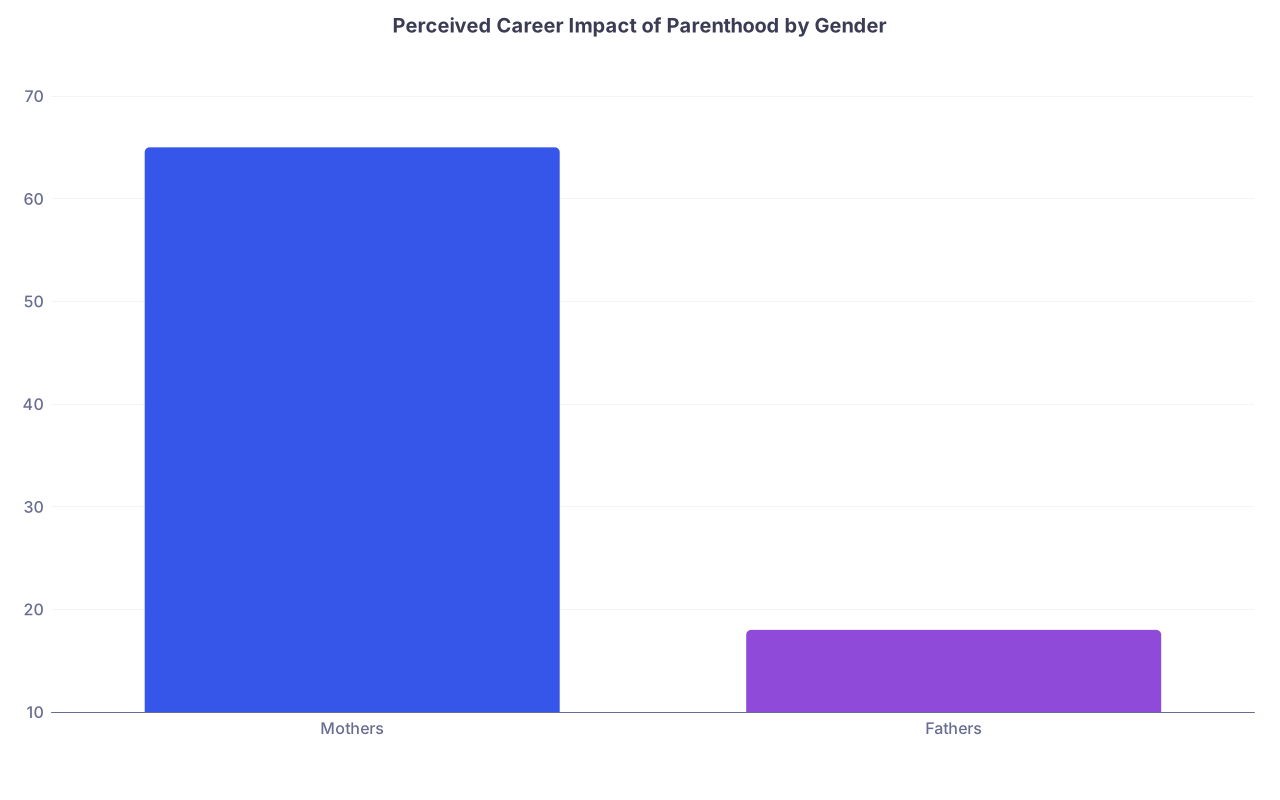
| Category | Value |
|---|---|
| Mothers | 65 |
| Fathers | 18 |
The hypothetical numbers here mirror what many surveys show: far more women physicians than men report that parenthood negatively impacted their career progression. That gap isn’t biology. It’s bias plus design.
What You Can Control (And What You Can Refuse to Internalize)
You can’t single-handedly redesign your institution. But you are not powerless, and you definitely don’t have to swallow the fatalistic version of this story.
A few uncomfortable but honest points:
Do not confuse other people’s anxiety with prophecy.
Senior physicians may warn you not to have kids “too early.” That’s them trying to retrofit their own compromises into advice. Listen, then decide. Their story is one data point, not your destiny.Interrogate any advice that starts with “women can’t” or “moms can’t.”
Before you absorb it, ask: is this truly a capacity issue, or a system issue?Treat “I don’t know anyone who’s done X” as a signal, not a stop sign.
Sometimes it just means no one with power bothered to carve that path yet.Choose institutions with their eyes open.
When job-hunting or ranking residency, ask concrete questions:- “How many faculty with children are full professors here?”
- “What percentage of your leadership took parental leave at some point?”
- “What happens to RVU expectations during pregnancy and postpartum?”
Evasive answers tell you more than any glossy brochure.
| Topic | Red Flag Answer | Better Sign Answer |
|---|---|---|
| Parental leave policy | Case-by-case, talk to your chair | Written, standardized for all genders |
| Promotion after leave | No formal adjustment | Automatic clock extension / adjusted metrics |
| Part-time arrangements | Rare, informal, hard to get | Common, with clear pathways back to full-time |
| Leadership representation | Few or no leaders with young children | Visible leaders who are active parents |

| Step | Description |
|---|---|
| Step 1 | Training complete |
| Step 2 | Seek flexible options |
| Step 3 | Traditional full time path |
| Step 4 | Nonlinear but robust career |
| Step 5 | Pressure to reduce ambitions |
| Step 6 | So called mommy track |
| Step 7 | Standard promotion track |
| Step 8 | Leadership or niche expertise |
| Step 9 | Have or plan children soon |
| Step 10 | Institution supports flexibility |
The point of that diagram: the “mommy track” is not triggered by the existence of children. It’s triggered by the absence of institutional support combined with pressure to conform to outdated norms.
Is the “Mommy Track” Myth Outdated? Yes. The Structures Creating It? Not Yet.
The language of “mommy track” is embarrassingly out of date. It smuggles in assumptions that:
- Caregiving is women’s work
- Career slowdowns are personal defects, not structural outcomes
- Men are the default workers; women are the special case
In 2026, that framing is frankly absurd. Yet the underlying structures — the ones that push mothers into narrow, penalized paths — are still very real in many places.
So here’s the honest position:
- The idea that motherhood inherently dooms your medical career is a myth.
- The reality that many systems still make motherhood costly is not a myth; it’s measurable, and it’s changeable.
- Calling it “inevitable” just gives cover to leaders who would prefer not to do the hard work of redesign.
You are not required to internalize someone else’s lazy framing of your options.
Years from now, you’re far more likely to remember which stories you refused to accept as “just the way it is” than any single promotion date on your CV.