
The word “difficult” gets weaponized against women in residency more than anyone will ever admit to you on the record.
You will not see it in your evaluations. You will hear it in the hallway after you leave a room. In the program director’s office with the door closed. In faculty meetings where your future is being quietly shaped by people who think they are being “objective.”
Let me walk you through what really happens.
The Quiet Economy Of Labels
Every residency program runs on an invisible vocabulary: “star,” “solid,” “low energy,” “quiet,” “great team player,” “bit rigid,” and yes—“difficult.”
On paper, programs talk about milestones, EPAs, professionalism, systems-based practice. Behind closed doors, they use shorthand. It saves time in meetings. It also slants careers.
When a female resident gets labeled “difficult,” it usually does not mean she is clinically unsafe, grossly unprofessional, or truly disruptive. Those people—of any gender—are dealt with formally: remediation plans, documentation, probation. That’s rare.
“Difficult” is a softer, slipperier word. It means:
I don’t like how she is pushing against the unwritten rules.
And here is the part you are not told: the behaviors that get a woman labeled “difficult” are often the same behaviors that get a man labeled “strong leader,” “assertive,” or “future chief.”
The Situations That Trigger The Label
You want specifics. Good. Because the patterns are remarkably consistent across institutions.
1. Pushing Back On Unsafe Or Unfair Workloads
Every program director has heard some version of this in a faculty meeting:
“She’s always questioning the schedule.”
“He’s a go-getter—never complains, just gets it done.”
Same workload. Same concerns. Different spin.
A female resident who says, “I’m concerned this cross-cover model is unsafe—there’s no way to realistically manage 80 patients overnight,” is seen by some attendings as “complaining,” “negative,” “not resilient.”
A male resident saying the same thing is more likely to be read as “looking out for the patients,” “seeing the big picture,” or “ready for leadership.”
The difference is not the words. It’s the expectation.
Programs expect women to absorb, accommodate, and smooth things over. When you start questioning systems, you are stepping out of the script. Some faculty admire that. Others quietly bristle.
2. Not Playing The “Smile And Soften” Game
I’ve sat in meetings where someone said (about a female senior resident):
“She knows her stuff, but her tone can be a little… sharp.”
Then the attending who said it imitated her:
“‘No, that’s not correct, we should not do that.’ It just comes off wrong.”
The content was right. The patient-care decision was correct. But she did not pad it with, “Sorry,” “I might be wrong but…,” or a nervous laugh. She sounded… confident.
You will hear male residents say, “No, that’s wrong—do it this way,” and be praised for being decisive. A woman uses the same directness and it trips an internal alarm for some evaluators: “attitude,” “not approachable,” “difficult.”
Nobody writes, “She failed to use gender-normative softening strategies in her communication” on an evaluation. They write, “Could work on communication style” or “Sometimes perceived as abrasive by team members.”
Same phenomenon.
3. Protecting Boundaries Around Time And Respect
This one really sets people off, especially older attendings who trained in a different era.
Examples that have triggered “difficult”:
- Saying no to repeated last-minute “asks” on your post-call day
- Declining to come in early for a non-mandatory teaching session after a brutal string of nights
- Pointing out that you’re being repeatedly assigned scut that your male colleague isn’t
- Pushing back when an attending yells at you in front of a patient and you say later, “That was not acceptable.”
I’ve watched this happen:
Resident: “I’d like feedback to be delivered privately, not in front of patients or nurses.”
Faculty (later, to program leadership): “She’s a bit fragile. Hard to give her feedback. Comes off as defensive.”
What she did was set a basic professional boundary. The system doesn’t like that coming from a woman. Men who do this get a different narrative: “He knows his worth,” “He advocates for himself.”
4. Not Playing The “Cool Girl” With Staff
One of the harshest hidden expectations is that female residents will be emotionally available: nice to everyone, endlessly patient, smoothing conflicts between nurses, techs, and consultants.
When a female resident says straightforwardly to a nurse who is chronically hostile, “We need to talk. This pattern is not okay; let’s figure out what’s going on,” that conversation will get retold. And not always fairly.
Program directors hear, “Nurses think she’s difficult.” Or: “She’s not popular with the staff.” Those comments carry weight, especially in fields like OB/GYN and pediatrics where nursing perception is heavily valued.
But look closer. Often the male resident who hides in the call room and dumps orders without talking to anyone is described as “busy,” “focused,” or “not super social but fine.” The woman who engages and actually addresses the conflict gets called “difficult.”
There’s a reason for that: she violated the unspoken rule that she should absorb emotional friction quietly.
How This Label Actually Hurts You
This is not just about feelings or “being liked.” The “difficult” label seeps into decisions that matter.
Here is how it shows up behind closed doors:
| Decision Area | How The Label Shows Up |
|---|---|
| Rotation Assignments | Kept off “plum” electives or away rotations |
| Leadership Roles | Passed over for chief or committee positions |
| Letters of Rec | Hesitant, coded language about “fit” |
| Fellowship Support | “Neutral” advocacy instead of strong support |
| Remediation Flags | Extra scrutiny for small mistakes |
Nobody says, “We are holding her back because we find her difficult.” That would be too honest.
Instead, it goes like this in review meetings:
“She’s clinically strong, but I’ve heard some concerns about her working style.”
“He’s raw but very promising—people like working with him.”
That “some concerns” phrase is program director code. I’ve watched it tank chief applications, tilt fellowship decisions, and downgrade otherwise excellent residents to “solid but not exceptional.”
Sometimes, the label starts as a single story—one conflict, one misunderstanding—and then gets repeated so many times it becomes her identity in the program. Even with no new evidence.
The Structural Bias Underneath It
Let’s strip away the politeness: this is gender bias wrapped in professional language.
Residency, like most of medicine, was built on male norms:
- Speaking loudly and directly = leadership
- Working until collapse = dedication
- Never mentioning personal life = professionalism
- Absorbing abuse without comment = “thick skin”
So when a woman shows up and does not conform perfectly to those expectations—or worse, uses those same behaviors herself—people get uncomfortable and reach for words like “abrasive,” “high maintenance,” or “difficult.”
I have seen:
- A male surgical resident throw instruments, curse, and still be defended as “old school but brilliant.”
- A female surgical resident raise her voice once in a high-stress case and get a half-page writeup on “emotional regulation.”
Guess which one got the bigger career hit?
The dirty secret: faculty assessments are not as objective as they pretend. There is research on this, but honestly, you can see it just by sitting in enough CCC (Clinical Competency Committee) meetings. Same behaviors. Different adjectives depending on who did it.
Where Legitimate Concerns End And Bias Begins
Now, to be clear: some residents of all genders are genuinely problematic.
Chronic lateness. Unreliable follow-through. Disrespect to patients or staff. Refusal to do basic work. Dangerous clinical judgment.
When that happens, the conversation is very different. There’s documentation. There are multiple faculty reports. The program director has to move formally.
You should know the difference because it changes how you respond.
Here’s the rough internal test good leaders use (and the bad ones should):
- Is there a patient safety issue?
- Is there a pattern across rotations and evaluators?
- Is the feedback concrete (“she missed three pages overnight”) or vague (“people say her vibe is off”)?
If what you are hearing is mostly vague, tonal, or second-hand—“some nurses find you difficult”—you are likely in the bias terrain, not the true professionalism-violation terrain.
That doesn’t mean you can ignore it. It means you need a strategy.
How To Recognize If You’ve Been Labeled
You will not get an email saying, “Congratulations, you are now in the Difficult Bucket.”
You have to read the signals.
Red Flags You Should Not Ignore
- You start hearing third-hand feedback: “So-and-so said some people think you can be intense.”
- You notice your evals say things like “very knowledgeable, could work on communication style” over and over without specifics.
- You are left out of informal opportunities—procedures, leadership tasks, special projects—without a clear explanation.
- Suddenly, your smallest missteps get magnified while your male colleagues’ mistakes are brushed off.
Another tell: the “compliment-with-a-hook” from faculty.
“You’re one of the best residents I’ve worked with, but sometimes you just need to relax a bit.”
That “relax” often means “be less assertive” or “go back to being easier for me to manage emotionally.”
If you’re hearing this repeatedly from different sources, assume your name has been mentioned in at least one behind-the-scenes discussion.
How To Respond Without Selling Your Soul
You do not have to choose between being a doormat and being labeled difficult. There’s a middle path, but you have to be deliberate.
Get Specific Data, Not Vibes
When you get fuzzy feedback, force precision—calmly.
Instead of, “Ok, I’ll work on that,” try:
- “Can you give me two or three concrete examples of when my communication was a problem so I can understand the pattern?”
- “What did I say or do in that situation that landed poorly?”
- “If a male resident said or did the same thing, how would you want it handled?”
That last question you may not always say out loud—but you should ask it in your head.
Your goal is twofold:
- Extract real, actionable information, if it exists.
- Make the person giving feedback aware that you are not going to accept lazy, gendered character critiques without detail.
Use “Strategic Softening” Without Internalizing It
Here’s the reality: the system is slow to change. You live in it right now. So you use techniques that work.
You do not need to apologize for existing. But you can adjust the surface-level delivery while keeping your core.
Things that help in practice:
- Start with the shared goal: “For patient safety, I’m concerned that…”
- Ask questions instead of direct negation when appropriate: “Can you walk me through why we’re choosing that plan?”
- Pair a firm “no” with an alternative: “I can’t stay late today because I’m post-call, but I can help transition this to the night team.”
Is it fair that you have to tone-check more than some male colleagues? No. Is it sometimes strategically smart if it keeps you out of the “difficult” bucket while you accrue power and credibility? Yes.
You are playing a long game.
Build A Counter-Narrative On Purpose
A single attending’s opinion can be diluted if others actively see and feel your strengths.
Cultivate a reputation as:
- Relentlessly reliable. Your work is done, your notes are accurate, your follow-through is impeccable. That makes it harder to dismiss you as “just emotional.”
- A strong advocate—for patients and for juniors. When you speak up, people notice it usually benefits someone vulnerable.
- Someone who invites feedback—but does not grovel. “I really do want to get better. If you see anything specific I can change, I hope you’ll tell me.”
A few well-respected faculty who see you clearly can neutralize a lot of vague “she’s difficult” noise.
Document When Things Cross The Line
If you’re dealing with clear gendered comments—“You’re too emotional,” “You’re hormonal,” “Women are always like this on nights”—start keeping a dated record. Names, contexts, quotes.
Do not threaten to use it. Just have it.
If the label starts to materially affect your career—probation talk without specific incidents, major opportunities removed on the basis of “fit”—you may need that record in conversations with the program director, GME office, or ombuds.
You are not paranoid for keeping receipts. You are protecting yourself in a system that sometimes protects itself first.
The Ethical Conflict Underneath All This
You’re in the “Personal Development and Medical Ethics” phase of your career whether you realize it or not.
The ethical tension is this:
- You have a duty to advocate for patients, for safety, for equity.
- The system sometimes punishes the very behavior that ethical practice requires—especially from women.
That’s not just unfair. It’s ethically corrosive. Because it sends the message: “If you want to survive here, shut up and be agreeable.”
Some residents internalize that and go quiet. They coast. They stop asking hard questions. They survive, but they lose something sharper and more necessary in themselves.
Others swing the opposite way—rage against every slight, fight every battle, and burn themselves out, becoming exactly the “difficult” caricature people whisper about.
The skilled path is neither. It’s selectively fierce.
You choose your battles. You gather allies. You speak in ways that are hard to dismiss. You stay oriented to your values but adapt your tactics.
That balance is personal. But pretending the tension does not exist—that’s how you get slowly bent into someone you do not recognize.
A Realistic Playbook Going Forward
Let me put this all into something you can actually use tomorrow.
- Start paying attention to language in your evaluations. Anytime you see “abrasive,” “intense,” “could work on tone,” without detail, mentally flag it.
- Find one senior woman (or man who “gets it”) in your department you trust. Ask directly: “Have you heard anything about people finding me difficult to work with?” Then shut up and listen.
- In conflicts, narrate your intent explicitly: “My goal here is to keep this safe for patients and sustainable for the team.” That framing matters more than you’d think.
- After any high-tension incident, debrief with a neutral mentor: “Here’s what I said, here’s what they said. How could I have done that differently without compromising the point?”
- Keep a quiet log of any clearly biased comments or patterns. You may never need it. You’ll be glad you have it if you do.
You’re not crazy if you sense a double standard. You’re not overly sensitive if you see your male colleague praised for what gets you side-eyed.
You are reading the room accurately.
The goal is not to become “less difficult” in the sense of being more compliant. The goal is to become so precise, so grounded, and so effective that vague labels stop sticking—and to protect yourself until you are in a position to change the system for the women coming behind you.
You’re not just learning medicine. You’re learning how power, gender, and personality get braided together in this profession.
Once you see it, you cannot unsee it.
And with that awareness, you’re better positioned for the next step in your journey: using your voice on committees, in hiring decisions, and in teaching the next generation what real professionalism looks like. But that is a story for another day.
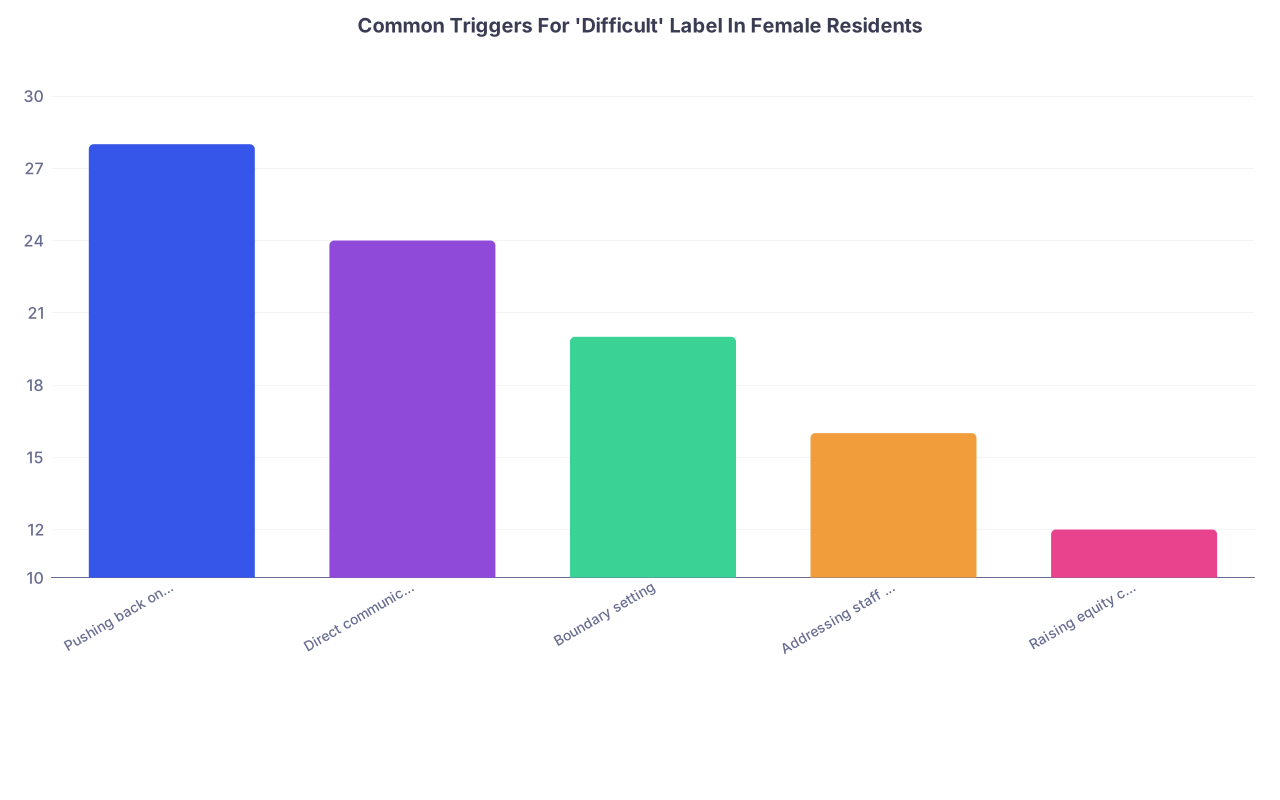
| Category | Value |
|---|---|
| Pushing back on workload | 28 |
| Direct communication | 24 |
| Boundary setting | 20 |
| Addressing staff conflict | 16 |
| Raising equity concerns | 12 |

| Step | Description |
|---|---|
| Step 1 | Hear Vague Feedback |
| Step 2 | Clarify Examples And Impact |
| Step 3 | Ask For Concrete Incidents |
| Step 4 | Adjust Tactics If Reasonable |
| Step 5 | Recognize Possible Bias |
| Step 6 | Seek Mentor Perspective |
| Step 7 | Document Patterns |
| Step 8 | Build Counter Reputation |
| Step 9 | Continue Strategic Adaptation |
| Step 10 | Escalate To PD Or GME With Data |
| Step 11 | Is There Specific Behavior Cited |
| Step 12 | Career Impact Increasing |