
It’s 7:15 a.m. You’re standing in the back of the conference room, clutching your coffee, waiting for morning report to start. The program director sits in the front row, arms folded, watching the room fill. You’re a PGY-2 now. You know you’re being watched in a different way. “Leadership potential.” “Fellowship material.” “Team player.”
You also know — even if you can’t quite prove it — that the way he evaluates you is not the way he evaluates your male co-resident who speaks twice as loud and gets half as much done.
Let me tell you what the male PDs actually say when it’s just them, a couple senior attendings, and a closed door.
Because I’ve heard those conversations. I’ve sat in those ranking meetings. I’ve watched how they talk about women publicly vs privately. It’s not cartoon-level sexism. It’s more insidious than that. And it absolutely shapes your evaluations, your letters, and which doors quietly open — or quietly close — for you.
The Unspoken Filters: How Male PDs “See” Women Residents
Male PDs won’t tell you this at the welcome dinner. But behind closed doors, the conversation changes.
Here’s the dirty truth: most of the bias isn’t in the overt statements. It’s in what they notice, what they remember, and what they label as “concern.”
I’ve heard all variations of this:
“She’s very competent… I just wish she had a bit more ‘presence’ on rounds.”
“She’s strong clinically, but I’m not sure she can handle a really tough service.”
“For her, I worry about burnout.”
For “her.” Not for the guy who’s visibly falling apart and charting until midnight. For her.
What they don’t realize — or don’t admit — is that they’re running every woman through a few invisible filters:
Likeability tax
Men can be “intense,” “driven,” “no-nonsense.”
Women with the same exact behavior? “Abrasive,” “not a team player,” “rubs some people the wrong way.”Emotional interpretation
A male resident gets frustrated in a code: “He cares, he’s invested.”
A woman does the same: “She gets flustered under pressure.”Leadership stereotypes
Men who take charge: “Natural leader.”
Women who take charge: “Pushy,” “bossy,” or “not aware of the hierarchy.”
No one writes “she’s bossy” in your evaluation anymore. They’re not that stupid. They code it. “Interpersonal skills need maturation.” “Can work on approach to team conflict.”
And PDs read between those lines. Especially male PDs who think they’re “objective.”
The Double Standard on Confidence, Volume, and “Presence”
When male PDs say “presence,” they usually mean some version of “acts like the confident male archetype I’m used to seeing in leadership.”
Let me give you a concrete pattern I’ve watched in multiple programs.
Two PGY-3s on medicine:
Male resident: speaks loudly, interrupts occasionally, calls plans “simple,” occasionally over-corrects interns in front of patients.
Faculty comments: “Strong presence, decisive, maybe needs a bit of humility but clearly leadership material.”Female resident: speaks clearly but not loudly, pushes back when attending is wrong but carefully, asks for input from nurses in huddles.
Faculty comments: “Very solid clinically, but quiet. Needs to be more assertive. I don’t always feel her leading the room.”
Same capability. Different read.
Here’s what a male PD told me verbatim one year when we were reviewing chief residents:
“I know she’s good, but chiefs need to be commanding. I’m just not sure everyone would naturally look to her.”
Translation: she doesn’t mimic the loud male energy I unconsciously equate with leadership.
And yes, he’d swear up and down he supports women in leadership. He’d even point to the one female chief that year as proof.
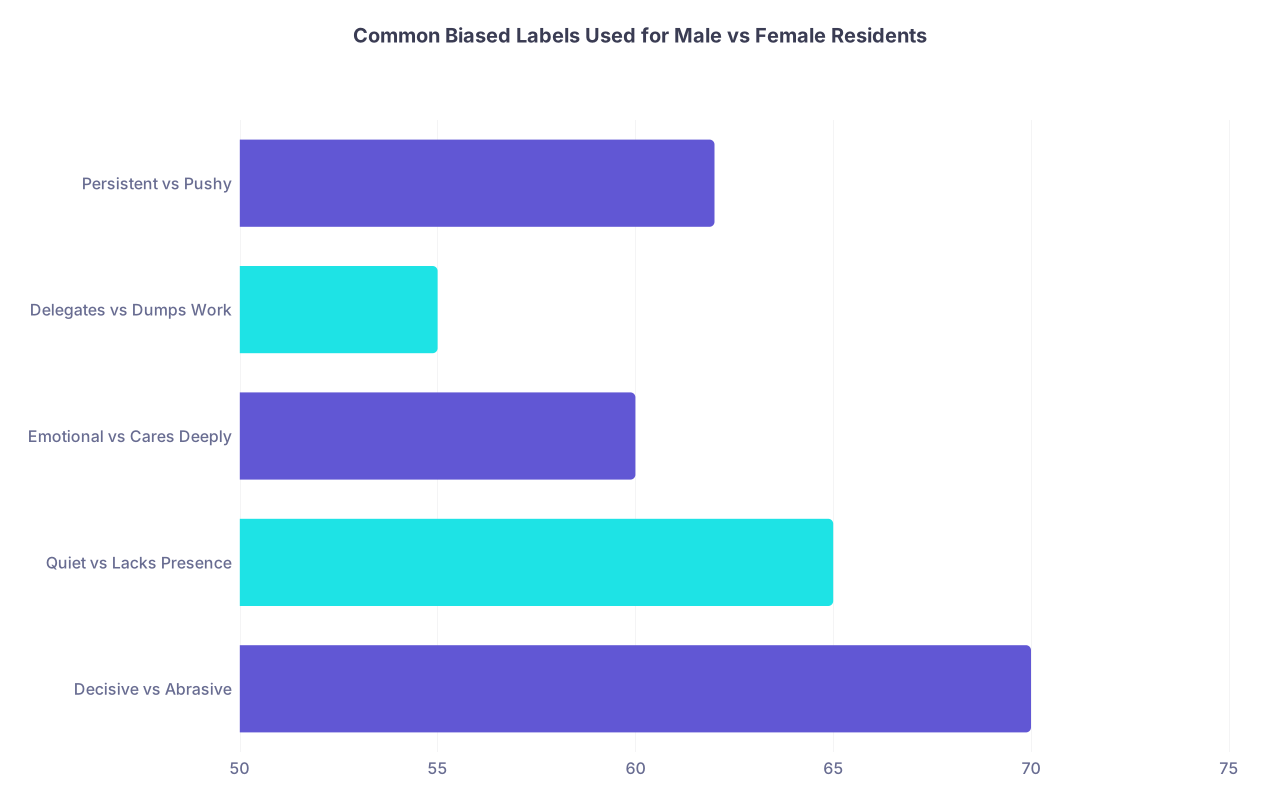
| Category | Value |
|---|---|
| Decisive vs Abrasive | 70 |
| Quiet vs Lacks Presence | 65 |
| Emotional vs Cares Deeply | 60 |
| Delegates vs Dumps Work | 55 |
| Persistent vs Pushy | 62 |
This doesn’t mean you should cosplay as a loud, overbearing dude just to signal “presence.” That backfires too; women don’t get the same forgiveness curve when they overshoot.
What it means is: male PDs are pattern-matching you to the leadership archetype in their head. And that archetype is still male-coded.
How Personal Life, Pregnancy, and “Future Plans” Quietly Get Scored
You know this one intuitively. I’ll just confirm it for you.
I’ve watched multiple ranking meetings where male PDs say some version of:
“She’s fantastic, but she just had a baby, and I worry about how much she can take on next year.”
Or:
“He’s getting married? Great, he seems more settled now.”
Same life event. Different conclusion.
Here’s the way it actually plays out when programs decide who to trust with big responsibilities:
- Women of childbearing age are mentally tagged as “possible maternity leave risk,” even if no one says it.
- Pregnant residents are evaluated with a magnifying glass for any sign of “fatigue,” “less engagement,” “stepping back.”
- New dads are assumed to be unchanged unless they explicitly ask for accommodation. New moms are assumed to need accommodation, and it’s framed as a compromise on commitment.
I heard a male PD once say, about a female resident considering fellowship:
“I think she’ll do great, but given she wants kids soon, I’m not sure she’ll want such a demanding subspecialty.”
He said that with no irony, as if he was being considerate. He wasn’t malicious. Just biased. Deeply.
Women who even mention wanting “work-life balance” get slotted into the “probably outpatient / probably not a star academic” bucket. Men can say the same thing and get framed as “mature” or “centered.”
And yes, there have been programs where, in closed conversations, male PDs essentially say: “Let’s lean toward the candidate who’s less likely to need extended leave.” They’ll never put that in writing. But I’ve heard the euphemisms: “continuity,” “service coverage,” “predictability.”
Evaluation Language: How Male PDs Code Bias in Your File
If you want to really see bias, don’t listen to what PDs say about fairness. Read how documentation looks across gender. The patterns are disgusting once you start noticing them.
When male PDs discuss residents in Clinical Competency Committee (CCC) meetings, they often unconsciously split evaluation comments along gender lines.
This is the kind of thing that actually shows up in files:
| Resident | Strengths Emphasized | Concerns Emphasized |
|---|---|---|
| Male | Knowledge, decisiveness | Rarely “personality” based |
| Female | Communication, teamwork | Confidence, “style”, “fit” |
| Male | “Leadership potential” | “Needs more experience” |
| Female | “Very nice to work with” | “Needs more confidence/assertion” |
| Female | “Reliable, very thorough” | “Can get overwhelmed emotionally” |
When male PDs sit down to write letters of recommendation, the adjectives they default to for women vs men are different. Even the ones who genuinely like you.
I’ve watched a PD dictate two letters in the same afternoon:
For a male resident: “He is among the strongest residents I have worked with. He is brilliant, analytically gifted, and I trust him with the sickest patients. He is destined to be a leader in the field.”
For a female resident with equivalent performance: “She is extremely hard-working, very dependable, and a pleasure to have on our team. She is thoughtful, kind to patients, and works well with colleagues.”
Same caliber. Different story.
This matters. Fellowship directors and hiring committees read those adjectives like a code. Male PDs may not intend to soft-pedal your accomplishments, but they absolutely do it.
The “Communication Problem” That Isn’t Yours
Here’s a fun pattern: when there’s interpersonal friction on a team that involves a woman resident, male PDs are more likely to consider it “her communication style” problem.
Especially if the other party is:
- a senior male attending
- a “well-liked” male resident
- an older male nurse or staff member “who’s been here forever”
I’ve sat in meetings where something like this happened:
Scenario: Female PGY-2 pushes back on a surgeon about unrealistic post-op discharge plans. She’s right on the medicine. The tone gets tense. The surgeon complains to the PD that “she was disrespectful and argumentative.”
Male PD’s response behind closed doors?
“Look, she’s smart, but she does come off strong sometimes. She probably could’ve handled that more diplomatically.”
When the same surgeon clashes with a male resident?
“He and Dr. X had a disagreement. Strong personalities, they’ll work it out.”
See the difference? Same tension. Men = “two strong personalities.” Woman = “communication problem.”
So women get coached — or warned — about “softening their approach,” “reading the room,” “using more I-statements.” Men get “it’s just part of the culture, don’t take it personally.”
The net effect: you’re doing extra emotional labor to manage other people’s egos, and then getting evaluated on how gracefully you clean up messes that weren’t yours.
How Male PDs Use “Culture Fit” As a Shield
When programs do not want to own their bias, they use one phrase almost universally: “culture fit.”
I heard this line from a male PD about a female prelim who was frankly one of the most competent residents in the program:
“She’s good, but she just isn’t a great fit for the culture here. A little… intense.”
What did “intense” mean?
- She didn’t laugh along when male co-residents made lazy jokes about “touchy-feely specialties.”
- She called out a senior for consistently handing scut to the only woman on nights.
- She refused to come in early off the clock to pre-round for someone else’s convenience.
“Intense” means “not willing to absorb unfairness quietly.”
Male PDs use “culture fit” when a woman makes them or their attendings uncomfortable — not by being bad, but by refusing to be small.
The twist is this: those same PDs will proudly tell applicants their program is “very supportive of women.”
They’ll point to:
- One female APD
- A “Women in Medicine” luncheon once a year
- A slide about “diversity” in orientation
And then still knock a woman down a peg in rankings because she “doesn’t quite fit the vibe.”
What You Can Actually Do (Without Selling Your Soul)
You can’t fix a sexist system during a 28‑hour call. You’re not going to rewire your PD’s brain by being extra nice in morning report.
But you are not powerless either. There are a few levers that actually work — and I’ve seen women use them strategically.
1. Control the narrative, not just your performance
Most women assume: “If I work hard and do well, the right people will notice.” That’s not how institutional memory works.
Male PDs remember stories, not raw performance.
Feed them the right stories.
- When you handle a brutally sick patient well, send a short email to the attending: “I appreciated the opportunity to manage that case; I learned a lot about X/Y/Z.” That attending now has a hook to mention you positively to the PD.
- When you lead a difficult family meeting, ask for brief feedback. That invites them to mentally tag you as “good with complex communication,” not just “nice.”
You’re planting headlines in their heads.
2. Anticipate the predictable biases and pre-empt them
If you’re quiet, you will be labeled as “lacking confidence.” So you don’t need to become loud. You just need a few deliberate, visible moments of leadership every month.
Things like:
- Volunteering to present at noon conference
- Running the team huddle at least once a week and making that obvious
- Explicitly summarizing plans on rounds: “To make sure I’m clear, our plan is X, Y, Z.”
These are small behaviors that signal “presence” in the male PD vocabulary, without you turning into a caricature.
3. Build written evidence
Male PDs lean heavily on vibes and memory. Counter that with a paper trail.
- Save strong written comments from attendings and fellows.
- Ask specifically for “I would trust her with my own family member” type lines. That phrase hits PDs right in their bias center.
- When you ask for letters, be explicit: “I’d really appreciate if you could speak to my leadership on nights and my ability to manage high-acuity patients.”
You’re not begging. You’re scripting.
4. Use other men’s reputations strategically
Here’s the irony: male bias can sometimes be used against itself.
If there is a male attending or APD whom the PD deeply respects and who respects you, that person’s word will carry more weight than your female allies’ combined. That’s how warped it is.
Do not be shy about asking that person to:
- Speak up for you in CCC
- Co-sign you for a chief or senior role
- Make sure the PD knows about your wins
This is how games are actually played at the upper levels.
The Line Between Surviving and Colluding
You’re going to feel this tension: “If I adapt too much to biased expectations, am I just feeding the bias?”
Yes, a little. That’s the honest answer. The system is built so that the people who conform to its unwritten rules get rewarded faster.
But here’s the nuance: playing the game to protect your career is not the same as agreeing that the game is fair.
You don’t have to:
- Laugh at sexist jokes
- Pretend maternity bias isn’t real
- Participate in tearing down other women as “too much” or “difficult”
You can:
- Document your value
- Make your work visible
- Choose your battles strategically
- Use the institution’s own language (“leadership,” “systems thinking,” “patient safety”) to frame your advocacy
The goal is not to leave residency as the Most Pure Uncompromising Feminist Who Never Bent, but with the power, credentials, and platform to change things later — when you’re not subject to a single PD’s whims anymore.

| Step | Description |
|---|---|
| Step 1 | Intern Year |
| Step 2 | Noticed as Nice and Hardworking |
| Step 3 | Builds Allies and Evidence |
| Step 4 | Subject to Vibes and Labels |
| Step 5 | Stronger Letters and Opportunities |
| Step 6 | Under-ranked Despite Competence |
| Step 7 | Better Fellowships or Jobs |
| Step 8 | Adapts Strategy? |
The Things Male PDs Will Never Say To Your Face
They will not say:
- “We worry you’ll have kids and be less available.”
- “We’re harsher on your tone than on his.”
- “We take male ‘confidence’ at face value and question yours.”
- “We encode ‘she made us uncomfortable’ as ‘not a good fit’ in your file.”
But behind closed doors? I have heard every single one of those sentiments in cleaner language.
There are male PDs who are trying to learn. Who genuinely want to do better. Some ask female faculty to review their letters. Some look at their eval data by gender, and don’t like what they see. They at least know something is off.
The rest? They’re convinced they are “objective.” That’s the dangerous group. Because they will deny the existence of water while swimming in it.
Years from now, you won’t remember the exact wording of your PGY-2 evaluation. You will remember which parts of yourself you refused to shrink to fit someone else’s comfort. That’s the piece you need to protect.
FAQ (Exactly 5 Questions)
1. Should I directly bring up gender bias with my male PD if I feel it’s affecting my evaluation?
You can, but do it surgically, not emotionally. Frame it around patterns and opportunities, not accusation. For example: “I’ve noticed feedback often focuses on my ‘confidence’ rather than my clinical decisions. Can we be specific about situations where my decision-making fell short, so I can work on concrete skills?” If he’s even mildly self-aware, that will make him reflect. If he’s defensive, you’ve at least signaled you’re tracking the dynamic.
2. Is it safer to have a male or female mentor when I know male PDs hold the power?
You need both. Female mentors will translate the landmines for you and validate your reality. Male mentors, especially ones respected by the PD, can vouch for you in rooms you’re not allowed into. Do not romanticize either group. Choose individuals with actual pull and a track record of going to bat for people, not just talking about “supporting women.”
3. How do I push back on unfair comments about my “tone” without being labeled difficult?
You don’t fight every instance. You counter strategically. When someone calls you “too direct,” respond with: “I hear that. My goal is always to be clear and efficient. If there’s a specific instance where that came across poorly, I’d like to know so I can adjust without compromising clarity.” You’re making them either name a real example or back down from a vague character critique.
4. What if I actually am more emotional or anxious under stress — am I just feeding the stereotype?
You’re human, not a stereotype generator. The key is not to pretend you never feel overwhelmed, but to show you can still function. Verbalize your process: “I’m feeling the pressure of this situation, but here’s how I’m prioritizing.” If you own the narrative, observers are more likely to see you as self-aware under stress instead of “emotional.”
5. If my male PD clearly favors male residents, should I still ask him for a letter?
If he controls access to your next step (fellowship, job) and his letter is expected, you probably have to. But hedge your bets. Line up at least one or two other heavyweight letter writers who know your clinical work and will write in strong, decisive language. When you request his letter, be specific: “Programs are very interested in my ability to manage high-acuity patients and lead teams on nights — I’d be grateful if you could address those experiences in your letter.” You’re nudging him away from the “she’s nice and hardworking” trap.