
The leadership pipeline in medicine was not built for women—and it still runs on rules nobody will put in writing.
If you’re a woman physician aiming for chief, chair, program director, CMO, or any role with real power, you’re playing a game that has two sets of rules. The official rules live in policies, DEI statements, and glossy brochures. The real rules get whispered in offices with the door half-closed, in “informal” emails, and at 7:15 a.m. meetings that somehow always conflict with school drop-off.
I’m going to walk you through those real rules. The ones division chiefs talk about after you walk out of the room. The patterns I’ve seen on search committees and promotions committees where everyone swears they’re “just looking for the best candidate.”
Rule #1: Leadership Roles Are Given Long Before They’re Posted
Here’s what nobody tells you: by the time you see “Section Chief” or “Program Director” posted, there’s usually already a front-runner. Often a man. Often someone who has been “shadow-leading” for a while.
Behind closed doors, what actually happens is more like this:
- The chair identifies someone as “a natural leader” 2–5 years before any formal title appears.
- That person is quietly given stretch assignments: leading QI projects, “representing the department” on cross-institution committees, steering key initiatives.
- Then, when the role becomes “open,” the committee says, “Well, X already has so much experience in this space…”
Women get cut out early because they’re never identified as that “natural leader” or they’re stuck running invisible work that doesn’t translate into authority.
If you want leadership, you cannot wait for the posting. You have to position yourself as the obvious choice before anyone types a job description.
How that looks in real life:
You’re in a division meeting. The division chief says, “We need someone to coordinate our quality metrics for this new pay-for-performance thing.” Most people look at their phones. One or two guys think, “This is annoying administrative work.”
That’s actually a leadership on-ramp.
If you raise your hand and then do three specific things—define strategy, communicate clearly, and report results in a way that makes your chief look good—you’ve just moved yourself into their “emerging leader” category.
Do this consistently over a couple of years, and when a medical director or associate chief role appears, you’re no longer “a great clinician” alone. You’re “already functioning as a leader.”
Most women wait to be tapped on the shoulder. Men pitch themselves earlier. That mismatch alone sidelines a lot of excellent women.
Rule #2: You Are Being Evaluated on Two Totally Different Scales
On committees, I see this pattern constantly: men are judged on potential; women are judged on proof.
For male candidates, you’ll hear:
- “He’s never led a division, but he’s got a lot of upside.”
- “He has a strong presence. I can see him growing into this.”
For women:
- “Has she run a budget of this size?”
- “Has she ever dealt with a difficult faculty termination?”
- “I’m not sure she’s quite ready for this level yet.”
That “ready” word is the kiss of death.
The ethical problem is obvious. But let’s talk tactics, because you want to win inside the system that actually exists, not the one that should exist.
Your goal is to remove as many “but has she ever…” questions as possible before you’re up for the role. That means aggressively seeking out concrete experiences that check their mental boxes.
You want lines on your CV that sound like:
- “Led $3.2M annual clinical service line with 12 FTE physicians.”
- “Chair, institutional quality committee overseeing system-wide sepsis bundle implementation.”
- “Principal investigator or co-PI on funded initiatives involving multi-department stakeholders.”
You don’t need the title yet; you need the receipts.
Here’s the game: Make it very hard for anyone in that room to say “not ready” without sounding lazy or biased.
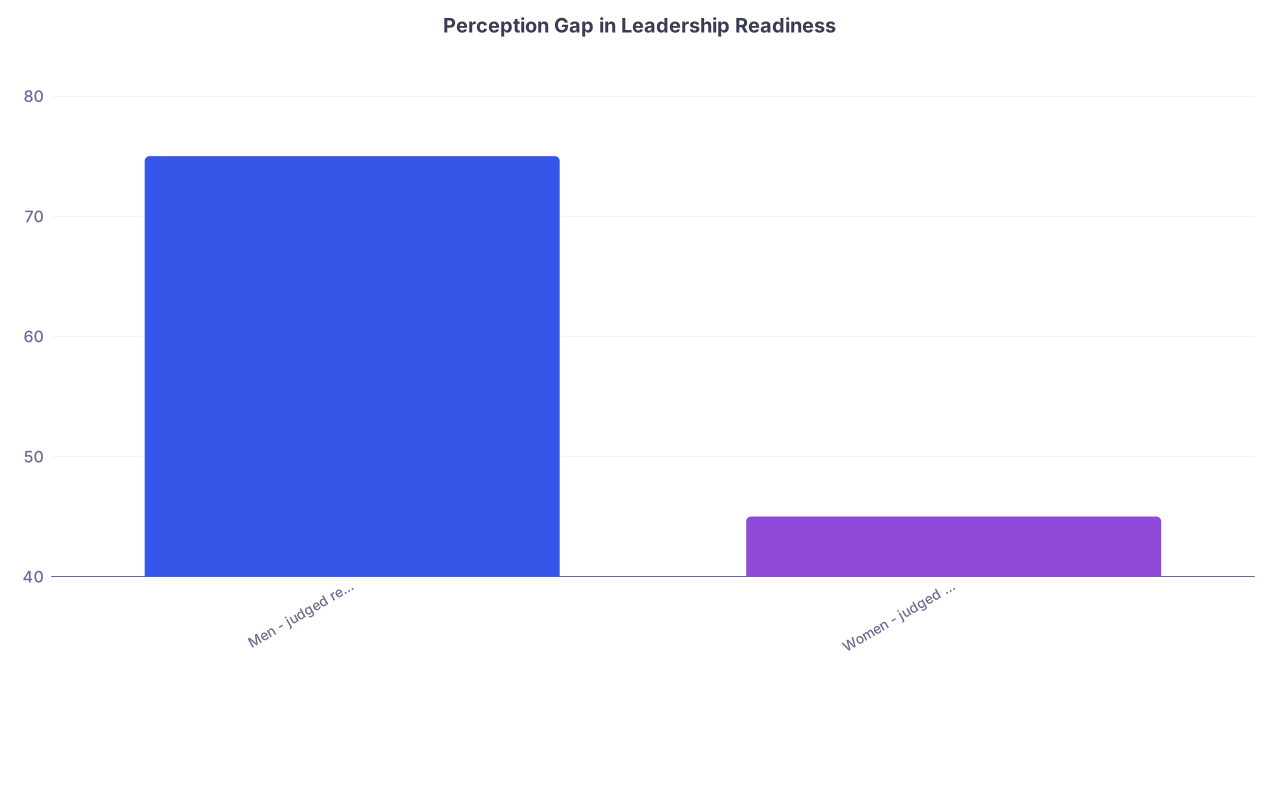
| Category | Value |
|---|---|
| Men - judged ready | 75 |
| Women - judged ready | 45 |
That gap? I’ve seen worse in real review meetings. You can’t fix it overnight, but you can force people to confront your track record instead of their gut feeling.
Rule #3: The Work That Gets You Praised Is Not Always the Work That Gets You Power
This one hurts, because women physicians are propped up as “heroes of the system” while being kept far from where decisions are actually made.
Here’s how the bait-and-switch works:
You’re spectacularly reliable. Patients love you. Residents adore you. You’re the person they call when there’s a scheduling crisis, when someone has to fix the curriculum last-minute, when the new EMR order set needs to be tested.
You’ll hear:
- “You’re the glue of this department.”
- “We don’t know what we’d do without you.”
- “You’re so good with the residents. Could you take on just a bit more of the education piece?”
That “glue work” is essential. Ethically, the system runs on it. But politically? It’s often career poison.
Search committee members do not say, “She’s amazing, she built all the schedules and smoothed all the interpersonal conflicts.” They say, “She’s such a great team player—maybe she’s better in a supportive role.”
The work that actually propels people into leadership is different:
- Owning revenue-generating or cost-saving initiatives.
- Leading visible, cross-department projects tied to strategic priorities.
- Being the person who “delivers” for the chair on high-stakes institutional initiatives.
If you spend 80% of your extra time on tasks that keep the machine running but don’t change the machine, you are making everyone else’s life easier while freezing your own progress.
You don’t need to stop caring or stop helping. But you do need to start saying no to some of the low-visibility emotional labor and operational grunt work, and yes to the projects that get mentioned in C-suite presentations.
Simple test: Ask yourself, “Will this be on a slide when the chair presents departmental accomplishments this year?” If the answer is no, think twice.
Rule #4: Likeability Is Weaponized Against Women Who Want Power
I’ve sat in candidate debriefs where the same behavior was praised in a man and punished in a woman—sometimes in the same sentence.
What they’ll say about a man: “Direct. Clear expectations. He’s going to shake things up in a good way.”
About a woman doing the same thing: “A bit abrasive. I’m just not sure how she’ll be received.” Or the dagger: “I’m concerned about her fit.”
You are walking a tightrope: too soft and you’re “not leadership material”; too firm and you’re “difficult.” This is the double bind everyone talks about, but here’s the unspoken operational rule:
You’re not trying to be universally liked. You’re trying to be respected by the people who actually have influence over your promotion.
That circle is smaller than you think. Chairs, a few key senior faculty, maybe the CMO, maybe the dean. Fifteen people, max. Often more like six.
Almost every woman leader I know who actually has real authority solved this in the same way: they deliberately cultivated a reputation for being fair, prepared, and non-reactive in conflict. Not “nice.” Not “sweet.” Steady.
Behind the scenes, what protects women in leadership discussions is not “likeability” but specific stories like:
- “She handled that disruptive surgeon issue without drama and nobody filed grievances.”
- “When the budget got cut, she restructured call schedules and we still met coverage—people were unhappy, but it held.”
- “Her meetings run on time and things actually get done.”
You still have to manage how you show up in rooms full of fragile egos. But do not confuse that with being a people pleaser. People pleasers become burnout statistics, not division chiefs.
Rule #5: Sponsorship Beats Mentorship Every Time
Here’s the quiet truth: the men getting the big jobs are being sponsored, not just mentored.
Mentor: “Let me give you advice on your CV.” Sponsor: “I just told the Dean you’re the person who should run this new clinical enterprise.”
Different planet.
Women are drowning in mentorship and starving for sponsorship. Every institution sets up “Women in Medicine” panels. Coffee chats. Book clubs. Meanwhile, real decisions happen in a completely different ecosystem.
The people who end up in leadership have someone in a higher, more powerful role who does at least three things for them:
- Puts their name into conversations they are not in.
- Shields them from some of the inevitable backlash when they start taking up more space.
- Routes real opportunities and visibility their way.
Ethically, should this be the system? No. But it is.
Your job is to identify who in your environment actually has that kind of clout—then become professionally indispensable to them.
That doesn’t mean flattery. It means:
- Doing superb work on high-visibility projects they care about.
- Making their life easier by anticipating needs rather than just responding.
- Asking directly for sponsorship when the relationship is established: “I’m interested in becoming a section chief in the next 3–5 years. What would it take for you to feel confident recommending me when the next opportunity comes up?”
I’ve watched women silently hope someone would notice their talent for ten years. I’ve watched men with half the talent say, “I want to be a vice chair” out loud and have someone start shaping their path the next week.
Say the quiet part out loud—to the right person.
Rule #6: Your Reputation Is Built When You’re Not in the Room
This one is brutally simple. On promotion and search committees, the first few minutes are not about your CV. They’re about your story inside the institution.
The conversation sounds like:
- “Oh, she’s the one who fixed the resident scheduling disaster.”
- “He’s the research machine, always getting grants.”
- “She’s solid, but I haven’t really seen her in any institutional roles.”
- “Isn’t he the guy who made that whole OR change initiative happen?”
That narrative forms long before you ever apply for leadership.
So you need to decide what you want the one-line story about you to be. Not five lines. One.
- “She runs the service that always hits its metrics.”
- “She’s the person who gets cross-department people to actually work together.”
- “She’s built our education program into something other departments copy.”
That’s the level of detail people actually remember.
And yes, this means you have to manage perception. Ethically, you can do that without lying, exaggerating, or stepping on others.
The practical steps:
- Present your work publicly: grand rounds, QI presentations, institutional meetings.
- Share results in concise, outcome-focused language: “We reduced X by 22% in 6 months.”
- Loop your boss into wins, explicitly tying them to institutional priorities, not just “my project.”

The ethical piece is this: if you do not tell the story of your work, the system will erase it or assign it to someone else.
Rule #7: Boundaries Are Not Optional If You Want to Last Long Enough to Lead
Medical culture quietly assumes that women will absorb endless extra work—both at the hospital and at home. Then it acts surprised when they’re “not in the pipeline” for leadership because they’re exhausted or part-time or completely done with the whole mess.
Here’s what I’ve seen over and over:
- The woman who stays late to “help” with every crisis becomes the default problem-solver, then burns out.
- The man who says, “I can take that on if we remove X and Y from my plate” looks “strategic” and ends up leading a major initiative.
Same move. Different framing.
The unspoken rule: if you do not proactively protect your time and energy, the institution will consume all of it—and then fault you for not being “resilient.”
You are not ethically obligated to sacrifice your health or your family to demonstrate leadership commitment. In fact, leaders who can set and hold boundaries model the only sustainable way forward for everyone else.
So you need to practice saying:
- “I’d be interested in that, but my plate is full. What would you suggest comes off so I can do this well?”
- “That’s not aligned with my priorities right now. I’m focusing on X and Y.”
- “I can contribute for 6 months, but then someone else will need to take it forward.”
People will sometimes call this “not a team player.” That’s code for “someone who won’t be exploited.” You don’t need those people on your side. You need the ones who recognize that focused work produces better outcomes.
And yes, that means you’ll say no to some things your male colleagues say yes to. You’re not playing the same game they are. You’re building a sustainable path to power, not auditioning for martyrdom.
Rule #8: You Have to Name the Bias Without Letting It Own You
Let’s talk ethics plainly. The bias against women leaders in medicine is not theoretical. It’s measurable. It causes real harm: stalled careers, lost income, burnout, departure from academic medicine.
But here’s the part insiders won’t say on stage: if you lean only on the language of bias and neglect strategy, the system will listen sympathetically and then move on without changing much—and without promoting you.
On promotion committees, when someone says, “We need more women in these roles,” the default response is, “Absolutely, we’re committed to that.” Then they pick the candidate who feels comfortable and familiar—usually a man who looks like leaders they’ve seen before.
So you need a dual track:
Track one: You see the bias clearly. You don’t gaslight yourself. Track two: You play the long game strategically anyway.
This is where you start using the bias to your advantage in very particular ways.
You choose high-visibility wins in areas where institutions are under pressure: quality metrics, patient safety, DEI with real outcomes, wellness tied to retention and cost savings. Then, when bias tries to sideline you, there’s a counterweight: “If we don’t promote her, what does that say about how seriously we take XYZ initiative she led to success?”
And occasionally—this is advanced-level—when you’ve built enough capital, you call it out in a way that forces accountability.
Example: “I’ve heard some concerns that I’m ‘too direct.’ My understanding is that the results in X, Y, and Z have been strong. I’d like clarity on what leadership behaviors are expected in this role so I can address specific feedback rather than vague concerns.”
You’re not playing the victim. You’re forcing them to articulate their discomfort, and that discomfort, when spoken aloud, often sounds as biased and flimsy as it actually is.
| Task Type | Career Impact |
|---|---|
| Running a major QI project | High-value |
| Permanent schedule fixing | Career-stalling |
| Chairing institutional committee | High-value |
| Being the “go-to” crisis helper | Career-stalling |
| Leading new clinical service line | High-value |
Rule #9: You Need a Timeline and a Target—Not Just a Vague Aspiration
Most women I talk to say things like, “I’d like to be in a leadership role someday.” Someday is where careers go to die.
The men aiming for the top? They often have disturbingly specific targets: “I want to be department chair by 50.” They back-calculate the steps, sometimes with the help of senior insiders.
You don’t have to copy the exact ambition, but you do need clarity.
Something like:
- “I want to be a program director within 5 years.”
- “I want to be a section chief or vice chair within 7–10 years.”
- “I want to be CMO or equivalent by mid-career.”
Then you align.
Ask yourself for each year: “What would make a promotion committee say yes to that role for me?” Then you go get those pieces: committee roles, grants, service line leadership, formal leadership coursework (yes, it helps, especially when your CV is being compared to men with similar training).
And you say it out loud to someone with power: “My goal is X by Y. I’d like your help figuring out the path.”
Institutional leaders actually like people with clear goals. It makes their job easier. They know who to consider for what. The ones who quietly hope “someone will see my dedication” are the ones who get passed over with a regretful shrug.

| Step | Description |
|---|---|
| Step 1 | Identify Target Role |
| Step 2 | Seek High-Visibility Projects |
| Step 3 | Secure Sponsor |
| Step 4 | Build Measurable Wins |
| Step 5 | Protect Time and Boundaries |
| Step 6 | Apply or Position for Role |
| Step 7 | Negotiate Scope and Support |
That’s the real sequence. Not “work hard, be nice, wait to be recognized.”
FAQ (Exactly 3 Questions)
1. When is the “right time” to start positioning myself for leadership?
Earlier than you think. By late residency or early faculty years, your reputation is already forming. Within your first 2–3 years as attending, you should be selectively taking on one or two meaningful, visible projects that align with institutional priorities. You don’t need a leadership title yet, but you do need a story: “She’s the one who did X.” If you’re 10–15 years in and just now starting, it’s not too late—but you will need to be more aggressive and more selective about what you say yes to.
2. How do I avoid being labeled “difficult” when I start setting boundaries or pushing for leadership?
You will be labeled something by someone no matter what you do. The trick is to be consistently professional, prepared, and solutions-oriented—so that any “difficult” narrative clashes with observable reality. When you say no, pair it with a rationale tied to quality: “If I take that on as well, I won’t be able to give either responsibility the attention it deserves. Here’s what I can do.” Document your work, your communication, and your wins. That documentation becomes your shield when vague complaints surface.
3. I’m in a small or politically toxic department. Is it even worth trying for leadership here?
Sometimes yes, sometimes no. In a small setting, you can accumulate broad experience fast—great for your CV. But if the culture is entrenched, you may hit a hard ceiling you cannot ethically or strategically break. In that case, you use your current position to build a leadership portfolio (projects, committees, outcomes) that makes you attractive to another institution. Smart women leaders often make one well-timed jump mid-career to get the title and authority that were never going to come where they started.
If you remember nothing else, remember this:
Leadership roles are not awarded to the “best human” or the “hardest worker.” They go to the person with visible wins in the right domains, backed by the right sponsor, at the right time.
Do the work that moves needles, not just the work that keeps everyone comfortable.
Make sure powerful people know exactly what you want.
And stop waiting for the system to spontaneously reward your sacrifice. It won’t.